Key takeaways
- Brand awareness asks whether people (and AI models) know you exist. Brand perception asks what they believe about you and whether that belief gets you chosen.
- In AI search, awareness shows up as mention rate and citation share. Perception shows up as sentiment, the claims AI repeats about you, and how you are framed against competitors.
- Different levers move each one. Awareness is driven by third-party roundups and comparisons. Perception is driven by your own pages, reviews, and forums.
- The two metrics change at different speeds, so each needs its own measurement cadence.
- High awareness with poor perception is often worse than low awareness. Read both together before deciding what to fix.
The short version of the difference
Awareness is being known. Perception is being chosen.
That is the cleanest framing I have seen, and it comes from AI Brand Report's breakdown of the two metrics: awareness answers "do people know you exist?" while perception answers "what do they believe about you, and does that belief make them choose you?"
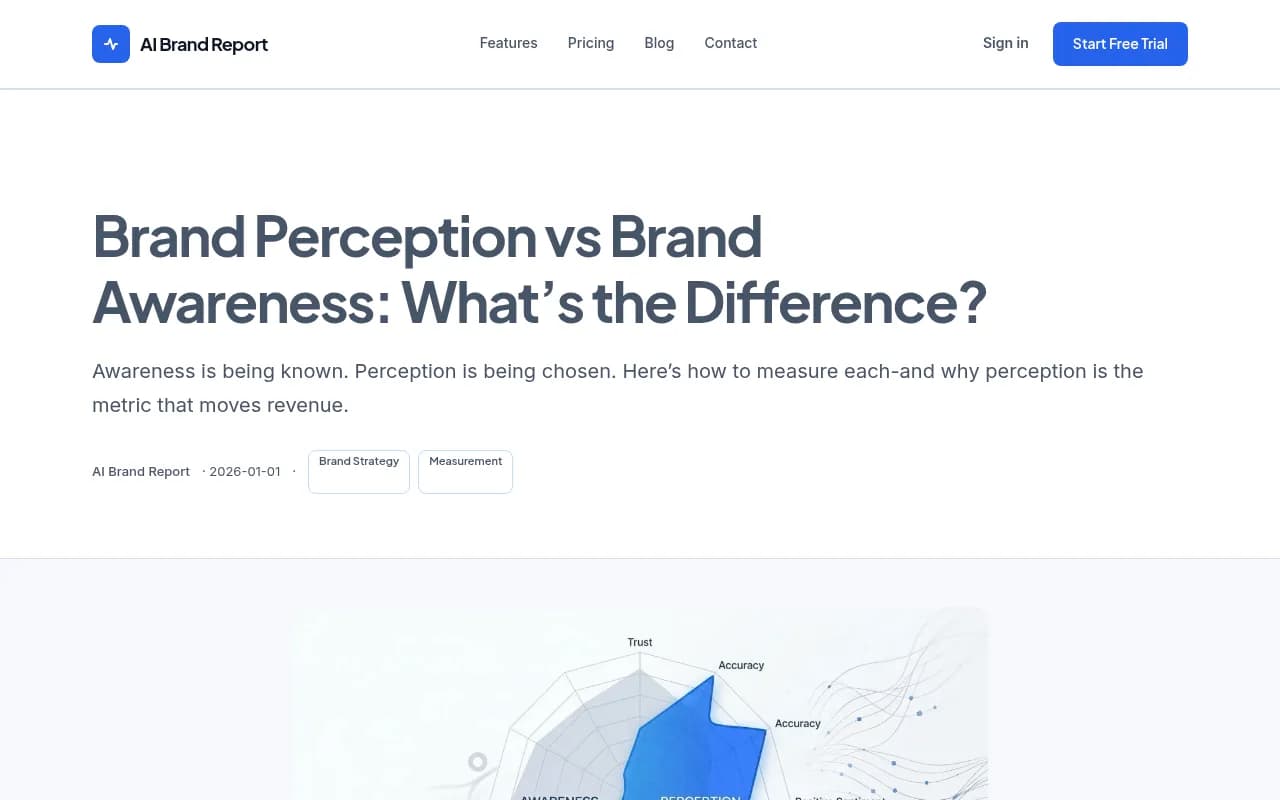
This was already a useful split in the survey era. In 2026 it matters more, because a growing share of buying research happens inside ChatGPT, Gemini, Perplexity, and Google AI Overviews. Those systems do two separate things when someone asks about your category. First they decide whether to name you. Then they decide how to describe you. Those are two different failures with two different fixes.
| Brand awareness | Brand perception | |
|---|---|---|
| Core question | Do they know us? | What do they believe about us? |
| Predicts | Visibility | Choice, trust, willingness to pay |
| Built by | Reach and repetition | Positioning, proof, and experience |
| Traditional measures | Surveys, impressions, branded search, share of voice | Sentiment, themes, associations, competitor comparisons |
| AI search equivalent | Mention rate, citation share, share of voice | Sentiment, claims AI makes about you, framing versus competitors |
| Best use | Top of funnel | Winning deals and defending margin |
What brand awareness measures
Awareness is recognition and recall. The classic questions are "have you heard of this brand?", "can you recognize this logo?", and "can you name brands in this category?"
The distinction between prompted and unprompted awareness is worth keeping. Maze's guide to brand perception research points out that unprompted awareness means the brand comes to mind first, ahead of every competitor, while prompted awareness only means someone recognizes you from a list. Morning Consult calls awareness the prerequisite for every other metric, which is hard to argue with. If nobody recognizes you, there is nothing to have an opinion about.
The usual measurement set:
- Brand surveys (aided and unaided)
- Reach and impressions
- Share of voice
- Branded search volume
These answer one limited question: are we known? They do not tell you why someone would pick you.
Awareness inside AI answers
The AI-era version of unaided awareness is simple. You ask a model a category question without naming anyone, and you see whether it names you. A commonly used KPI is brand mention rate: the percentage of AI responses that include your brand when at least one competitor is mentioned.
Slots are scarce, which is what makes this competitive. According to Promptwatch Data on average sources per response, ChatGPT cites about 5 sources per web-search answer, while Google AI Overviews and Perplexity cite about 10. Five slots is not many when a dozen brands want one.
The metrics that map to awareness in AI search:
- Mention rate across a fixed set of category prompts
- Share of voice (your slice of all brand mentions)
- Citation share (how often your domain is a cited source)
- Position (where you land in the order of brands within an answer)
What brand perception measures
Perception covers beliefs, associations, and expectations. Are you seen as premium or overpriced? Reliable or risky? Easy to use or hard to implement? A real contender, or "another option"?
Maze lists the components that most perception research tracks: awareness, associations (the words and emotions buyers attach to you), trust, consideration (would you make the shortlist), and preference (how you compare when buyers choose directly against named competitors). The Alchemic's 2026 piece compresses this into four layers: salience, associations, consideration, and advocacy.
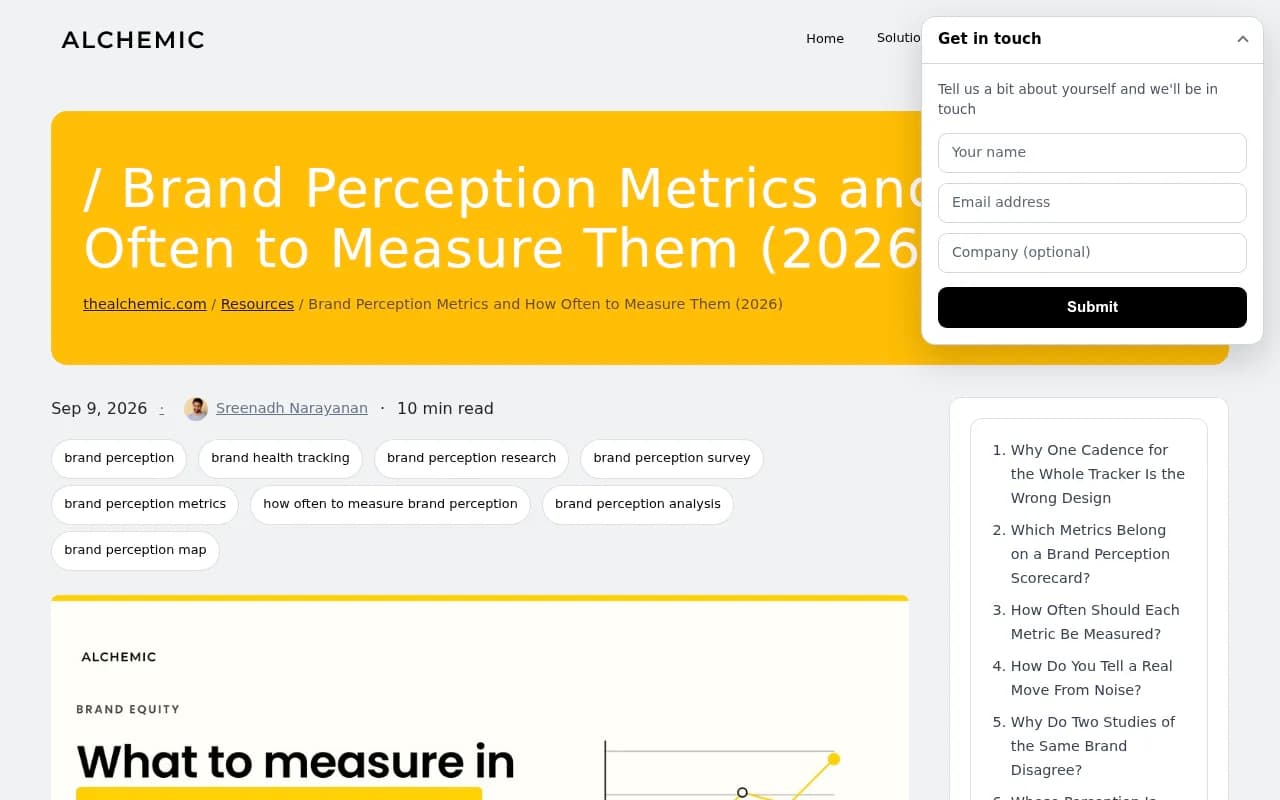
The point that stuck with me from that piece is that these layers move at different speeds. Salience is a memory structure that builds over years. Consideration can swing within a quarter. Advocacy can be read continuously from your customer base. A single tracker wave for everything is a compromise that fits nothing well.
Perception inside AI answers
When a model describes you, it is repeating claims it picked up from somewhere: your site, review platforms, forums, news. Perception in AI search is the set of those claims, plus the tone around them.
What to look at:
- Sentiment of responses that mention you, scored separately from whether you appear at all
- The specific claims made about you ("affordable for small teams", "good for beginners, not professionals", "support is slow")
- How you are framed next to competitors in comparison prompts
- Whether the claims are accurate
That last point is new. Surveys capture what humans believe. AI answers can also contain things that are simply wrong, like an outdated price or a feature you never had. Wrong claims are a perception problem you can trace to a source and fix.
Why awareness without perception is dangerous
High awareness with weak perception can be worse than low awareness. Three patterns come up constantly:
- Everyone knows your brand, but associates it with "expensive and hard to use".
- AI answers mention you every time, but frame you as the beginner option.
- You rank well in search, but Reddit threads keep warning people away.
In each case the awareness number looks healthy and the pipeline does not. A dashboard that only reports mentions would miss all three. That is the main reason to track both metrics instead of picking one.
The reverse case exists too. Low awareness with strong perception is a distribution problem. People who find you love you, but too few find you. Your fix there is coverage: getting into the roundups, comparisons, and category pages AI already pulls from.
Different metrics, different levers
This is where the data gets practical. Promptwatch Data's breakdown of ChatGPT citations by content type (Sep 28 to Oct 4, 2026) shows that the sources ChatGPT cites depend heavily on the kind of prompt.
For commercial prompts like "best CRM for small businesses", product pages are 26.0% of citations, landing pages 20.6%, listicles 15.0%, and comparisons 7.9%. Those four types account for almost 70%. That is the awareness arena: to get named, you need to show up in the roundups and comparison content that AI leans on, not only on your own site.
For branded prompts, the ones that name a company, such as "is HubSpot good for startups", the mix changes:
- Product pages are 23.3% and landing pages 22.8%, almost half combined.
- Reviews rise to 5.6%, more than three times their overall share.
- Social posts rise to 3.0%, almost four times their overall share.
- FAQ pages are 4.8% and press releases 2.1%, both above their overall shares.
This is the perception arena. When someone asks directly about you, the model leans on your own pages and on what customers say about you. So the levers are different:
| Goal | Where AI looks | What you do |
|---|---|---|
| Raise awareness (get named) | Listicles, comparisons, third-party roundups, category pages | Earn inclusion in roundups, publish comparison content, cover the prompts buyers ask |
| Improve perception (get described well) | Your homepage, product pages, docs, review sites, FAQs, forums | Make your own pages state the right claims plainly, collect reviews on trusted sites, add a plain-language FAQ, fix wrong facts |
One caution on the numbers: these shares shift month to month, and ChatGPT's source mix has changed noticeably during 2026 (for example, Reddit's share of ChatGPT citations collapsed from about 4% to 0.5% on August 14). Re-check before building a strategy on any single percentage. The broader point, that branded prompts pull from your own pages and reviews, is the durable part.
How to measure both without fooling yourself
Freeze your instrument
Method changes move numbers more than people expect. The Alchemic notes that Pew Research split 3,003 respondents into two groups and asked the same 60 questions, one group by phone and one online. Answers differed by 5.5 percentage points on average, and eight of the 60 items differed by 10 points or more. Ten points is bigger than the annual movement most brand programs try to detect.
The AI equivalent: keep your prompt set, personas, countries, languages, and models fixed between readings. If you change the prompts every month, you are measuring your prompt list, not your brand.
Set a cadence per metric
| Metric | Layer | Suggested cadence |
|---|---|---|
| Mention rate and share of voice in AI answers | Awareness | Daily to weekly, read as a monthly trend |
| Citation share | Awareness | Weekly to monthly |
| Sentiment score | Perception | Weekly trend, monthly review |
| Claims and themes AI repeats about you | Perception | Monthly, plus after any pricing, product, or messaging change |
| Survey-based salience and associations | Both | Twice a year on a frozen questionnaire |
| Consideration and preference | Perception | Quarterly |
AI answers are volatile enough that daily snapshots mislead. The same Promptwatch Data report notes that Microsoft Copilot swung from under 2 to nearly 17 sources per response within a few weeks before settling, and advises judging Copilot on monthly trends. Treat single-day movement as noise unless it follows something you did.
Read the metrics together
A simple diagnostic I use:
- Low share of voice: a coverage problem. You are not in the answers.
- Late position: a prominence problem. You are named, but after the competitors.
- Mentions without citations to your own domain: a content or crawlability problem.
- Weak sentiment or wrong claims: a perception problem. Find the source the model is learning from.
Also keep human limits in mind. Maze makes the point that if consideration rises while conversions rise, that does not prove one caused the other. Perception shifts and revenue shifts correlate, and you should say so honestly in reports.
Tools for tracking each side
You need two kinds of tooling: something that tells you what AI says, and something that tells you what people say.
AI answer tracking (awareness and perception in LLMs)
Promptwatch is the one I would start with if you want both halves in one place. It collects responses from the real interfaces of ChatGPT, Gemini, Perplexity, Google AI Overviews, and others in the countries and languages you choose, then reports Visibility Score, Share of Voice, Position, and sentiment. Its Brand Narrative feature extracts the individual claims AI makes about you and competitors, grouped under themes like Pricing, Features, Support, and Reputation, and Fact Check lets you mark a claim inaccurate and find the page on your site that is teaching the model the wrong thing. It also covers the fix side with content gap analysis and a Content Agent, which most monitoring-only tools skip. Pricing starts at $95/month for Essential, and you can confirm current plans at promptwatch.com/pricing.

Other AI visibility trackers worth a look, depending on budget and depth:



Otterly.AI and Peec AI are lighter monitoring tools, while Profound targets enterprise teams. If you want to compare more options, the GEO software directory at bestgeosoftware.com lists many of them.
Social listening and reputation (perception among humans)
AI answers reflect what the web says, so you still need to hear the web. Brand24 tracks mentions and sentiment across social and web sources, and its Presence Score compares your online visibility against other businesses. It is a reasonable awareness proxy plus a sentiment read.
For larger programs, Meltwater covers media, social, and consumer intelligence at scale.
If reviews are where your objections live, review platforms and reputation tools matter because reviews carry extra weight on branded AI prompts:

Survey-based brand tracking (salience, associations, preference)
Surveys remain the only direct way to measure unaided awareness and preference among real buyers. Brainsuite's guide to brand health tracking describes the usual setup: a stable set of metrics, surveyed quarterly or twice a year, tracked against competitors and your own baseline. Its warning is worth repeating: by the time the tracker confirms a trend, the decisions that caused it are months old.
AI answer tracking is a useful complement here because it is faster. It will not replace a survey, but it can flag a shift in how models describe you weeks before a quarterly wave catches it.
Quick comparison
| Need | Tool type | Examples |
|---|---|---|
| Mention rate, share of voice, citations in AI answers | AI visibility platform | Promptwatch, Profound, Otterly.AI, Peec AI |
| Claims AI makes about you, fact-checking | AI visibility platform with narrative analysis | Promptwatch |
| Web and social mentions, sentiment | Social listening | Brand24, Meltwater |
| Reviews and reputation | Review platforms | Trustpilot, ReviewTrackers |
| Unaided awareness, preference | Survey-based tracking | Brand health tracking platforms |
A simple monthly routine
- Pick 30 to 50 prompts that mirror real buyer questions. Split them into category prompts (no brand named), comparison prompts, and branded prompts.
- Run them across the models your buyers use, in the markets you sell in. Do not change the set mid-quarter.
- Record mention rate and share of voice from the category prompts. That is your awareness baseline.
- Record sentiment and the top claims from the branded and comparison prompts. That is your perception baseline.
- List any claim that is wrong or unflattering, and trace it to a source page, review, or thread.
- Fix the sources you control (your pages, FAQs, docs), and decide whether to pursue the ones you do not (reviews, roundups, forums).
- Re-read next month and compare against the baseline, not against last week.
If you want to learn how the underlying data is collected before trusting any number, Promptwatch's Academy guide on how Promptwatch collects data is a good reference, and the Share of Voice and Visibility Score definitions explain what the headline numbers actually include.
Which metric should you prioritize?
It depends on where the gap is, not on which one sounds more strategic.
- New or small brand: start with awareness. You cannot be perceived well if the model never names you.
- Established brand with flat conversions: look at perception first. Mentions are probably fine and the framing is the problem.
- Competitive category with similar products: both, but weight perception. When everyone is named, the description decides the shortlist.
- Brand after a pricing change, rebrand, or incident: perception, immediately, and on a faster cadence than usual.
The awareness number is the easier one to report upward, which is why it tends to win budget. Perception is the one that explains why the pipeline does or does not follow. Track both, label them separately in your reports, and do not let a rising mention rate stand in for a good reputation.