Key takeaways
- Traditional social listening tools track what people say about your brand online. AI brand monitoring tracks what AI systems say back when someone asks them about you. These are not the same job, and most listening vendors are bolting AI tracking onto platforms built for a different problem.
- Brand24 is the cheapest entry point into AI visibility ($99/month add-on on top of a $199+ base plan) but only covers 4 models and 30 prompts. Meltwater's GenAI Lens and Sprinklr's LLM Insights are bundled into enterprise contracts that start around $15,000-25,000 a year. Mention still has no dedicated AI/LLM module at all.
- Reddit's share of ChatGPT citations collapsed from roughly 4% to 0.5% in a single day in August 2026. If your monitoring strategy leans on "social buzz" as a proxy for AI visibility, that one data point should worry you.
- Citation tracking alone is incomplete. An AI answer can link to your site and still describe your brand wrong. Talkwalker and others now argue you need to monitor narrative framing, not just presence.
- Purpose-built AI visibility platforms like Promptwatch cover more models (12+), track crawler logs and Reddit/YouTube citation sources the legacy tools mostly ignore, and go beyond monitoring into actually generating and publishing the content that fixes visibility gaps.
Why this comparison even needs to exist
A year ago, if you wanted to know what people were saying about your brand, you picked a social listening tool, plugged in some keywords, and watched the mention volume roll in. Brand24, Mention, Meltwater, Talkwalker, Sprinklr - these companies spent a decade perfecting that exact workflow.
Then ChatGPT Search, Google AI Overviews, Perplexity, and Gemini started answering questions directly, often without a single click to your website. Suddenly "what are people saying about my brand" and "what is the AI saying about my brand" became two different questions, and the listening vendors had to decide: build something new, bolt something on, or ignore it.
I went through what each of the five did, what it costs, and where the cracks show. The honest answer is that none of them were built for this from the ground up, and it shows in different ways depending on the vendor.
The core distinction nobody markets clearly
Traditional listening tracks inputs: what gets posted on social media, news, forums, and reviews about your brand. AI brand monitoring tracks outputs: what an LLM actually says when a real person asks it a question. A brand can have zero negative mentions on Twitter and still get described inaccurately by ChatGPT, because the model is synthesizing from sources you've never seen and may not control.
Talkwalker's own documentation makes this point directly: most people only read the AI's summary, not the sources underneath it. So a citation to your site means almost nothing if the surrounding text mischaracterizes what you do. That's a fundamentally different monitoring job than counting mentions.
How each platform actually handles AI search
Brand24
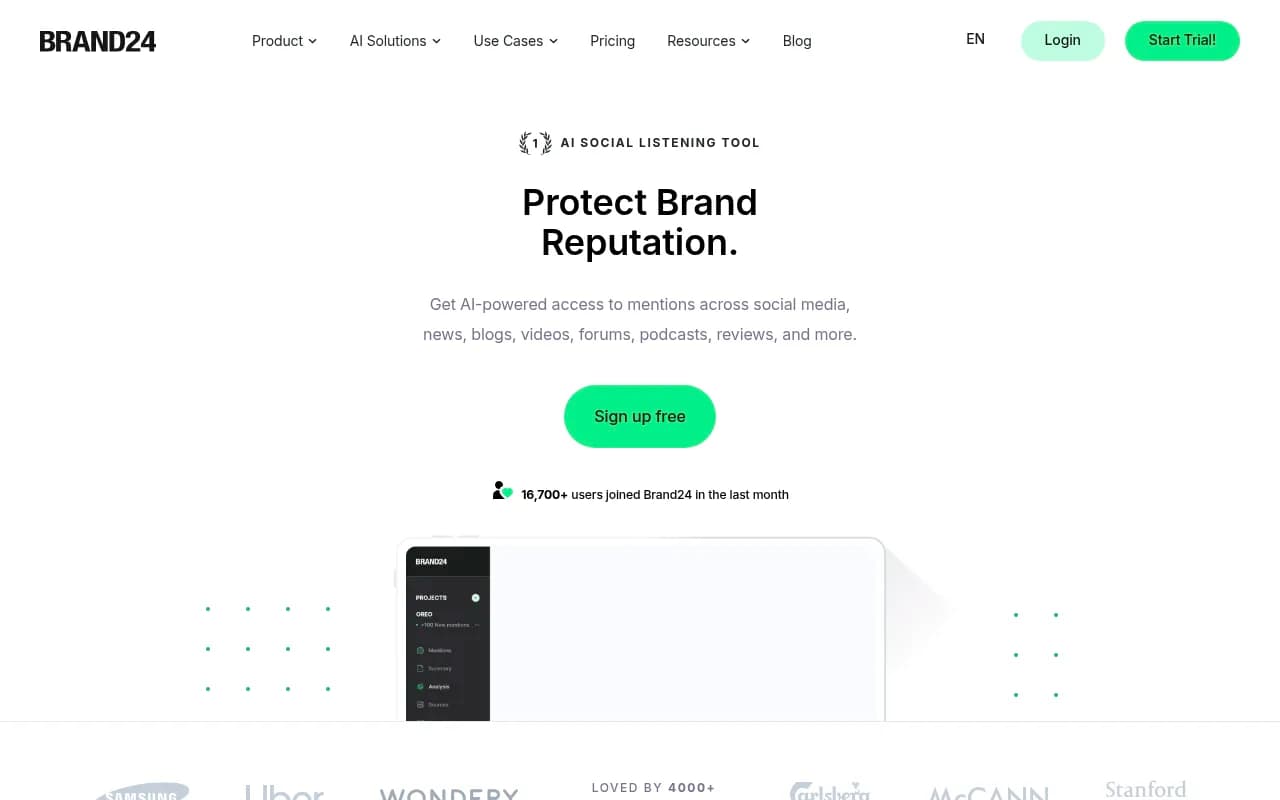
Brand24 bakes its AI tracking into the existing dashboard as an "LLM Listening" sidebar item, powered by its Chatbeat acquisition. The free trial covers 4 models (ChatGPT, Perplexity, Google AI Overview, Gemini) and 5 prompts; paying $99/month on top of your base subscription unlocks 30 prompts across the same 4 models. Brand24 markets "9 LLMs tracked," but the actual functioning set in most test accounts is those 4.
What you get: a Brand Score combining mention frequency and position, competitor share-of-voice, a "Key Prompts & Questions" discovery feature with search volume data, and a Semrush integration that can auto-populate prompts from existing keyword lists. Brand24 reports case studies with gains as high as 62% average AI visibility lift, though those numbers come from the vendor's own customer stories, not independent audits.
For a small team that already has Brand24 for social listening, this is the cheapest way to dip a toe into AI visibility. It is not a production-grade GEO platform. Four models and 30 prompts won't cut it once you're tracking a real competitive set across Claude, Grok, and regional AI Overviews.
Mention
Mention is the one name on this list with no dedicated AI/LLM visibility module as of this writing. Its Company plan runs $599/month on an annual contract ($7,188/year), with unlimited users, Boolean search precision, and competitive benchmarking dashboards. G2 rates it 4.3/5 against Brand24's 4.6/5, and reviewers consistently flag the pricing as steep for what smaller teams get.
Mention is strong at what it was built for: keyword and brand mention tracking with tight Boolean filtering. If AI visibility matters to you, Mention currently isn't the tool for that job. You'd need to pair it with something else.
Meltwater
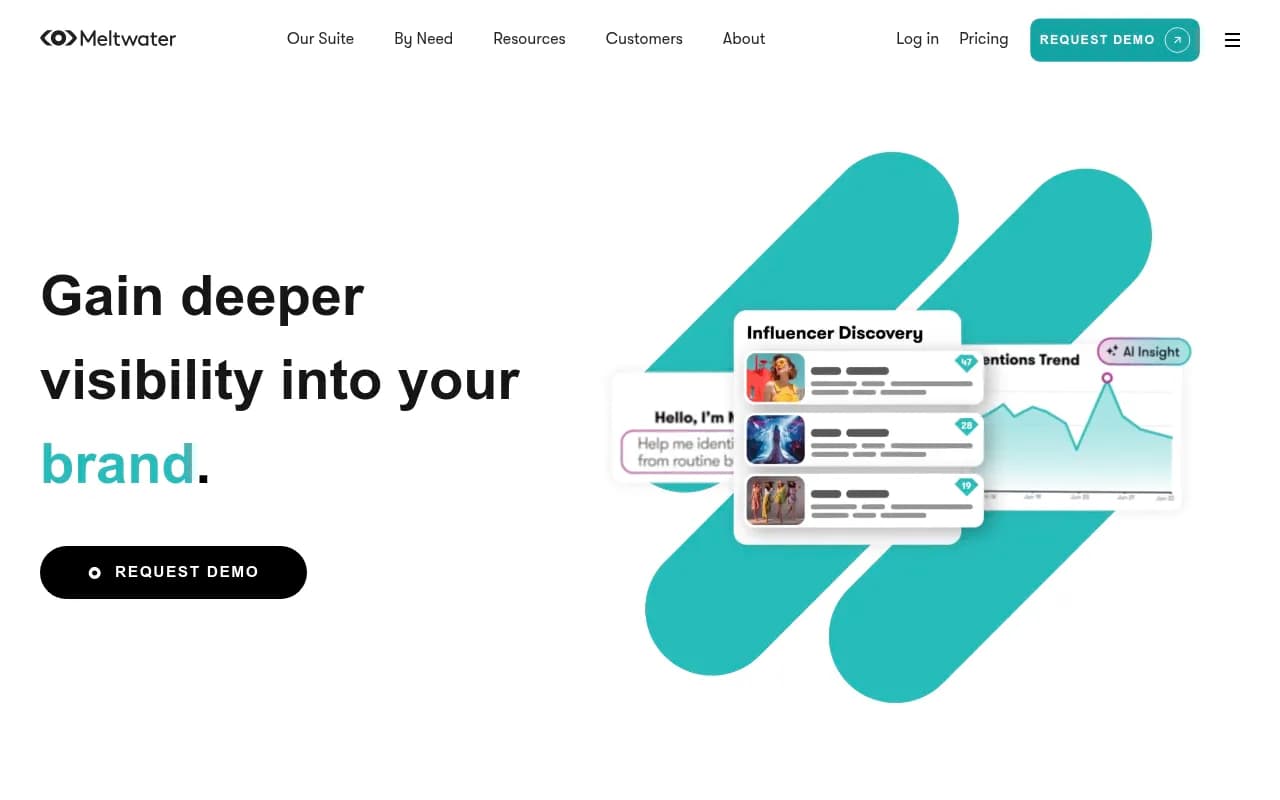
Meltwater's GenAI Lens (branded GAIL) runs custom prompts across ChatGPT, Gemini, Claude, Perplexity, Grok, and DeepSeek every 24-48 hours. Unlike Brand24's position-and-frequency scoring, GenAI Lens captures the full model response text, so you can analyze how your brand is actually portrayed, not just whether it's mentioned. It also identifies specific journalists and publishers that LLMs cite and feeds that straight into Meltwater's existing journalist database, which is a genuinely useful loop for PR teams who want to go from "AI cited this reporter" to "pitch that reporter."
Meltwater's own research is worth noting here: its June 2026 AI Search Visibility Report found press release citations had fallen to just 0.2% of total AI citations, while earned media coverage held steady near 38%. That's a brutal data point for anyone still measuring PR success by press release distribution volume.
The catch is pricing. Meltwater doesn't publish numbers, but deal data puts the median annual contract around $25,000, with small-team deals starting near $15,000 and enterprise tiers running $100,000-150,000+. There's no public trial. This is a tool you buy after a sales conversation, not one you self-serve into.
Talkwalker
Talkwalker's LLM Insights module, now wrapped into Hootsuite's broader platform, tracks how ChatGPT, Gemini, Perplexity, and Claude answer consumer questions about your category. Setup requires building an "LLM monitoring channel" under Settings, which is a bit more manual than Brand24's sidebar toggle.
Where Talkwalker stands out conceptually is its framing: it explicitly argues traditional listening metrics (mention volume, reach, sentiment score, share of voice) don't transfer cleanly to AI search. What you actually need to track, per Talkwalker, is narrative themes, competitive framing, category positioning, and the confidence or tone of the language AI uses to describe you. It's a more sophisticated mental model than most competitors offer, even if the execution is still enterprise-gated and custom-priced, roughly in the same band as Meltwater.
Sprinklr
Sprinklr launched LLM Insights as a new module inside Sprinklr Insights, sitting alongside its existing Social Listening, Competitive Benchmarking, and Visual Insights products. It's positioned to help brands "measure, benchmark, and influence" how they're represented in AI-generated answers. Sprinklr was named a Leader in the 2026 Gartner Magic Quadrant for Social Media Management & Listening, which says a lot about its enterprise CXM credibility but doesn't tell you much about how deep the AI tracking actually goes.
Pricing runs $249-359 per seat per month depending on the source, with full omnichannel contracts quoted individually. If you're already a Sprinklr customer for customer experience management, the LLM module is a reasonable bolt-on. If you're starting from zero, it's an expensive way to get AI visibility tracking that's one module among many rather than the core product.
Side-by-side comparison
| Platform | AI model coverage | AI feature pricing | Base plan starting price | Best fit |
|---|---|---|---|---|
| Brand24 | ChatGPT, Perplexity, Gemini, AI Overview (4) | +$99/mo add-on, 30 prompts | $199-249/mo | Small teams wanting a cheap entry point |
| Mention | None (no dedicated module) | N/A | $599/mo (annual only) | Boolean-precision social mention tracking, not AI search |
| Meltwater | ChatGPT, Gemini, Claude, Perplexity, Grok, DeepSeek (6) | Bundled in suite | ~$15,000-25,000/yr | PR teams who need journalist-citation workflows |
| Talkwalker | ChatGPT, Gemini, Perplexity, Claude (4) | Bundled in enterprise tier | Custom, comparable to Meltwater | Enterprises wanting narrative/framing analysis |
| Sprinklr | Not fully disclosed, multi-model | New module within Insights suite | $249-359/seat/mo | Existing Sprinklr CXM customers |
Why social listening DNA is a liability, not just a feature gap
The real problem isn't that these tools are new to AI tracking, it's that their core assumptions carry over in ways that don't fit the new environment. Social listening tools were built to be comprehensive across platforms: Instagram, TikTok, Facebook, X, Reddit, forums, review sites. That breadth was the whole value proposition.
But AI search doesn't distribute citations the way social platforms distribute attention. According to Promptwatch's data on social media citations by AI model, Reddit draws roughly 5.19% of ChatGPT's citations, more than 20 times its next-best social source, LinkedIn, which sits at just 0.23-0.74%. Meanwhile X/Twitter never exceeds 0.25% of citations on any engine tracked, even Grok, despite being the platform most social listening tools treat as a top-tier source. AI Overviews and Grok lean on YouTube instead (4.08% and 4.85% respectively).
That means Sprinklr and Talkwalker's deep Instagram/TikTok/Facebook monitoring, genuinely impressive for traditional social listening, adds almost nothing to AI-citation visibility. You'd get more signal from tracking which YouTube videos and old Reddit threads AI engines are pulling from than from any amount of Instagram comment sentiment.
And then Reddit itself reminded everyone how fragile these sources are. Promptwatch's data on Reddit citations dropping in ChatGPT shows Reddit held a steady 3.8-4.1% share of ChatGPT Search citations through early August 2026, then collapsed to about 0.5% on a single day, August 14, 2026, with no recovery since. It happened before too: in September 2025, Reddit briefly made up 10-14% of all ChatGPT citations, then cratered to roughly 1% within days after Reddit changed its API terms. If you built your AI visibility strategy around Reddit presence, a platform-level business decision you have no control over just erased most of your signal.
What the legacy tools miss that a GEO-native platform doesn't
Here's where I think the comparison gets genuinely useful instead of just descriptive. Brand24, Mention, Meltwater, Talkwalker, and Sprinklr all answer some version of "is my brand mentioned by AI." None of them answer "why am I not showing up, and what do I do about it."
That's the gap platforms like Promptwatch were built to close. Promptwatch doesn't just add an LLM tracking tab to an existing social dashboard, it treats AI visibility as the core product, with crawler logs showing exactly when ChatGPTBot, ClaudeBot, PerplexityBot, and 400+ other crawlers hit your site and whether they encounter errors, citation trend data broken into 22 content types and 20 source types, and dedicated Reddit and YouTube citation reporting, the two channels that actually matter for AI citations, which the five tools above either ignore or lump into generic "social."

Where Promptwatch pulls further ahead is in what happens after you find a gap. Content Agents plan, write, and publish GEO-optimized content directly to Webflow, Framer, or WordPress on a schedule, and Unified Actions turns all that visibility and crawler data into a prioritized to-do list rather than a dashboard you have to interpret yourself. Meltwater's GenAI Lens gets close to this with its journalist-citation-to-outreach pipeline, which is genuinely clever for PR teams. But none of the five legacy platforms publish content or close the loop the way an agentic GEO platform does. Promptwatch also monitors across 12+ AI surfaces including Claude, Grok, Meta Llama, DeepSeek, Mistral, Copilot, and Google AI Mode, well past the 4-6 models Brand24, Meltwater, and Talkwalker each track.
If you want to see where other dedicated GEO platforms land on this spectrum, the directory at bestgeosoftware.com is a reasonable next stop.
Content format matters more than most monitoring dashboards show
One thing none of the five legacy platforms surface well: what type of content actually gets cited. Promptwatch's data on ChatGPT citation types in August 2026 shows product pages led citations at roughly 28.7%, listicles sat around 10.1%, and how-to content more than doubled its share over the month, from 4.3% to 9.1%. Documentation-style pages also climbed, from 3.3% to 8.2%. If your monitoring tool tells you you're invisible but doesn't tell you what format of content is winning in your category, you're flying half-blind.
There's also a domain authority myth worth busting. The same data shows mid-authority domains, DR 46-75, captured almost half of all ChatGPT citations in August 2026, while the very highest authority sites (DR 91-100) fell to just 3% of citations by month's end. You don't need Forbes-level domain authority to get cited. You need the right content type, published and maintained consistently.
Picking the right tool for where you actually are
If you already run Brand24 for social listening and just want a cheap way to see whether ChatGPT mentions your brand, the $99/month add-on is a reasonable low-stakes trial. Don't expect it to replace a GEO strategy.
If you're a PR team that lives and dies by journalist relationships, Meltwater's GenAI Lens closing the loop from AI citation to outreach is the most practically useful feature on this entire list, worth the enterprise price tag if PR is genuinely your bottleneck.
If you're already paying for Sprinklr or Talkwalker as your CXM or enterprise listening backbone, use the new AI modules as a signal layer, but don't expect them to generate or fix anything for you.
If AI visibility is the actual strategic priority, not a side feature on a social listening contract, you're better served by a platform built around that problem from day one. That's the pitch for Promptwatch, and it's also worth browsing the wider AI rank tracking category at ai-rank-tools.com if you want to compare more single-purpose alternatives before committing.
The bottom line
Traditional brand monitoring platforms are adapting to AI search, but adaptation shows its seams. Mention has no answer yet. Brand24's add-on is cheap and shallow. Meltwater and Talkwalker have genuinely thoughtful AI features, but they're locked behind enterprise contracts and built as one module in a much larger (and more expensive) suite. Sprinklr is somewhere in between, credible on the CXM side, still new on the AI side.
If you need to know what people are saying about you on social media, these five tools are still good at that job, that's what they were built for. If you need to know what AI is saying about you, and more importantly, what to do about it, you'll get further with a platform that treats that as the whole point rather than a feature request.