Key takeaways
- Agent Chat is a conversational interface built into your AI visibility platform's own dashboard; an MCP server exposes the same data and actions through the open Model Context Protocol so external assistants like Claude, Cursor, or ChatGPT can query it too.
- The real dividing line in this category isn't chat vs protocol, it's read-only vs write-capable. A server that can only report a problem is a different product from one that can create prompts, tag competitors, or publish content.
- Promptwatch ships both: an in-app Agent Chat and a hosted MCP server over streamable HTTP, available from its Essential plan at $95/month, with no separate add-on fee.
- MCP adoption has gone mainstream fast. Anthropic's ecosystem update counted over 10,000 active public servers by December 2025, and Tier-1 SDK downloads were approaching half a billion a month by mid-2026.
- Whichever interface you use, remember that AI answers are inherently inconsistent between sessions, so treat any single chat answer about your visibility as a data point, not gospel.
Why this question even exists now
A year ago, if you wanted to know how your brand showed up in ChatGPT or Google AI Overviews, you logged into a dashboard, found the right chart, and maybe exported a CSV. Now most AI visibility vendors offer two separate ways to ask that same question in plain English: a chat box inside their own app, and a connector that lets your actual working assistant (Claude Desktop, Cursor, ChatGPT) reach into their data directly.
That's not a cosmetic difference. It changes where you do the work, who else on your team can get at the data without a login, and whether "ask a question" can turn into "take an action" without you touching a keyboard again.
I want to walk through both, because the marketing copy on most AI visibility sites makes them sound interchangeable. They aren't.
What Agent Chat actually is
Agent Chat is the vendor's own conversational layer, sitting inside their dashboard. You type something like "why did our citation rate drop last week" or "which competitor is winning the most prompts in the finance category," and the assistant digs through your account's visibility data, citations, and crawler logs to answer, usually with charts rendered right there.
The appeal is obvious: zero setup, no API keys, and the assistant already knows your account context because it's living inside the product that owns the data. Promptwatch built its Agent Chat this way, and it's a fair description of the category generally, not just one vendor's pitch: ask questions about your AI search performance in plain language and act on the answer without leaving the conversation.

The catch is that "Agent Chat" isn't a standardized term the way MCP is a standardized protocol. Ansvisor's Agent Chat pulls share of voice, citations, and competitor comparisons for AEO recommendations. Devs.ai's Agent Chat is a completely different thing, a multi-model conversation hub that has nothing to do with AI visibility specifically. If a vendor says "we have Agent Chat," ask what it can actually read and do before assuming it matches what you saw at a different tool.
What an MCP server actually is
The Model Context Protocol is an open standard Anthropic released in November 2024, now governed by the Agentic AI Foundation under the Linux Foundation. Instead of building a proprietary chat widget, a vendor exposes their product's data and actions as a set of "tools" that any MCP-compatible assistant can call. Point Claude, Cursor, or ChatGPT at the server's URL, authorize it, and your existing assistant, wherever you already work, can now query that vendor's data as part of whatever else it's doing.
Adoption of the protocol itself is no longer a theoretical conversation. Anthropic's December 2025 ecosystem update counted more than 10,000 active public MCP servers, the official registry held nearly 29,000 total server and version records, and the modelcontextprotocol/servers GitHub repo had passed 86,000 stars. By mid-2026, Tier-1 SDK downloads were closing in on half a billion a month, with the TypeScript and Python SDKs each crossing a billion total downloads. That's a real ecosystem, not a side feature vendors bolted on to look current.
Promptwatch's MCP implementation is a good concrete example of what a serious server looks like in this category. It's hosted over streamable HTTP, meaning there's nothing to install or run locally, you just add the URL and authorize via OAuth or an API key. It works with Claude, Claude Code, Cursor, Lovable, OpenAI Codex, and any other MCP-compatible client, and the same backend also powers an official ChatGPT plugin and a listed connector in Claude's directory. Read tools cover visibility trends, citations with rank analysis, Reddit and YouTube citation data, competitor heatmaps, content gaps, query fan-outs, and crawler and visitor analytics. Write tools let the assistant create prompts, manage tags and personas, push content drafts, publish to a connected CMS, or generate action items, all inside the same conversation where you asked the question.
The feature that actually separates good servers from decorative ones
Here's the thing nobody puts on a pricing page: almost every AI visibility vendor now has some kind of MCP server, so "we have an MCP server" has become a useless line item. What matters is the shape of what's underneath.
A testing comparison from LLM Pulse that pinged unauthenticated MCP endpoints across major AI visibility vendors found a wide spread in tool counts and, more importantly, in write access. Otterly.AI exposes 17 tools, 6 of them writes. SE Ranking's server spans 217 tools across its whole SEO suite, with roughly 40 touching AI search specifically. The review frames the real split bluntly: read-only servers let an agent diagnose a problem, but then "the conversation moves back to a browser tab" to actually fix anything. Write-capable servers let the agent add prompts, tag a competitor cohort, or kick off a content brief without that round trip.
| Platform | MCP tools | Write access | Auth method |
|---|---|---|---|
| Promptwatch | Read tools across visibility, citations, crawler logs, plus write tools for prompts, content, publishing | Yes (prompts, content, CMS publish, reports) | OAuth or API key, project or org scoped |
| LLM Pulse | ~90 read + write tools | Yes | OAuth 2.1 or API key |
| Profound | Not publicly enumerated | Yes (prompts, agents, knowledge bases, projects) | OAuth |
| Otterly.AI | 17 tools (11 read, 6 write) | Limited | OAuth 2.0 |
| SE Ranking | 217 total, ~40 touch AI search | Yes | OAuth 2.1 or API key |
When you're evaluating any vendor's MCP server, ask three things before you connect it. Can it write, or does every tool just read and report back? Is MCP actually included on the plan you're paying for, since some vendors gate it behind a higher tier? And does the server explain its own metrics well enough that the assistant doesn't start inventing numbers when you ask it to compare you against a competitor?
Authentication: the part that got boring, which is good
A year ago, most AI visibility MCP servers made you paste an API key into a config file, which is fine for a solo operator and a mess for a team. That's converged hard toward OAuth with protected-resource discovery across nearly every major vendor, including Promptwatch, Profound, Otterly.AI, and SE Ranking. In practice that means an agent hitting the server without credentials gets a 401 that tells it exactly how to authenticate, rather than a dead end.
Promptwatch's setup splits access into project-scoped keys, which see one project, and organization keys, which see everything, plus a read-only mode that disables every write tool. That last option matters more than it sounds: it's the difference between handing an assistant a key that can only look, versus one that could accidentally publish a draft to your live site because an agent misread an instruction.
Pricing: is this a premium feature or just included?
On Promptwatch specifically, both Agent Chat and MCP/API access are bundled starting at the entry Essential tier, not gated as a premium add-on.
| Plan | Price/month | Prompts tracked | Agent Chat | MCP and API |
|---|---|---|---|---|
| Essential | $95 | 50 | Included | Included |
| Professional | $245 | 150 | Included | Included |
| Business | $579 | 350 | Included | Included |
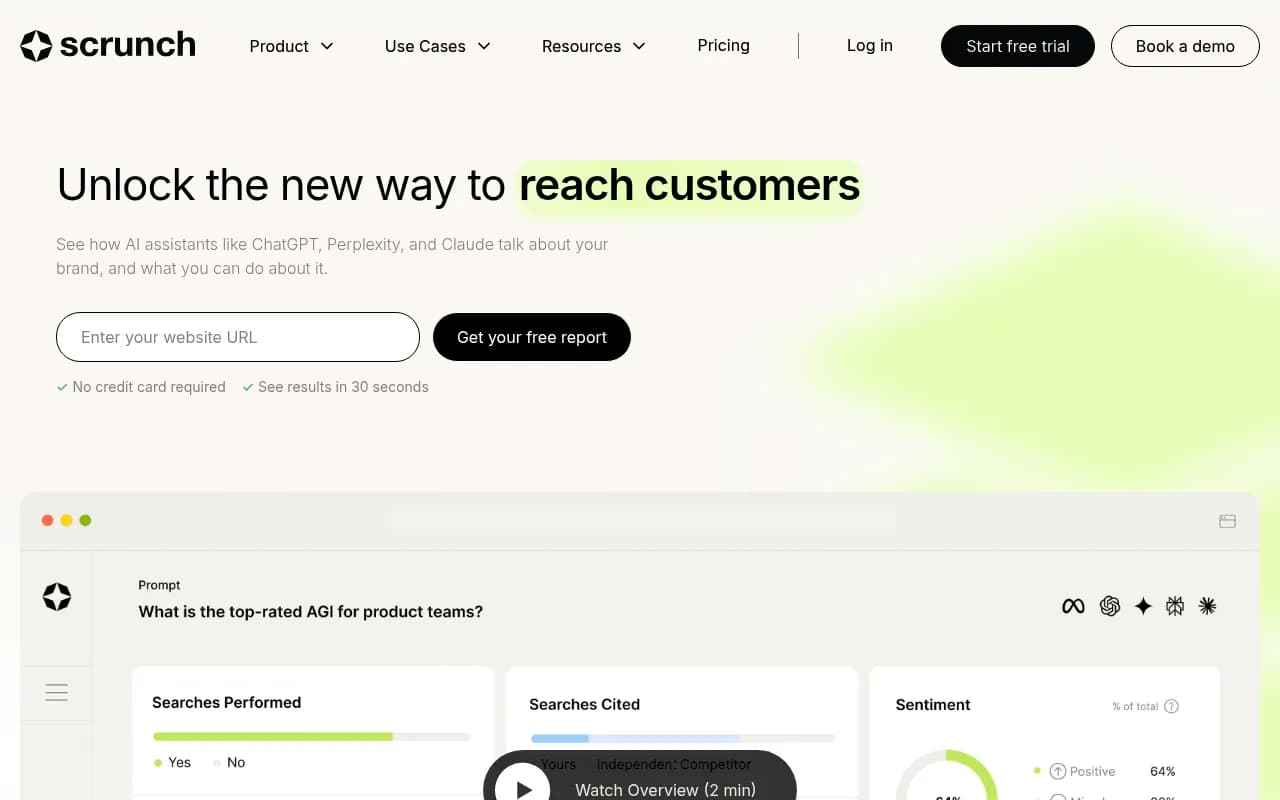
Across the wider market, prices for AI visibility tracking range from around $29/month for lighter tools like Otterly.AI up to $250/month for Scrunch, with several mid-tier options like Peec AI sitting close to Promptwatch's entry price. If you want to survey more of that landscape before deciding, the GEO software directory at bestgeosoftware.com and the rank-tracking listings at ai-rank-tools.com are useful starting points.


Which one should you actually use
This isn't really an either/or decision, because most vendors that offer MCP also keep Agent Chat around. The useful question is which situations call for which interface.
Use Agent Chat when you're inside the dashboard already, reviewing a report or chasing a specific number, and you want an answer without switching context. It's also the lower-friction option for teammates who don't want to configure a connector.
Use the MCP server when the question needs to live somewhere else: a content brief you're drafting in Claude, a CI pipeline in Cursor that should flag visibility regressions, or a Slack digest an agent assembles on its own schedule. It's also the only option if you want an assistant to act across multiple tools in one conversation, say, pulling citation gaps from your visibility platform and immediately drafting a page in your CMS.
A caveat worth repeating before you trust either one
Whichever interface answers your question, remember the data underneath is volatile. A widely cited SparkToro experiment found less than a 1% chance that ChatGPT and Google's AI give the same list of brand recommendations in two separate answers to the same prompt. Promptwatch's own data backs up a version of this instability at the engine level: average sources per response sits around 5 for ChatGPT but roughly 10 for both Perplexity and Google AI Overviews, and Microsoft Copilot swings from under 2 to nearly 17 sources per response within weeks, according to Promptwatch's average sources per response data. If Agent Chat or an MCP tool tells you "you're cited in 40% of responses for this prompt," that's a snapshot, not a fixed fact, and it's worth pulling the number again a few days later before you build a strategy around it.
The same instability shows up in how ChatGPT actually searches. Promptwatch's query fanout tracking shows average query length dropping from roughly 117 characters in early December to around 53 characters by April, meaning ChatGPT is now searching more like someone typing keywords than asking full questions. That's a useful thing to ask your Agent Chat or MCP connection about directly: how are the fanout queries for your prompts trending, and are your page headings matching that shorter, more keyword-like pattern.
A quick security note if you're setting up MCP
Because MCP servers can execute actions, not just answer questions, the usual web API risks apply plus a few specific to the protocol: unauthenticated servers, tool poisoning (a malicious tool description tricking the assistant into unsafe behavior), and over-broad OAuth scopes that hand an assistant more access than it needs. Well-built servers tag each tool with safety hints, read-only, idempotent, or destructive, and the assistant is supposed to confirm anything destructive with you before running it. If a vendor's documentation doesn't mention this at all, that's worth asking about before you connect a write-capable key.
Bottom line
Agent Chat and an MCP server are two doors into the same room. One keeps you inside the vendor's dashboard with zero setup; the other lets your own assistant walk in from wherever you already work and, if the server supports it, actually do something while it's there. The vendors worth paying attention to in 2026 offer both, bundle them without a surcharge, and give you the option to lock an assistant to read-only when that's all you want it doing. If you're evaluating platforms from scratch, the broader directory of agentic SEO tools at agenticseotools.com is a reasonable place to compare how many of them have caught up to that bar.