Key takeaways
- Scrunch AI is a capable monitoring tool, but enterprise teams consistently hit its ceiling: no prompt volume data, limited competitor depth, and no content optimization path.
- The best alternatives close the loop between "where am I invisible?" and "what do I do about it?" — most monitoring-only tools don't.
- Promptwatch is the strongest all-around option for enterprise teams that need tracking, content gap analysis, and AI-native content generation in one platform.
- Profound and AthenaHQ are solid enterprise picks if you primarily need analytics and stakeholder-ready dashboards.
- Budget-conscious teams can get meaningful coverage from Peec AI or Otterly.AI, but expect to hit walls when you need to act on the data.
Why enterprise teams outgrow Scrunch
Scrunch AI does a few things well. It monitors brand mentions across 10+ AI platforms, surfaces citation data, and gives you a baseline picture of where you appear (or don't) in AI-generated answers. For teams just getting started with AI visibility, that's genuinely useful.
But enterprise teams tend to hit the same frustrations fast.
The most documented one: Scrunch doesn't share prompt volume data. You can see which prompts you're tracking, but you can't tell whether those prompts get asked 50 times a day or 50,000. That makes prioritization basically a guessing game. As one practitioner noted on Reddit's r/SEO, "Scrunch provides prompt and citation tracking but doesn't share prompt volume data -- and its prompt trend feature is too basic to be actionable."
Then there's pricing. Scrunch starts at $300/month and scales to $1,000+ once you add team members at $25/user. For a tool that shows you problems but doesn't help you fix them, that's a hard number to justify to a CMO.
And the core issue: Scrunch is a monitoring dashboard. It tells you that competitors are beating you in AI search. It doesn't tell you why, or what content changes would close the gap. For teams managing serious marketing budgets, that's an expensive dead end.
The alternatives below are evaluated on what actually matters for enterprise use: depth of competitive intelligence, whether the tool helps you act on data (not just view it), model coverage, prompt intelligence, and total cost of ownership.
The 9 best Scrunch alternatives for enterprise teams in 2026
1. Promptwatch — best overall for teams that need to act, not just monitor
Promptwatch is the most complete option on this list. Where most tools stop at tracking, Promptwatch runs a full loop: find the gaps, create content that addresses them, track whether that content gets cited.
The Answer Gap Analysis is the feature that separates it from everything else here. It shows you exactly which prompts your competitors appear in that you don't -- with the specific content topics and angles that AI models are looking for but can't find on your site. That's not a vague "you're missing coverage" warning; it's a specific list of what to write.
From there, the built-in AI writing agent generates articles, listicles, and comparison pages grounded in citation data from 880M+ analyzed citations. The content is engineered to get cited by ChatGPT, Claude, Perplexity, and other models -- not generic SEO filler.
For enterprise teams specifically: Promptwatch includes AI crawler logs (real-time logs of which AI crawlers hit which pages, errors they encounter, how often they return), prompt volume estimates with difficulty scores, query fan-outs showing how one prompt branches into sub-queries, and traffic attribution via code snippet, GSC integration, or server log analysis. You can connect visibility to actual revenue, which is what makes the ROI conversation with leadership much easier.
It monitors 10 AI models: ChatGPT, Claude, Gemini, Perplexity, Google AI Overviews, Google AI Mode, Grok, DeepSeek, Copilot, and Mistral. Multi-language and multi-region support with customizable personas. Looker Studio integration and API for custom reporting.
Pricing: Essential $99/mo, Professional $249/mo, Business $579/mo. Free trial available.

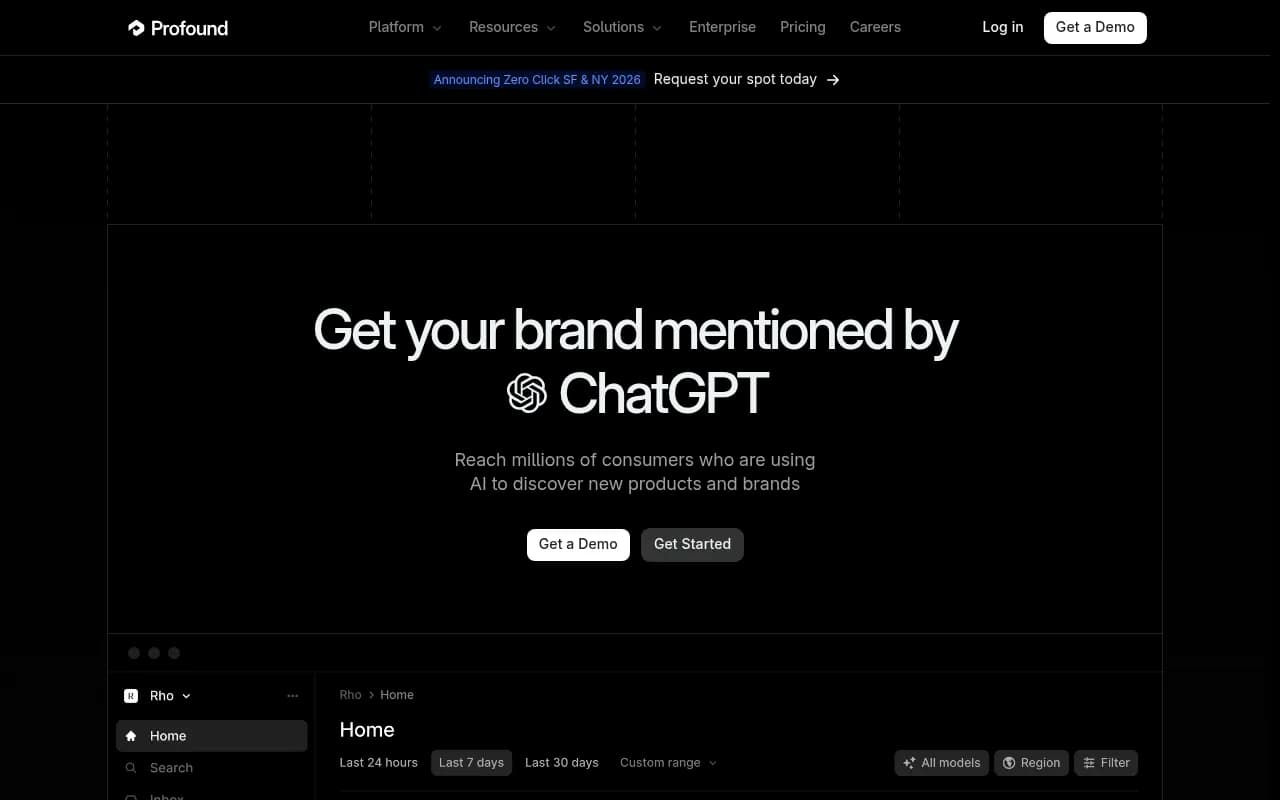
2. Profound — best for enterprise analytics and conversation intelligence
Profound is the closest thing to a true enterprise analytics suite in this space. Its Conversation Explorer lets you dig into the actual AI-generated responses mentioning your brand -- not just whether you appeared, but what was said, in what context, and alongside which competitors.
The prompt volume intelligence is genuinely strong. Profound gives you real search volume estimates for AI prompts, which directly addresses the gap that frustrates Scrunch users most. You can prioritize by volume, not just by gut feel.
Where Profound falls short: it's expensive (starting around $499/month), and like most tools in this category, it's primarily an analytics platform. It doesn't generate content or close the optimization loop. You'll still need a separate content workflow to act on what you find.
That said, for a large brand that needs to present AI visibility data to senior stakeholders, Profound's dashboards are among the most polished available.
3. AthenaHQ — best for enterprises that want strategic recommendations built in
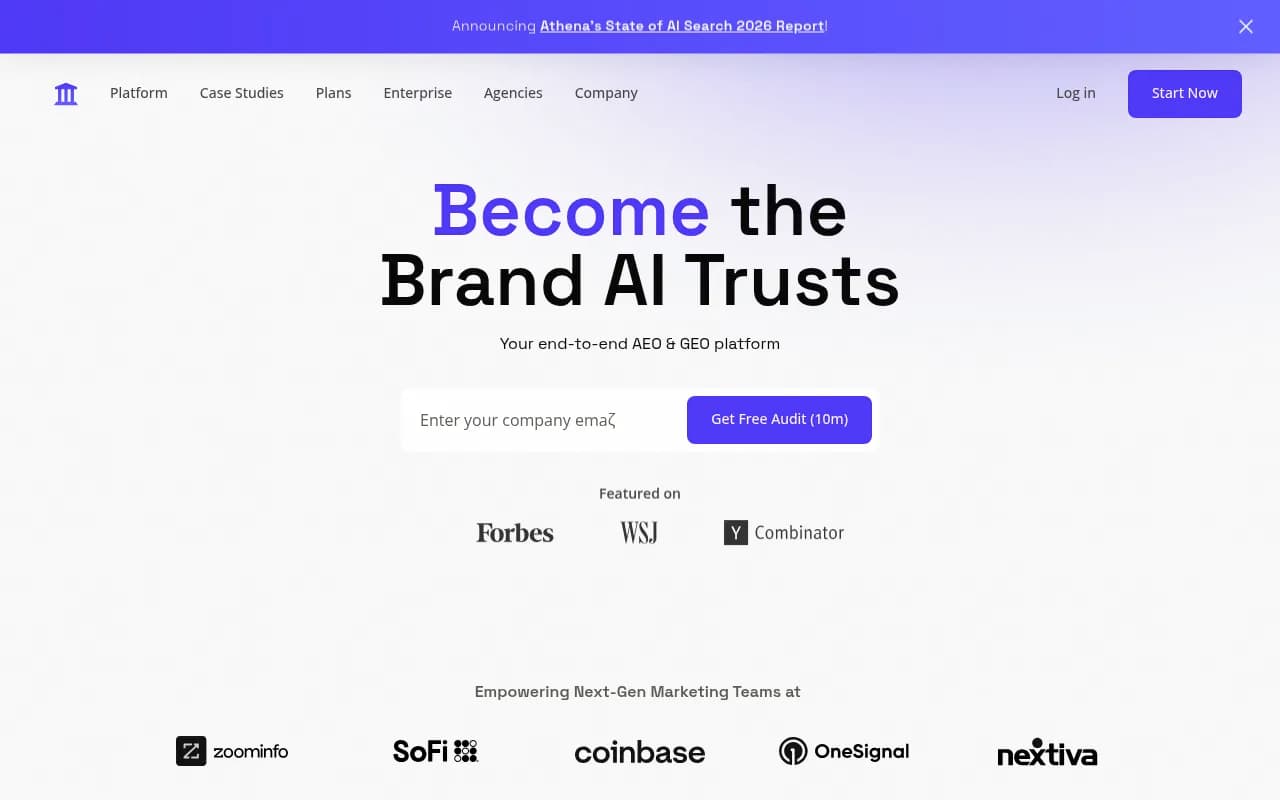
AthenaHQ sits between pure monitoring and full optimization. Its Action Center surfaces strategic recommendations based on your visibility data -- not just "you're missing this prompt" but "here's what you should prioritize and why."
Coverage is solid: ChatGPT, Perplexity, Claude, Gemini, Copilot, and AI Overviews. The competitive intelligence layer is more developed than Scrunch's, showing you not just that competitors are winning but giving you more context on how their content is structured.
The limitation is that AthenaHQ still doesn't generate content for you. The recommendations are useful, but execution stays on your team. Starting around $295/month, it's a reasonable middle ground for enterprise teams that have content resources but need better direction.
4. Peec AI — best for global brands tracking non-English markets
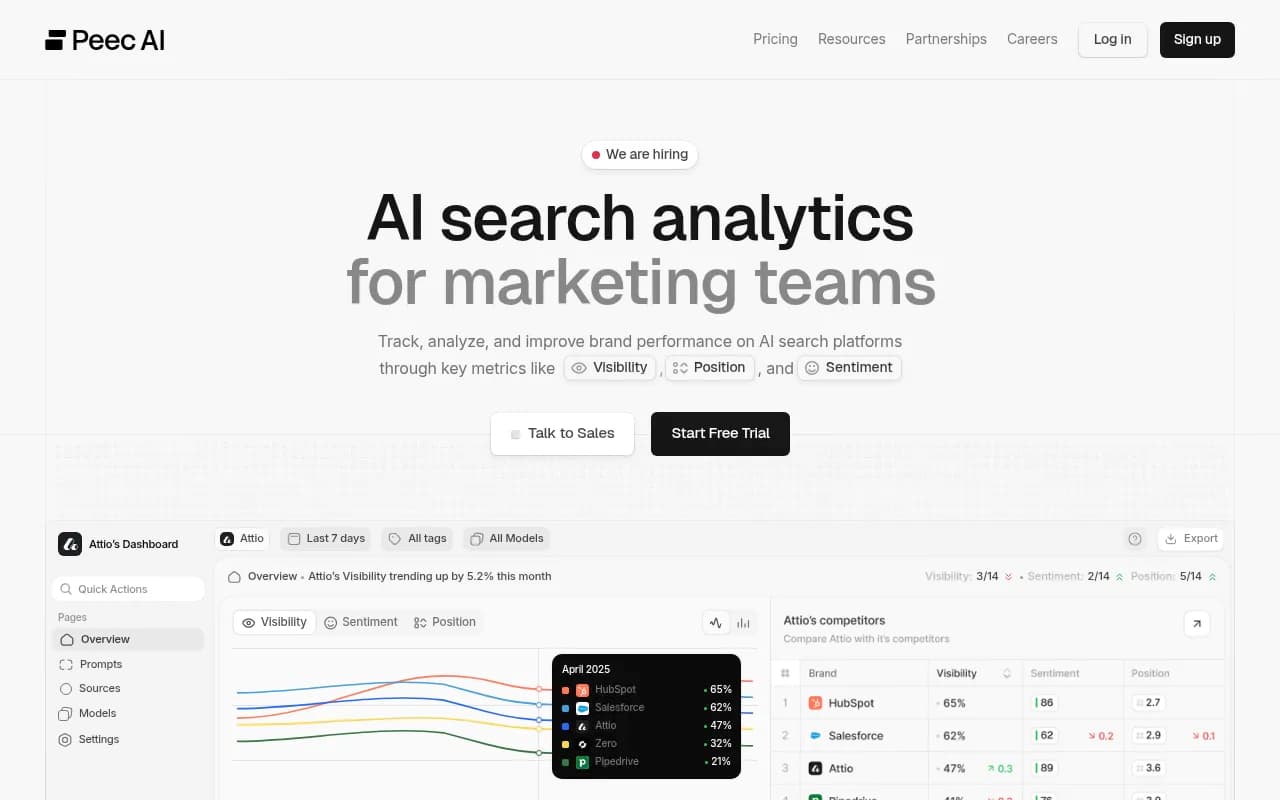
If your enterprise operates across multiple languages and regions, Peec AI is worth serious consideration. It supports 115+ languages, which no other tool on this list matches. For brands running AI visibility programs in German, French, Japanese, or Arabic markets, that's a meaningful differentiator.
The prompt-level analytics are well-regarded -- you get granular source targeting data that helps you understand which pages and domains AI models are pulling from in each market.
The trade-off: Peec AI is primarily a monitoring tool. No content generation, no crawler logs, no traffic attribution. At €89/month it's affordable for what it does, but enterprise teams will likely need to pair it with other tools to build a complete workflow.
5. Otterly.AI — best for brand monitoring and sentiment tracking
Otterly.AI focuses on brand monitoring across AI search engines, with particular attention to sentiment -- not just whether you appear, but whether the AI is saying positive or negative things about you. For PR teams and brand managers, that distinction matters.
It's one of the more affordable options (pricing starts well below the enterprise tier of most competitors), which makes it accessible for teams that want to add AI monitoring without a major budget commitment.
The ceiling is clear though. Otterly.AI is monitoring-only. No content gap analysis, no optimization guidance, no crawler logs. It's a solid early-stage tool that enterprise teams tend to graduate from once they need to do something with the data.

6. SE Ranking — best for teams that want AI visibility inside a broader SEO suite
SE Ranking has built AI search tracking into its existing SEO platform, which makes it appealing for teams that don't want to manage yet another standalone tool. If you're already using SE Ranking for traditional rank tracking, the AI visibility layer integrates cleanly into your existing workflow.
The strategic view is decent -- you get a picture of AI visibility alongside traditional search performance, which helps teams understand how the two channels interact. That cross-channel view is something pure-play AI monitoring tools can't offer.
The limitation is depth. SE Ranking's AI visibility features are newer and less developed than dedicated platforms. For teams where AI search is a primary focus (not just an add-on), you'll likely want something more specialized.
7. Semrush — best for teams that want AI monitoring inside an all-in-one marketing platform
Semrush added AI search monitoring to its existing suite, covering ChatGPT, Claude, and Perplexity among others. For enterprise teams already paying for Semrush's broader SEO, competitive intelligence, and content tools, the AI visibility layer is a natural extension.
The honest limitation: Semrush uses fixed prompts rather than letting you define custom ones, and there's no AI traffic attribution. It's useful for getting a general read on AI visibility, but teams that need to go deep on prompt strategy will hit the ceiling quickly.
At $199/month for the base plan (though enterprise teams typically pay significantly more), it makes sense if you're already in the Semrush ecosystem. As a standalone AI visibility investment, there are better options.
8. ZipTie — best for visual, answer-level auditing
ZipTie takes a different approach: it focuses on the actual AI-generated answers themselves, letting you audit what's being said at the response level across AI Overviews, ChatGPT, and Perplexity. The visual interface makes it easier to see exactly how your brand appears in context.
For teams doing deep competitive analysis -- wanting to understand not just citation frequency but the actual narrative being built around your brand and competitors -- ZipTie's answer-level view is genuinely useful.
It's more niche than the other options here, and it doesn't offer content generation or traffic attribution. But as a research and auditing tool, it fills a specific gap that broader platforms sometimes gloss over.
9. Ahrefs Brand Radar — best for Ahrefs users who want AI visibility in their existing ecosystem
Ahrefs Brand Radar brings AI search monitoring into the Ahrefs ecosystem, which means enterprise teams already using Ahrefs for backlink analysis, keyword research, and site auditing can add AI visibility without switching platforms.
The integration with existing Ahrefs data is the main draw -- you can cross-reference AI visibility with your traditional SEO metrics in one place. The competitive benchmarking is solid.
The limitations are real: Brand Radar uses fixed prompts (you can't define custom ones), and there's no AI traffic attribution. Like Semrush, it's a strong choice if you're already in the ecosystem, but a weaker standalone investment for teams whose primary focus is AI search.
How these tools compare
| Tool | Starting price | Content generation | Prompt volume data | Crawler logs | Traffic attribution | Model coverage |
|---|---|---|---|---|---|---|
| Promptwatch | $99/mo | Yes | Yes | Yes | Yes | 10 models |
| Profound | ~$499/mo | No | Yes | No | No | 10+ models |
| AthenaHQ | ~$295/mo | No | Partial | No | No | 6 models |
| Peec AI | €89/mo | No | Partial | No | No | 3+ models |
| Otterly.AI | Low | No | No | No | No | 5+ models |
| SE Ranking | Varies | No | No | No | No | 5+ models |
| Semrush | $199/mo | No | No | No | No | 5 models |
| ZipTie | Varies | No | No | No | No | 3 models |
| Ahrefs Brand Radar | Varies | No | No | No | No | 4+ models |
| Scrunch | ~$300/mo | No | No | No | No | 10+ models |
What to look for when evaluating alternatives
Prompt volume and prioritization
This is the gap that frustrates Scrunch users most. Without knowing how often a prompt is actually searched, you can't prioritize. Look for tools that give you volume estimates and difficulty scores, not just a list of prompts to track.
The gap between monitoring and optimization
Most tools in this category are monitoring dashboards. They show you data. The harder question is: what do you do with it? Enterprise teams should look for tools that identify specific content gaps, not just visibility scores. Even better if the tool can help you create content that addresses those gaps.
Crawler intelligence
Understanding how AI crawlers interact with your site is different from understanding how often you're cited. Tools with real crawler logs (which pages AI bots visit, how often, what errors they hit) give you a technical layer that pure citation trackers miss entirely.
Traffic attribution
AI visibility is meaningless to a CFO unless you can connect it to revenue. Look for tools that offer traffic attribution -- whether through a code snippet, GSC integration, or server log analysis. This is what makes the internal business case.
Model coverage that matches your audience
Not all AI models matter equally for every brand. A B2B software company might care most about Perplexity and Claude. A consumer brand might prioritize ChatGPT and Google AI Overviews. Make sure the tool covers the models your customers actually use.
The bottom line
Scrunch is a reasonable starting point for AI visibility monitoring, but enterprise teams consistently hit its ceiling: no prompt volume data, no content optimization path, and pricing that escalates quickly when you add team members.
The tools above fill different parts of that gap. If you need deep analytics and polished stakeholder dashboards, Profound is worth the premium. If you need multi-language coverage at scale, Peec AI is hard to beat. If you're already invested in Semrush or Ahrefs, their AI monitoring layers are a natural extension.
But if you need a platform that actually closes the loop -- finds the gaps, helps you create content that gets cited, and tracks whether it's working -- Promptwatch is the only tool on this list that does all three. That's the difference between knowing you have an AI visibility problem and actually fixing it.