Key takeaways
- Traditional SEO tools don't track how brands appear in ChatGPT, Perplexity, Google AI Overviews, or Claude — you need dedicated AI visibility tooling for that
- The biggest differentiator between tools isn't feature count, it's whether they help you act on what they find or just show you a dashboard
- For agencies, multi-client workspace architecture and white-label reporting matter as much as LLM coverage
- Promptwatch is the only platform in this comparison rated as a "Leader" across all evaluation categories, and the only one with a full action loop: find gaps, generate content, track results
- Most tools on this list are monitoring-only; if your agency wants to offer GEO as a service (not just a report), that distinction matters a lot
AI search is no longer a trend your clients are asking about speculatively. It's where their customers are finding answers right now. According to Ahrefs' December 2025 data, AI Overviews reduce clicks on the #1 organic result by 58%. HubSpot's 2026 State of Marketing Report found that 73% of SEO professionals consider AI tools an important part of their strategy.
That means the question "are we showing up in ChatGPT when someone searches for our product?" is now a standard client conversation. And if you're running an agency with 15, 30, or 50 clients, you can't answer that question by manually checking AI platforms one by one.
You need tools built for scale. This guide covers the 7 best AI search visibility platforms for marketing agencies in 2026, evaluated on the criteria that actually matter for agency operations.
How we evaluated these tools
Raw feature lists don't tell you much. A tool can claim to "monitor 10 LLMs" and still be useless for agency work if every client needs a separate login. Here's what we actually looked at:
- LLM coverage: Which AI models does it track? The ones that matter most are ChatGPT, Perplexity, Google AI Overviews, Claude, Gemini, and Copilot.
- Multi-client architecture: Can you manage all client brands from one workspace, or does the tool fall apart at scale?
- Reporting and white-label: Can you export branded reports or share live dashboards with clients?
- Competitive intelligence: Can you track how a client's competitors appear in AI answers alongside the client?
- Action capabilities: Does the tool help you fix what it finds, or just show you the problem?
That last point is where most tools diverge sharply.
The 7 best AI search visibility tools for agencies
1. Promptwatch — best overall for agencies that want to optimize, not just monitor
Promptwatch is the most complete platform on this list. It's the only tool here that covers the full cycle: find visibility gaps, generate content to close them, and track whether that content actually starts getting cited.

For agencies, this matters because clients don't just want to know they're invisible in AI search — they want you to fix it. Promptwatch's Answer Gap Analysis shows exactly which prompts competitors rank for that your client doesn't, down to the specific topics and angles AI models are looking for. From there, Content Agents generate briefs and articles grounded in real prompt data, citation patterns, and competitor analysis. It's not generic AI writing — it's content built around what the models actually want to cite.
The platform also has AI Crawler Logs, which show in real time which pages ChatGPT, Claude, Perplexity, and others are crawling, how often they return, and when a page moves from "crawled" to "cited." Most competitors don't have this at all. For agencies, it's the kind of data that makes client reporting feel concrete rather than theoretical.
Other agency-relevant capabilities: multi-site management, multi-language and multi-region tracking, Looker Studio integration, and traffic attribution that connects AI visibility to actual revenue. Pricing starts at $99/month for a single site, with the Professional plan ($249/month) covering 2 sites, crawler logs, and local tracking. Agency and enterprise plans are available with custom pricing.
Best for: Agencies that want to offer GEO as an active service, not just a monitoring report.
2. Profound AI — strong enterprise option with agency mode
Profound has built a solid reputation in the enterprise AI visibility space. Its agency mode includes brand configurations and pitch environments, which makes it easier to onboard new clients and present findings in a client-ready format.
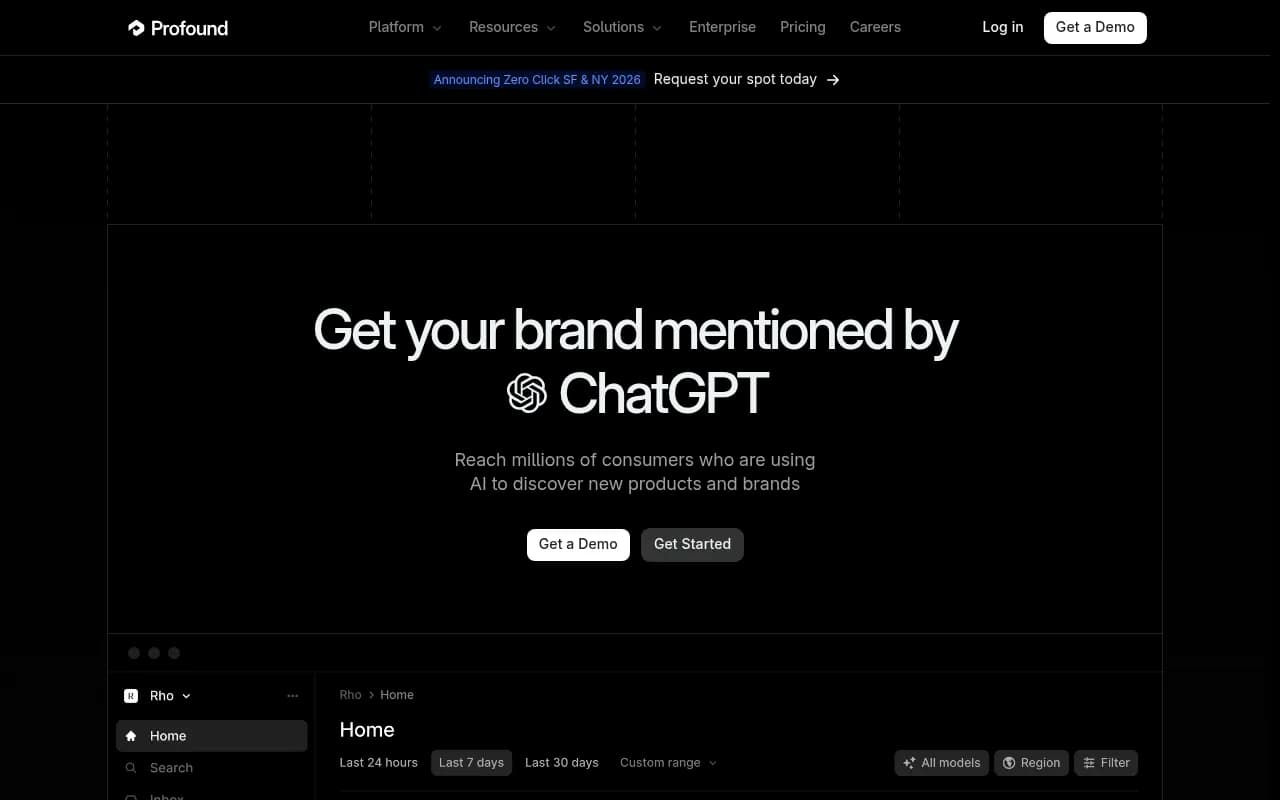
The platform covers major LLMs and has good competitive benchmarking features. Where it falls short for some agencies is price — Profound sits at a higher price point than most alternatives, which can make it harder to justify for smaller clients or agencies still building out their GEO practice. It also lacks Reddit tracking and ChatGPT Shopping monitoring, which are increasingly relevant for consumer-facing brands.
Best for: Enterprise-focused agencies with larger client budgets and a need for polished pitch environments.
3. Slate — purpose-built for agency workflows
Slate is one of the few tools designed with agencies as the primary user, not an afterthought. The multi-client workspace architecture is clean, and the platform handles prompt tracking and brand mention analysis across the major LLMs.
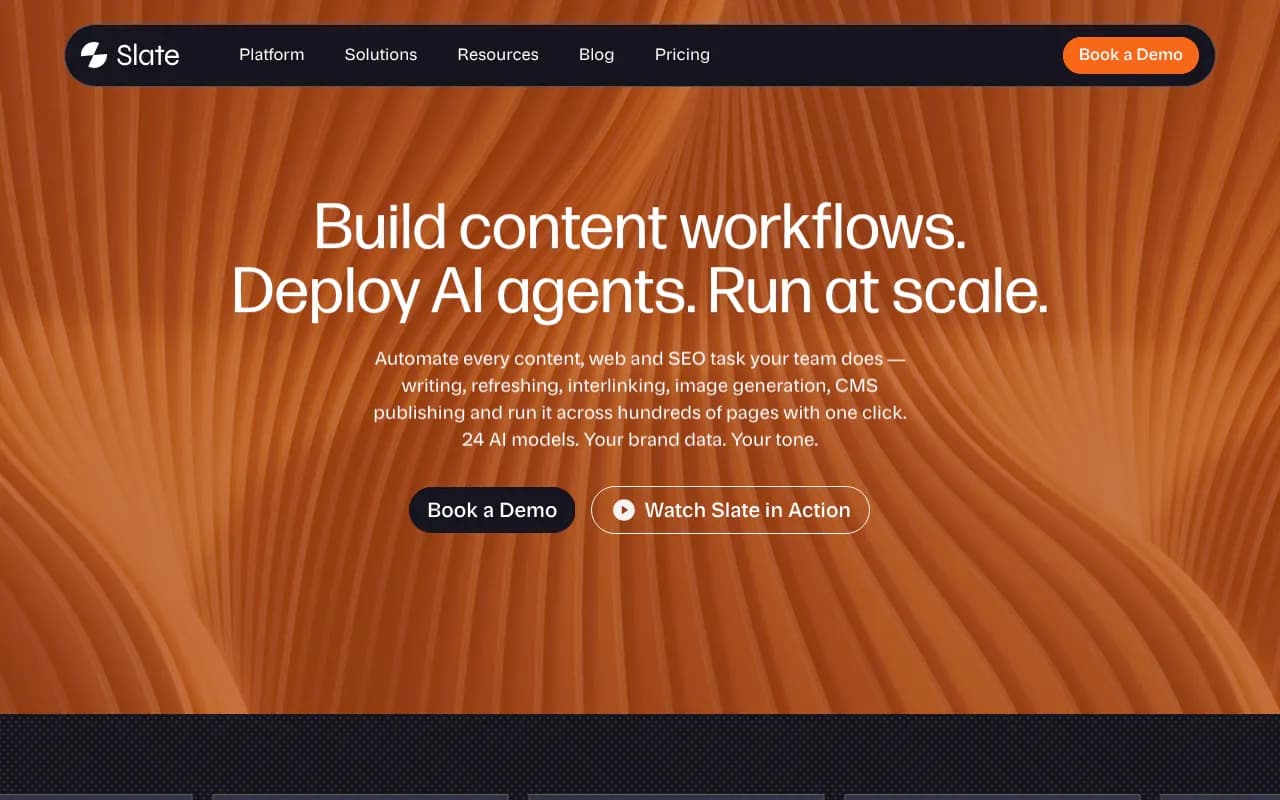
What makes Slate worth considering is its focus on operational efficiency. Centralized dashboards, per-client segmentation, and reporting tools are all built with the assumption that you're managing many brands simultaneously. It's not the deepest platform in terms of raw data, but for agencies that need something they can actually run at scale without a lot of manual overhead, it's a practical choice.
Best for: Mid-sized agencies that prioritize workflow efficiency and clean client reporting over deep analytics.
4. Otterly.AI — affordable entry point for smaller agencies
Otterly.AI is one of the more accessible options on this list, both in terms of price and ease of use. It tracks brand mentions across ChatGPT, Perplexity, and Google AI Overviews, and the interface is straightforward enough that you don't need a dedicated analyst to interpret the data.

The honest limitation: Otterly is a monitoring tool. There's no content generation, no crawler logs, no prompt volume data, and no gap analysis. If a client asks "why aren't we showing up?" you can tell them they're not showing up, but the tool won't help you answer the follow-up question. For agencies just starting to add AI visibility to their service offering, that might be fine. For agencies that want to build a full GEO practice, you'll hit the ceiling quickly.
Best for: Smaller agencies or freelancers adding basic AI visibility reporting to existing packages.
5. Scrunch AI — solid monitoring with competitive benchmarking
Scrunch covers a good range of LLMs and has competitive benchmarking features that let you show clients how they stack up against specific competitors in AI answers. The heatmap-style visualizations are genuinely useful for client presentations.
Like Otterly, Scrunch is primarily a monitoring platform. It doesn't have content generation or crawler log capabilities. But its competitive intelligence layer is more developed than most monitoring-only tools, which makes it useful for agencies that want to build a narrative around "here's where you are vs. your competitors" before pitching optimization work.
Best for: Agencies focused on competitive benchmarking and client education rather than active optimization.
6. Peec AI — straightforward LLM monitoring
Peec AI does one thing and does it cleanly: it tracks how brands appear across AI search engines. The interface is minimal, setup is fast, and the data is presented without a lot of noise.

The tradeoff is depth. Peec doesn't have visitor analytics, crawler logs, content generation, or prompt volume data. It's a monitoring dashboard, and a fairly basic one. That said, for agencies that just need to add a line item to their reporting — "here's your AI visibility score this month" — Peec can get you there without a steep learning curve or a large budget.
Best for: Agencies that need a lightweight, low-cost AI visibility add-on for existing clients.
7. Cairrot — agency-focused pricing with multi-LLM tracking
Cairrot is a newer entrant specifically targeting agencies, with pricing structured around managing multiple client brands. It tracks visibility across 5+ LLMs and has basic reporting features designed for client delivery.
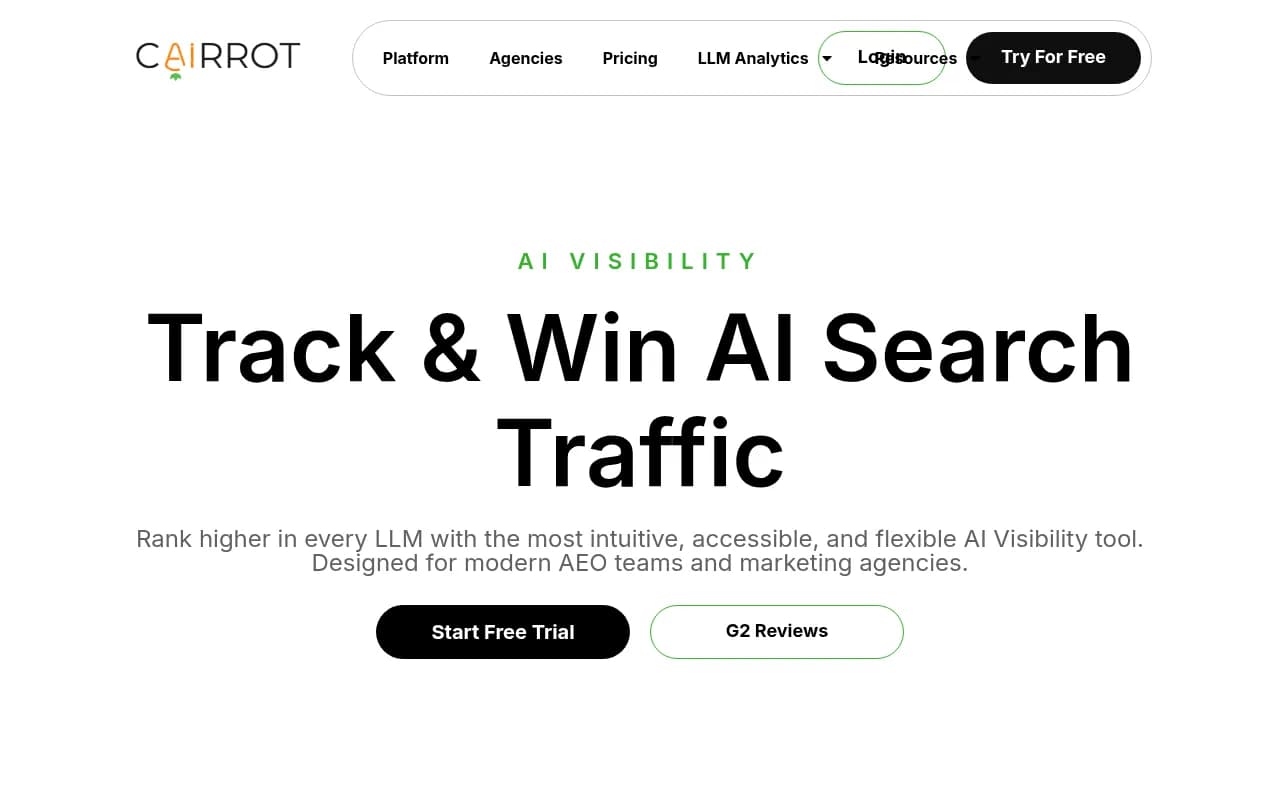
It's not the most feature-rich platform, but the agency-first pricing model makes it worth considering if budget is a constraint. The competitive intelligence features are limited, and there's no content generation or gap analysis, but for agencies that need to cover a lot of clients at a reasonable cost, Cairrot offers a practical middle ground.
Best for: Budget-conscious agencies managing a high volume of smaller clients.
Comparison table
| Tool | LLM coverage | Multi-client workspace | Content generation | Crawler logs | White-label reporting | Starting price |
|---|---|---|---|---|---|---|
| Promptwatch | 10+ models | Yes | Yes (Content Agents) | Yes | Yes | $99/mo |
| Profound AI | Major LLMs | Yes (agency mode) | No | No | Yes | Higher tier |
| Slate | Major LLMs | Yes | No | No | Yes | Mid-range |
| Otterly.AI | ChatGPT, Perplexity, GAI | Limited | No | No | Basic | Low |
| Scrunch AI | Major LLMs | Yes | No | No | Yes | Mid-range |
| Peec AI | Major LLMs | Limited | No | No | Basic | Low |
| Cairrot | 5+ LLMs | Yes | No | No | Basic | Low |
What most agencies are missing
Here's the thing that doesn't show up in feature comparison tables: most of these tools will tell you your client has an AI visibility problem. Very few of them will help you solve it.
That gap matters more than it might seem. When a client asks "why aren't we showing up in ChatGPT?" and your answer is "we're tracking it," that's a weak position. When your answer is "here are the 12 specific topics your competitors are getting cited for that you're not, and here are the articles we're creating to close those gaps," that's a service worth paying for.

The agencies that will win in AI search aren't just the ones monitoring the most LLMs. They're the ones that have a repeatable process: identify gaps, create content that closes them, and show clients the results. That loop is what separates a GEO practice from a GEO report.
What to look for if you're just starting out
If your agency is new to AI visibility, don't over-invest in tooling before you've had a few client conversations. Start with a platform that covers the major LLMs (ChatGPT, Perplexity, Google AI Overviews, Claude, Gemini), has clean reporting you can share with clients, and doesn't require a separate account for every brand.
Once you've validated that clients care about this data and are willing to pay for it, then invest in a platform with deeper capabilities — gap analysis, content generation, crawler logs, and traffic attribution. That's when the difference between a monitoring tool and an optimization platform becomes commercially meaningful.
The tools on this list cover the full range from "basic monitoring for a low monthly fee" to "end-to-end GEO platform with content generation and revenue attribution." Where you start depends on where your clients are in their AI search journey. Where you end up depends on how seriously you want to build this as a service.