Key takeaways
- Omnia raised €3.5M but still has sentiment analysis listed as "coming soon," data exports locked to its €279/month Pro plan, and a cost per prompt nearly 3x higher than some competitors.
- Most AI visibility tools stop at monitoring -- they show you a number and leave you to figure out what to do with it.
- The tools worth switching to combine tracking with built-in content generation, so you can close the gap between "we're not being cited" and "here's the content that will fix that."
- Promptwatch is the only platform in this space rated a "Leader" across all categories in a 2026 comparison of 12 GEO tools, specifically because it goes beyond monitoring to help you act.
- If content generation is your priority, look for tools that generate articles grounded in real citation data -- not generic SEO filler.
Omnia has made a lot of noise since raising €3.5 million in pre-seed funding in late 2025. Fair enough -- funding is a signal that people believe in the product. But it's not the same as the product being finished.
Right now, Omnia's pricing page still lists sentiment analysis as "coming soon." Data exports are locked behind the €279/month Pro plan. The entry-level plan charges €3.16 per prompt, which is nearly three times more expensive than alternatives. And the feature count sits around 6-7 live capabilities while competitors are shipping 20+.
None of that makes Omnia a bad product. It makes it an early product. And for teams that need to actually move the needle on AI search visibility -- not just watch a dashboard -- "early" is a problem.
The bigger issue is structural. Omnia, like most tools in this space, is primarily a monitoring platform. It tells you where you stand. It doesn't tell you what to write, help you write it, or show you whether the content you published actually improved your citations. That missing action layer is where most teams get stuck.
This guide focuses specifically on alternatives that include built-in content generation -- tools where you can go from "we're invisible for this prompt" to "here's a published article that should fix that" without switching platforms.
What to look for in an Omnia alternative with content generation
Before getting into specific tools, it's worth being clear about what "built-in content generation" actually means in this context. There's a spectrum.
On one end, you have tools that generate generic AI content -- essentially a ChatGPT wrapper with some SEO keywords sprinkled in. That content might rank in traditional search but it won't get cited by AI models, because AI models cite sources that are authoritative, specific, and well-structured for their retrieval systems.
On the other end, you have tools that generate content grounded in real citation data -- articles engineered around the specific prompts, angles, and question structures that AI models are already rewarding with citations. That's a fundamentally different product.
When evaluating alternatives, look for:
- Content generation tied to actual citation gap analysis (not just keyword gaps)
- Prompt volume and difficulty data to prioritize what to write first
- Tracking that closes the loop -- showing whether new content actually improved your visibility
- Coverage across multiple AI models (ChatGPT, Claude, Perplexity, Gemini, etc.)
- Transparent pricing that doesn't penalize you for using the tool seriously
The 5 best Omnia alternatives with built-in content generation
1. Promptwatch
Promptwatch is the most complete option in this category. It's an end-to-end AI search visibility platform that covers monitoring, gap analysis, content generation, and traffic attribution in one place -- which is genuinely rare.

The content generation piece is what separates it from most competitors. Promptwatch's built-in AI writing agent generates articles, listicles, and comparison pages grounded in 880M+ citations analyzed across 10 AI models. The output isn't generic -- it's built around the specific prompts your competitors are visible for but you're not, the angles AI models are already rewarding, and the question structures that drive citations.
The workflow looks like this: Answer Gap Analysis surfaces the exact prompts where competitors appear but you don't. You pick a gap, generate content targeting that specific prompt cluster, publish it, and then watch your visibility scores update as AI models start citing the new page. Page-level tracking shows which pages are being cited, how often, and by which models. Traffic attribution (via code snippet, GSC integration, or server log analysis) connects those citations to actual revenue.
That loop -- find gaps, generate content, track results -- is what makes Promptwatch an optimization platform rather than a monitoring dashboard.
A few other things worth noting: Promptwatch logs real-time AI crawler activity (which pages ChatGPT, Claude, and Perplexity are reading, errors they're hitting, how often they return), tracks Reddit and YouTube discussions that influence AI recommendations, monitors ChatGPT Shopping appearances, and supports multi-language and multi-region tracking with customizable personas.
Pricing starts at $99/month for the Essential plan (1 site, 50 prompts, 5 articles), $249/month for Professional (2 sites, 150 prompts, 15 articles, crawler logs), and $579/month for Business (5 sites, 350 prompts, 30 articles). A free trial is available.
In a 2026 comparison of 12 GEO platforms, Promptwatch was the only tool rated a "Leader" across all categories. Most competitors were rated as monitoring-only dashboards.
2. Writesonic
Writesonic has evolved from a general AI writing tool into something more interesting: an AI search visibility platform that combines tracking with content creation.
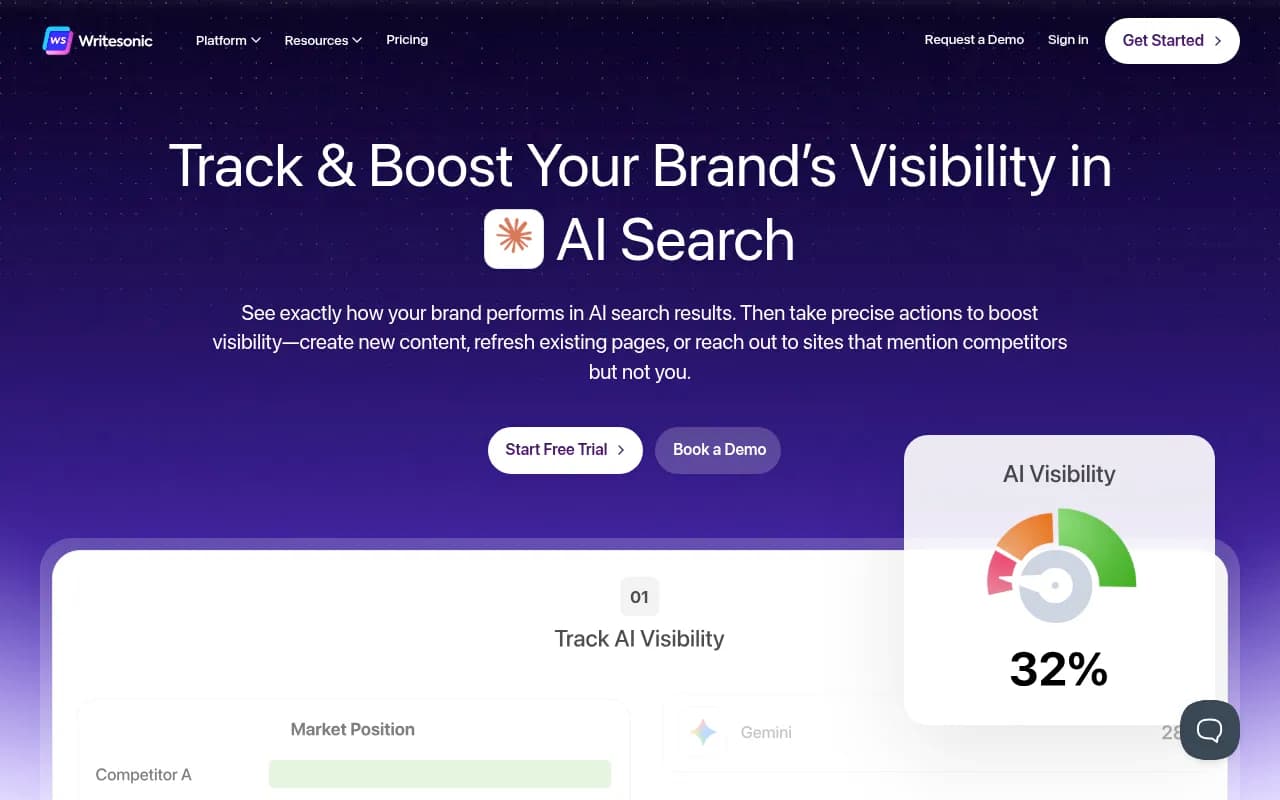
The tracking side covers brand mentions and citations across major AI models. The content side is where Writesonic has an advantage over pure monitoring tools -- it can generate long-form articles, landing pages, and structured content at scale. The connection between the two isn't as tight as Promptwatch's (you won't get prompt-level gap analysis feeding directly into content briefs), but for teams that already have a content workflow and just need better AI-optimized output, it's a solid option.
Writesonic also has a broader content suite than most AI visibility tools -- social copy, ad copy, product descriptions -- which makes it useful for teams that want one AI writing tool rather than several.
3. Relixir
Relixir positions itself as an all-in-one GEO platform with AI content generation and analytics built in.
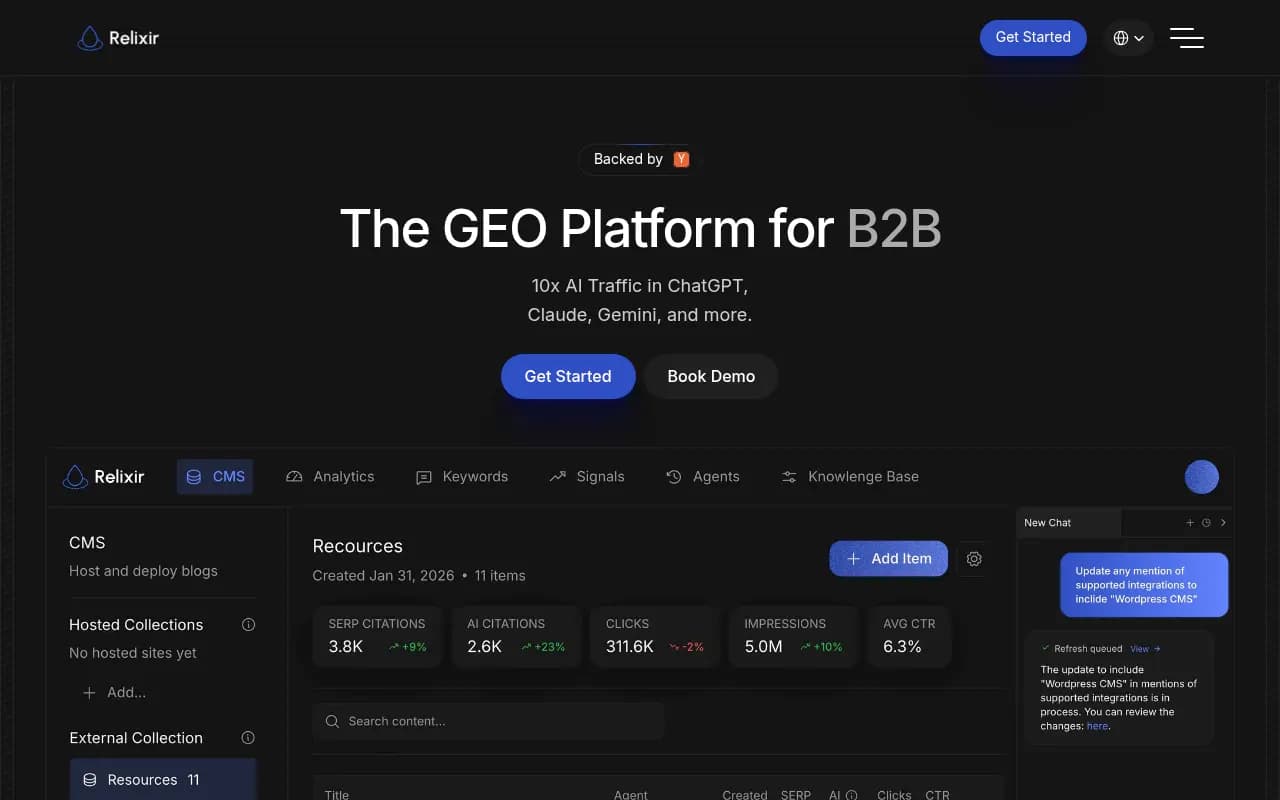
What makes Relixir interesting is that it's designed from the ground up for generative engine optimization rather than retrofitting AI visibility onto a traditional SEO tool. The content generation is tied to competitive gap analysis -- you can see where competitors are winning citations and generate content targeting those same prompt clusters.
It's a younger platform than Promptwatch, so the citation database and model coverage are smaller, but the core workflow (monitor, identify gaps, generate content, track results) is there. Worth evaluating if you want a purpose-built GEO tool with a tighter scope than Promptwatch's full platform.
4. AirOps
AirOps takes a different angle. It's primarily an AI workflow automation platform that connects AI citation analysis, Google Search Console, and GA4 through its Page360 feature -- giving you a unified view of how your content performs across both traditional and AI search.
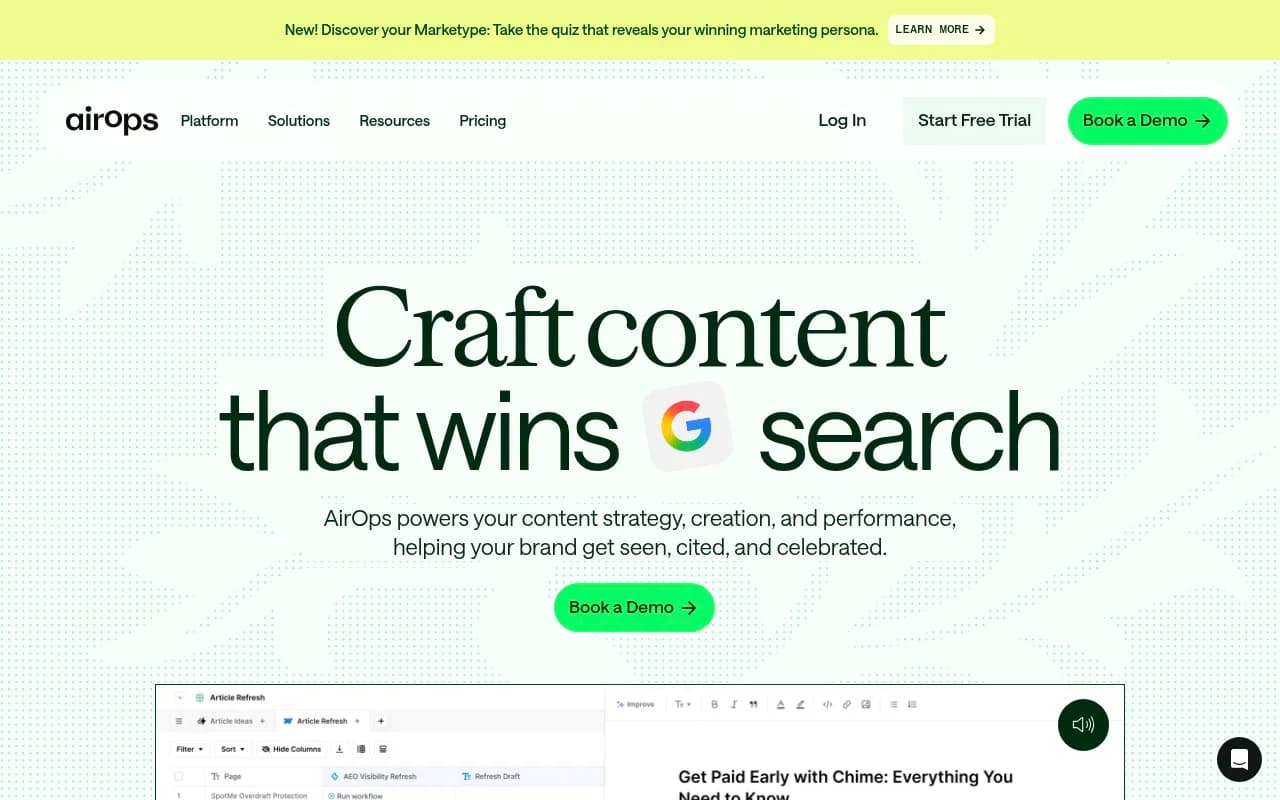
The content generation in AirOps is workflow-based: you build AI pipelines that can generate, optimize, and publish content at scale. It's more flexible than purpose-built GEO tools but also more complex to set up. Teams with technical resources will get more out of it; smaller marketing teams might find the setup overhead frustrating.
Where AirOps genuinely shines is in connecting AI visibility data to existing analytics infrastructure. If you're already deep in GSC and GA4 and want to layer AI citation tracking on top without rebuilding your reporting stack, AirOps is worth a serious look.
5. SearchAtlas LLM Visibility
SearchAtlas has been building out its AI visibility capabilities alongside its existing SEO platform, and the LLM visibility module now includes content generation tools.

The advantage here is integration with a mature SEO platform. If you're already using SearchAtlas for keyword research and on-page optimization, the AI visibility layer slots in without requiring a separate tool. Content generation is AI-powered and can be informed by both traditional keyword data and AI citation patterns.
The limitation is that SearchAtlas is primarily an SEO platform that added AI visibility -- not a GEO-first tool. The citation analysis depth and prompt intelligence aren't as granular as Promptwatch or Relixir. But for teams that want to consolidate tools and already have SearchAtlas in their stack, it's a practical choice.
Feature comparison
| Tool | Content generation | Citation gap analysis | Prompt volume data | Crawler logs | AI model coverage | Starting price |
|---|---|---|---|---|---|---|
| Promptwatch | Yes (AI writing agent) | Yes (Answer Gap Analysis) | Yes | Yes | 10 models | $99/mo |
| Writesonic | Yes (broad content suite) | Limited | No | No | 4-5 models | ~$99/mo |
| Relixir | Yes (GEO-focused) | Yes | Limited | No | 5+ models | Custom |
| AirOps | Yes (workflow-based) | Via Page360 | No | No | Varies | Custom |
| SearchAtlas | Yes (SEO-integrated) | Limited | No | No | 4-5 models | ~$99/mo |
| Omnia | No | No | No | No | 4 models | €79/mo |
Why most AI visibility tools stop at monitoring
It's worth stepping back to understand why the content generation gap exists in the first place.
Building a monitoring dashboard is relatively straightforward. You send prompts to AI models on a schedule, parse the responses, check for brand mentions, and display the results. That's useful data, but it's not a complete product.
Building content generation that actually improves AI visibility is harder. You need to understand which prompts are driving citations, what content structures AI models prefer, how to write for retrieval rather than just for ranking, and how to close the loop between content published and citations earned. That requires a much larger investment in citation data, prompt intelligence, and content engineering.
Most tools in this space -- including Omnia -- haven't made that investment yet. They're monitoring dashboards with roadmaps that promise more. The tools in this guide have actually shipped the action layer.
Which tool should you choose?
The honest answer depends on your situation.
If you want the most complete platform -- monitoring, gap analysis, content generation, crawler logs, traffic attribution, Reddit/YouTube tracking, and ChatGPT Shopping -- Promptwatch is the clear choice. It's the only tool in this comparison that covers the full loop from discovery to optimization to revenue attribution, and it's been validated by 6,700+ brands including Booking.com and Center Parcs.
If you already have a content team and primarily need AI-optimized writing at scale, Writesonic is worth evaluating. It's less GEO-specific but more flexible for general content production.
If you want a purpose-built GEO platform with a tighter scope, Relixir is the most direct Omnia alternative with content generation included.
If you have technical resources and want to build custom AI content workflows connected to your existing analytics stack, AirOps offers the most flexibility.
If you're already in the SearchAtlas ecosystem and want to add AI visibility without switching tools, the LLM Visibility module is the path of least resistance.
What you shouldn't do is pay for a monitoring-only tool and assume the content strategy will figure itself out. The brands winning in AI search right now are the ones that have closed the loop between visibility data and content production -- and they're doing it systematically, not manually.
Omnia might get there eventually. For now, these five alternatives are already there.