Key takeaways
- Most AI search visibility tools, including Meteoria.ai, focus on monitoring but leave you to figure out content fixes on your own.
- The best alternatives in 2026 combine tracking with built-in content generation so you can close the loop between "where am I invisible?" and "what do I publish?"
- Promptwatch is the only platform in this comparison rated as a leader across monitoring, content generation, and traffic attribution.
- Tools like Writesonic and Relixir offer solid content generation but vary significantly in how deeply they integrate AI search data into what they write.
- If you're an agency or brand that needs to move fast, the monitoring-only approach is a bottleneck you can't afford.
Meteoria.ai sits in a growing category of tools that track how your brand appears in AI search engines like ChatGPT, Perplexity, and Google AI Overviews. It does the monitoring part reasonably well. But if you've spent any time with it, you've probably hit the same wall: you can see where you're invisible, but the tool doesn't help you do anything about it.
That gap matters more than it used to. In 2026, AI search isn't a side channel. It's where a meaningful chunk of discovery happens, and brands that can't generate content specifically engineered to get cited by LLMs are falling behind. Monitoring your visibility score without being able to act on it is a bit like checking your bank balance but having no way to earn money.
This guide covers five alternatives that actually help you create content for AI search, not just watch the numbers.
What to look for in a Meteoria.ai alternative
Before getting into the tools, it's worth being clear about what "built-in content generation for AI search" actually means, because the phrase gets used loosely.
A genuine content generation capability for AI search should:
- Pull from real citation data to understand what AI models are actually citing
- Identify specific content gaps (prompts where competitors appear but you don't)
- Generate articles, listicles, or comparisons that are structured to get cited, not just to rank on Google
- Track whether the content you publish actually improves your visibility
A tool that lets you write blog posts with an AI assistant is not the same thing. Generic AI writing tools are everywhere. What's rare is a platform that connects citation intelligence to content creation in a single workflow.
With that in mind, here are the five alternatives worth considering.
1. Promptwatch
Promptwatch is the most complete option on this list. Where Meteoria.ai stops at monitoring, Promptwatch runs a full loop: find the gaps, create content to fill them, track the results.

The content generation piece is what sets it apart from most competitors. The built-in AI writing agent generates articles, listicles, and comparisons grounded in citation data from over 880 million citations analyzed. It's not producing generic filler. It's producing content engineered around the specific prompts where AI models are looking for answers and not finding them on your site.
The Answer Gap Analysis is particularly useful here. It shows you exactly which prompts your competitors are visible for that you're not, down to the specific questions and angles. You then hand those gaps to the writing agent and get content built around them.
On top of that, Promptwatch tracks AI crawler activity in real time, so you can see when ChatGPT, Claude, or Perplexity is actually reading your pages. Most competitors don't offer this at all. It also covers Reddit and YouTube as citation sources, which matters because AI models frequently pull from those channels when forming recommendations.
Pricing starts at $99/month for the Essential plan (1 site, 50 prompts, 5 articles). The Professional plan at $249/month adds crawler logs, city-level tracking, and 15 articles per month. A free trial is available.
If you're looking for one platform that handles the entire AI visibility workflow, this is it.
2. Writesonic
Writesonic has evolved well beyond a basic AI writing tool. In 2026, it functions as an AI search visibility platform that combines brand monitoring with content generation.
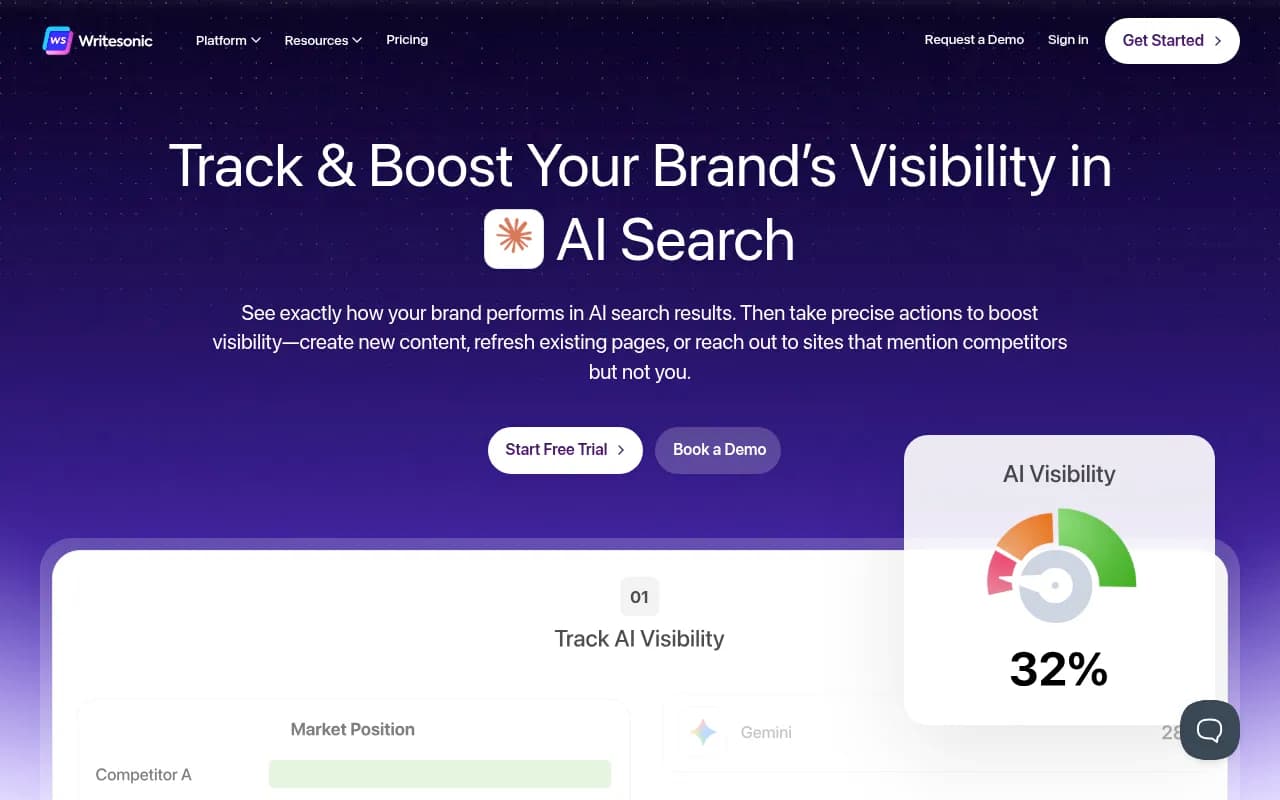
The monitoring side tracks how your brand appears across major AI engines. The content side lets you generate SEO and AI-optimized articles directly within the platform. The integration between the two isn't as tight as Promptwatch's, but it's more connected than most alternatives.
Where Writesonic shines is volume. If you need to produce a lot of content quickly, it's fast and the output quality is consistently decent. It's also more affordable at entry level, which makes it a reasonable choice for smaller teams that need both tracking and writing in one place.
The main limitation: the content generation isn't specifically trained on citation data the way Promptwatch's is. You're getting good AI writing, but not necessarily writing that's been engineered around what LLMs want to cite.
3. Relixir
Relixir positions itself as an all-in-one GEO platform with AI content generation baked in. It's one of the more ambitious tools in this space and worth a serious look if you want something that goes beyond basic monitoring.

The platform analyzes how AI models respond to prompts in your category, identifies where your brand is missing, and generates content designed to fill those gaps. The workflow is similar in concept to Promptwatch's, though the citation database and depth of analysis differ.
Relixir is particularly strong for teams that want a structured GEO workflow without needing to stitch together separate tools. The content generation output is solid, and the platform does a reasonable job of connecting what you publish to changes in your visibility scores.
It's worth noting that Relixir is newer and the feature set is still maturing in some areas, particularly around traffic attribution and multi-language support. But for teams that want a genuine monitoring-plus-creation platform, it's a credible option.
4. SearchAtlas LLM Visibility
SearchAtlas takes a different approach. It's built around SEO automation, and the LLM visibility layer sits on top of a broader content and technical SEO platform.

The content generation here is genuinely useful because it's connected to SearchAtlas's existing SEO data infrastructure. You get content briefs and articles that are optimized for both traditional search and AI search simultaneously, which is valuable if you're not ready to treat them as entirely separate channels.
The AI search monitoring covers the major LLMs and includes some prompt intelligence features. It's not as deep as Promptwatch on the citation analysis side, but it's more than enough for teams that want a single platform handling SEO and AI visibility together.
If your team is already using SearchAtlas for SEO and wants to add AI search coverage without switching tools, this is the most natural path.
5. Orchly.ai
Orchly.ai is a content ops platform built specifically around AI search. It writes, optimizes, and publishes content with AI search visibility as the primary goal, not an afterthought.

The platform is more content-forward than the others on this list. If monitoring is secondary to your needs and you primarily want a tool that produces high volumes of AI-search-optimized content efficiently, Orchly.ai is worth testing.
The visibility tracking is present but lighter than what you'd get from Promptwatch or Relixir. Think of it as a content production engine with AI search awareness built in, rather than a full GEO platform with content generation added on.
For content teams that already have visibility data from another source and just need help producing content at scale, this is a practical choice.
Comparison table
| Tool | AI search monitoring | Built-in content generation | Citation data | Crawler logs | Traffic attribution | Starting price |
|---|---|---|---|---|---|---|
| Promptwatch | Yes (10 LLMs) | Yes (citation-grounded) | 880M+ citations | Yes | Yes | $99/mo |
| Writesonic | Yes | Yes (general AI writing) | Limited | No | No | ~$99/mo |
| Relixir | Yes | Yes (GEO-focused) | Yes | Partial | Partial | Custom |
| SearchAtlas LLM | Yes | Yes (SEO + AI) | Moderate | No | No | Custom |
| Orchly.ai | Basic | Yes (content-forward) | Limited | No | No | Custom |
| Meteoria.ai | Yes | No | Limited | No | No | Custom |
Why monitoring-only tools aren't enough anymore
The category of "AI search monitoring" tools has exploded in the past two years. Most of them do roughly the same thing: run your brand name and a set of prompts through ChatGPT, Perplexity, and a few others, then show you a visibility score and a list of citations.
That's useful data. But it's not a strategy.
The brands that are actually improving their AI search visibility in 2026 are the ones treating it like a content problem. AI models cite sources because those sources have clear, well-structured answers to specific questions. If your site doesn't have that content, no amount of monitoring will change your score.
The tools that close this loop, where you go from "I'm invisible for this prompt" to "here's the article that fixes it" to "my visibility score improved," are the ones worth paying for. Meteoria.ai doesn't do that. The five tools above do, to varying degrees.
Which alternative should you choose?
It depends on what you're optimizing for.
If you want the most complete platform that handles monitoring, content generation, and traffic attribution in one place, Promptwatch is the clear choice. The citation-grounded content generation and the Answer Gap Analysis workflow are genuinely differentiated from anything else in the market right now.
If you're primarily a content team that needs to produce AI-search-optimized articles at scale and already have monitoring covered elsewhere, Orchly.ai or Writesonic are worth testing.
If you're an SEO team that wants to add AI search coverage to an existing workflow without switching platforms, SearchAtlas is the most natural fit.
And if you want a purpose-built GEO platform that's trying to do what Promptwatch does but from a different angle, Relixir is the one to watch.
The monitoring-only era is ending. The tools that survive in this space will be the ones that help you act on what they find.