Key takeaways
- Most AI visibility tools -- including Ceyo.ai -- are monitoring dashboards. They show you where you're invisible but don't help you fix it.
- The tools worth paying for in 2026 combine tracking with content generation, so you can act on the data immediately.
- Built-in content generation matters because AI models cite specific pages, not brands. You need to publish the right content, not just know you're missing.
- The best alternatives here range from full GEO platforms to specialized AI writing tools that feed directly into AI search optimization workflows.
- If you want one platform that does everything -- tracking, gap analysis, content generation, and attribution -- Promptwatch is the only option rated as a Leader across all categories in a 2026 comparison of 12 GEO platforms.
Why "monitoring only" isn't enough anymore
When AI search was new, just knowing whether ChatGPT mentioned your brand felt like progress. That window has closed. By 2026, most marketing teams already have some form of AI visibility tracking. The question isn't "are we being cited?" -- it's "what do we do about it?"
This is where Ceyo.ai runs into a wall. It's a decent monitoring tool. You can track brand mentions across LLMs, see sentiment trends, and get a rough picture of your AI visibility. But when you find a gap -- a competitor getting cited for a prompt you should own -- Ceyo.ai leaves you to figure out the fix yourself.
That's a real problem. AI models don't cite brands randomly. They cite specific pages that answer specific questions well. If those pages don't exist on your site, no amount of monitoring will change your visibility score.
The tools below all offer something Ceyo.ai doesn't: a path from "we're invisible here" to "we published content that gets cited here."
What to look for in a Ceyo.ai alternative
Before getting into the list, here's the framework I used to evaluate these tools:
- Does it track AI visibility across multiple LLMs (not just one or two)?
- Does it identify which prompts competitors rank for that you don't?
- Does it have built-in content generation -- not just a link to ChatGPT?
- Is the generated content grounded in citation data, not generic SEO logic?
- Can you close the loop with traffic attribution?
Tools that only hit the first bullet are monitoring tools. The ones below hit most or all of them.
The 5 best Ceyo.ai alternatives with built-in content generation
1. Promptwatch
Promptwatch is the most complete option on this list. It's built around what it calls the "action loop": find the gaps, create content that ranks in AI, track the results.
The Answer Gap Analysis is the standout feature. It shows you exactly which prompts your competitors appear in that you don't -- not as a vague category, but as specific questions with prompt volume estimates and difficulty scores. You can see the actual AI responses where a competitor gets cited and you don't, which makes it obvious what content you need to write.
From there, the built-in AI writing agent generates articles, listicles, and comparisons grounded in real citation data. Promptwatch has processed over 880 million citations, so when it generates content, it's working from patterns of what actually gets cited by ChatGPT, Claude, Perplexity, and others -- not generic SEO best practices.
The tracking side is equally strong. Page-level visibility shows which specific pages are being cited, by which models, and how often. AI Crawler Logs show when ChatGPT or Perplexity's crawlers visit your site, which pages they read, and what errors they hit. Traffic attribution connects all of this to actual revenue through a code snippet, GSC integration, or server log analysis.
It also covers things most competitors skip entirely: Reddit and YouTube tracking (both heavily influence AI recommendations), ChatGPT Shopping carousels, and multi-language/multi-region monitoring.
Pricing starts at $99/month for the Essential plan (1 site, 50 prompts, 5 articles). Professional is $249/month and adds crawler logs, 150 prompts, and 15 articles. Business is $579/month for 5 sites. A free trial is available.

2. Writesonic
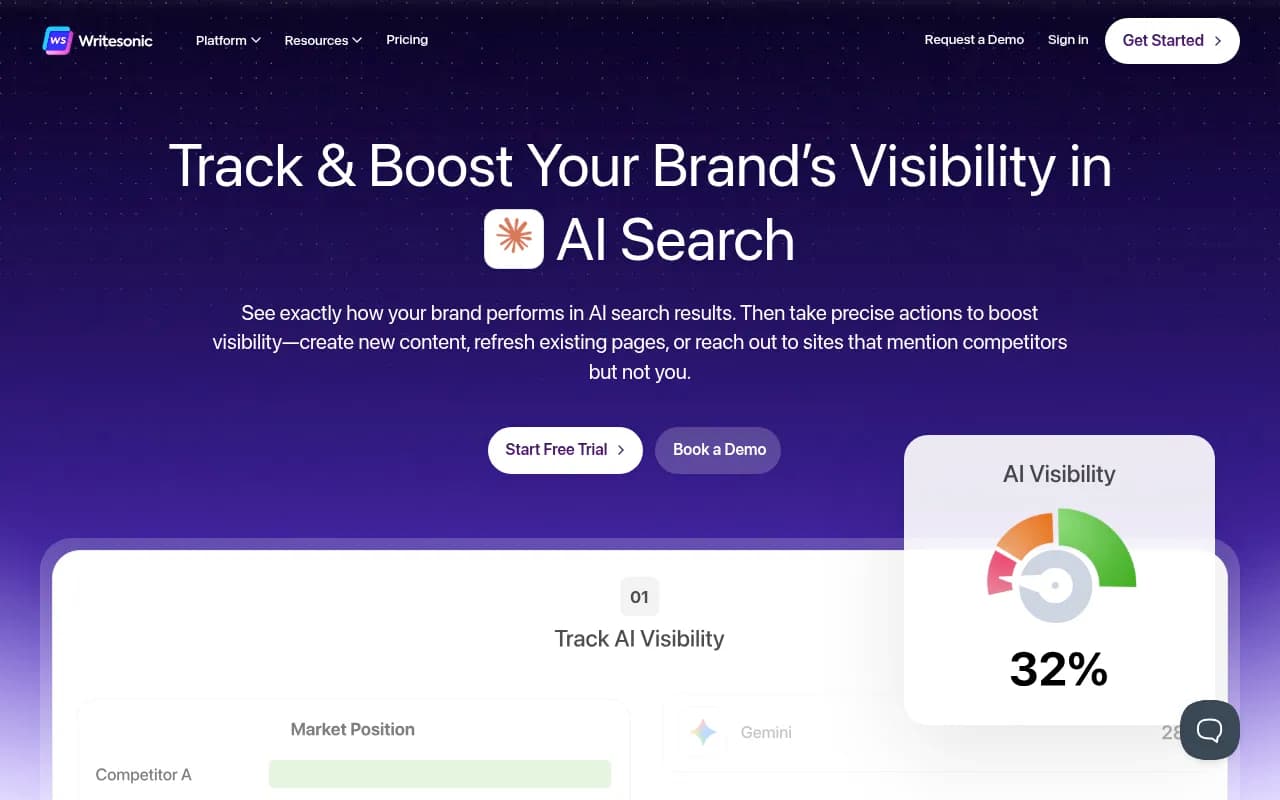
Writesonic has evolved well beyond its origins as a copywriting tool. The current platform combines AI search visibility tracking with content generation in a single workflow, which is exactly what this list is about.
On the tracking side, it monitors brand mentions across major LLMs and surfaces where competitors are gaining ground. The content generation side is mature -- Writesonic has years of training data and produces solid long-form content. The integration between the two isn't as tight as Promptwatch's (the gap analysis isn't as granular, and the content generation isn't explicitly grounded in citation data), but for teams that want a single subscription covering both functions, it's a reasonable choice.
It's also worth noting that Writesonic's content tools are genuinely good for traditional SEO too, so if you're running parallel workflows for Google and AI search, there's less tool sprawl.
3. Relixir
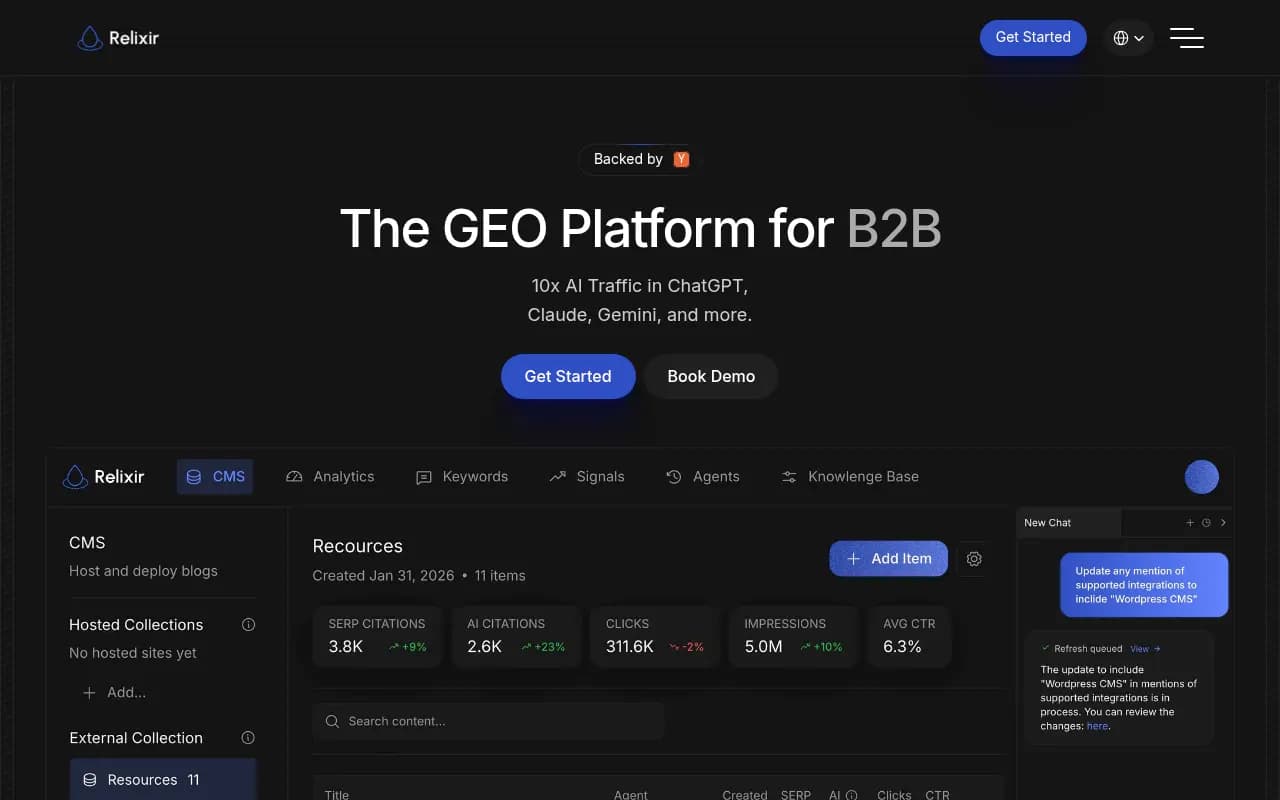
Relixir is an all-in-one GEO platform with AI content generation built in. It's newer than some options here, but it's designed from the ground up for AI search optimization rather than retrofitting tracking onto an existing content tool.
The platform identifies visibility gaps, generates content targeted at specific prompts, and tracks how that content performs in AI responses over time. The content generation is more focused on AI search than general-purpose writing -- it's optimized for the kind of structured, authoritative content that LLMs tend to cite.
If you're a team that's primarily focused on GEO (rather than needing a general content platform), Relixir is worth a close look.
4. SearchAtlas LLM Visibility
SearchAtlas takes a different angle. It's an AI-powered SEO automation platform that deploys fixes and content directly -- the emphasis is on automation rather than manual content creation workflows.
For teams that want to move fast without a dedicated content team, that's appealing. The platform identifies what's missing from your AI visibility footprint and can generate and deploy content changes with less manual intervention than most tools require.
The trade-off is that automated content at scale can be hit-or-miss in quality. SearchAtlas works best for teams with enough volume that automation ROI is clear, rather than smaller teams that need every piece of content to be carefully crafted.

5. Orchly.ai
Orchly.ai positions itself as an AI-powered content ops platform that writes, optimizes, and publishes content for AI search visibility. It's more content-ops focused than pure GEO tracking, which makes it a good fit for teams where the bottleneck is production rather than strategy.
The platform handles the workflow from brief to published content, with optimization built around AI citation patterns. It's less strong on the monitoring and analytics side compared to Promptwatch or Writesonic, but if your team already has visibility data and needs help turning insights into published content at scale, Orchly fills that gap.

Side-by-side comparison
| Tool | AI visibility tracking | Answer gap analysis | Built-in content generation | Citation-grounded content | Traffic attribution | Starting price |
|---|---|---|---|---|---|---|
| Promptwatch | Yes (10 LLMs) | Yes | Yes | Yes (880M+ citations) | Yes | $99/mo |
| Writesonic | Yes | Partial | Yes | Partial | Limited | ~$99/mo |
| Relixir | Yes | Yes | Yes | Yes | Partial | Custom |
| SearchAtlas | Yes | Yes | Yes (automated) | Partial | No | Custom |
| Orchly.ai | Limited | Limited | Yes | Partial | No | Custom |
| Ceyo.ai | Yes | No | No | No | No | Custom |
The pattern is clear: Ceyo.ai covers the first column well and stops. Every alternative here goes further, with varying degrees of depth on the content generation and attribution side.
Which tool fits which situation
Not every team needs the same thing. Here's a rough guide:
If you're a marketing team or SEO team that wants a complete workflow -- from gap identification through content creation to revenue attribution -- Promptwatch is the most complete option. The action loop is genuinely differentiated: most tools make you export data and figure out next steps in a separate tool. Promptwatch keeps it in one place.
If you already use Writesonic for content and want to add AI visibility tracking without switching tools, the expanded Writesonic platform is a natural upgrade path. You lose some depth on the GEO side but gain workflow simplicity.
If you're a GEO-first team (AI search is your primary channel, not a side project), Relixir is worth evaluating seriously. It's built for this use case from the ground up.
If you're running a high-volume content operation and need automation over craftsmanship, SearchAtlas handles scale better than most.
If your team has the strategy covered but needs a content production partner, Orchly.ai fills the production gap without requiring you to rethink your entire stack.
The content generation piece matters more than it looks
One thing worth saying directly: the reason built-in content generation matters for AI search isn't just convenience. It's that the content needs to be calibrated to what AI models actually cite.
Generic SEO content -- keyword-stuffed, structured for Google's crawlers -- doesn't automatically get cited by ChatGPT or Perplexity. LLMs tend to cite content that answers questions directly, comprehensively, and in a format that's easy to parse. That's a different brief than traditional SEO writing.
Tools that generate content grounded in actual citation data (what's already being cited, by which models, for which prompts) produce meaningfully better results than tools that just generate text and hope for the best. That's the distinction between Promptwatch's approach and a generic AI writer.
A note on what Ceyo.ai does well
To be fair: if your only need is monitoring -- tracking brand mentions across LLMs, getting sentiment data, seeing how your visibility changes over time -- Ceyo.ai does that competently. The interface is clean and the data is reliable.
The gap is on the action side. Once you know you're invisible for a set of prompts, Ceyo.ai doesn't help you become visible. For teams that have a strong content operation already and just need the data layer, that might be fine. But most teams hit the same wall: they have the data, they don't have time to translate it into content, and the monitoring dashboard starts feeling like an expensive report nobody acts on.
That's the problem the tools above are designed to solve.
Bottom line
The shift from monitoring to optimization is the defining trend in GEO tooling in 2026. Ceyo.ai is a monitoring tool. If you've outgrown that -- if you want to actually move your AI visibility scores rather than just watch them -- you need something with content generation built in.
Promptwatch is the strongest all-in-one option. Writesonic is the best choice if you're already in their ecosystem. Relixir, SearchAtlas, and Orchly.ai each have specific situations where they fit better than the others.
Pick the one that matches where your bottleneck actually is: data, content, automation, or attribution. The worst outcome is paying for a monitoring tool and treating it like a strategy.