Key takeaways
- Gauge's Growth plan ($599/mo) tracks six AI platforms, but Claude and Grok are not in the base package. You have to bring your own API keys and pay the providers directly, roughly $2.50–$3 per prompt per month for Claude and $1–$2 for Grok.
- Multi-location tracking is Enterprise-only. Growth is single-location, which is a problem for any brand selling into multiple markets.
- AI crawler log analysis isn't native. Gauge supports connecting your own Cloudflare or Vercel logs, but it's an integration you set up, not an out-of-the-box dataset.
- Gauge itself acknowledges that referral traffic only captures a tiny fraction of true AI visibility, since users rarely click citations in generative engines.
- Category-wide blind spots affect every prompt tracker: ads in AI answers, shopping features, query fan-outs, and citation volatility. ChatGPT's ad rate hit 32.4% of citation-enabled responses in the last week of Promptwatch's 90-day study, and most visibility tools don't monitor this at all.
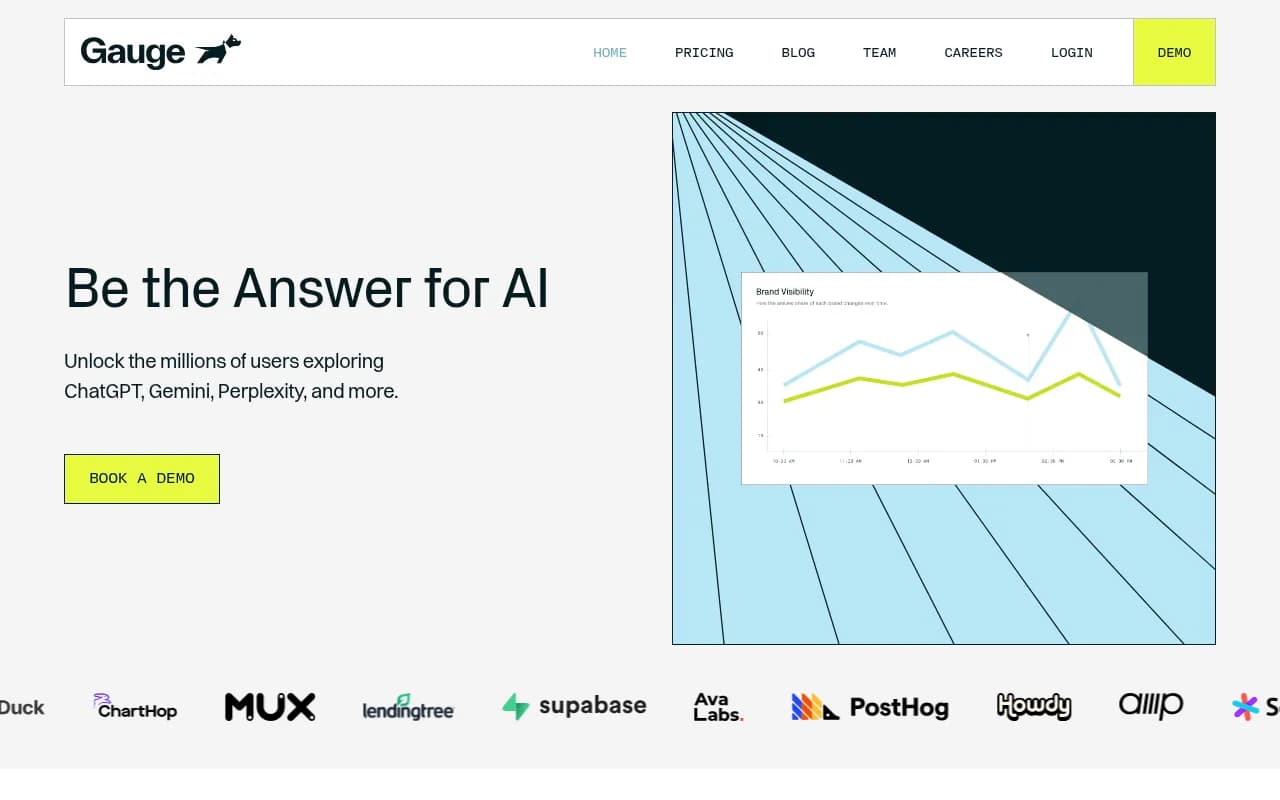
Gauge is one of the more interesting entries in the AI visibility space. It's a Y Combinator-backed (S24) AEO platform founded in 2024, led by CEO Caelean Barnes and CTO Evan Doyle, with named customers like PostHog, Braintrust, Vellum AI, and LendingTree. Its pitch is straightforward: a lot of prompt coverage for the money. Growth at $599/month gets you 600 prompts per day across six platforms, which Gauge claims works out to roughly 108,000 AI answers tracked per month, plus 18 publish-ready articles.
That's a genuinely strong volume story. Profound's Lite/Growth tiers run $399–499/month for around 9,000 answers per month across three platforms. Gauge is claiming roughly 12x the answer volume for about $200 more.
But volume is not the same as coverage. When you dig into what Gauge actually monitors by default, and what it doesn't, the picture gets more complicated. This guide walks through the gaps, both the ones specific to Gauge and the ones that affect every tool in this category.
The gaps specific to Gauge
Claude and Grok aren't in the base plan
Gauge's marketing says six platforms: ChatGPT, Google AI Overviews, Google AI Mode, Gemini, Perplexity, and Microsoft Copilot. What's less obvious is that Claude and Grok, the two engines Gauge lists as Enterprise add-ons, require bring-your-own-key (BYOK) setup on every plan, including Enterprise.
The reason is technical. Claude has no logged-out web UI to scrape, so it has to be queried through the Anthropic API, which means the customer pays the token costs directly. Based on current API pricing, that works out to roughly $2.50–$3 per prompt per month for Claude and $1–$2 for Grok. If you're tracking 100 prompts, adding Claude could mean $250–300/month in additional API spend on top of your Gauge subscription.
This matters more for some companies than others. Gauge's own comparison content concedes the point: Claude matters most if you sell to developers or technical buyers, and Grok matters if your audience lives on X. If your buyers fit those profiles, you're either paying extra or flying blind on two engines that are increasingly influential with exactly the people you're trying to reach.
Multi-location tracking is locked behind Enterprise
Growth is a single-location plan. If you need to see how your visibility differs between, say, the US and Germany, or even between New York and Texas, that's a custom Enterprise conversation. For a $599/month tool, that's a surprising limitation, and it's one that doesn't show up prominently in the feature comparison. Most buyers we talk to assume location coverage is included until they're already onboarded.
Crawler logs require your own setup
Gauge advertises "real AI traffic from your own logs" as a feature, which sounds like native crawler analytics. In practice, you need to connect your own Cloudflare or Vercel logs. That's an integration step requiring technical setup, and if your logs aren't already structured for it, some engineering time.
This is standard across the category, to be fair. Profound, Scrunch, and most other AEO platforms handle crawler data the same way. But it means the "AI traffic" insight that's advertised isn't something you get out of the box, and the quality of what you see depends entirely on your own infrastructure.
Gauge admits referral traffic is a weak signal
This one comes from Gauge's own materials: "referral traffic also only represents a tiny fraction of your true visibility across AI answers, as users infrequently actually click on citations in generative engines."
It's honest, and it's correct. But it also means the traffic numbers in any AEO dashboard, Gauge's included, undercount real-world impact. People read the answer, form an impression of your brand, and never click. That's invisible in click-based analytics.
Thin third-party validation
G2 lists Gauge with a 4.8/5 rating, but from only four reviews, and at least one of those appears to be about a completely different product, an open-source test automation tool that also happens to be named Gauge. The review discusses "steps" and "tags" in a testing context, nothing to do with AI visibility. Until recently, there were essentially no independent practitioner reviews of Gauge anywhere online. Every mention was either Gauge's own marketing or a passing note in a tool roundup.
That doesn't mean the product is bad. It means you should weight the marketing claims appropriately and push for a thorough trial before committing.
The gaps that affect every AEO tool
Some blind spots aren't Gauge's fault. They're structural to how prompt-tracking works, and every vendor in the space has to deal with them. Here's what no simple "prompt in, answer out" tracker catches well.
Ads inside AI answers
ChatGPT started serving ads in search responses on May 27, 2026. Within 90 days, the ad rate climbed to a 20.1% average across citation-enabled responses, and it hit 32.4% in the final week of that window, with daily peaks above 40%. Of ad-bearing responses, 73.3% were triggered by organic-intent prompts, not brand queries. Your competitor can now buy placement inside the exact answer where you're trying to rank organically.
Almost no visibility platform tracks this as a first-class metric. If your dashboard says you're visible for a prompt, but a competitor's sponsored placement is sitting above you in the actual answer, your visibility score is telling you a comforting story.
Shopping and product-card features
ChatGPT attaches shopping features, product cards and price comparisons, to a small but unstable percentage of web-search responses. The rate roughly doubled overnight in late May 2026 before falling back, which tells you OpenAI is actively experimenting. For e-commerce brands, this surface matters enormously, and it's largely invisible to citation trackers.
Query fan-outs
ChatGPT doesn't run one search per prompt. It fans out into multiple sub-queries, and those sub-queries are what actually determine what content gets retrieved and cited. Promptwatch's fanout data shows average queries per response shifting significantly over just a few months. If you're optimizing content for the exact phrasing of your tracked prompts, you may be optimizing for queries that are never actually executed.
Citation volatility
Reddit's share of ChatGPT Search citations held steady around 3.8% through early August 2026, then dropped to roughly 0.5% within days. An 86% relative collapse, in about a week. Google's AI Overviews and AI Mode, by contrast, showed only gradual Reddit declines over the same period. A tool that checks one engine, or checks infrequently, would miss this entirely. And if your content strategy was built on Reddit citations, you'd want to know within days, not at your next quarterly review.
Engine-specific citation behavior
Different engines cite very differently. ChatGPT averages around 5 sources per answer, Google AI Overviews around 10, Perplexity a stable 10, and Microsoft Copilot has swung from under 2 to nearly 17 within weeks. Social citation mix also varies sharply: ChatGPT skews heavily toward Reddit, Google's surfaces lean toward YouTube, and Grok is the only engine giving Facebook and Instagram meaningful share. A single aggregate "visibility score" across engines hides all of this.
What to ask before you buy
Whether you end up choosing Gauge or any other platform, here's the checklist:
- Which engines are actually included in the base price, and what does adding the excluded ones cost? Get the BYOK math in writing.
- How many locations can you track, and what does adding markets cost?
- Is crawler log analysis native or does it require your own integration?
- How does the tool handle ads and shopping features in AI answers? If the answer is "we don't track that," factor that into your competitive intelligence plan.
- Does the tool show query fan-outs, or just the original prompt?
- What's the actual click-through and conversion attribution story? Referral traffic undercounts impact. Ask how the vendor handles the gap.
- How often are citations sampled, and can you detect a Reddit-style collapse within days rather than weeks?
How Gauge compares
| Gauge Growth | Profound | Scrunch | Promptwatch Professional | |
|---|---|---|---|---|
| Starting price | $599/mo | $399/mo | ~$300/mo | $245/mo |
| Platforms in base plan | 6 (Claude/Grok BYOK) | 3+ | 5+ | 11+, including Claude and Grok |
| Multi-location | Enterprise only | Yes | Yes | Included (state/city level) |
| Crawler logs | Bring your own (Cloudflare/Vercel) | Limited | Limited | Native, 25M logs on Professional |
| Ads in AI answers | Not tracked | Not tracked | Not tracked | Ads Radar |
| Content generation | 18 articles/mo | Add-on | Add-on | 15 AEO articles/mo, automated |
A note on that table: every vendor positions itself favorably in its own comparisons, including Gauge, including us. Verify current pricing and feature lists directly before making a decision. Gauge's pricing page, as of this writing, shows only Growth and Enterprise tiers; an older Starter tier at $99/month appears in some third-party reviews but no longer seems to exist.
The bottom line
Gauge's core value proposition, high prompt volume at a mid-market price, is real. But the gaps are real too: two of the eight major engines cost extra, location tracking requires an Enterprise contract, crawler analytics need your own setup, and the third-party validation record is thin. None of these are disqualifying on their own. Together, they mean the effective price for full coverage is higher than the sticker price suggests.
The category-wide gaps, ads in answers, shopping features, fan-outs, citation volatility, are arguably more important, because they affect every buyer regardless of vendor. The platforms that acknowledge and address them, like Promptwatch does with its Ads Radar and native crawler analytics, are building for how AI search actually works in 2026. The ones that don't are showing you a cleaner picture than reality.
