Key takeaways
- Ceyo.ai does several things genuinely well: share-of-answer tracking, competitor heatmaps, and its autonomous agents that ship fixes without manual intervention
- Its pricing ($89-$199/mo) is competitive, but several critical capabilities are missing or underdeveloped compared to the broader GEO platform market
- The 7 gaps most commonly cited by teams switching away include limited prompt volume data, no Reddit/YouTube tracking, weak traffic attribution, and restricted multi-site support at lower tiers
- Teams that need a full action loop (find gaps, create content, track results) often find Ceyo strong on detection but thin on the content generation and attribution sides
- Several alternatives cover these gaps at comparable price points -- the right choice depends on whether you prioritize monitoring depth, content output, or proving revenue impact
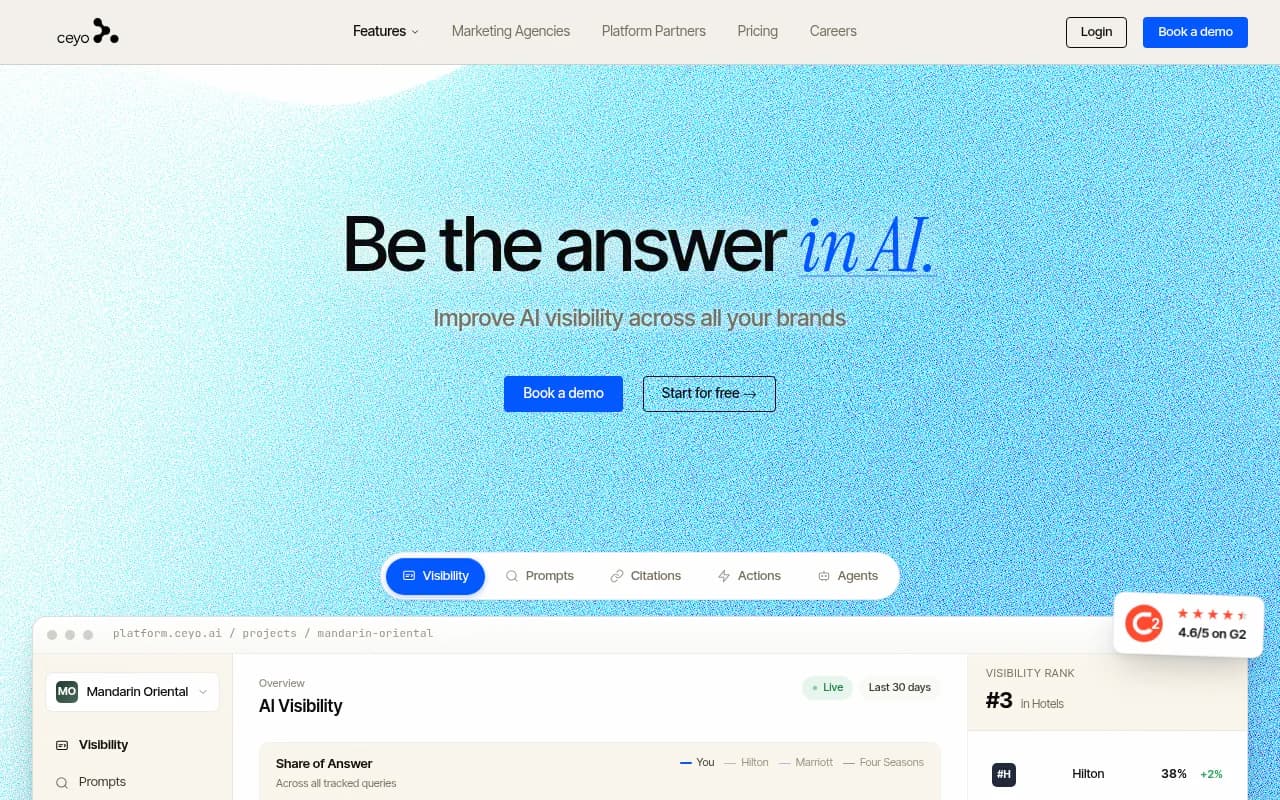
Ceyo.ai launched into a crowded GEO market and managed to carve out a real position. It's not vaporware. The platform has 1,200+ brands live, a 4.6/5 rating on G2, and agency partners like Havas and Traffic Builders using it at scale. That's worth acknowledging before we get into the gaps.
But "good enough for some teams" and "right for your team" are different questions. If you're evaluating Ceyo or wondering why colleagues are quietly shopping for alternatives, this guide breaks down both sides honestly.
What Ceyo actually gets right
Share-of-answer tracking that goes beyond mention counts
Most early GEO tools counted mentions. Ceyo tracks share of answer -- the percentage of AI responses where your brand appears, across specific prompts and models. That's a more useful metric. Knowing you're mentioned 40 times tells you nothing; knowing you hold 24% share for "best luxury hotel Tokyo" across ChatGPT and Gemini tells you something you can act on.
The competitor visibility view is genuinely good. You can see ranked positions per query per model, watch share shift week over week, and identify which competitors are gaining ground and why. For brand and category tracking, this is where Ceyo is strongest.
Autonomous agents that actually ship fixes
This is Ceyo's most distinctive feature. Most GEO platforms give you a list of recommendations and leave you to implement them. Ceyo's agents -- Schema Agent, Crawl Agent, Content Agent, FAQ Agent -- can execute fixes autonomously. Schema errors, robots.txt issues, missing FAQ markup: the platform can fix these without someone manually touching the CMS.
That's a real operational advantage for agencies managing dozens of brands. The "actions" queue shows AI-prioritized fixes with status tracking, so you know what's been addressed and what's pending.
Prompt tracking across branded, category, and comparison queries
Ceyo tracks three prompt types: branded (your brand name), category ("best hotel in Tokyo"), and comparison ("Marriott vs Hilton"). That coverage matters because AI search behavior spans all three, and your visibility in each tells a different story. A brand that dominates branded queries but disappears in category prompts has a real problem that mention-count tools would miss entirely.
Reasonable entry pricing for agencies
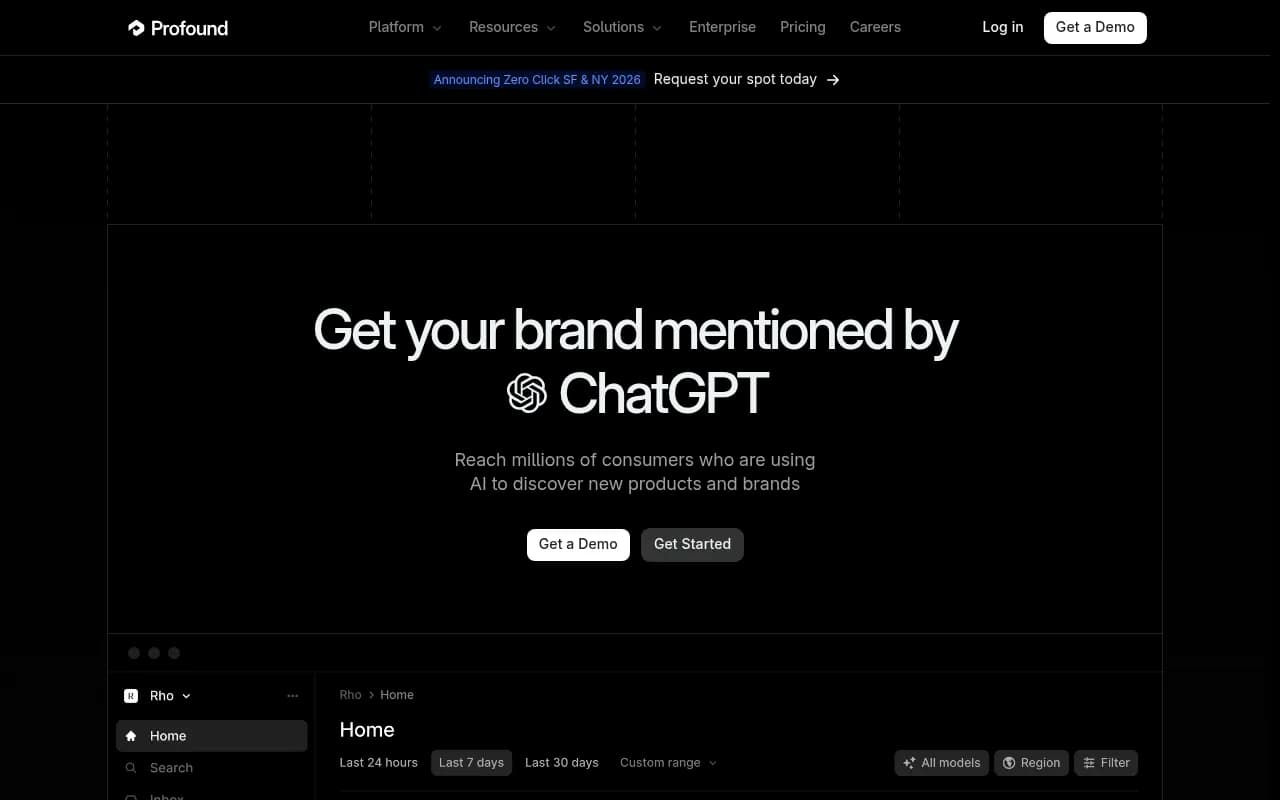
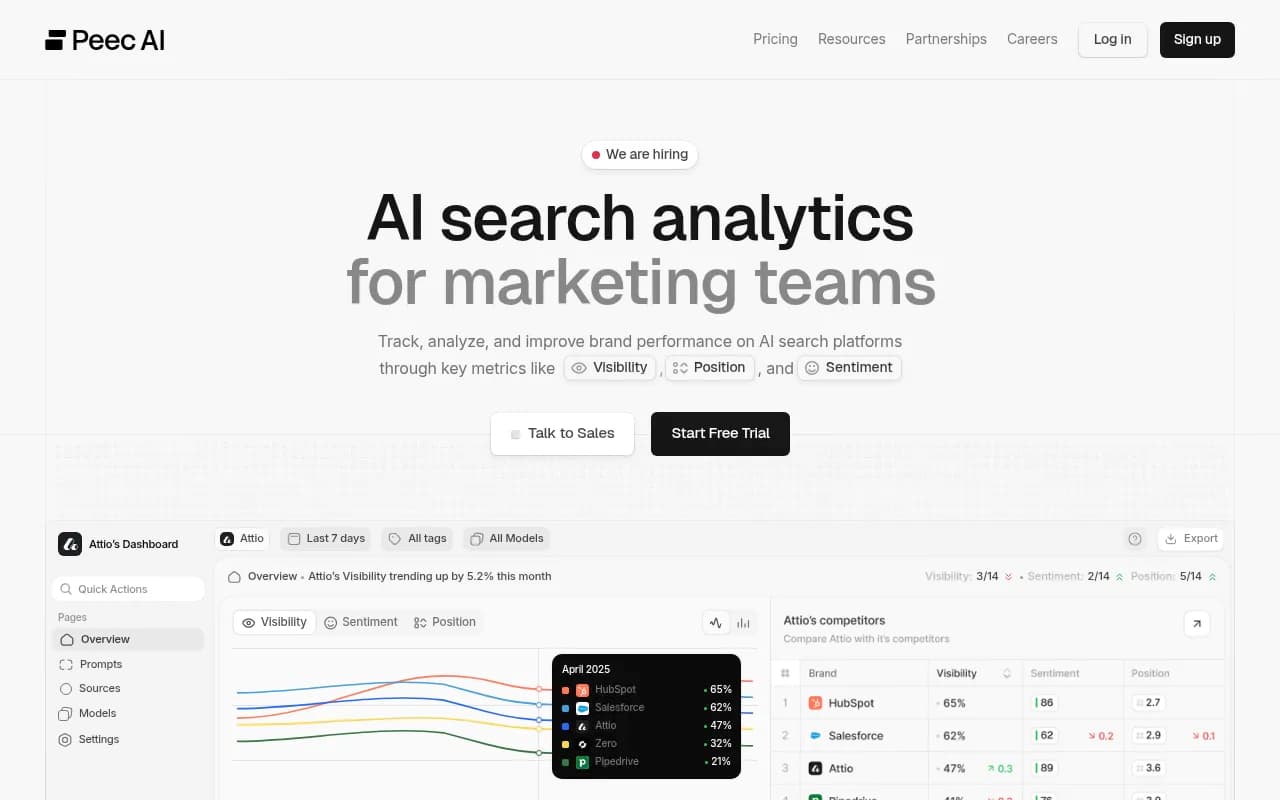
At $89/month, Ceyo is accessible for small agencies and in-house teams who can't justify enterprise GEO pricing. Compared to Profound's custom pricing (reportedly $400+/month) or Peec's $149-$299 range, the entry point is genuinely competitive. For teams just getting started with AI visibility, the price-to-feature ratio is decent.
Citation source analysis
Ceyo shows which sources AI models trust when citing your brand -- owned pages, Forbes, TripAdvisor, Reddit threads, and so on. Knowing that 34% of your citations come from your own site and 21% from Forbes is useful for prioritizing where to invest content and PR efforts.
The 7 gaps that send teams looking elsewhere
Gap 1: Prompt volume and difficulty data is thin
Knowing which prompts you're visible for is step one. Knowing which prompts are worth targeting -- how often real users ask them, how competitive they are -- is step two. Ceyo shows you visibility data but doesn't give you meaningful volume estimates or difficulty scores for individual prompts.
This matters because not all prompts are equal. A prompt with 50,000 monthly searches in AI engines is worth fighting for; one with 200 isn't. Without that prioritization layer, teams end up optimizing for prompts that don't move the needle.
Platforms like Promptwatch include prompt volume estimates and difficulty scoring, which lets teams rank their optimization efforts by expected impact rather than guessing.

Gap 2: No Reddit or YouTube tracking
AI models don't just cite brand websites. They cite Reddit threads, YouTube videos, forum discussions, and third-party review content heavily. If you don't know which Reddit discussions are shaping how ChatGPT describes your brand, you're missing a significant chunk of the citation picture.
Ceyo's citation analysis covers owned and major publisher sources, but Reddit and YouTube tracking aren't part of the platform. For brands in consumer categories where community content drives AI citations, this is a real blind spot.
Gap 3: Content generation is absent
Ceyo identifies what's broken and can fix technical issues autonomously. What it doesn't do is help you create the content that would make AI models cite you more. There's no built-in writing agent, no answer gap analysis that shows you which topics competitors are visible for but you aren't, and no content briefs grounded in citation data.
This matters because technical fixes have a ceiling. You can fix every schema error and crawlability issue and still lose to a competitor who publishes better-structured answers to the questions AI models are fielding. The content gap is where a lot of AI visibility battles are actually won.
If content generation is a priority, platforms with built-in AI writing agents -- trained on citation data rather than generic SEO signals -- fill this gap more directly.
Gap 4: Traffic attribution is limited
Proving that AI visibility improvements translate to actual traffic and revenue is the hardest problem in GEO right now. Ceyo tracks AI crawler activity (84k+ AI agent requests per month in their demo data), but connecting that to actual visitor sessions, conversions, and revenue is not a core part of the platform.
For teams that need to justify GEO investment to finance or leadership, "our share of answer went from 24% to 31%" is a hard sell without a revenue number attached. Traffic attribution -- through a code snippet, server log analysis, or analytics integration -- is where the business case gets made.
Gap 5: Multi-site and multi-brand support at scale
Ceyo's pricing tiers aren't fully public, but the platform is positioned primarily around single-brand or small-portfolio use cases at entry pricing. Agencies managing 50+ brands need robust multi-site infrastructure: separate dashboards per client, white-label reporting, bulk prompt management, and consolidated billing.
Several teams report that Ceyo works well for managing a handful of brands but gets unwieldy at agency scale without moving to custom enterprise pricing. For larger agencies, this creates a cost structure problem.
Search Party
Gap 6: Query fan-out and sub-query analysis
A single user prompt like "best project management tool for remote teams" branches into dozens of sub-queries that AI models process internally before generating a response. Understanding this fan-out -- which sub-topics the model explores, which sources it consults for each -- helps you understand why you're cited or not cited.
Ceyo tracks the top-level prompt but doesn't surface the sub-query structure. This means you can see that you're not appearing for a prompt, but you can't easily diagnose which specific sub-topic or angle is causing the gap.
Gap 7: LLM coverage gaps in some models
Ceyo covers the major models -- ChatGPT, Gemini, Perplexity -- but coverage of newer or regional models (DeepSeek, Grok, Mistral, Meta AI) varies. For brands operating in markets where these models have meaningful user bases, incomplete coverage means incomplete visibility data.
This is a moving target across all GEO platforms, but it's worth checking current model coverage against your actual audience's AI usage patterns before committing.
How Ceyo compares to the main alternatives
The GEO platform market has fragmented into roughly three categories: monitoring-only tools, monitoring-plus-recommendations tools, and full action-loop platforms. Ceyo sits in the second category -- it monitors and recommends, and its agents execute some fixes, but it doesn't close the full loop from gap identification to content creation to revenue attribution.
| Feature | Ceyo | Promptwatch | Profound | Peec | Otterly.AI |
|---|---|---|---|---|---|
| Share-of-answer tracking | Yes | Yes | Mentions only | Mentions only | Basic |
| Prompt volume/difficulty | No | Yes | No | No | No |
| Reddit/YouTube tracking | No | Yes | No | No | No |
| Content generation | No | Yes | No | No | No |
| Traffic attribution | Limited | Yes | No | No | No |
| Autonomous fix agents | Yes | No | No | No | No |
| AI crawler logs | Yes | Yes | No | No | No |
| Query fan-out analysis | No | Yes | No | No | No |
| ChatGPT Shopping tracking | No | Yes | No | No | No |
| Entry pricing | ~$89/mo | $99/mo | $400+/mo | $149/mo | Lower |
| Multi-model coverage | Major LLMs | 10+ models | Major LLMs | ChatGPT, Gemini | Limited |

When Ceyo is the right call
Ceyo makes sense if your primary need is automated technical remediation. The autonomous agents are genuinely differentiated -- no other platform at this price point ships schema fixes, crawl fixes, and FAQ updates without manual implementation. If you have a technically complex site with recurring schema drift or crawlability issues, Ceyo's agent layer saves real engineering time.
It also works well for teams that want a clean share-of-answer view without needing to build content or run attribution analysis. Brand monitoring at the category and competitor level is solid.
When to look elsewhere
If you need to prioritize which prompts to target (volume and difficulty data), understand why you're not being cited (sub-query analysis, Reddit/YouTube sources), create content that gets cited (AI writing agents grounded in citation data), or prove revenue impact (traffic attribution), Ceyo's current feature set leaves gaps that matter.
For teams that need the full loop -- find gaps, create content, track results -- Promptwatch covers all three stages in one platform, including prompt volume scoring, an AI writing agent trained on 880M+ citations, and traffic attribution through GSC integration or server log analysis.

Practical advice for teams evaluating Ceyo
Run a free trial and specifically test these three things:
First, pull up your top 10 target prompts and check whether Ceyo gives you any volume or difficulty signal. If the answer is no, you'll need a separate tool or manual research to prioritize your optimization work.
Second, check citation sources for two or three prompts where you're underperforming. If Reddit or YouTube content is showing up in the citations and Ceyo isn't surfacing it, you have a visibility gap in your gap analysis.
Third, ask the sales team directly about traffic attribution. How do they connect AI visibility improvements to actual sessions and conversions? The answer will tell you a lot about whether the platform fits your reporting needs.
Ceyo is a real product with real strengths. The autonomous agents are worth taking seriously, and the share-of-answer tracking is among the better implementations in the market. But the gaps above are genuine, and teams with content-heavy optimization needs or complex attribution requirements will likely find themselves stitching together additional tools to fill them.
The GEO platform market is moving fast. What's missing from Ceyo today may ship in six months. But in 2026, the decision comes down to whether you need a platform that fixes what's broken technically, or one that helps you build the content and prove the revenue impact that makes AI visibility a board-level conversation.