Key takeaways
- Most AI brand monitoring tools stop at tracking. They show you where you're invisible but don't help you fix it.
- Scrunch and Brandlight.ai are solid monitoring dashboards with good coverage, but both lean heavily toward reporting rather than optimization.
- Ceyo.ai is a newer entrant with a narrower feature set -- useful for specific use cases but not a full-stack solution.
- Promptwatch is the only platform in this comparison that closes the full loop: find gaps, generate content, track results -- across 10+ AI models with crawler logs, prompt intelligence, and built-in content creation.
The AI search monitoring category has exploded. In 2024, there were maybe a handful of tools worth considering. By mid-2026, there are dozens -- and most of them look nearly identical from the outside. Dashboard. Brand mentions. Competitor comparison. Sentiment score. Done.
But what you actually need depends on what you're trying to accomplish. Are you just reporting on AI visibility to a client or stakeholder? Or are you trying to improve it? That distinction separates the tools in this comparison more than any feature list.
Let's go through each platform honestly.
What we're actually comparing
Before the breakdown: this isn't a feature-by-feature spec sheet. The question we're asking for each tool is simpler -- what does it actually help you do? Monitoring is table stakes. The interesting question is what happens after you see the data.
Here's a quick overview before we go deep:
| Platform | Core strength | Content generation | Crawler logs | Prompt intelligence | Best for |
|---|---|---|---|---|---|
| Ceyo.ai | Brand mention tracking | No | No | Limited | Small teams, quick setup |
| Scrunch | Broad AI engine coverage | No | No | Basic | Agencies needing clean reporting |
| Brandlight.ai | Sentiment + brand monitoring | No | No | Limited | Brand teams focused on perception |
| Promptwatch | Full optimization loop | Yes (built-in AI writer) | Yes | Yes (volume + difficulty) | Teams that want to actually improve visibility |
Ceyo.ai
Ceyo.ai is a relatively new entrant in the AI visibility space. It positions itself as a lightweight brand monitoring tool -- track your brand mentions across AI responses, see how competitors appear, get alerts when things change.
The setup is fast, which is genuinely useful. You're not spending a week configuring prompt lists before you see any data. For small marketing teams or solo practitioners who just need a quick read on "are we showing up in ChatGPT and Perplexity?", Ceyo.ai gets you there without much friction.
Where it runs into limits: the platform doesn't go particularly deep on any single dimension. Prompt coverage is narrower than Scrunch or Promptwatch. There's no content generation, no crawler log analysis, no traffic attribution. You get a monitoring view, and then you're on your own to figure out what to do with it.
Pricing isn't prominently displayed, which is a minor frustration -- you need to contact them for most plan details.
Verdict: A reasonable starting point if you're new to AI visibility tracking and want something quick to set up. Not the right tool if you're trying to move the needle.
Scrunch
Scrunch has been around long enough to build a real product. It covers a solid range of AI engines -- ChatGPT, Perplexity, Claude, Google AI Overviews among them -- and the dashboard is genuinely well-designed for stakeholder reporting. Week-over-week visibility trends, competitor share of voice, prompt-level breakdowns. It does that stuff well.
One thing Scrunch does better than most: it makes the data legible to non-technical stakeholders. If you're an agency running monthly reports for clients, Scrunch gives you something you can actually put in a slide deck without a lot of manual work.
The limitation that comes up repeatedly in practitioner discussions is that Scrunch is stronger at showing you what's happening than at telling you what to do about it. You can see that a competitor is appearing for prompts you're missing. You can't generate content to close that gap from within the platform. You can't see which of your pages AI crawlers are actually reading. The monitoring is solid; the optimization layer isn't there.
Pricing starts around $300/month for entry plans, scaling from there. That's not unreasonable for agency use, but it's worth knowing what you're getting -- a monitoring tool, not an optimization platform.
Verdict: One of the better pure monitoring tools in the category. Good for agencies that need clean, consistent reporting. Less useful if your goal is to actively improve your AI search presence.
Brandlight.ai
Brandlight.ai takes a slightly different angle. Where Scrunch focuses on prompt-level visibility tracking, Brandlight leans more into brand perception -- how your brand is described and positioned in AI responses, not just whether you appear.
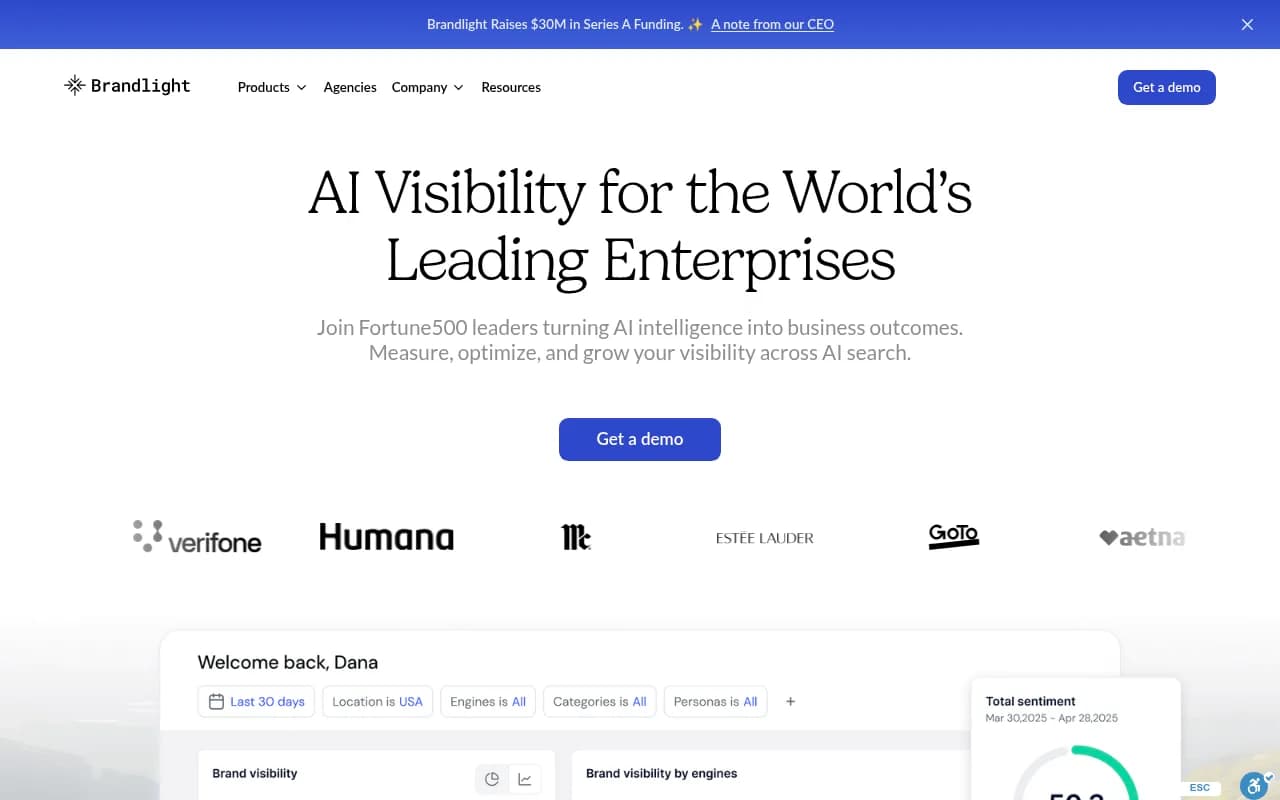
That's a genuinely useful distinction. Showing up in an AI response is one thing. Being described accurately, positively, and in a way that matches your positioning is another. Brandlight.ai gives you more visibility into the sentiment and framing of AI-generated mentions, which matters for brand teams who care about reputation as much as reach.
The platform covers the major AI engines and offers competitor comparison. The reporting is clean. For brand managers who are more concerned with how their brand is portrayed than with raw citation counts, Brandlight.ai has a clearer use case than some of the more SEO-focused tools.
What it doesn't do: content optimization, crawler analysis, traffic attribution, or anything that helps you actively change what AI models say about you. Like Scrunch, it's a monitoring and reporting tool. The data is useful; the action layer is missing.
Pricing is available on request for most tiers, which is a pattern in this category that's worth noting -- it often signals enterprise-oriented pricing.
Verdict: Worth considering if brand sentiment and perception in AI responses is your primary concern. Less suited to teams trying to build or improve their AI search presence from scratch.
Promptwatch
Promptwatch is the platform that most directly answers the question "okay, but what do I do about it?"
Promptwatch monitors across 10 AI models -- ChatGPT, Claude, Perplexity, Gemini, Google AI Overviews, Google AI Mode, Grok, DeepSeek, Meta AI, Mistral, and Copilot -- which is broader coverage than any of the other three tools in this comparison. But coverage isn't the main differentiator.

The core difference is what happens after you see the data. Promptwatch is built around a three-step loop:
Step 1: Find the gaps. The Answer Gap Analysis shows you exactly which prompts competitors are appearing for that you're not. Not just "you're missing some prompts" -- it shows you the specific questions and topics where AI models have nothing to cite from your site. That's actionable in a way that a visibility score isn't.
Step 2: Create content that gets cited. There's a built-in AI writing agent that generates articles, comparisons, and listicles grounded in actual citation data (Promptwatch has processed over 880 million citations). The content it produces is engineered to match what AI models actually cite -- not generic SEO filler. This is the piece that Scrunch, Brandlight.ai, and Ceyo.ai all lack entirely.
Step 3: Track the results. Page-level tracking shows which specific pages are being cited, by which models, and how often. Traffic attribution connects that visibility to actual revenue through a code snippet, Google Search Console integration, or server log analysis.
Beyond the core loop, Promptwatch has a few capabilities that stand out in this comparison:
- AI Crawler Logs: real-time logs of when ChatGPT, Claude, Perplexity, and others crawl your site, which pages they read, and what errors they hit. None of the other three tools offer this.
- Prompt Intelligence: volume estimates and difficulty scores for each prompt, plus query fan-outs that show how one prompt branches into sub-queries. This helps you prioritize instead of guessing.
- Reddit and YouTube tracking: surfaces discussions that directly influence AI recommendations. Most tools ignore these channels entirely.
- ChatGPT Shopping tracking: monitors when your brand appears in ChatGPT's product recommendations and shopping carousels.
Pricing is transparent: Essential at $99/month (1 site, 50 prompts, 5 articles), Professional at $249/month (2 sites, 150 prompts, 15 articles, crawler logs), Business at $579/month (5 sites, 350 prompts, 30 articles). A free trial is available.
Verdict: The only platform in this comparison that helps you improve your AI visibility, not just measure it. If you're serious about GEO and AI search optimization, this is where the category is actually going.
How to choose
The honest answer is that the right tool depends on what you're trying to accomplish.
If you're a brand manager who needs to report on AI visibility to leadership and wants clean, presentable data, Scrunch or Brandlight.ai will serve you well. Scrunch is better for prompt-level tracking and agency reporting; Brandlight.ai is better if brand sentiment and perception are your primary concern.
If you're just getting started and want something lightweight to get a baseline read on where you stand, Ceyo.ai is a low-friction option -- though you'll likely outgrow it quickly.
If you're trying to actually improve your AI search visibility -- build content that gets cited, close competitive gaps, understand how AI crawlers interact with your site -- Promptwatch is the only tool in this group that does that. The others will tell you there's a problem. Promptwatch helps you fix it.
A note on the category overall
The AI visibility monitoring space is maturing fast, but there's still a meaningful gap between tools that monitor and tools that optimize. Most of the 30+ platforms that have launched in this space since 2024 are monitoring dashboards. They're useful for understanding where you stand. They're not useful for changing where you stand.
That gap matters more as AI search becomes a larger share of how people discover brands. If 60% of searches are ending without a click and AI-generated answers are the primary interface between your brand and your potential customers, "we're tracking it" isn't enough. You need to be able to act on what you're tracking.
The tools that will matter in 2027 are the ones that close that loop today.