Summary
- API access and custom reporting are essential for agencies, enterprises, and technical teams that need to integrate AI visibility data into existing workflows, dashboards, or client reporting systems
- Promptwatch leads the category with a full API, Looker Studio integration, and the ability to export raw citation data -- plus it's the only platform that combines monitoring with content gap analysis and AI content generation
- Profound, Conductor, and Semrush offer API access at higher price points, while most monitoring-only tools (Otterly.AI, Peec AI, AthenaHQ) lack APIs entirely
- When evaluating platforms, prioritize those that expose granular data (page-level citations, prompt volumes, competitor metrics) rather than just aggregated scores
- The best platforms for custom reporting are those that treat data as a product: clean exports, documented endpoints, and flexible query parameters
Why API access and custom reporting matter for AI visibility
Most AI visibility platforms show you a dashboard. You log in, see some charts, maybe export a PDF. That's fine if you're a solo marketer checking in once a week. But if you're an agency managing 20 clients, an enterprise with multiple brands, or a technical team that wants to pipe AI visibility data into your existing BI stack, you need more.
API access means you can pull data programmatically -- citation counts, prompt volumes, competitor rankings, page-level metrics -- and feed it into your own systems. Custom reporting means you can build dashboards that match your workflow, not the vendor's assumptions about what matters. You can combine AI visibility data with traffic analytics, revenue attribution, or content performance in a single view.
The problem: most AI visibility tools don't offer APIs. They're built as standalone dashboards, not data platforms. The ones that do offer APIs often gate them behind enterprise pricing or limit what you can query. This section breaks down which platforms actually deliver on API access and flexible reporting, and what you can (and can't) do with each.
What to look for in an AI visibility platform with API access
Not all APIs are created equal. Some platforms call it an "API" but only let you pull a daily summary score. Others expose every data point but require custom contracts. Here's what separates the useful APIs from the marketing fluff:
Granular data access: Can you query individual prompts, page-level citations, competitor mentions, and source URLs? Or just a single "visibility score"?
Flexible endpoints: Can you filter by date range, AI model, geography, or persona? Can you pull raw response text or just aggregated metrics?
Rate limits and quotas: Is the API throttled to a few requests per hour, or can you pull bulk data for analysis?
Documentation quality: Are the endpoints documented with examples, or do you need to reverse-engineer the internal API the dashboard uses?
Export formats: Can you get JSON, CSV, or direct integrations with BI tools like Looker Studio, Tableau, or Power BI?
Webhook support: Can the platform push updates to your systems when new citations appear, or do you have to poll constantly?
The platforms below are ranked by how well they meet these criteria.
Best AI visibility platforms with API and custom reporting
Promptwatch: Full API + Looker Studio integration + content generation
Promptwatch is the only AI visibility platform that combines monitoring, optimization, and content generation in a single tool -- and it's one of the few that offers a full API with granular data access.

What makes Promptwatch different: most competitors stop at showing you where you're invisible. Promptwatch shows you the gaps, then helps you fix them. The Answer Gap Analysis feature identifies prompts where competitors are cited but you're not, surfaces the specific content angles your site is missing, and feeds that directly into an AI writing agent that generates articles grounded in real citation data (880M+ citations analyzed). You're not guessing what to write -- you're creating content engineered to get cited by ChatGPT, Claude, and Perplexity.
The API exposes everything: page-level citations, prompt volumes, difficulty scores, competitor rankings, query fan-outs (how one prompt branches into sub-queries), and even raw crawler logs showing when AI models hit your site. You can pull this data into your own dashboards or use the built-in Looker Studio integration to create custom reports that combine AI visibility with GSC traffic data or revenue attribution.
Unique capabilities:
- AI Crawler Logs: Real-time logs of ChatGPT, Claude, Perplexity, and other AI crawlers hitting your website -- which pages they read, errors they encounter, how often they return. Most competitors don't track this at all.
- Reddit & YouTube Insights: Surface discussions and videos that directly influence AI recommendations -- a channel most tools ignore.
- ChatGPT Shopping Tracking: Monitor when your brand appears in ChatGPT's product recommendations and shopping carousels.
- Multi-language & Multi-region: Track AI responses in any language, from any country, with customizable personas.
Pricing: Essential $99/mo (1 site, 50 prompts, 5 articles), Professional $249/mo (2 sites, 150 prompts, 15 articles, crawler logs), Business $579/mo (5 sites, 350 prompts, 30 articles). Agency and enterprise plans available. Free trial included.
Best for: Agencies, technical teams, and brands that want to close the loop from visibility tracking to content creation to traffic attribution. If you need an API that exposes raw data and a platform that helps you act on it, Promptwatch is the top choice.
Profound: Enterprise API with 400M+ prompt insights
Profound positions itself as the enterprise solution for AI visibility, with an API that exposes prompt volumes, answer engine insights, and agent analytics. The platform tracks 10+ AI engines and claims 400M+ prompt insights in its dataset.
The API is available on enterprise plans (pricing not public). Profound's strength is granular analytics -- you can drill into specific prompts, see which competitors are winning, and track how your visibility changes over time. The platform also offers Agency Mode with brand configurations and pitch environments, which is useful if you're managing multiple clients.
What's missing: Profound is monitoring-focused. It shows you where you're invisible but doesn't help you create content to fix it. There's no built-in content generation, no Reddit tracking, no ChatGPT Shopping monitoring. You're paying for visibility data, not optimization tools.
Best for: Enterprises with technical teams that want to build custom dashboards on top of a large prompt dataset. Not ideal if you need an all-in-one solution that includes content creation.
Conductor: Enterprise AEO platform with API access
Conductor is a legacy SEO platform that added AI visibility tracking (they call it AEO -- Answer Engine Optimization). The API is available on enterprise plans and integrates with their broader SEO dataset.
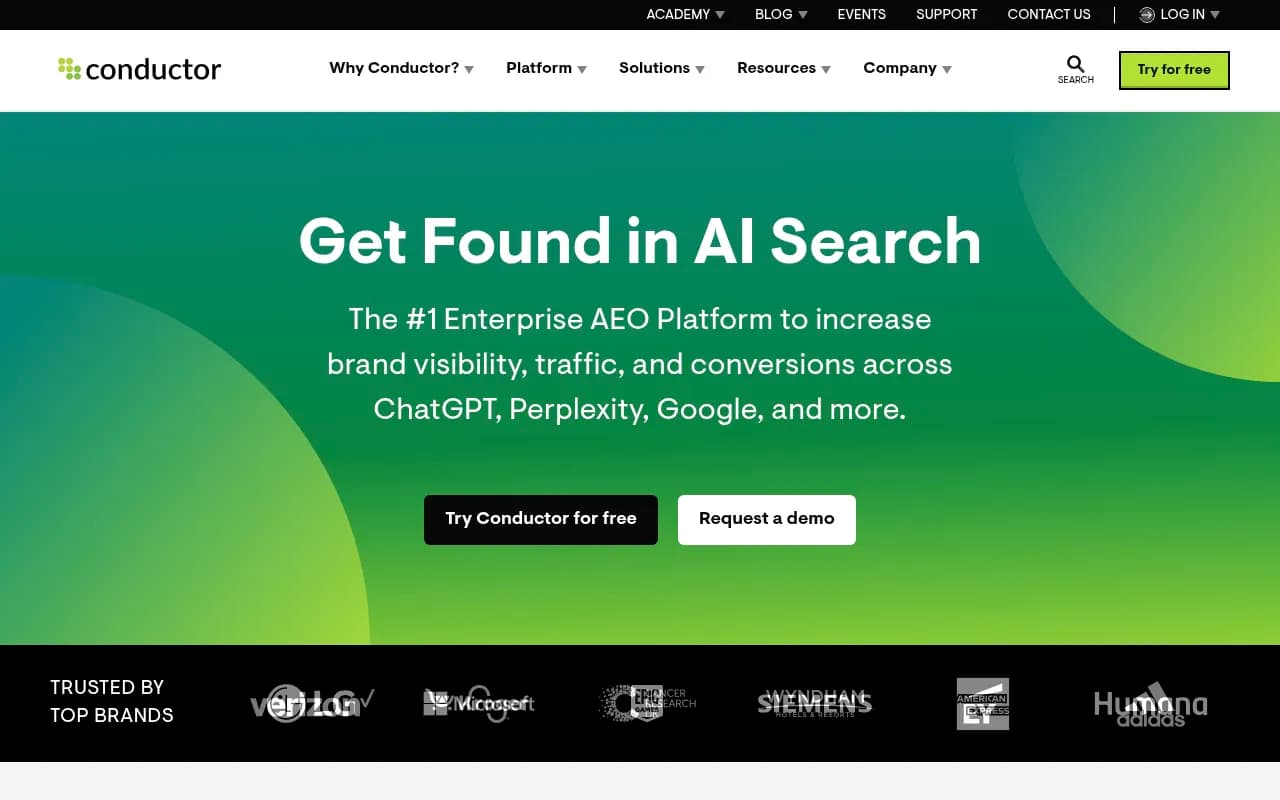
Conductor's advantage is that you're not just getting AI visibility data -- you're getting it alongside traditional SEO metrics, keyword rankings, and content performance. If you're already a Conductor customer, the API makes it easy to combine AI and SEO reporting in one place.
The downside: Conductor is expensive (enterprise pricing starts around $3,000/mo) and the AI visibility features feel bolted on rather than native. The platform tracks fewer AI models than Promptwatch or Profound, and there's no content generation or crawler log tracking.
Best for: Large enterprises already using Conductor for SEO that want to add AI visibility tracking without switching platforms.
Semrush: AI Overviews tracking with limited API
Semrush added AI Overviews tracking to its platform in 2025. The API is available to existing Semrush customers and lets you pull data on which keywords trigger AI Overviews and whether your pages are cited.
The problem: Semrush only tracks Google AI Overviews. It doesn't monitor ChatGPT, Claude, Perplexity, or other LLMs. The API is also limited to pre-defined keyword sets -- you can't query arbitrary prompts or track custom personas. If you're already paying for Semrush and only care about Google, it's a convenient add-on. But it's not a full AI visibility solution.
Best for: Existing Semrush customers who want basic AI Overviews tracking without adding another tool.
Scrunch: API access with Reddit and YouTube tracking
Scrunch is a newer AI visibility platform that tracks ChatGPT, Claude, Perplexity, and Google AI Overviews. The platform offers API access on its higher-tier plans and includes Reddit and YouTube tracking -- a feature most competitors lack.
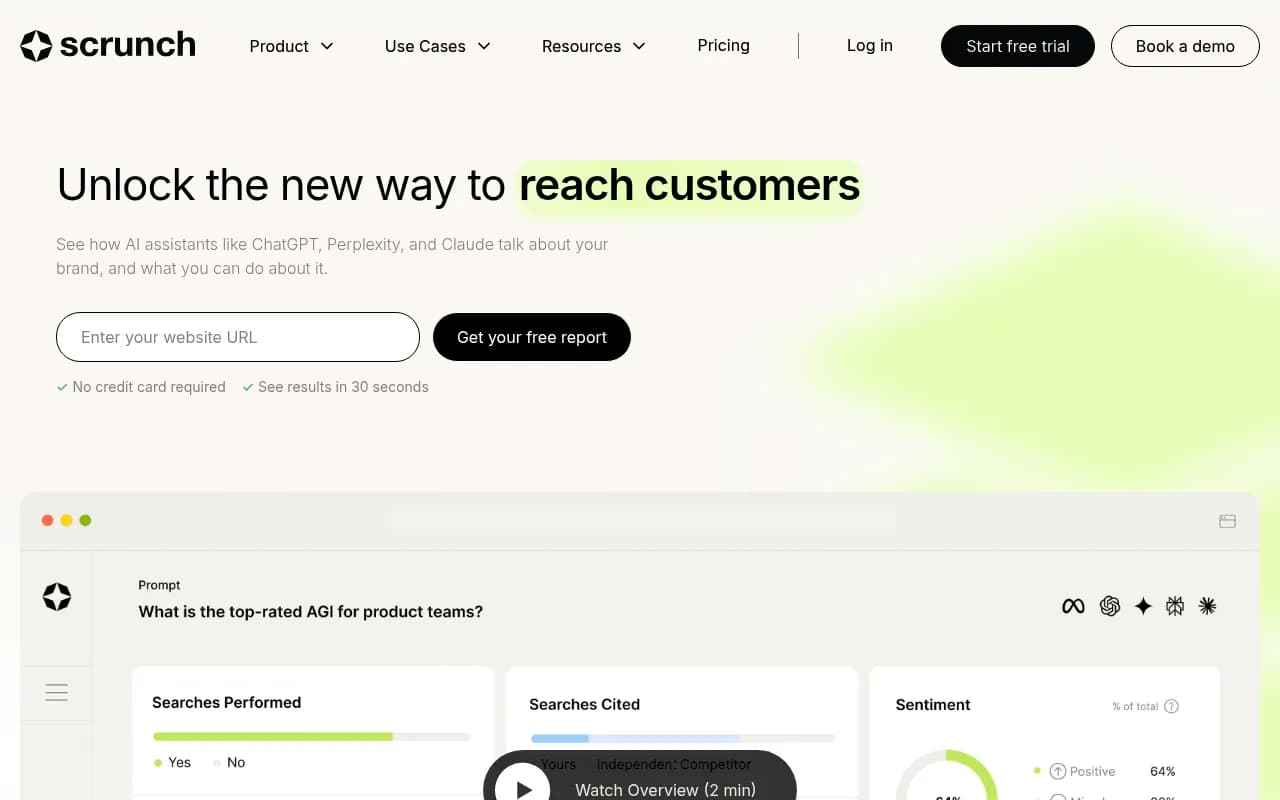
Scrunch's API exposes citation data, source URLs, and competitor mentions. The Reddit and YouTube tracking is useful for understanding which discussions and videos influence AI recommendations. However, Scrunch is monitoring-only -- there's no content generation, no crawler logs, and no traffic attribution.
Pricing is not public but reportedly starts around $500/mo for API access.
Best for: Teams that want Reddit and YouTube insights alongside AI visibility tracking and need API access for custom reporting.
SE Visible (SE Ranking): Affordable API with strategic view
SE Visible is SE Ranking's AI visibility tool. It tracks brand mentions across ChatGPT, Perplexity, Claude, and Google AI Overviews, with API access available on paid plans.
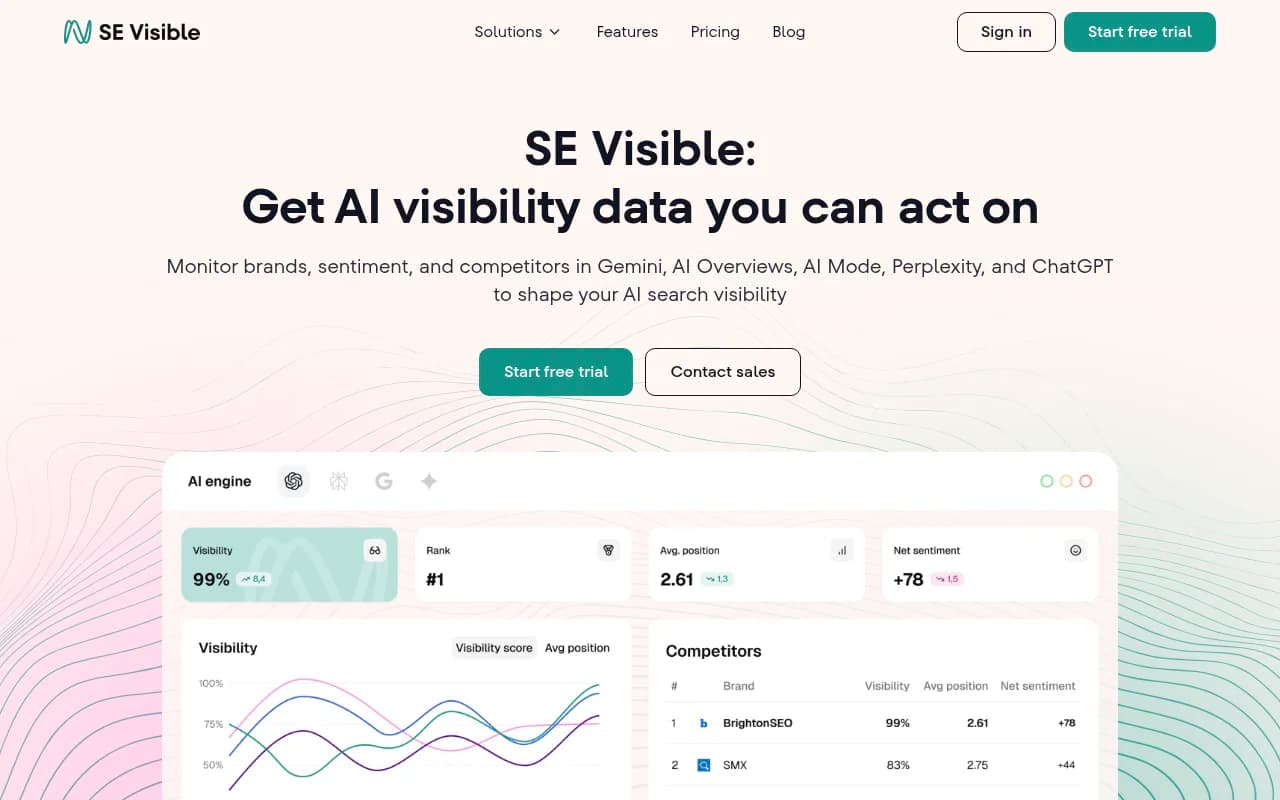
The API is straightforward: you can pull citation counts, sentiment analysis, and competitor benchmarks. SE Visible is one of the more affordable options with API access (plans start around $200/mo), but the feature set is basic. There's no content generation, no crawler logs, no Reddit tracking.
Best for: Small teams that need API access on a budget and only require basic citation tracking.
Platforms without API access (but worth mentioning)
Several popular AI visibility tools don't offer APIs at all. If API access is a hard requirement, skip these:
- Otterly.AI: Affordable monitoring tool ($99/mo) but no API, no custom exports beyond CSV
- Peec AI: Multi-language tracking but no API access
- AthenaHQ: Tracks 8+ AI search engines but no API or custom reporting
- Search Party: Agency-focused but no API access
- Ahrefs Brand Radar: Fixed prompts, no API, limited export options
Comparison table: API features across platforms
| Platform | API Access | Granular Data | BI Integrations | Webhook Support | Starting Price |
|---|---|---|---|---|---|
| Promptwatch | Yes | Page-level citations, prompt volumes, crawler logs | Looker Studio | No | $99/mo |
| Profound | Yes (enterprise) | Prompt insights, agent analytics | Custom | No | Custom |
| Conductor | Yes (enterprise) | Combined SEO + AI visibility | Custom | No | ~$3,000/mo |
| Semrush | Limited | AI Overviews only, keyword-based | Semrush dashboards | No | Included |
| Scrunch | Yes | Citations, Reddit, YouTube | CSV export | No | ~$500/mo |
| SE Visible | Yes | Citation counts, sentiment | CSV export | No | ~$200/mo |
| Otterly.AI | No | N/A | CSV only | No | $99/mo |
| Peec AI | No | N/A | CSV only | No | Custom |
How to evaluate an AI visibility API before committing
Before you sign a contract, test the API with these questions:
-
Can you query individual prompts? Ask for a sample API response showing citation data for a specific prompt. If they only return aggregated scores, the API is too limited.
-
What's the rate limit? If you're tracking 500 prompts across 5 brands, can you pull all that data daily without hitting throttles?
-
Can you filter by AI model? You should be able to query "show me citations from ChatGPT only" or "compare Claude vs Perplexity."
-
Is historical data available? Can you pull data from 3 months ago, or only the latest snapshot?
-
What's the export format? JSON is ideal for programmatic access. CSV works for one-off reports. PDF is useless.
-
Do they charge per API call? Some platforms meter API usage separately from dashboard access. Clarify pricing upfront.
-
Is the documentation public? If they won't share API docs before you sign, assume the API is incomplete or poorly maintained.
Custom reporting workflows: What's actually possible
Once you have API access, here's what technical teams are building:
Agency client dashboards: Pull citation data for 20+ clients into a single Looker Studio or Tableau dashboard. Show each client their visibility score, top-cited pages, and competitor benchmarks -- all branded with your agency's design.
Revenue attribution models: Combine AI visibility data with traffic analytics (GSC, server logs) to show which prompts drive actual visitors and conversions. Promptwatch's traffic attribution feature does this natively, but you can also build it yourself with API data.
Content gap alerts: Set up a daily script that queries the API for prompts where competitors are cited but you're not. Feed those gaps directly into your content team's workflow.
Crawler health monitoring: Track AI crawler logs (available in Promptwatch) to see when ChatGPT or Claude stop visiting your site. Alert your dev team if crawlers hit errors or get blocked.
Multi-brand rollups: If you manage multiple brands, aggregate visibility scores across all properties into a single executive dashboard. Show which brands are winning in AI search and which need attention.
Prompt performance forecasting: Pull historical prompt volume data and build predictive models to identify which prompts are growing in popularity. Prioritize content creation around high-growth, low-competition prompts.
The reality check: Most teams don't need an API
Here's the uncomfortable truth: if you're a solo marketer or a small team, you probably don't need API access. The built-in dashboards in tools like Promptwatch, Profound, or Otterly.AI are sufficient for 90% of use cases. You can export CSVs, screenshot charts for reports, and manually check in weekly.
APIs matter when:
- You're an agency managing 10+ clients and need automated reporting
- You're an enterprise with multiple brands and want a unified dashboard
- You have a technical team that wants to build custom workflows
- You need to combine AI visibility data with other datasets (traffic, revenue, CRM)
If none of those apply, save the money and use a simpler tool. API access often doubles the price.
Final recommendation: Start with Promptwatch
If you need API access and custom reporting for AI visibility, start with Promptwatch. It's the only platform that combines monitoring, optimization, and content generation in one tool, with a full API and Looker Studio integration at a price point that makes sense for agencies and mid-market teams.
For enterprises with bigger budgets and a need for 400M+ prompt insights, Profound is a strong alternative. For teams already using Conductor or Semrush, their AI visibility add-ons are convenient but limited.
Avoid monitoring-only tools (Otterly.AI, Peec AI, AthenaHQ) if API access is a requirement -- they don't offer it, and even if they did, you'd still need a separate tool to act on the data.
The best AI visibility platform is the one that shows you the gaps and helps you fix them. Most competitors stop at step one. Promptwatch closes the loop.