Key takeaways
- By the end of 2025, four platforms dominated the AI visibility conversation: Promptwatch, Profound, Peec AI, and Otterly.AI -- each with a genuinely different philosophy about what "AI visibility" means.
- Monitoring alone turned out to be a weak value proposition. The platforms that gained the most ground were the ones that helped users do something with the data.
- Profound earned its enterprise reputation but came with a price tag to match. Otterly.AI stayed cheap and useful for small teams. Peec AI carved out a niche in multilingual markets. Promptwatch was the only one that closed the loop from tracking to content creation to traffic attribution.
- If you're evaluating platforms in 2026, the 2025 landscape is worth understanding -- the category moved fast, and a lot of the early assumptions about what these tools should do turned out to be wrong.
The AI visibility category barely existed at the start of 2024. By the end of 2025, it had exploded into a crowded, confusing market with dozens of tools all claiming to tell you how your brand appears in ChatGPT, Perplexity, Claude, and Gemini responses.
Most of them were monitoring dashboards. Some were genuinely useful. A few were solving the wrong problem entirely.
This is a retrospective on the four platforms that got the most attention in 2025 -- Promptwatch, Profound, Peec AI, and Otterly.AI -- what each one actually delivered, and what the competitive dynamics looked like by the time the year closed out.
Why 2025 was the year AI visibility became a real discipline
Before getting into the platforms themselves, it's worth acknowledging why this category mattered so much in 2025 specifically.
Google's AI Overviews rolled out to a much wider audience. ChatGPT's user base kept growing. Perplexity started eating into traditional search for research-heavy queries. Brands that had spent years optimizing for blue links suddenly realized they had no idea whether they were showing up in AI-generated answers at all -- and no way to find out.
That created a real problem, and a real market. Marketing teams needed to know: Is our brand being mentioned? Are competitors getting cited instead of us? Which AI models are recommending us, and for what kinds of queries?
The first wave of tools answered those questions with dashboards. The second wave started asking a harder question: now that you know you're invisible, what are you going to do about it?
That tension -- monitoring vs. optimization -- defined the competitive landscape all year.
Promptwatch: the platform that built the full loop
Promptwatch entered 2025 with a clear thesis: tracking your AI visibility is only useful if you can act on it. The platform was built around what it calls the action loop -- find gaps, create content, track results.

The Answer Gap Analysis feature was probably the most talked-about differentiator. Instead of just showing you where you appear, it shows you which prompts your competitors rank for that you don't -- and specifically what content your site is missing that would help AI models cite you. That's a meaningfully different thing than a share-of-voice dashboard.
The built-in AI writing agent took it a step further. Rather than exporting a list of gaps and leaving you to figure out what to write, Promptwatch generates articles, listicles, and comparisons grounded in citation data from over 880 million citations analyzed. The content is engineered around what AI models actually cite, not generic SEO best practices.
A few other things that stood out in 2025:
- AI Crawler Logs showed which pages ChatGPT, Claude, and Perplexity were actually reading -- and which ones they were bouncing from with errors. Most competitors had nothing like this.
- Reddit and YouTube tracking surfaced the discussions that directly influence AI recommendations, a channel that almost everyone else ignored.
- ChatGPT Shopping tracking monitored when brands appeared in product recommendation carousels -- a new surface that became increasingly important through the year.
- Traffic attribution (via code snippet, GSC integration, or server log analysis) connected AI visibility to actual revenue, closing the loop that most platforms left open.
By the end of 2025, Promptwatch was being used by 6,700+ brands and agencies, including Booking.com and Center Parcs. In a comparison of 12 GEO platforms, it was the only one rated as a "Leader" across all categories.
Pricing in 2025 ranged from $99/month (Essential) to $579/month (Business), with agency and enterprise tiers available. The free trial made it accessible for teams that wanted to test before committing.
The honest critique: for very small teams or solo operators, the feature depth can feel like a lot to navigate at first. The platform rewards users who have a clear content strategy and the bandwidth to act on what they find.
Profound: the enterprise choice that earned its price tag
Profound positioned itself firmly at the enterprise end of the market, and it largely delivered on that positioning.
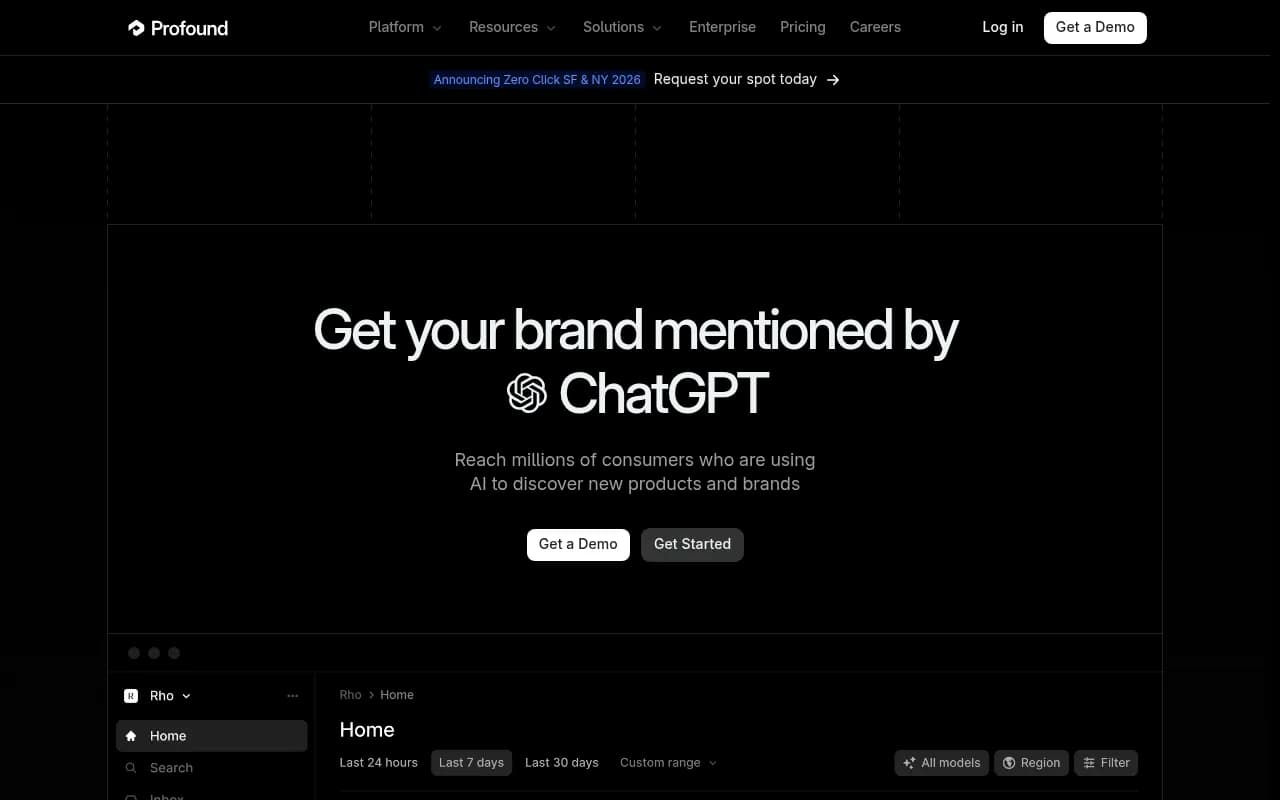
The platform's analytics depth was genuinely impressive. Prompt volume data, agent analytics, and answer engine insights gave enterprise marketing teams the kind of granular data they needed to justify AI visibility investments to leadership. Profound also built out a research hub and an AEO (Answer Engine Optimization) report that became reference documents for the category.
According to a comparison published by Discovered Labs, Profound "delivers enterprise-grade depth at $499/month" -- and that framing is accurate. If you're a large brand with a dedicated SEO or AEO team, Profound gives you a lot to work with.
Where Profound fell short in 2025:
- No Reddit or YouTube tracking. For a platform at this price point, that was a notable gap given how much AI models pull from those sources.
- No ChatGPT Shopping monitoring.
- The content generation capabilities were limited compared to Promptwatch. Profound could tell you what was missing; it didn't help you create it.
- No AI crawler logs, which meant you couldn't see how AI engines were actually discovering and reading your pages.
Profound's comparison blog post against Peec AI was candid about Peec's limitations, but it also inadvertently highlighted Profound's own gaps when stacked against a more full-featured platform. The "better all-in-one solution" framing works when the comparison is Peec -- it's harder to sustain against Promptwatch.
For enterprise teams with budget and a content team already in place, Profound was a solid choice in 2025. For teams that needed the platform to do more of the heavy lifting, the gaps mattered.
Peec AI: multilingual reach, limited depth
Peec AI had a clear differentiator: multilingual support across 115+ languages. For brands operating in non-English markets, that was a real advantage that most competitors couldn't match.
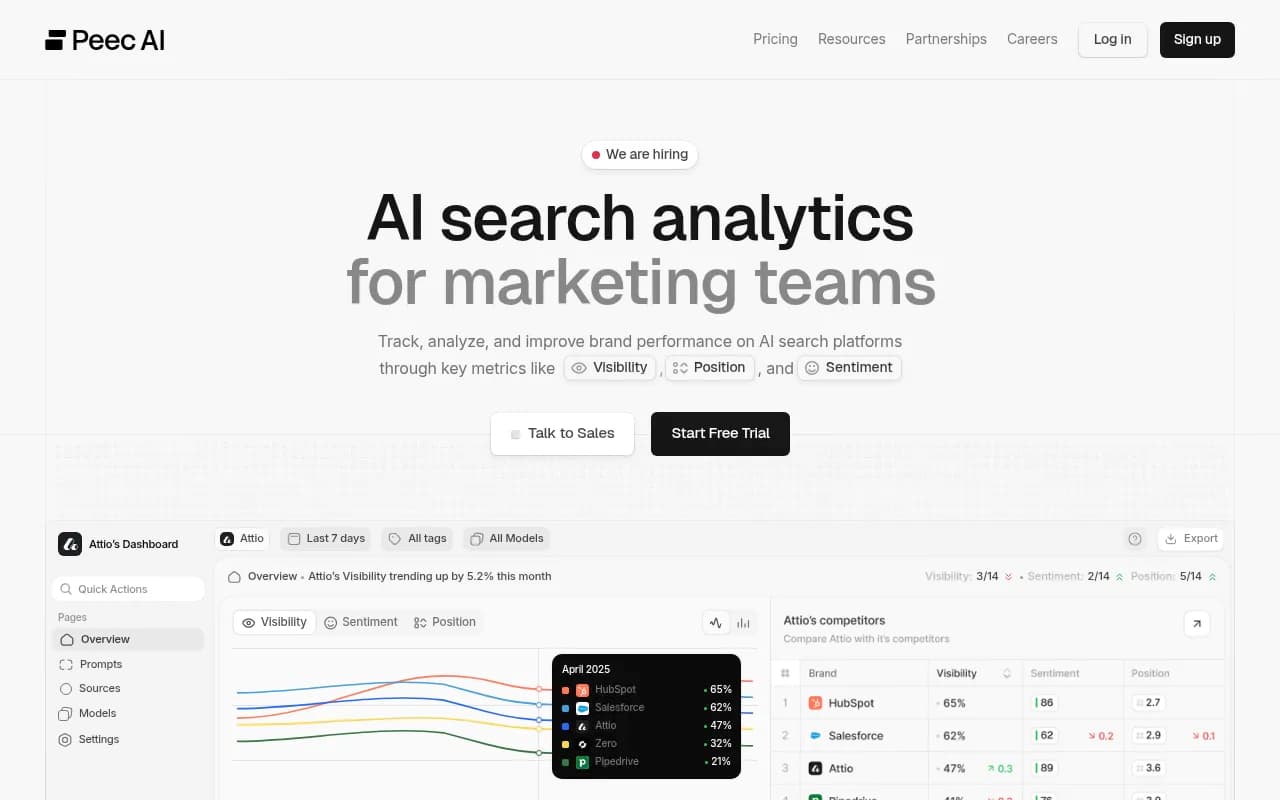
The platform offered basic AI visibility metrics, position tracking, and sentiment analysis at a starting price that made it accessible for mid-market teams. The UI was clean and the onboarding was relatively fast.
The limitations were real, though. As Profound's own review of Peec noted, the platform "mainly offers AI visibility tools but lacks actionable workflows." That's a fair characterization. Peec could show you where you stood; it couldn't help you change it.
A Reddit thread in r/seogrowth from 2025 made an interesting observation about the category broadly: "The methodology differs slightly between Peec AI, Otterly, AthenaHQ, Rankscale, and Knowatoa -- but the underlying logic is very similar." That's the problem with monitoring-only tools. When the core product is a dashboard, differentiation gets thin fast.
Peec's pricing started lower than Profound's, which made it attractive for teams that needed multilingual coverage without enterprise budgets. But teams that wanted to actually improve their AI visibility -- not just measure it -- consistently found themselves needing to bolt on other tools.
Otterly.AI: the budget-friendly entry point
Otterly.AI found its audience in 2025 by being the most accessible option in the category. At $29/month, it was the entry point for teams that wanted to start tracking AI visibility without a significant budget commitment.

The GEO Audit feature was genuinely useful and somewhat unique -- it gave teams a structured way to assess their current AI visibility posture before diving into ongoing tracking. For agencies onboarding new clients, that was a practical tool.
The trade-offs were significant, though. No crawler logs. No visitor analytics. No content generation. No Reddit or YouTube tracking. Otterly.AI was a monitoring tool, and a fairly basic one at that.
For small businesses or freelancers who just wanted to know whether their brand was showing up in AI responses, Otterly.AI made sense in 2025. For anyone trying to build a systematic AI visibility program, it was a starting point rather than a destination.
The Ranksmith comparison guide published in late 2025 described Otterly.AI as "the most budget-friendly option" -- which is accurate, and also tells you most of what you need to know about where it fits.
How the four platforms compared
Here's a direct comparison across the dimensions that mattered most in 2025:
| Feature | Promptwatch | Profound | Peec AI | Otterly.AI |
|---|---|---|---|---|
| AI model coverage | 10+ models | Multiple | Multiple | Multiple |
| Content generation | Yes (built-in AI agent) | Limited | No | No |
| Answer gap analysis | Yes | Partial | No | No |
| AI crawler logs | Yes | No | No | No |
| Reddit/YouTube tracking | Yes | No | No | No |
| ChatGPT Shopping tracking | Yes | No | No | No |
| Traffic attribution | Yes (GSC, snippet, logs) | No | No | No |
| Multilingual support | Yes | Limited | 115+ languages | Limited |
| GEO audit | No | No | No | Yes |
| Starting price | $99/mo | ~$499/mo | Mid-market | $29/mo |
| Best for | Teams wanting full optimization loop | Enterprise analytics | Multilingual markets | Budget entry point |
The pattern is clear. Promptwatch was the only platform in 2025 that covered the full cycle from discovery to creation to attribution. The others were monitoring tools with varying degrees of depth and different pricing strategies.
What the 2025 landscape revealed about the category
A few things became obvious by the end of 2025 that weren't obvious at the start:
Monitoring alone doesn't justify the budget. Teams that bought monitoring-only tools in early 2025 often found themselves with dashboards full of data and no clear path to improving their numbers. The platforms that retained customers were the ones that helped users take action.
Citation data is the real product. The most valuable thing any of these platforms could offer was insight into why AI models cite certain sources -- which pages, which formats, which topics. Platforms that surfaced this data (and helped users act on it) were more valuable than platforms that just showed share-of-voice scores.
Reddit and YouTube matter more than most teams realized. AI models pull heavily from these sources, and brands that ignored them were often invisible in AI responses even when their own website content was strong. This was an insight that most platforms weren't surfacing at all.
The content generation question became unavoidable. By mid-2025, the obvious follow-up to "you're invisible for these prompts" was "so what do I write?" Platforms that could answer that question -- with content grounded in actual citation data, not generic SEO advice -- had a clear advantage.
What this means for 2026
The category is more mature now, and the bar has risen. Teams evaluating AI visibility platforms in 2026 should be asking harder questions than "does this track my brand mentions in ChatGPT?"
The right questions are: Can this platform show me exactly what content I'm missing? Can it help me create that content? Can it tell me whether the content I publish is actually getting cited? And can it connect that citation activity to traffic and revenue?
If a platform can't answer yes to most of those questions, it's a monitoring dashboard -- useful for awareness, but not sufficient for a real AI visibility program.
For teams that want to start somewhere, Otterly.AI is still a reasonable entry point at $29/month. For multilingual requirements, Peec AI still has the broadest language coverage. For enterprise analytics depth, Profound remains a strong option.
But for teams that want to actually move the needle on their AI search visibility -- not just measure it -- Promptwatch is where the category has ended up. The action loop (find gaps, create content, track results) is the right framework, and it's the one that the 2025 competitive landscape ultimately validated.
The platforms that treated AI visibility as a monitoring problem are still useful. The platforms that treated it as an optimization problem are the ones that will define 2026.