Key Takeaways
- No official prompt volume data exists: Unlike traditional search engines that publish keyword volume, AI platforms (ChatGPT, Claude, Perplexity) don't release usage metrics. All prompt volume estimates are directional signals, not exact counts.
- Three core data sources: Most platforms combine search demand alignment (traditional keyword behavior), real-time anonymized usage data, and AI model interaction patterns to estimate prompt volume.
- Volume is relative, not absolute: Platforms typically use index scores (e.g. 0-100) over rolling periods rather than exact monthly search counts. The goal is prioritization, not precision.
- Prompt volumes inform content strategy: Knowing which prompts have high demand helps teams allocate resources to the queries that actually matter—not ghost prompts no one asks.
- Measurement alone isn't enough: The best platforms connect volume estimates to actionable workflows like content gap analysis, AI content generation, and visibility tracking.
Traditional SEO has always run on keyword volume. You research a term, check its monthly search count in Google Keyword Planner or Ahrefs, assess difficulty, and decide whether it's worth targeting. The data is imperfect but directional enough to build a strategy around.
AI search broke that model.
ChatGPT doesn't publish how many people ask "best project management tools for remote teams." Perplexity doesn't tell you whether "how to optimize landing pages for conversions" gets 10 queries a month or 10,000. Claude, Gemini, DeepSeek—none of them share usage data.
Yet brands still need to know: which prompts matter? Where should we focus our AI visibility efforts? What's the actual demand behind these conversational queries?
This is where prompt volume estimation comes in. It's not a perfect science—no public dataset exists—but platforms have built methodologies to approximate demand using proxy signals. Some are more sophisticated than others. Here's how they work, what data they use, and why it matters for your 2026 AI visibility strategy.
Why prompt volume estimation matters
Before diving into the technical details, it's worth understanding why this even matters.
Focus on real demand, not vanity metrics
Ranking for a prompt no one asks is worthless. If your brand appears in ChatGPT's response to "best CRM for underwater basket weaving startups" but the prompt gets asked twice a year, you've optimized for nothing.
Prompt volume estimates help you prioritize. They separate high-value opportunities (prompts with real user demand) from low-value noise (edge cases, test queries, prompts that sound plausible but no one actually uses).
Allocate resources strategically
AI visibility work is resource-intensive. You're creating content, optimizing pages, building citations, tracking results. Volume data tells you where to invest those resources.
A prompt with 10x the volume of another prompt deserves 10x the attention—or at least a higher spot in your backlog. Without volume estimates, you're guessing.
Competitive advantage
Most brands are still flying blind in AI search. They track whether they appear for a handful of prompts but have no sense of which prompts are high-traffic vs low-traffic.
Platforms that surface prompt volume give you an edge: you can see demand signals your competitors can't. You optimize for the prompts that matter while they waste time on ghost queries.
How AI visibility platforms estimate prompt volume
There's no single methodology. Different platforms use different data sources and weighting systems. But most approaches fall into three buckets:
1. Search demand alignment
This is the most common starting point: map AI prompts to traditional keyword search behavior.
The logic: people who search "best CRM for small business" on Google are likely asking similar questions in ChatGPT or Perplexity. The phrasing might differ (AI prompts tend to be longer and more conversational), but the underlying intent is the same.
Platforms analyze historical search volume data—Google Keyword Planner, Google Trends, clickstream data from browser extensions—and use it as a baseline for estimating AI prompt demand.
Example: If "project management software" gets 50,000 monthly searches on Google, a platform might estimate that the AI prompt "what's the best project management software for remote teams" has proportional demand, adjusted for conversational phrasing and specificity.
Limitations: This approach assumes AI search behavior mirrors traditional search behavior. That's not always true. Some queries are AI-native (e.g. "explain the difference between X and Y in simple terms") and have no direct Google equivalent. Others are asked more frequently in AI because the conversational interface lowers friction.
2. Real-time anonymized usage data
Some platforms work with consent-based data sources that capture anonymized prompt activity. This might include:
- Browser extensions that log AI interactions (with user permission)
- Partnerships with AI platforms or third-party analytics providers
- Aggregated, anonymized data from enterprise customers using the platform
This data provides directional signals about current user behavior. It's not a complete picture—no single data source covers all AI users—but it's closer to ground truth than search volume proxies.
Example: A platform might observe that "best AI writing tools" appears in their anonymized dataset 500 times over a two-week period, while "best AI video editors" appears 50 times. That 10:1 ratio becomes a volume signal.
Limitations: Sample size and representativeness. If the data comes from a skewed user base (e.g. mostly tech workers, mostly US users), the volume estimates will reflect that bias. Platforms address this by normalizing data across demographics and geographies, but it's never perfect.
3. AI model interaction patterns
The third data source: insights from AI models themselves.
Some platforms train models on historical interaction data—logs of prompts, responses, follow-up queries—to identify patterns in how users engage with AI search. These models can predict which prompts are likely to have high volume based on linguistic features, topic clusters, and user behavior trends.
Example: A model might learn that prompts starting with "how to" or "best" tend to have higher volume than prompts starting with "why" or "when." It might also learn that prompts in certain topic areas (e.g. software tools, health advice, travel planning) see more traffic than others (e.g. obscure historical events, niche hobbies).
Limitations: This approach is only as good as the training data. If the model was trained on data from 2024, it might miss emerging trends in 2026. It also requires significant ML infrastructure—smaller platforms may not have the resources to build and maintain these models.
What volume estimates actually look like
Most platforms don't give you an exact monthly search count (e.g. "this prompt gets 12,450 queries per month"). Instead, they use relative volume indices.
Index-based scoring
A typical system might score prompts on a 0-100 scale, where:
- 80-100: Very high volume (top-tier prompts with significant demand)
- 60-79: High volume (strong demand, worth prioritizing)
- 40-59: Moderate volume (decent demand, consider targeting)
- 20-39: Low volume (niche queries, lower priority)
- 0-19: Very low volume (edge cases, rarely asked)
The index is calculated over a rolling period—usually 30-60 days—to smooth out short-term fluctuations.
Why indices instead of absolute numbers? Two reasons:
- Data uncertainty: Without official platform data, absolute counts would be misleading. An index communicates "this prompt has more demand than that prompt" without overstating precision.
- Prioritization focus: The goal isn't to know the exact volume. It's to rank prompts by demand so you can decide which ones to target first.
Confidence weighting
Sophisticated platforms also surface confidence scores alongside volume estimates. A prompt with a volume index of 75 and a confidence score of 90% is more reliable than a prompt with a volume index of 75 and a confidence score of 40%.
Confidence depends on:
- Data source coverage: How much data the platform has for this specific prompt
- Signal consistency: Whether multiple data sources agree on the volume estimate
- Temporal stability: Whether the volume is steady over time or spiking due to a one-off event
Low-confidence estimates are still useful—they tell you a prompt might be worth exploring—but they shouldn't drive major resource allocation decisions.
Platform-specific approaches
Different AI visibility platforms handle prompt volume estimation differently. Here's a snapshot of how a few leading tools approach it:
Spotlight
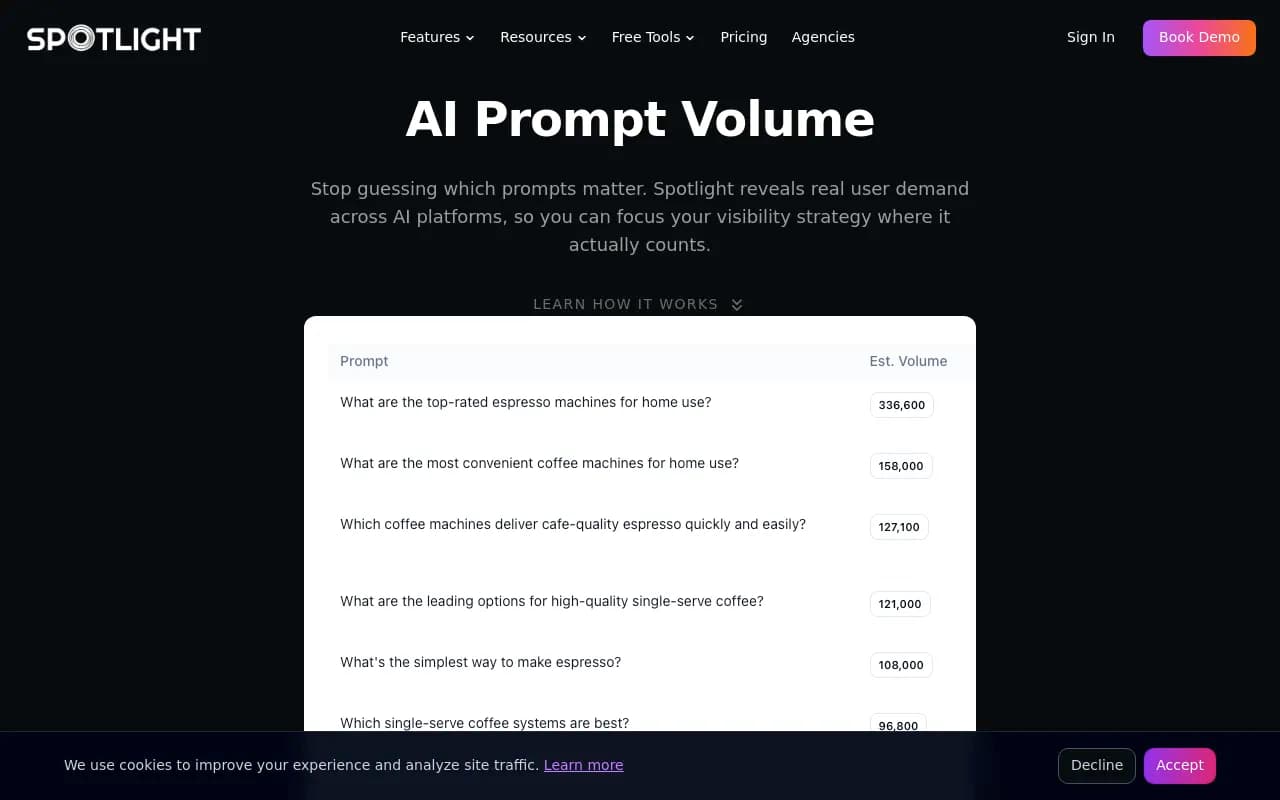
Spotlight combines three data sources: real-time anonymized usage data, search demand alignment, and AI model insights. They calculate a relative volume index over a rolling 2-month period and surface it directly in the dashboard.
Key feature: Spotlight supports all countries and languages, making it the only provider that offers global prompt volume estimates. Most competitors focus on English-language, US-based queries.

Promptwatch
Promptwatch takes a different angle: instead of just showing you volume estimates, it connects them to action. The platform's Answer Gap Analysis shows which prompts competitors are visible for but you're not—filtered by volume and difficulty—so you can see exactly which high-demand prompts you're missing.
The built-in AI writing agent then generates content grounded in citation data (880M+ citations analyzed) and prompt volumes, so you're not just tracking demand—you're creating content engineered to capture it.
Promptwatch also surfaces prompt intelligence: volume estimates, difficulty scores, and query fan-outs that show how one prompt branches into sub-queries. This helps teams prioritize high-value, winnable prompts instead of guessing.
Promptwatch is the only platform rated as a "Leader" across all categories in a 2026 comparison of 12 GEO platforms. The core difference: most competitors are monitoring-only dashboards. Promptwatch is built around taking action.
seoClarity
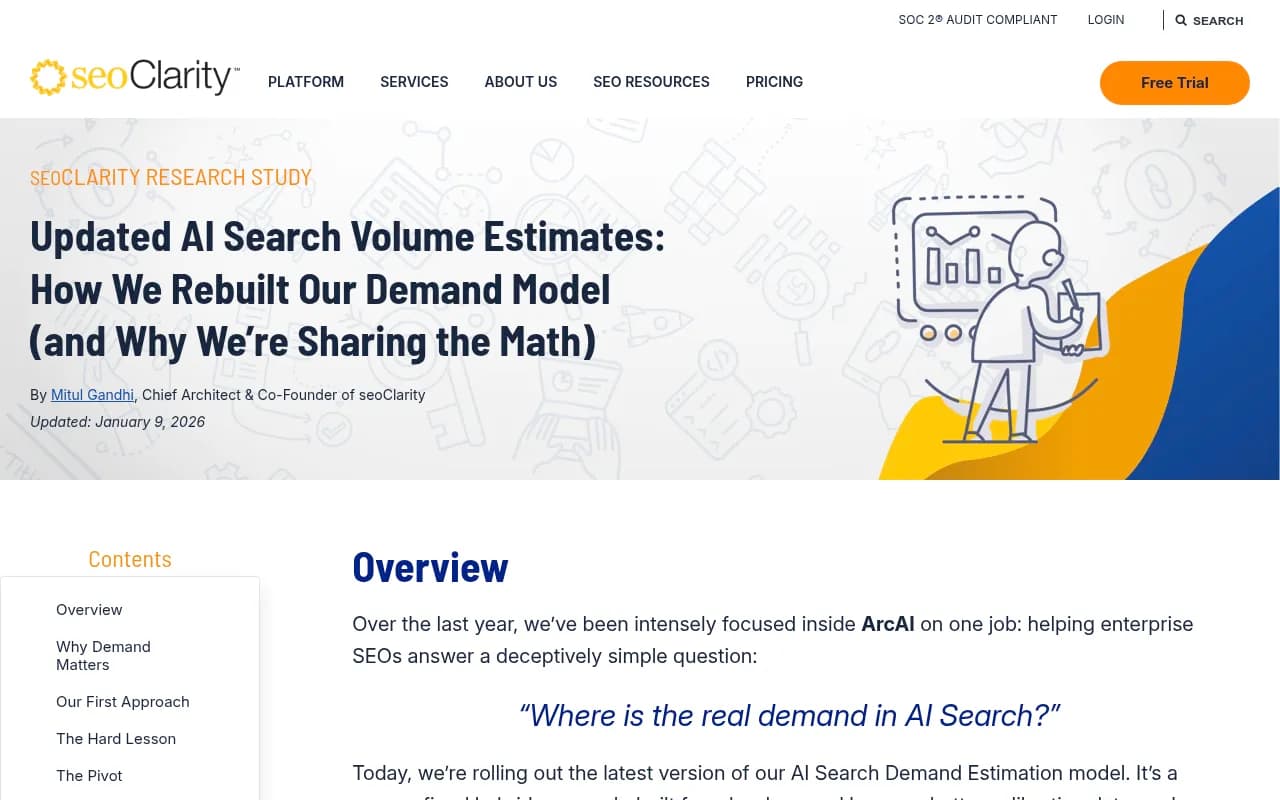
SeoClarity's ArcAI Search Demand Estimation Model applies intelligent adjustments to traditional search volume data to estimate AI search demand. They use their prompt corpus to understand how AI queries differ from traditional search queries, then adjust volume estimates accordingly.
Key feature: seoClarity integrates prompt volume directly into their broader SEO platform, so teams can compare traditional keyword volume vs AI prompt volume side-by-side.
Profound
Profound offers a Prompt Volumes feature that lets you search any topic and access AI search volume estimates. They focus on making volume data actionable: you can filter prompts by volume, export lists for content planning, and track how your visibility changes for high-volume prompts over time.
Writesonic
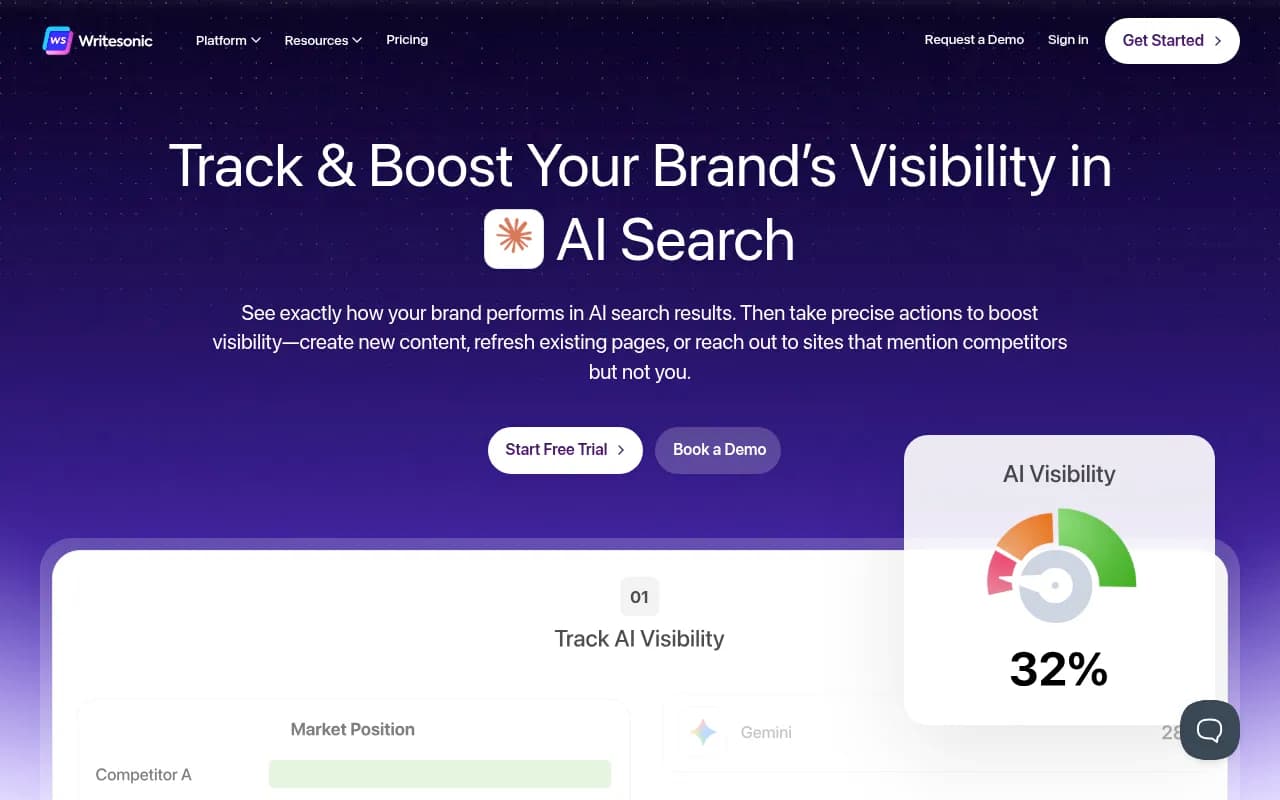
Writesonic recently launched an AI Search Volume feature that shows month-on-month prompt volume across major AI platforms. They emphasize trend tracking: not just current volume, but how volume is changing over time.
This is useful for identifying emerging opportunities—prompts that are growing in popularity but haven't yet saturated with competition.
How to use prompt volume data in your workflow
Having volume estimates is one thing. Using them effectively is another. Here's how leading teams integrate prompt volume into their AI visibility strategy:
1. Prioritize content creation
Start with high-volume, low-competition prompts. These are the "quick wins"—queries with real demand where you can realistically rank without massive effort.
Use volume data to build a content backlog ranked by opportunity score (volume × difficulty). Focus on the top 10-20 prompts first.
2. Identify content gaps
Compare your prompt coverage to competitors. If a competitor ranks for a high-volume prompt but you don't, that's a gap.
Platforms like Promptwatch automate this: Answer Gap Analysis shows exactly which high-demand prompts you're missing, then helps you create content to fill those gaps.
3. Track ROI of AI visibility efforts
Volume data lets you connect visibility improvements to business impact. If you optimize for a prompt with 10,000 estimated monthly queries and your visibility score improves from 0% to 50%, you can estimate the traffic uplift.
This is especially important for justifying AI visibility budgets. "We improved visibility for 50 prompts" is vague. "We improved visibility for 50 prompts with a combined volume index of 3,500" is concrete.
4. Adjust strategy based on trends
Prompt volume isn't static. Trends shift—new topics emerge, old topics fade. Platforms that show month-on-month volume changes help you stay ahead.
If you notice a prompt's volume spiking, prioritize it. If a prompt's volume is declining, deprioritize it.
Limitations and caveats
Prompt volume estimation is useful but imperfect. Here's what to keep in mind:
It's directional, not precise
No platform has access to official AI search volume data. All estimates are approximations based on proxy signals. Treat them as prioritization tools, not ground truth.
A prompt with a volume index of 80 probably has more demand than a prompt with a volume index of 20. But don't assume the 80-index prompt gets exactly 4x the queries.
Sample bias matters
If a platform's data comes from a skewed user base (e.g. mostly US users, mostly tech workers), the volume estimates will reflect that bias. Ask platforms about their data sources and coverage.
Prompts evolve
AI search is conversational. Users don't repeat the exact same prompt every time—they rephrase, add context, ask follow-ups. Volume estimates for a specific prompt phrasing might undercount total demand for the underlying intent.
Some platforms address this with intent clustering: grouping similar prompts together and estimating volume at the cluster level rather than the individual prompt level.
Platforms vary widely
Not all volume estimates are created equal. Some platforms use sophisticated multi-source methodologies. Others rely on a single data source (e.g. search volume proxies) and call it a day.
Before committing to a platform, ask:
- What data sources do you use?
- How do you weight and combine them?
- What's your confidence level for volume estimates?
- How often do you update volume data?
Comparison: Prompt volume features across platforms
| Platform | Volume metric | Data sources | Confidence scoring | Global coverage | Integration with content workflows |
|---|---|---|---|---|---|
| Promptwatch | Index + difficulty | Search alignment, usage data, AI models | Yes | Yes (all languages) | Yes (Answer Gap + AI writer) |
| Spotlight | Relative index | Search alignment, usage data, AI models | Yes | Yes (all languages) | Limited |
| seoClarity | Adjusted search volume | Search alignment, prompt corpus | No | Limited (English-focused) | Yes (SEO platform integration) |
| Profound | Volume index | Search alignment, usage data | No | Limited (English-focused) | Yes (export for content planning) |
| Writesonic | Monthly volume | Search alignment, usage data | No | Limited (English-focused) | Yes (AI writer integration) |
| Semrush | Fixed prompt sets | Search alignment | No | No (fixed prompts only) | Limited |
The future of prompt volume estimation
As AI search matures, volume estimation will get more sophisticated. Here's what to expect:
1. More data sources
Platforms will integrate additional signals: AI crawler logs (which prompts trigger crawls of your site), Reddit/YouTube discussion volumes (which topics are trending in communities that influence AI recommendations), and direct partnerships with AI platforms (if OpenAI, Anthropic, or Google ever share aggregated usage data).
2. Real-time updates
Current platforms update volume estimates weekly or monthly. Future platforms will offer real-time or daily updates, so you can react to emerging trends faster.
3. Intent-level clustering
Instead of estimating volume for individual prompt phrasings, platforms will cluster prompts by intent and estimate volume at the cluster level. This accounts for the conversational, variable nature of AI search.
4. Predictive modeling
AI models will predict which prompts are likely to grow in volume over the next 30-90 days, so you can optimize proactively instead of reactively.
Final thoughts
Prompt volume estimation isn't perfect. It's a best-effort approximation in a world where official data doesn't exist. But it's also essential.
Without volume estimates, AI visibility work is guesswork. You're optimizing for prompts that might matter or might not. You're allocating resources blindly. You're tracking vanity metrics instead of real demand.
With volume estimates, you have a prioritization framework. You can separate high-value opportunities from noise. You can justify budgets. You can connect visibility improvements to business outcomes.
The platforms that do this well—Promptwatch, Spotlight, seoClarity, Profound—don't just show you volume data. They connect it to action: content gap analysis, AI content generation, visibility tracking, traffic attribution. They close the loop from insight to execution.
If you're serious about AI visibility in 2026, start with the platforms that treat prompt volume as a strategic input, not a vanity metric. Then build a workflow that turns those estimates into content, citations, and rankings.
The data is imperfect. The opportunity is real.