Key takeaways
- Profound is a well-funded, enterprise-grade AI visibility platform with strong monitoring capabilities across 10+ AI models -- but it's expensive, starting at $399/mo for meaningful feature access.
- Promptwatch covers the same monitoring ground and adds content gap analysis, AI content generation, crawler logs, and traffic attribution -- at a lower price point.
- If you only need to track where your brand shows up in AI search, Profound is a solid choice. If you need to actually fix the gaps and improve visibility, Promptwatch has more to work with.
- Both platforms offer free trials, so you can test before committing.
Two platforms keep coming up in every serious conversation about AI search visibility in 2026: Profound and Promptwatch. They're often compared because they overlap in the most obvious ways -- both track brand mentions across AI engines, both show you citation data, and both are positioned at marketing teams that care about what ChatGPT and Perplexity say about them.
But underneath that surface similarity, they're built around pretty different philosophies. Profound is fundamentally a monitoring and analytics platform. Promptwatch is trying to be an end-to-end optimization loop. Whether that distinction matters to you depends entirely on what you're actually trying to do.
This guide breaks down both platforms honestly -- pricing, features, where each one shines, and where each one falls short.
What each platform actually does
Profound
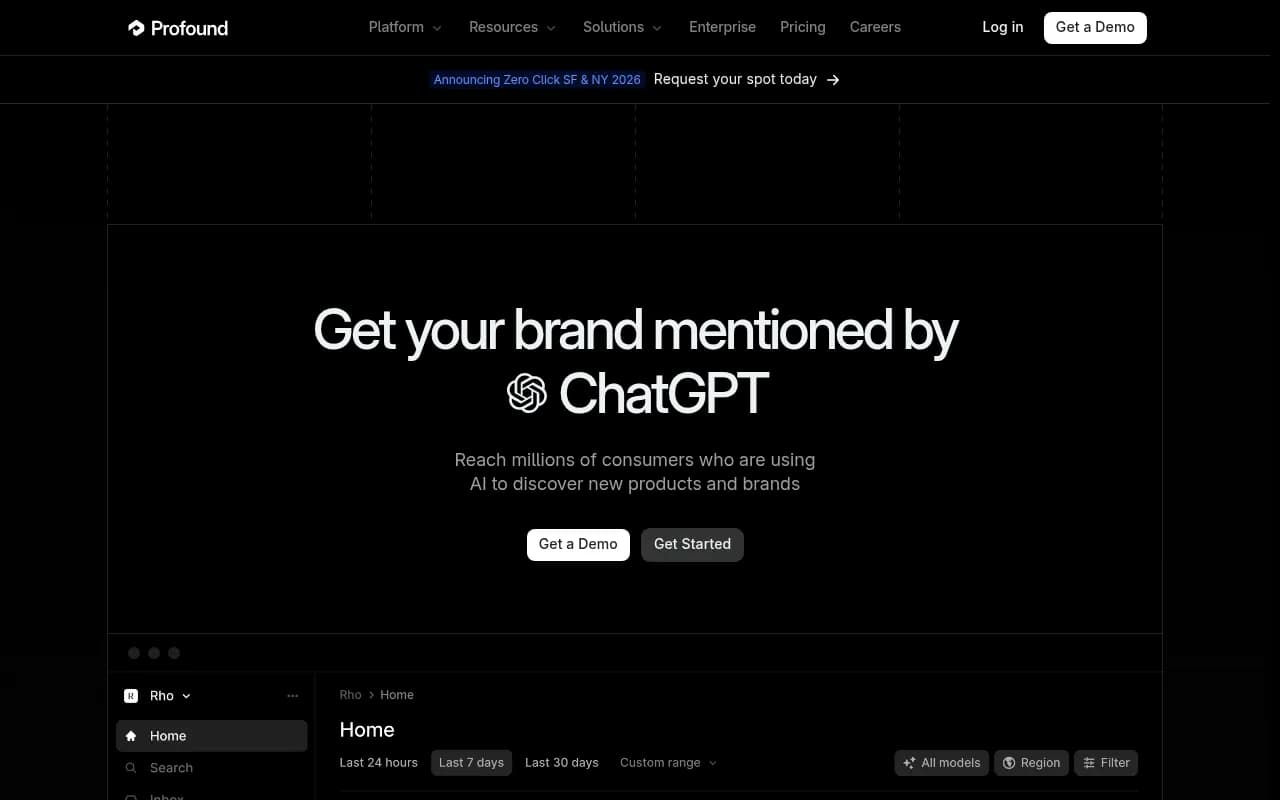
Profound has been one of the better-funded players in the GEO space, and it shows in the product. The platform covers more than ten AI models, which matters because ChatGPT, Perplexity, and Google AI Overviews don't all behave the same way -- they have different citation habits, different source preferences, and different ways of surfacing brand mentions.
Profound's core strength is analytics depth. You get visibility scores, share-of-voice comparisons against competitors, prompt tracking across AI engines, and detailed breakdowns of which sources AI models are pulling from. The reporting is polished and the data is genuinely useful for understanding where you stand.
In 2026, Profound also shipped autonomous Agents and MCP integration, which adds some workflow automation on top of the monitoring layer. That's a meaningful step toward actionability.
Where Profound gets complicated is price. The Starter plan at $99/mo is limited to ChatGPT with only 50 prompts -- which is fine for a proof-of-concept but not for real ongoing tracking. Meaningful enterprise access pushes significantly higher, and for most mid-market teams, the cost-to-value ratio starts to feel stretched.
Promptwatch
Promptwatch takes a different approach. The monitoring layer is there -- 10 AI models covered, citation tracking, share-of-voice, competitor heatmaps -- but the platform is built around what happens after you see the data.
The core workflow is: find the gaps, create content to fill them, track whether it worked. The Answer Gap Analysis shows you exactly which prompts competitors are visible for that you're not. The Content Agents then generate articles, listicles, and briefs grounded in that prompt data. And the page-level tracking shows you when AI crawlers pick up your new content and start citing it.
That last piece -- the AI Crawler Logs -- is something most competitors don't have at all. You can see which pages ChatGPT's crawler has visited, how often, what errors it encountered, and when a crawled page moved to an actual citation. That's a level of diagnostic visibility that's hard to get anywhere else.

Pricing comparison
This is where the comparison gets interesting.
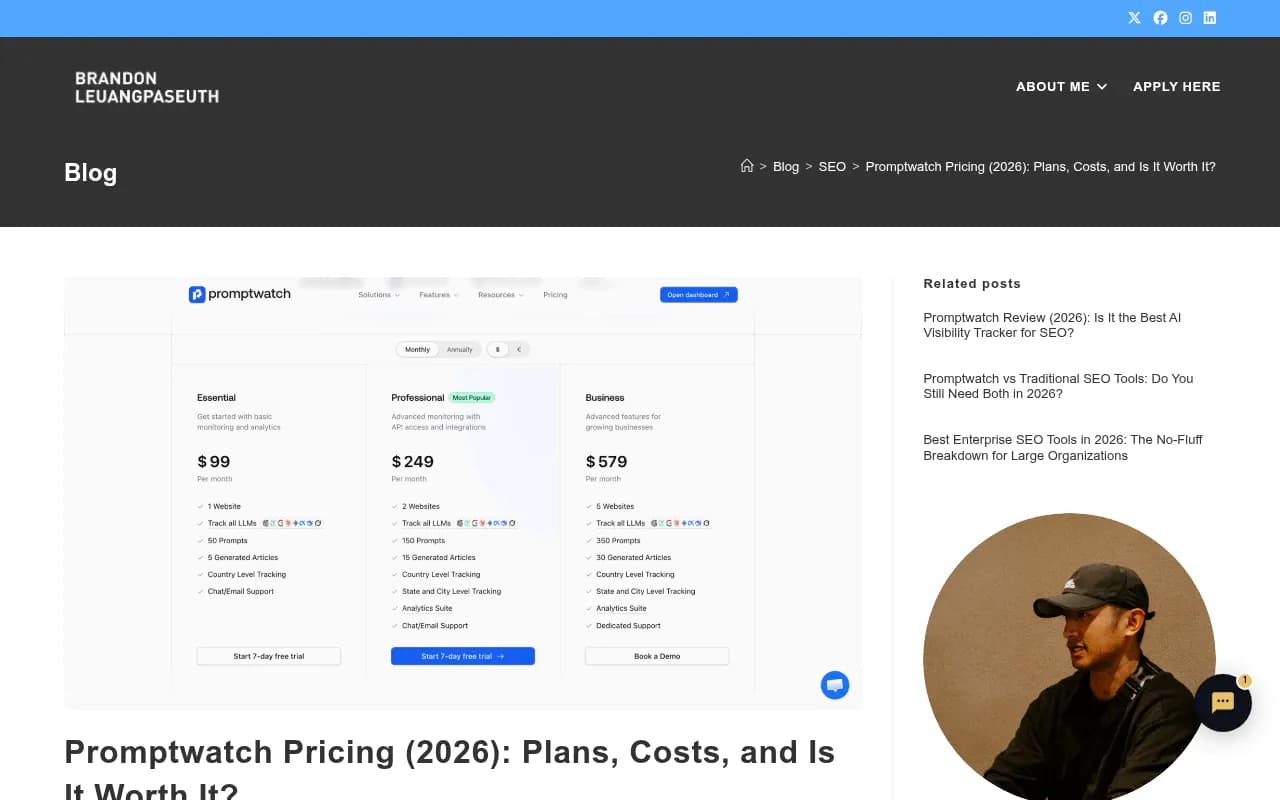
| Plan | Profound | Promptwatch |
|---|---|---|
| Entry-level | $99/mo (ChatGPT only, 50 prompts) | $99/mo (1 site, 50 prompts, 5 articles) |
| Mid-tier | ~$399/mo (multi-model, more prompts) | $249/mo (2 sites, 150 prompts, 15 articles, crawler logs) |
| Business | Enterprise pricing | $579/mo (5 sites, 350 prompts, 30 articles) |
| Free trial | Yes | Yes |
| Content generation | No | Yes (Content Agents) |
| AI Crawler Logs | No | Yes (Professional+) |
| Reddit/YouTube insights | No | Yes |
| ChatGPT Shopping tracking | No | Yes |
The entry-level price looks identical at $99/mo, but the comparison falls apart quickly. Profound's $99 plan is ChatGPT-only. Promptwatch's $99 plan covers all 10 models. By the time you get to equivalent multi-model coverage on Profound, you're looking at roughly $399/mo -- which is $150 more than Promptwatch's Professional plan at $249/mo, which also includes content generation and crawler logs.
For teams that are purely in monitoring mode and have budget to spare, Profound's analytics depth might justify the premium. For everyone else, the math is hard to ignore.
Feature-by-feature breakdown
AI model coverage
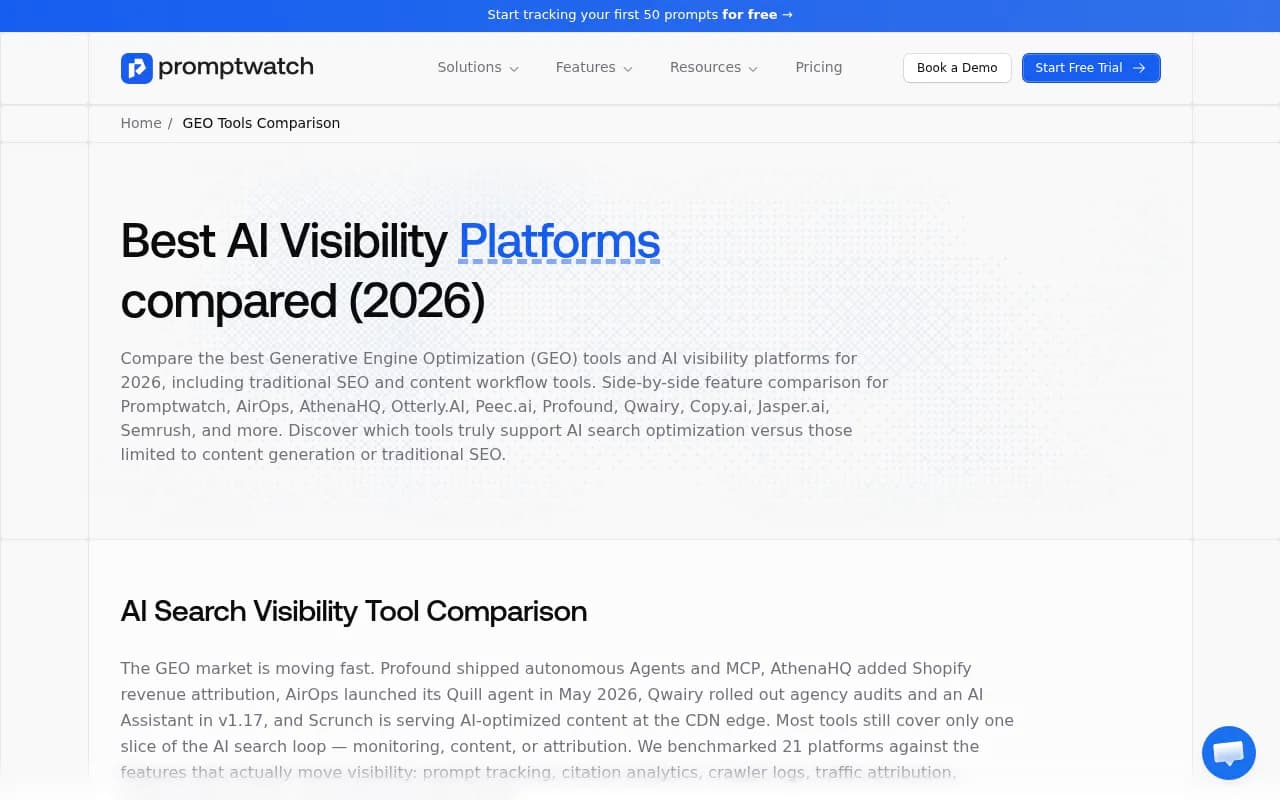
Both platforms cover 10+ AI models. Profound's coverage includes the major engines -- ChatGPT, Perplexity, Google AI Overviews, Gemini, Claude. Promptwatch covers the same set plus Mistral, Meta AI, DeepSeek, Grok, and Copilot. The breadth matters more than it might seem: different models have very different citation behaviors, and a brand that's well-cited in ChatGPT might be nearly invisible in Perplexity.
Prompt tracking and intelligence
Promptwatch tracks prompt volume estimates and difficulty scores for each prompt, plus query fan-outs that show how one prompt branches into related sub-queries. That's useful for prioritizing -- you want to know which prompts are high-traffic and actually winnable before you invest in content.
Profound has prompt tracking but doesn't surface the same level of prioritization data. You can see where you rank, but the "what to do next" layer is thinner.
Content creation
Profound doesn't generate content. It shows you gaps; you figure out how to fill them.
Promptwatch's Content Agents generate articles, comparisons, and briefs that are grounded in real citation data, prompt volumes, and competitor analysis. The output isn't generic AI filler -- it's built around the specific gaps the platform has identified. Whether you use the generated content as a first draft or a brief, it saves meaningful time.
Crawler logs and technical diagnostics
This is the biggest functional gap between the two platforms. Promptwatch's AI Crawler Logs show you real-time data on when ChatGPT, Claude, Perplexity, and other AI crawlers visit your site -- which pages they read, what errors they hit, how often they return, and when a crawled page actually converts to a citation.
Profound doesn't have this. If your content isn't getting cited and you're using Profound, you're left guessing whether it's a crawling issue, a content quality issue, or something else. With Promptwatch's crawler logs, you can actually diagnose the problem.
Traffic attribution
Promptwatch connects AI visibility to actual website traffic and revenue through integrations with Cloudflare, Fastly, Vercel, server logs, and Google Search Console. You can see which AI citations are driving real visitors.
Profound has some attribution capabilities, but the depth of integration is more limited.
Reddit and YouTube insights
Promptwatch surfaces Reddit discussions and YouTube content that AI models are actively citing -- which is more relevant than it sounds, because Reddit threads frequently appear in AI responses and influence recommendations. Profound doesn't track these channels.
Reporting and analytics
Profound's reporting is genuinely polished. The dashboards are clean, the share-of-voice visualizations are easy to read, and the competitive comparison views are well-designed. If your primary use case is showing AI visibility data to stakeholders or clients, Profound's presentation layer is strong.
Promptwatch's reporting is solid but more operationally oriented -- it's built for people who are actively working to improve visibility, not just reporting on it.
Who each platform is actually built for
Profound is a good fit if...
- You're at an enterprise with budget for premium analytics
- Your primary need is monitoring and reporting, not optimization
- You want polished dashboards for executive or client presentations
- You're already using other tools for content creation and just need the visibility data layer
Promptwatch is a better fit if...
- You want to actually improve your AI visibility, not just measure it
- You need content generation built into the same workflow
- You want to diagnose crawling and indexing issues with AI engines
- You're tracking Reddit, YouTube, or ChatGPT Shopping alongside standard citation data
- You're managing multiple sites or working agency-side with several clients
- Budget matters and you want more capability per dollar
The monitoring-only problem
Here's the honest tension in this comparison: monitoring-only platforms are useful, but they leave you with a gap between "knowing" and "doing."
You can see that a competitor is getting cited for "best project management software for remote teams" and you're not. That's valuable information. But then what? You still need to figure out what content to create, how to structure it, what angle to take, and whether AI crawlers will actually find it once it's published.
Profound gives you the first part. Promptwatch tries to give you the whole loop.
That doesn't mean Profound is a bad platform -- it's not. The analytics are genuinely good and the coverage is broad. But if you're paying $399+/mo for a monitoring tool and then separately paying for content tools, briefs, and technical diagnostics, the total cost adds up fast. Promptwatch consolidates that stack at a lower combined price.
Other platforms worth considering
If neither Profound nor Promptwatch is quite the right fit, a few other platforms are worth a look:
Otterly.AI is one of the more affordable monitoring options and has earned strong user ratings. It's monitoring-only like Profound, but at a lower price point.

Peec AI is strong on accuracy -- it tracks what real users see in AI interfaces rather than relying solely on API outputs, and supports 115+ languages. Good for international brands.

AthenaHQ has native GA4 and Google Search Console integrations, which makes it appealing for teams that want AI visibility data connected to their existing analytics stack.

For agencies specifically, Search Party offers a different model focused on implementation rather than just tracking.
Search Party
The verdict
If price weren't a factor and you only needed monitoring, Profound would be a reasonable choice. The analytics are deep, the coverage is broad, and the platform is well-built.
But price is always a factor. And monitoring alone rarely moves the needle.
Promptwatch covers the same monitoring ground at a lower cost, then adds content generation, crawler logs, Reddit and YouTube tracking, ChatGPT Shopping data, and traffic attribution on top. For most marketing teams and agencies, that's a more complete toolkit for the money.
The clearest way to decide: run both free trials with your actual brand and a set of real prompts you care about. See which platform surfaces more actionable information and which one you'd actually use week to week. That answer will tell you more than any feature comparison.