Key takeaways
- Most AI visibility tools are monitoring dashboards -- they show you citation data but don't help you create content to improve it.
- Peec.ai is a clean, focused monitoring tool; it tracks share of voice across AI platforms but has no content generation or gap analysis features.
- Frase and Scalenut are strong SEO content writing tools, but their AI visibility tracking is limited or secondary to their core use case.
- Promptwatch is the only platform in this comparison that closes the full loop: it tracks AI visibility, identifies content gaps, and generates content designed to win citations.
- If your goal is to improve AI search visibility (not just measure it), you need a platform that does both halves of the job.
The question sounds simple: which tool tracks where your brand appears in AI search AND helps you write content to improve it?
In practice, very few platforms actually do both. Most tools in the "AI visibility" category are dashboards. They show you citation rates, share of voice, and competitor comparisons. Then they stop. You're left knowing you have a problem but with no clear path to fixing it.
The four platforms in this comparison take different approaches to that gap. Peec.ai is a pure monitoring tool. Frase and Scalenut are primarily content writing platforms that have added some AI visibility features. Promptwatch is built around the full optimization cycle: track, diagnose, create, repeat.
Here's how they actually compare.
What we're actually comparing
Before getting into features, it's worth being clear about what the job is.
AI visibility optimization has two distinct phases. The first is monitoring: understanding which prompts trigger mentions of your brand, how often you're cited, which competitors are outranking you, and on which AI platforms. The second is execution: figuring out what content is missing and creating it in a way that AI models will actually cite.
Most tools handle one phase. The question is whether any of them handle both well enough to be your primary platform.
| Platform | AI visibility tracking | Content gap analysis | AI content generation | Crawler logs | Pricing starts at |
|---|---|---|---|---|---|
| Peec.ai | Yes (core feature) | No | No | No | ~$95/mo |
| Frase | Limited (add-on) | Partial (SEO-focused) | Yes (SEO-focused) | No | $45/mo |
| Scalenut | Limited | Partial | Yes (SEO-focused) | No | $39/mo |
| Promptwatch | Yes (full, all plans) | Yes | Yes (AI-native) | Yes (Pro+) | $99/mo |
Peec.ai: clean monitoring, nothing more
Peec.ai was one of the first tools built specifically to track brand visibility in AI-generated answers. That focus shows. The interface is clean, the data is easy to read, and the core metrics -- citation frequency, share of voice, source URLs -- are presented without noise.
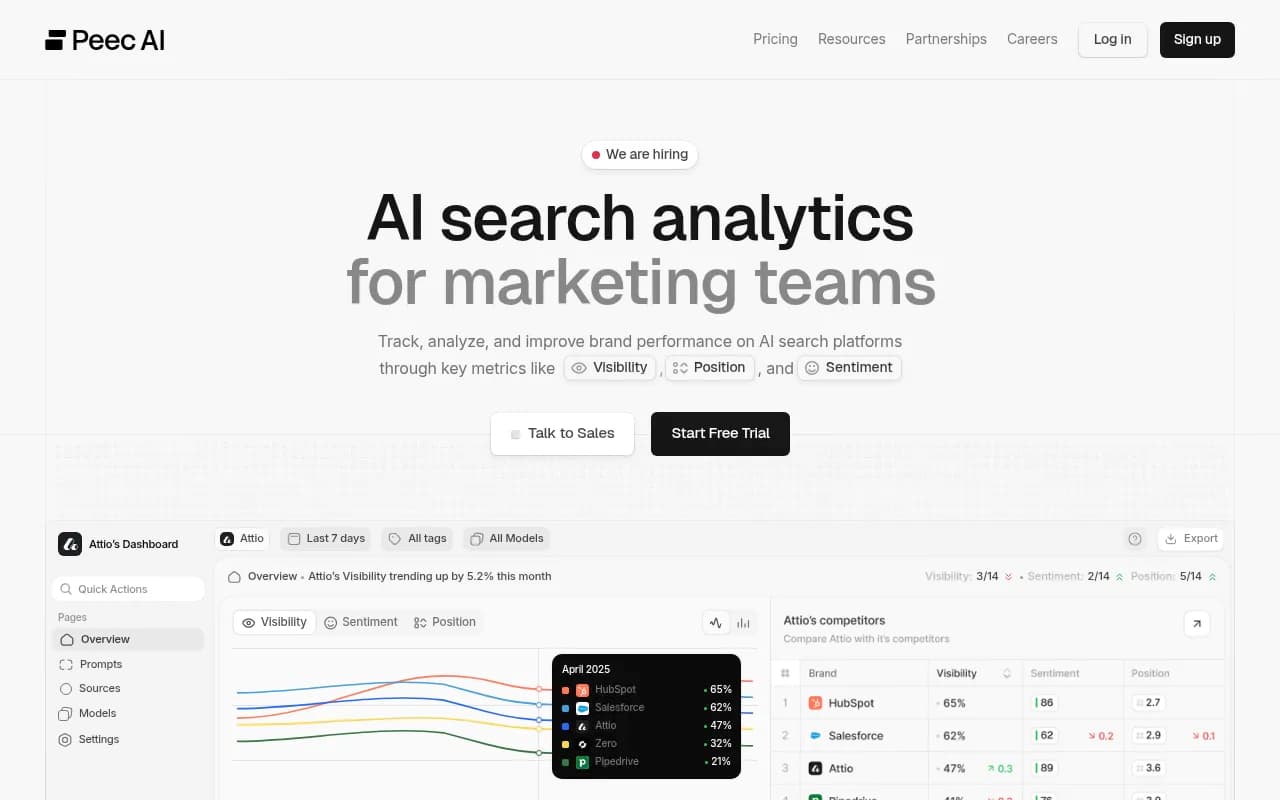
The platform uses UI scraping to simulate real user interactions with AI systems, which means the data reflects what users actually see rather than raw API outputs. That's a meaningful technical choice. It tracks ChatGPT, Perplexity, and Google AI Overviews on its entry plans, with broader coverage available at enterprise pricing.
Where Peec.ai runs into limits is everything after the monitoring. There's no content gap analysis. There's no way to identify which specific topics or questions your competitors are winning that you're not. There's no content generation. If Peec.ai shows you that your visibility on Perplexity dropped 15% last month, it can't tell you why or what to do about it.
For teams that just need clean reporting -- say, a marketing director who needs to show AI visibility metrics to leadership -- Peec.ai does that job well. For teams that need to actually move the numbers, it's the beginning of a workflow that requires other tools to complete.
Frase: strong SEO content writer, limited AI visibility
Frase has been a respected SEO content tool for years. Its core workflow -- research a topic, generate a content brief, write and optimize against top-ranking pages -- is genuinely good. The AI writing features are solid, and the SERP analysis is useful for traditional search.
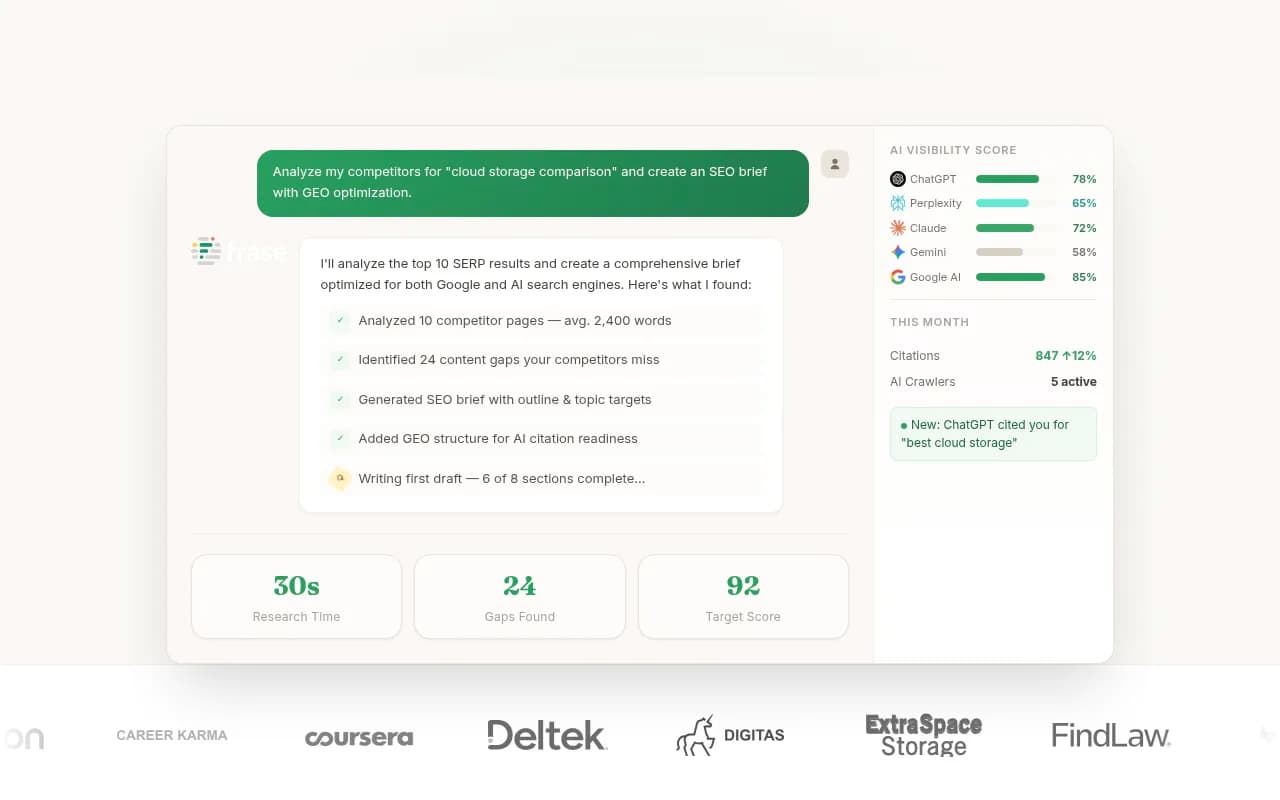
The AI visibility tracking Frase has added is more of a monitoring layer than a core capability. It tracks brand mentions across AI platforms, but the depth is limited compared to dedicated visibility tools. The content briefs Frase generates are grounded in traditional SERP data, not in prompt-level analysis of what AI models are actually citing.
That distinction matters more than it might seem. Writing content that ranks in Google and writing content that gets cited by ChatGPT or Perplexity are related but different problems. AI models weight different signals -- they tend to favor direct, authoritative answers to specific questions, structured data, and content that explicitly addresses the query being asked. Frase's optimization is built around Google's signals, not AI citation patterns.
If you're running a content operation that's primarily focused on traditional SEO with some AI visibility awareness on the side, Frase is a reasonable choice. If AI visibility is your primary goal, the tool isn't built for that job.
Scalenut: SEO content platform with GEO awareness
Scalenut sits in a similar position to Frase. It's a capable SEO content platform with NLP analysis, keyword clustering, and AI writing built around traditional search optimization. The platform has added GEO (generative engine optimization) features, and it does offer some AI visibility context.

The Scalenut vs. Peec.ai comparison is interesting because they're solving adjacent problems from different directions. Scalenut comes from the content creation side and has added visibility tracking. Peec.ai comes from the monitoring side and has no content creation. Neither covers the full loop.
Scalenut's AI visibility features are more useful as context for content decisions than as a standalone monitoring capability. The platform tells you something about how your content is performing in AI search, but it doesn't have the prompt-level granularity, crawler logs, or citation depth that a dedicated AI visibility platform provides.
For teams that need to produce a lot of SEO content and want some GEO awareness built in, Scalenut is worth considering. For teams where AI visibility is the primary metric, it's not the right fit.
Promptwatch: the full loop
Promptwatch is built around a different premise than the other three tools. The core idea is that monitoring without optimization is incomplete -- knowing you're invisible doesn't help unless you can do something about it.

The platform tracks visibility across 10 AI models (ChatGPT, Perplexity, Claude, Gemini, Google AI Overviews, Grok, DeepSeek, Copilot, Meta AI, and Mistral) on all plans starting at $99/month. That's a meaningful difference from Peec.ai's model, where full platform coverage requires enterprise pricing.
But the tracking is only the first step. What separates Promptwatch is what happens after you see the data.
Answer Gap Analysis shows you exactly which prompts your competitors are visible for that you're not. Not just "you have low visibility on Perplexity" -- but the specific questions and topics where competitors are being cited and your content isn't showing up. That's a content brief in itself.
From there, Content Agents generate articles, comparisons, and listicles grounded in real prompt data. The content is built around the specific gaps the analysis identified, using citation patterns, prompt volumes, and competitor analysis as inputs. This isn't generic AI writing -- it's content engineered to answer the questions AI models are already surfacing.
The Professional plan ($249/month) adds crawler logs, which show you in real time which AI crawlers are hitting your pages, what errors they're encountering, and when a page moves from being crawled to being cited. That's a level of technical visibility that most platforms don't offer at all.
Page-level tracking shows which specific pages are being cited, how often, and by which models. Traffic attribution connects those citations back to actual revenue. The full picture -- from prompt to citation to traffic to conversion -- is visible in one platform.
The content writing question
This is where the comparison gets interesting, because "content writing" means different things depending on which tool you're talking about.
Frase and Scalenut write content for Google. Their optimization signals come from SERP analysis -- what's ranking, what keywords are present, what the top pages cover. That's useful for traditional SEO, and it's not irrelevant to AI visibility (Google's signals and AI citation patterns overlap more than people think). But it's not the same as writing content specifically to be cited by AI models.
Promptwatch's Content Agents write content for AI search. The inputs are different: prompt volumes, citation data, competitor visibility gaps, and the specific questions AI models are already answering. The output is content designed to fill the gaps that the Answer Gap Analysis identified.
The practical difference: if you use Frase to write a comparison article, you'll get a piece optimized for the keywords and structure that rank on Google. If you use Promptwatch to write the same article, you'll get a piece optimized for the prompts where your competitors are currently being cited and you're not.
Both approaches produce content. Only one of them is specifically targeted at the AI visibility problem.
Who should use what
The right tool depends on what you're actually trying to accomplish.
Use Peec.ai if you need clean, focused AI visibility monitoring for reporting purposes and you have a separate content workflow. It's a good monitoring tool that does its job without complexity.
Use Frase if your primary goal is traditional SEO content production and you want some AI visibility awareness built into your workflow. The content writing features are strong; the AI tracking is supplementary.
Use Scalenut if you need a cost-effective SEO content platform with NLP optimization and some GEO context. Similar positioning to Frase with different UX and pricing.
Use Promptwatch if you want to actually improve your AI search visibility, not just measure it. The combination of prompt tracking, gap analysis, and AI-native content generation is the only setup in this comparison that addresses the full problem.
A note on the monitoring-only trap
There's a pattern worth naming here. A lot of teams buy an AI visibility monitoring tool, spend a few months looking at dashboards, and then realize they don't know what to do with the data. The numbers tell you you're invisible. They don't tell you how to become visible.
This isn't a knock on monitoring tools -- you need the data. But monitoring without a path to action is just a more expensive way to feel bad about your metrics.
The platforms that are actually moving the needle for brands in 2026 are the ones that close the loop: track the gaps, create the content, measure the improvement, repeat. That's the workflow that turns AI visibility from a vanity metric into a growth channel.
Feature comparison at a glance
| Feature | Peec.ai | Frase | Scalenut | Promptwatch |
|---|---|---|---|---|
| AI model coverage | 3 (Starter/Pro) | Limited | Limited | 10 (all plans) |
| Prompt-level tracking | Yes | No | No | Yes |
| Share of voice / citations | Yes | Partial | Partial | Yes |
| Competitor visibility comparison | Yes | No | Partial | Yes |
| Answer gap analysis | No | No | No | Yes |
| Content brief generation | No | Yes (SEO) | Yes (SEO) | Yes (AI-native) |
| AI content generation | No | Yes | Yes | Yes |
| Crawler / agent logs | No | No | No | Yes (Pro+) |
| Page-level citation tracking | No | No | No | Yes |
| Traffic attribution | No | No | No | Yes |
| Reddit / YouTube insights | No | No | No | Yes |
| ChatGPT Shopping tracking | No | No | No | Yes |
| Starting price | ~$95/mo | $45/mo | $39/mo | $99/mo |
The bottom line
If you're trying to understand your AI visibility, any of these tools will give you some data. If you're trying to improve it, the choice narrows quickly.
Frase and Scalenut are content tools that have added AI visibility features. They're good at what they were built for -- SEO content production -- and worth considering if that's your primary need.
Peec.ai is a focused monitoring tool. It does that job cleanly, but it stops there.
Promptwatch is the only platform here that treats AI visibility as an optimization problem rather than a reporting problem. The gap analysis, AI-native content generation, crawler logs, and page-level tracking add up to something the others don't have: a clear path from "we're invisible" to "we're being cited."
For most marketing teams in 2026, that's the tool that actually moves the number.