Key takeaways
- Otterly.AI is the most affordable entry point at $29/month, but its feature set is limited to basic monitoring -- no content generation, no crawler logs, no traffic attribution.
- Peec AI stands out for multi-language support (115+ languages) and smart prompt suggestions, but like Otterly, it stops at monitoring and doesn't help you act on what it finds.
- Promptwatch is the only one of the three that closes the full loop: find visibility gaps, generate content to fix them, and track whether that content actually gets cited by AI models.
- If budget is the only constraint, Otterly works. If you need to actually improve your AI visibility rather than just measure it, Promptwatch is in a different category.
- All three tools improved significantly through 2025 -- but the gap between "monitoring" and "optimization" widened, not narrowed.
Let's be honest about what happened in 2025. A lot of marketing teams bought an AI visibility tool, watched their dashboards fill up with mention counts and sentiment scores, and then... waited. The data looked interesting. The charts moved. But the actual question -- "how do we get cited more by ChatGPT and Perplexity?" -- went unanswered.
That's the real story behind comparing Otterly.AI, Peec AI, and Promptwatch. They're not just different tools at different price points. They represent fundamentally different answers to what "AI visibility" even means.
What each tool is actually trying to do
Before getting into features and pricing, it's worth being clear about the philosophy behind each platform.
Otterly.AI was built for affordability and simplicity. It tracks brand mentions across AI models, gives you a visibility score, and lets you monitor how you appear relative to competitors. The GEO Audit feature -- which generates conversational prompts from keywords automatically -- is genuinely useful and something Peec AI doesn't offer. At $29/month for the Lite plan, it's the easiest way to get started with AI visibility tracking without committing serious budget.
Peec AI took a different angle. Its standout feature is multi-language support across 115+ languages, which makes it one of the few tools that actually works for non-English markets. It also offers smart prompt suggestions that help you discover what questions people are asking AI models in your category. For international brands or agencies with multilingual clients, this was a real differentiator in 2025.
Promptwatch was built around a different premise entirely: monitoring is only useful if it leads somewhere. The platform tracks visibility across 10 AI models, but the core value is what happens after you see the data. Answer Gap Analysis shows you the specific prompts where competitors appear and you don't. A built-in AI writing agent then generates content designed to close those gaps. And page-level tracking shows whether the new content actually gets cited.

That's a meaningfully different product from the other two. Not just "more features" -- a different job to be done.
Feature comparison
Here's how the three tools stacked up across the capabilities that actually matter for AI visibility work:
| Feature | Otterly.AI | Peec AI | Promptwatch |
|---|---|---|---|
| AI models tracked | ChatGPT, Perplexity, Gemini, Claude | ChatGPT, Perplexity, Gemini, Claude | 10 models incl. Grok, DeepSeek, Copilot, Mistral |
| Entry price | $29/month (15 prompts) | ~€89/month | $99/month (50 prompts) |
| Multi-language support | Limited | 115+ languages | Yes, multi-region + persona |
| Content generation | No | No | Yes (built-in AI writing agent) |
| Answer gap analysis | No | No | Yes |
| AI crawler logs | No | No | Yes (Professional+) |
| Traffic attribution | No | No | Yes (GSC, code snippet, server logs) |
| Prompt volume/difficulty | No | No | Yes |
| Reddit/YouTube insights | No | No | Yes |
| ChatGPT Shopping tracking | No | No | Yes |
| GEO Audit / prompt generation | Yes | No | Yes |
| Competitor heatmaps | Basic | Basic | Yes |
| Free trial | Yes | Yes | Yes |
The table tells a pretty clear story. Otterly and Peec are monitoring tools. Promptwatch is an optimization platform. Whether that distinction is worth the price difference depends entirely on what you're trying to accomplish.
Pricing: what you actually get per dollar
Otterly.AI's pricing is prompt-based. The Lite plan at $29/month gives you 15 prompts -- which sounds fine until you realize 15 prompts covers maybe two or three topics at best. The Standard plan at $189/month bumps you to 100 prompts, which is where most serious teams end up. That's a significant jump.
Peec AI's entry tier sits around €89/month, which at current exchange rates puts it above Otterly's Standard plan. For that price you get the multi-language features and smart suggestions, but still no content generation or traffic attribution.
Promptwatch's Essential plan is $99/month for 50 prompts and 5 articles per month. The Professional plan at $249/month adds crawler logs, 150 prompts, 15 articles, and state/city-level tracking. Business is $579/month for 5 sites and 30 articles.
The honest framing: if you're just starting out and want to see where you stand in AI search, Otterly at $29 is a reasonable experiment. If you're running a brand or agency that needs to actually move the needle, the math on Promptwatch changes quickly -- because the content generation alone replaces tools you'd otherwise be paying for separately.
Where Otterly.AI actually shines
Otterly isn't a bad tool. It's a focused tool, and focus has value.
The GEO Audit feature -- where you enter keywords and it generates conversational prompts automatically -- is genuinely useful for teams that don't know where to start with prompt research. It removes a lot of the guesswork from figuring out what questions your potential customers are actually asking AI models.
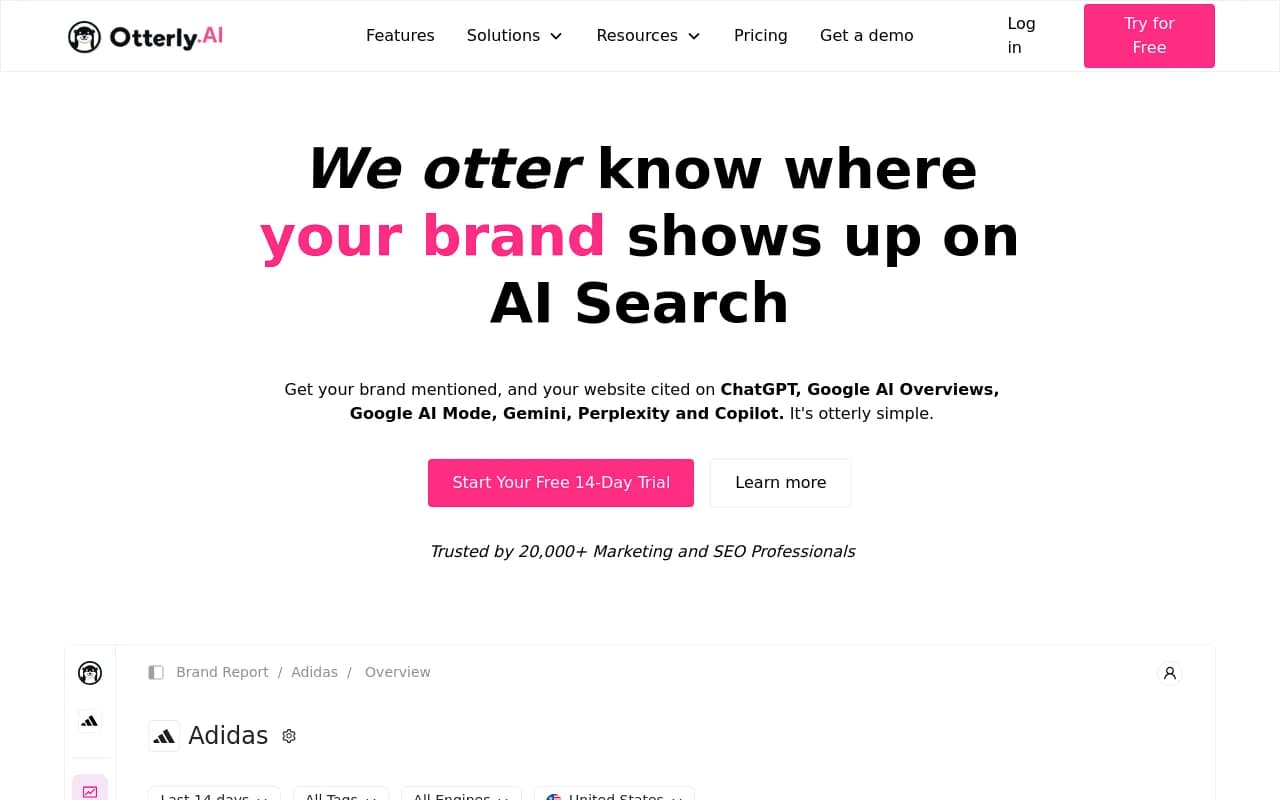
The dashboard is clean and fast. Visibility scores are easy to interpret. For a solo marketer or a small brand that just wants to know "are we showing up in ChatGPT when people ask about our category?" -- Otterly answers that question without overwhelming you.
The limitation is that it stops there. You see the score. You don't get told what to do about it. And if ChatGPT is saying something inaccurate about your brand -- wrong pricing, a feature you don't have, a competitor's product attributed to you -- Otterly will log the mention as a positive and move on.
Where Peec AI actually shines
Peec AI's multi-language support is the real story. If you're a European brand, a global agency, or a company where a significant chunk of your customers aren't searching in English, Peec AI was one of the only tools in 2025 that could actually track AI visibility across languages without requiring a separate setup for each market.
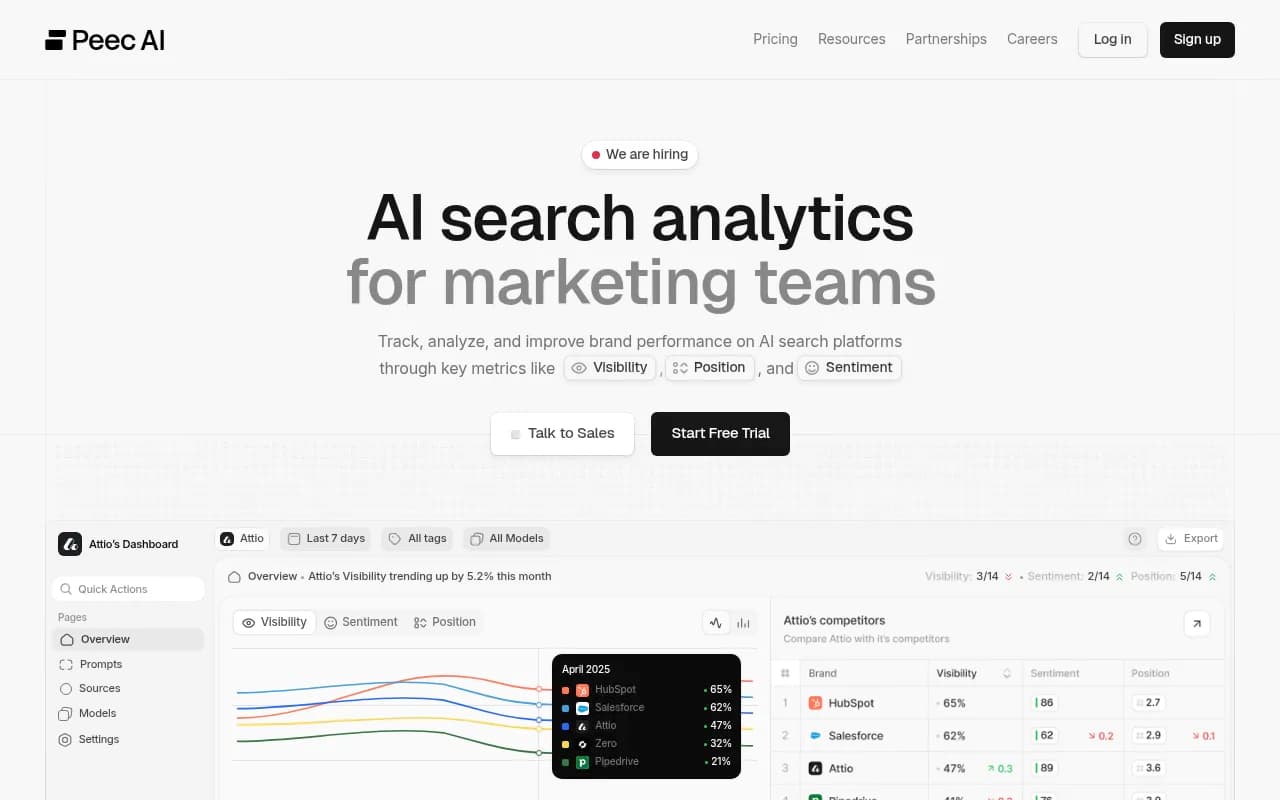
The smart prompt suggestions are also worth mentioning. Rather than requiring you to manually build out a prompt list, Peec AI helps surface the questions that are actually being asked in your category. For teams that are new to AI visibility work, this reduces the time-to-insight considerably.
Where Peec AI falls short is the same place Otterly does: it tells you what's happening but not what to do about it. There's no content generation, no gap analysis that connects to an action, and no traffic attribution to close the loop between AI mentions and actual revenue.
Where Promptwatch pulls ahead
The core difference isn't any single feature. It's the loop.
Most teams using Otterly or Peec AI in 2025 ended up in the same place: a dashboard full of data, and a separate workflow to figure out what to write, where to publish it, and whether it worked. That workflow usually involved a content team, a separate SEO tool, and a lot of manual effort connecting the dots.
Promptwatch collapses that into one platform. The Answer Gap Analysis shows you the exact prompts where competitors are visible and you're not -- not as a vague category observation, but as specific questions with prompt volume estimates and difficulty scores. The built-in AI writing agent then generates articles, listicles, and comparisons grounded in citation data from 880M+ analyzed citations. And page-level tracking shows which of your pages are being cited by which AI models, how often, and what traffic that's generating.
The AI Crawler Logs feature is worth calling out specifically. Seeing in real time which pages ChatGPT, Claude, and Perplexity are actually crawling -- and which ones they're ignoring or hitting errors on -- is the kind of technical insight that most monitoring tools don't touch at all.
For agencies, the multi-site support and Looker Studio integration make client reporting significantly less painful. And the Reddit and YouTube tracking surfaces the discussions that are actually shaping AI recommendations in a given category -- a channel that most tools ignore entirely.
Who should use which tool
This isn't a "one tool wins" situation. The right answer depends on what you're actually trying to do.
If you're a solo marketer or small brand that wants basic AI visibility monitoring without spending much, Otterly.AI at $29/month is a reasonable starting point. You'll know where you stand. You won't know how to improve it, but at least you'll have the data.
If you're running campaigns across multiple languages or managing international clients, Peec AI's multi-language support is a genuine differentiator that Otterly and even Promptwatch's base plans don't fully match. It's the right tool for that specific problem.
If you're a marketing team, SEO team, or agency that needs to actually improve AI visibility rather than just measure it, Promptwatch is the only one of the three that's built for that job. The monitoring is solid, but the content generation, gap analysis, and traffic attribution are what separate it from the other two.
One thing worth noting: the tools aren't mutually exclusive. Some teams in 2025 used Otterly for quick daily checks and Promptwatch for the strategic work. That's a reasonable approach if budget allows.
The accuracy problem nobody talks about
There's a dimension to AI visibility that all three tools handle differently, and it's worth raising directly.
AI models hallucinate. They quote wrong prices. They attribute features to the wrong product. They invent integrations that don't exist. A tool that counts your brand mentions without flagging whether those mentions are accurate is giving you an incomplete picture -- and potentially a misleading one.
Otterly and Peec AI both count mentions and report sentiment. Neither flags factual errors in what AI models are saying about you. This is a real gap. If ChatGPT is telling your prospects that your pricing is 60% higher than it actually is, a healthy mention count in your dashboard is cold comfort.
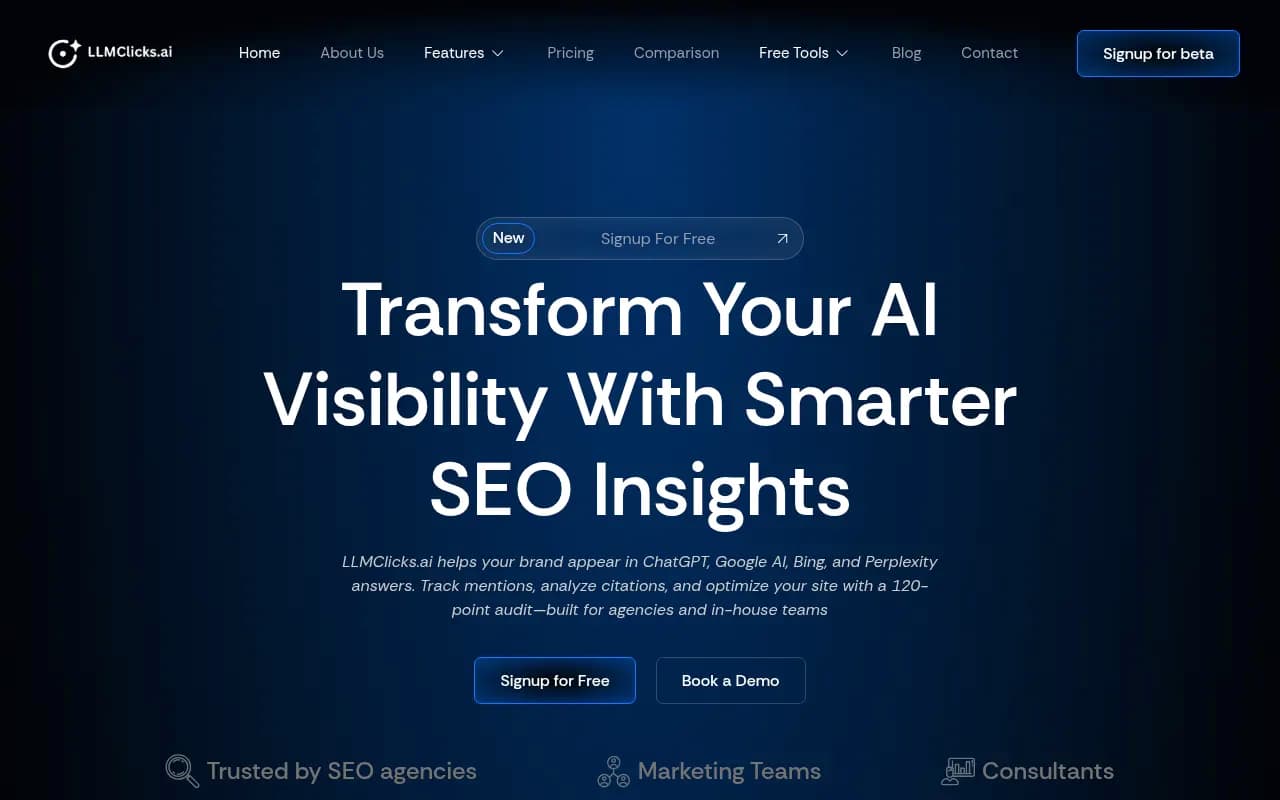
Promptwatch's citation and source analysis helps here -- you can see exactly what's being said and in what context -- but dedicated hallucination detection is still an emerging capability across the whole category. Tools like LLMClicks are specifically focused on this problem if accuracy monitoring is your primary concern.
The verdict
Looking back at 2025, the teams that got the most value from AI visibility tools were the ones that treated it as an optimization problem, not a monitoring problem. Watching your visibility score is interesting. Improving it requires a different kind of tool.
Otterly.AI and Peec AI are good at what they do. They're honest monitoring tools with specific strengths -- affordability for Otterly, multi-language coverage for Peec. If those are your constraints, they're worth considering.
But if the goal is to actually rank in AI search -- to get cited by ChatGPT when someone asks about your category, to close the gap on competitors who are showing up and you're not -- then Promptwatch is the platform that's built for that. It's the only one of the three that takes you from "here's where you're invisible" to "here's the content that will fix it" to "here's proof it worked."
That's a different product. And in 2026, as AI search continues to take traffic from traditional search, the difference between monitoring and optimizing is only going to matter more.