Key takeaways
- AI systems evaluate each location on its own evidence. A strong brand name does not rescue a location with a thin page, a stale profile or conflicting data.
- SOCi's 2026 Local Visibility Index (350,000+ locations, 2,751 brands) found ChatGPT recommends only 1.2% of local business locations. Brand-level visibility scores hide that gap.
- The most common failures are boring ones: incomplete profiles, duplicate location pages, inconsistent listings, review drift and tracking only brand-level prompts.
- Most fixes are governance problems, not content problems. Someone has to own location data, and drift has to be visible early.
- Track visibility per location and per market, not as one blended number.
Why local GEO breaks differently for multi-location brands
A single-location business has one profile, one page and one set of reviews. A brand with 400 locations has 400 of each, plus every directory, map app and aggregator that republishes them. Each one can quietly go wrong.
AI engines make this worse. Traditional local search returns a list, and a mediocre location can still show up on page two. AI answers produce a shortlist. As Uberall puts it from its work across roughly 1.4 million managed locations, models "generate a shortlist of local businesses, not endless search results." You are either on the shortlist or you are not.
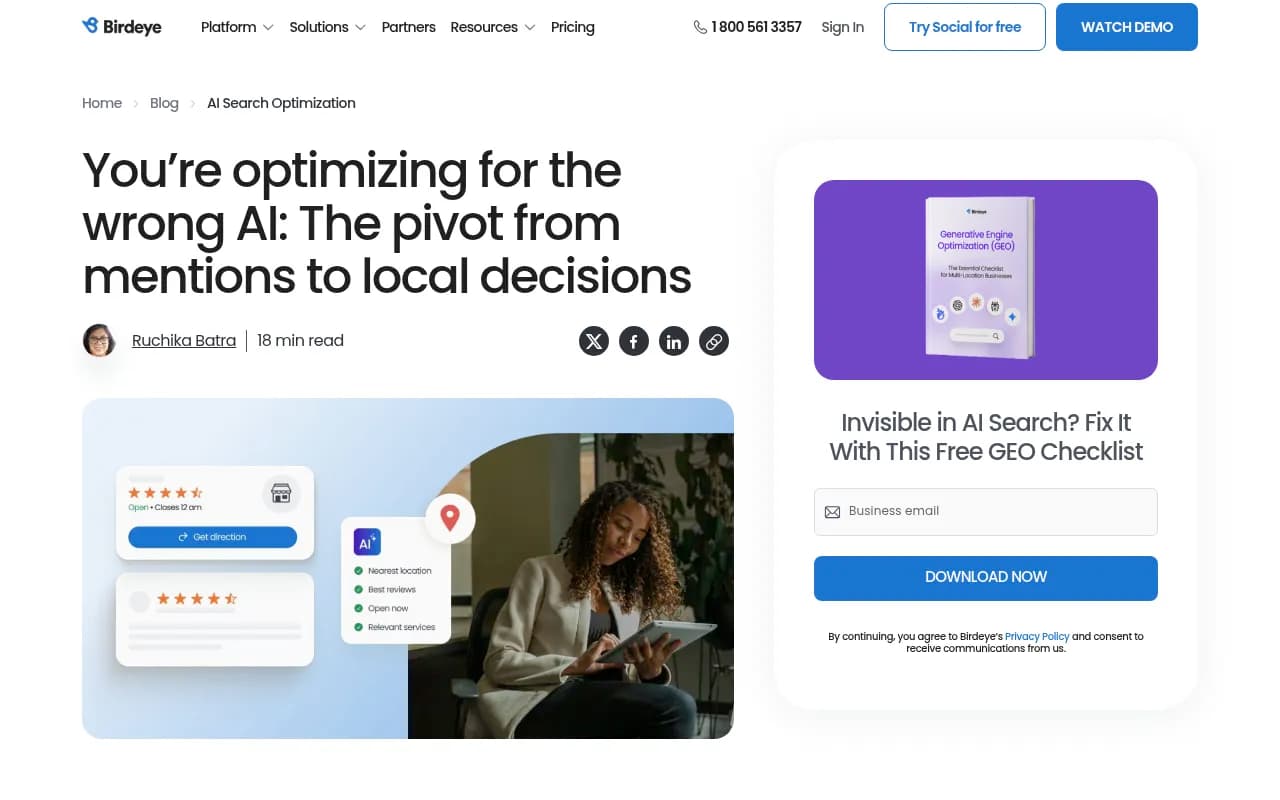
There is also a measurement trap. Birdeye makes the point in its AI visibility series that showing up is the wrong question. The real question is whether AI recommends the specific location a customer is near, with the right hours, services and reviews. A brand can report a healthy overall visibility score while a third of its locations are effectively absent.
Here is the data point worth sitting with. The SOCi figure of 1.2% of locations recommended by ChatGPT comes via a March 2026 press release from MapAtlas, and the same release cites research showing only about a 45% overlap between brands that do well in traditional local search and those that appear in AI recommendations. Treat the exact numbers as directional, since I have not independently re-verified them. The direction is hard to argue with: ranking well on Google does not carry over automatically.
Mistake 1: Incomplete or incorrect profiles
This is the dullest mistake and the most damaging.
Uberall describes auditing a brand with about 600 branches whose Apple Maps listings were unclaimed. Nobody at the company controlled listings across an entire platform. Another case involved a restaurant chain with two locations in the same town. One was permanently closed, the other open, and both listings pointed at the wrong URLs. The open location had no local page. Google and AI tools were reading a confused story about the brand in that town.
Completeness matters in measurable ways. In the Uberall research cited in their post, hotels with 6 to 10 profile attributes were mentioned 22% of the time. At 31 to 50 attributes, that rose to 94%. That is one vertical and one study, so do not generalize the number. But it matches what you would expect: models cannot recommend a location for "pet-friendly with parking" if the profile never says so.
What to do:
- Claim and verify every location on Google, Apple Maps and Bing, not just Google.
- Fill every attribute that exists for your category: services, payment types, accessibility, parking, amenities, languages.
- Close or mark duplicates and permanently closed locations properly rather than leaving them live.
- Make sure each profile links to its own location page, not the homepage.
Listing platforms built for this job include [tool:yext], [tool:uberall], [tool:synup], [tool:brightlocal] and [tool:moz-local]. They differ in depth and price, so check current pricing with each vendor.
Mistake 2: Duplicate, templated location pages
Copying a location page, swapping the city name and publishing 300 of them is still the default for many brands. V9 Digital describes the usual pattern: identical service descriptions, the same testimonials repeated in every city and almost no local detail. Their point, which I agree with, is that pages without unique local content tend to perform poorly because both search engines and AI systems look for real local relevance.
For AI specifically, the useful local signals are things a template cannot fake:
- Precise address and coordinates
- Nearby landmarks, neighborhoods and transit options
- Staff, team or manager names for that site
- Local FAQs (parking, opening hours on holidays, which services this site offers)
- Reviews and photos from that location
The MapAtlas release frames this as structured geo signals: coordinates, landmark references, neighborhood context, FAQ sections and schema markup. A clinic without schema identifying its specialty and service radius may simply not exist in AI-generated results, even if it ranks fine in classic search.
Promptwatch's own data supports putting effort into these pages. In Promptwatch Data's content-type report (Sep 28 to Oct 4, 2026), product pages made up 22.4% of classified ChatGPT citations and landing pages 16.8%. The report does not break out local prompts, so treating location pages as landing pages is my inference. Still, it suggests the page that describes what you sell in a specific place is the page models reach for. The report's advice is to keep those pages complete and factual, add FAQ pages and collect reviews on trusted sites.
A practical template that avoids the duplicate trap: keep a shared skeleton for structure, but require a minimum set of fields that are unique per location before a page can publish. If a store manager cannot fill in the local FAQ and the landmarks, the page is not ready.
Structured data helps here. [tool:schema-app] handles schema at scale, and [tool:yoast-seo] covers the basics on WordPress.
Mistake 3: Inconsistent listings and citations
Conflicting details across sources raise doubt for search engines, AI tools and customers. Different phone number formats are the classic example, but the list is long: suite numbers, abbreviated street names, old hours, a former brand name still live on an aggregator.
V9 Digital's retail case study listed the symptoms they found across hundreds of locations: inconsistent location page structure, fragmented citation management, underdeveloped Google Business Profiles and a mismatch between GBP data and the on-site contact information. Sound familiar? Most enterprise audits turn up the same pattern.
It matters more for AI because models cross-check. If your page says open until 9pm and an aggregator says 6pm, the model has a reason to hedge or skip you. Birdeye describes AI engines as live-checking location data, so stale inputs cost you in real time, not just at the next crawl.
Aggregators also tend to win citations outright in some verticals. In Promptwatch Data's vertical reports, for automotive prompts in August 2026 marketplaces like Autotrader and Cars.com outrank every car brand in ChatGPT citations (automotive report). For travel, booking and search sites earn more than half of citations, led by Skyscanner, Going and Tripadvisor (travel report). Your own domain is not the only place a location can be cited, so listings on those third-party platforms are part of the job.
Mistake 4: Letting review drift go unmanaged
Birdeye's central argument is that visibility erodes through drift: slowing review velocity, weakening sentiment, stale pages and inconsistent profile data that quietly make some locations less eligible for AI discovery. I think that framing is right. Nobody decides to become invisible. A location's reviews just slow down after a manager leaves, and six months later it has dropped off shortlists.
What drift looks like in practice:
- A location that got 15 reviews a month now gets two
- Negative reviews sit unanswered for weeks
- Profile hours still show last year's holiday schedule
- A rebrand updated the homepage but not 80 location pages
Reviews also carry more weight when the prompt names a brand. In the Promptwatch content-type report, branded prompts lift reviews to 5.6% of citations, more than 3x their share across all prompts. People asking about you specifically get reviews pulled in.
Fix it with ownership and thresholds. Pick a minimum review velocity per location, flag anything under it weekly and make a named person accountable for each region. Review platforms like [tool:birdeye], [tool:podium], [tool:reputation-com], [tool:reviewtrackers] and [tool:nicejob] can automate requests and responses. [tool:chatmeter] and [tool:soci] cover multi-location reputation and local social.
Mistake 5: Measuring only at the brand level
This is where the other mistakes hide. A single AI visibility score averaged over all your locations tells you the brand is mentioned. It does not tell you that 120 locations never appear.
Birdeye's LinkedIn post on this topic puts it bluntly: in AI-powered search, some of your locations are invisible even when the aggregate looks fine.
Uberall has a related warning about prompt sets: most brands either rush the prompt set or track thousands of prompts they never look at. Neither works. A workable multi-location prompt set is structured like this:
| Layer | Example prompt | What it tells you |
|---|---|---|
| Brand + city | "Best [category] in Leeds" | Whether you appear for the market |
| Near-me intent | "[service] open now near [neighborhood]" | Whether the right location is chosen |
| Branded | "[Brand] Leeds opening hours" | Whether data is accurate |
| Comparison | "[Brand] vs [competitor] in Leeds" | Who wins head to head |
| Long-tail attribute | "[category] with parking and weekend appointments" | Whether attributes are surfaced |
Track a sample of locations per tier (flagship, mid-volume, underperforming) rather than all of them at once, then widen once you see patterns. Country tracking is standard on tools like Promptwatch, and state or city tracking comes in from its Business plan, which matters for local work. Confirm current plans at promptwatch.com/pricing.

Other options for AI visibility monitoring include [tool:profound], [tool:scrunch], [tool:otterly-ai], [tool:peec-ai] and [tool:semrush]. Some are monitoring-only, so check whether they can segment by location. For local-specific AI visibility, [tool:tibly] targets local businesses, and the GEO directory at bestgeosoftware.com lets you compare more.
Mistake 6: Treating Google as the only platform
Birdeye calls the single-platform strategy a trap. Different engines pull from different places, and the differences are large enough to change your plan.
From Promptwatch Data's social media citations report (Sep 28 to Oct 4, 2026):
| Engine | Share of citations from social platforms | Notes |
|---|---|---|
| ChatGPT | 0.46% | Reddit fell from 5.19% to 0.09%; LinkedIn is the top social source at 0.3% |
| Perplexity | 2.7% | LinkedIn and Reddit tie at 0.86%, YouTube 0.79% |
| Google AI Overviews | 12.2% | YouTube 4.28%, Facebook 2.38%, Reddit 2.15%, Instagram 1.61% |
For a local brand whose customers search on Google, that matters. Public Facebook pages and Instagram profiles for each location are worth keeping complete and active, and local YouTube videos are worth making. Promptwatch's recommendation is to invest in YouTube first, then Facebook and Instagram, and not to rely on Reddit for ChatGPT. Reddit's share of ChatGPT citations also dropped from roughly 4% to 0.5% on August 14, 2026, per Promptwatch's Reddit report, so a strategy built on Reddit threads for local discovery is shaky.
Also check Apple Maps and Bing Places, not only Google Business Profile. Models draw from map data that is not Google's.
Mistake 7: Writing local pages that do not match how AI searches
AI engines break a question into several searches. Promptwatch's ChatGPT query fanouts data shows average query length falling from about 117 characters in December 2025 to about 53 characters from April 2026. Short queries favor headings that read like short search queries, with the entity and category first.
For local pages, that suggests leading with service plus city, then covering the sub-questions fanouts tend to produce: pricing, comparisons, alternatives and how-tos. A page titled "Our Leeds location" is weaker than "Emergency dental care in Leeds city centre" with a section on costs and one on how to book.
One more thing worth watching. Promptwatch Data reports that on August 8, 2026, ChatGPT began using the site: operator at scale, from about 0.4% to about 17% of fanout queries (site: operator report). I have not verified how this affects location pages, but brands with locations on their own domain should check whether those pages are discoverable that way, with clear titles and crawlable URLs.
Mistake 8: Forgetting that pages go stale
Local pages are not publish-and-forget. Promptwatch's content half-life report found that among pages ChatGPT cited on July 6, 2026, landing pages and docs stayed cited longest, while news lost half its pages within 36 days. Evergreen location pages have a durable edge, but only if the facts stay correct.
Build a refresh cadence:
- Quarterly: review hours, services, staff and FAQs per location
- On change: update every channel when a location moves, closes, rebrands or adds a service
- After events: holidays, seasonal menus, temporary closures
A crawl tool such as [tool:screaming-frog-seo-spider] helps find stale templates, and [tool:google-search-console] shows which location pages actually get impressions.
A simple audit order for multi-location teams
If you do not know where to start, work in this order. It follows cost against impact.
- Export all locations and compare against the source of truth. Count unclaimed, duplicate or closed-but-live listings.
- Fix the data layer: name, address, phone, hours, categories, attributes across Google, Apple and Bing.
- Audit location pages for unique content and schema. Mark pages that are pure templates.
- Check review velocity and response rate per location. Flag the bottom 20%.
- Build a tiered prompt set and sample 30 to 50 locations. Compare AI visibility to Google local performance.
- Assign owners per region and set a monthly drift report.
If you want outside help, an SEO and GEO agency like 1001 SEO Media works on technical, content and AI search visibility together, and can slot into a multi-location workflow. The tools above are enough to get started in-house.
What to compare when choosing tools
| Job | What to look for | Example tools |
|---|---|---|
| Listings management | Multi-platform sync, duplicate suppression, Apple Maps and Bing coverage | Yext, Uberall, Synup, BrightLocal |
| Reviews and reputation | Request automation, response workflows, per-location reporting | Birdeye, Podium, Reputation.com |
| Structured data | Schema at scale, location-level markup | Schema App, Yoast SEO |
| AI visibility tracking | Per-location or per-city prompts, multi-model coverage, citation data | Promptwatch, Profound, Scrunch, Otterly.AI |
| Local social | Location-level pages and publishing | SOCi, Hootsuite |
No single tool covers all of this cleanly. Most teams end up with a listings platform, a reviews platform and a visibility tracker, and the real work is getting their data to agree.
The bottom line
The pattern across Birdeye, Uberall, V9 Digital and the SOCi index is the same: AI recommendations are decided location by location, and the inputs are ordinary things like profile completeness, page quality, listing consistency and review activity. Brands that stay visible treat local presence as an operating discipline with owners and alerts. Start with the 20% of locations that look weakest on those four inputs, because that is where the shortlist gaps are.