Summary
- Prompt volume metrics are modeled estimates based on controlled testing, not real user behavior -- most platforms sample 100-500 prompts and extrapolate to millions
- Reliable validation requires understanding data sources (scraped vs API), testing methodology (sample size, refresh frequency), and whether the vendor discloses confidence intervals
- Focus on actionable metrics like citation share, source analysis, and traffic attribution instead of vanity numbers
- Cross-reference multiple tools and validate against your own analytics (GSC, CRM, server logs) to build a complete picture
- The goal isn't perfect accuracy -- it's knowing which decisions your data can actually support this quarter
The uncomfortable truth about prompt volume
You've seen the pitch: "Track your brand's visibility across 10 AI models. Monitor 500,000 prompts. See exactly how often you're cited."
It sounds like the AI equivalent of keyword search volume -- a clean, quantifiable metric you can report to leadership. The problem? It's mostly fiction.
Prompt volume is built on tiny data samples and massive extrapolations. A platform might test 200 prompts, see your brand mentioned in 15 responses, then multiply that by some proprietary "total addressable prompt market" number to tell you you're getting 47,000 monthly citations. The math is real. The underlying assumptions are not.
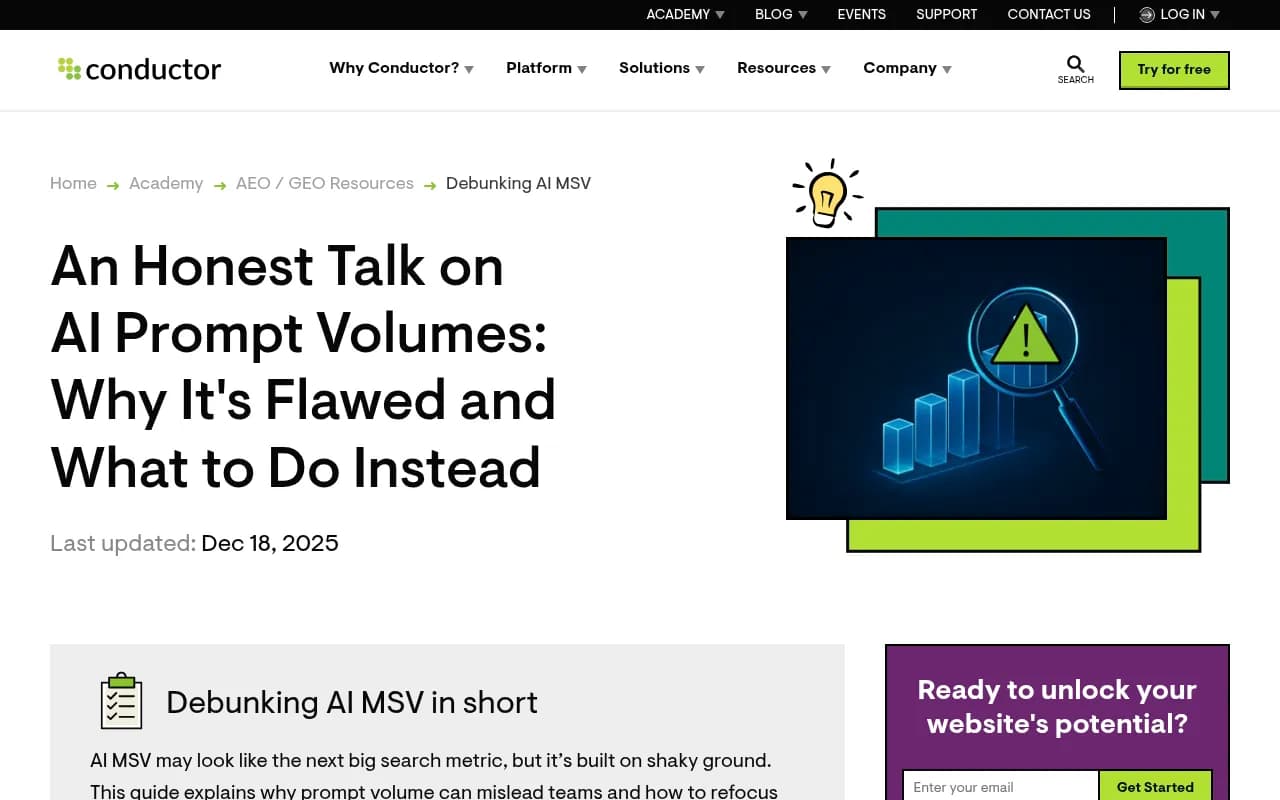
This isn't a conspiracy. It's a data availability problem. Unlike Google, which publishes search volume data through Keyword Planner, AI platforms like ChatGPT, Claude, and Perplexity don't share prompt data. There's no API endpoint that tells you "47,328 people asked about project management software this month." Vendors are forced to model it.
The question isn't whether prompt volume is flawed -- it is. The question is whether you can still use it to make better decisions.
Why traditional search volume worked (and AI prompt volume doesn't)
Keyword search volume was the cornerstone of SEO for two decades because it was built on three pillars:
- Direct data access: Google aggregated billions of real searches and published monthly volumes
- Stable user behavior: People typed predictable queries into a search box
- Transparent methodology: You knew exactly what "5,400 monthly searches" meant
AI prompt volume has none of these.
No direct data access: AI platforms treat prompt data as proprietary. Vendors must either scrape responses (which shows what the AI said, not what users asked) or run controlled tests (which means they're inventing the prompts themselves).
Unstable user behavior: People don't prompt AI models the way they search Google. A single conversation might include 10 follow-up questions, each refining the previous answer. Is that 10 prompts or one? How do you count multi-turn dialogues?
Opaque methodology: Most vendors won't tell you how they model volume. They'll show you a dashboard with confident numbers but won't disclose sample sizes, confidence intervals, or how they extrapolate from 500 test prompts to "2.3 million monthly queries."
This creates a dangerous illusion of precision. You're not measuring reality -- you're measuring a model of reality built on assumptions you can't verify.
The data source problem: Scraped vs API vs synthetic
How a platform collects AI responses determines what it can actually measure. There are three approaches, each with tradeoffs:
Scraped data (what real users see)
Some tools scrape public AI responses -- they capture what ChatGPT, Perplexity, or Claude actually show to users. This is the closest thing to "ground truth" because it reflects real output.
Pros: Shows actual citations, real formatting, live links. You see what users see.
Cons: Scraped data is expensive and legally gray. Platforms may throttle or block scrapers. You're limited to public responses (can't scrape logged-in ChatGPT sessions). Sample sizes are small.
API data (controlled but limited)
Other tools use official APIs (OpenAI API, Anthropic API, etc.) to query models programmatically. This is cleaner and more scalable.
Pros: Stable, repeatable, no legal risk. You can test thousands of prompts quickly.
Cons: API responses often differ from what users see. ChatGPT's web interface includes citations, shopping carousels, and rich formatting -- the API returns plain text. You're measuring a different product.
Synthetic prompts (modeled demand)
Most platforms generate their own test prompts based on keyword research, competitor analysis, or user surveys. They're not measuring real user queries -- they're modeling what users might ask.
Pros: You can test any topic, any angle, any persona. Full control over the prompt set.
Cons: If your prompt set is wrong, your entire dataset is wrong. Garbage in, garbage out.
The best tools combine all three: scrape when possible, use APIs for scale, and validate with real user research. But most vendors pick one approach and extrapolate wildly.
Red flags: How to spot unreliable prompt volume claims
When evaluating an AI visibility tool, ask these questions. If the vendor can't answer them, the data is suspect.
1. What's your sample size?
If a platform claims to track "500,000 prompts" but only tests 200 per month, they're extrapolating 2,500x. That's not measurement -- it's speculation.
Good answer: "We test 5,000 prompts per month across 10 models, refreshed weekly. Here's our prompt distribution by category."
Bad answer: "We track millions of prompts" (without disclosing how many they actually test).
2. How do you model volume?
Most platforms multiply their sample results by some "total addressable market" estimate. Where does that number come from?
Good answer: "We use search volume as a proxy, adjusted by a 0.3x conversion factor based on our user research showing 30% of Google searches migrate to AI."
Bad answer: "Proprietary algorithm" or "industry benchmarks" (without citing sources).
3. What's your confidence interval?
If you're extrapolating from a sample, you need error bars. A 95% confidence interval tells you the range where the true value likely falls.
Good answer: "Your estimated monthly citations are 12,000 ± 3,500 (95% CI)."
Bad answer: "12,000 citations" (presented as a precise, reliable number).
4. How often do you refresh data?
AI models update constantly. ChatGPT's training data, citation sources, and response formatting change every few weeks. If a tool tests prompts once and never re-runs them, the data decays fast.
Good answer: "We re-test all prompts weekly and flag significant changes."
Bad answer: "We update our database monthly" (without re-testing old prompts).
5. Can you show me the raw prompts?
If a vendor won't show you the actual prompts they tested, you can't evaluate whether they're realistic.
Good answer: "Here's our full prompt library. You can filter by category, add custom prompts, and see response history."
Bad answer: "Our prompts are proprietary" or "We use AI to generate prompts" (without human review).
What to measure instead: Metrics that actually matter
Prompt volume is a vanity metric. It's big, impressive, and mostly useless for decision-making. Here's what to track instead:
Citation share (not absolute mentions)
Instead of "How many times are we mentioned?", ask "What percentage of relevant responses cite us vs competitors?"
If ChatGPT answers 100 prompts about project management software and cites Asana in 45, Monday.com in 38, and you in 12, your citation share is 12%. That's actionable -- you know you're losing to two competitors and can analyze why.
Most AI visibility tools show citation share as a heatmap or leaderboard. Look for tools that let you drill down by prompt category, model, and time period.
Source analysis (where citations come from)
AI models cite specific URLs, not just brand names. Which pages are getting cited? Are they your blog posts, product pages, or third-party reviews?
Actionable insight: If competitors are cited from Reddit threads and YouTube videos while you're only cited from your own blog, you have a distribution problem. Publish where AI models are already looking.
Promptwatch surfaces Reddit discussions and YouTube videos that influence AI recommendations -- a channel most competitors ignore entirely.

Traffic attribution (did visibility drive revenue?)
The ultimate validation: did AI visibility translate to actual traffic and conversions?
Connect your AI visibility tool to Google Search Console, your CRM, or server logs. Track referrals from ChatGPT, Perplexity, and other AI platforms. Measure how many visitors came from AI citations and whether they converted.
Warning: AI referral traffic is still tiny for most brands (< 1% of total traffic). Don't expect hockey-stick growth yet. But if your visibility score doubles and traffic stays flat, your data is wrong.
Answer gap analysis (what you're missing)
Instead of obsessing over how often you're mentioned, focus on where you're invisible. Which prompts do competitors dominate that you don't appear in at all?
This is the most actionable metric. It tells you exactly what content to create.
Example: If competitors are cited for "best project management software for remote teams" but you're not, you need a page targeting that angle. If they're cited from Reddit AMAs and you're not on Reddit, you need a community strategy.
Tools like Promptwatch show exactly which prompts competitors are visible for but you're not, then help you generate content grounded in real citation data to close the gap.
How to validate your AI visibility data
You can't trust a single tool's numbers. Here's how to cross-check and build confidence:
1. Compare multiple tools
Sign up for 2-3 AI visibility platforms and run the same prompt set. Do they agree on your citation share? If one tool says you're cited 40% of the time and another says 8%, something's broken.
Tools to compare:
| Tool | Data source | Sample size | Refresh frequency | Best for |
|---|---|---|---|---|
| Promptwatch | Scraped + API | 5,000+/mo | Weekly | Action-oriented teams |
| Otterly.AI | API | 500+/mo | Monthly | Budget monitoring |
| Profound | Scraped | 2,000+/mo | Bi-weekly | Enterprise reporting |
2. Validate against your own analytics
Check Google Search Console for queries like "ChatGPT recommended [your brand]" or "Perplexity says [your product]." If users are discovering you through AI, they'll search for you afterward.
Look for spikes in branded search volume that correlate with AI visibility changes. If your citation share doubled but branded search stayed flat, your visibility data is probably inflated.
3. Run your own tests
Don't outsource all testing to vendors. Open ChatGPT, Claude, and Perplexity yourself and run 20-30 prompts relevant to your business. Take screenshots. Track which competitors appear and where.
This is slow and manual, but it's the only way to know what real users actually see. If your vendor says you're cited 30% of the time but you never see your brand in your own tests, trust your tests.
4. Track AI crawler logs
AI models crawl your website to gather training data and citation sources. If ChatGPT, Claude, or Perplexity bots are hitting your site, you'll see them in server logs.
Tools like Promptwatch provide real-time logs of AI crawlers hitting your website -- which pages they read, errors they encounter, how often they return. If crawlers aren't visiting your site, you won't be cited.
5. Ask your customers
The simplest validation: survey your customers. "How did you first hear about us?" If 10% say "ChatGPT recommended you," your AI visibility is real. If zero say that, your dashboard is lying.
The action loop: From metrics to decisions
Validating prompt volume isn't the goal. Making better decisions is.
Here's the framework that actually works:
Step 1: Find the gaps
Use answer gap analysis to identify prompts where competitors are cited but you're not. Focus on high-value, winnable prompts -- not every prompt matters equally.
Look for:
- Prompts with high search volume (proxy for demand)
- Prompts where 2-3 competitors dominate (not 10+)
- Prompts where your product is actually relevant (don't chase irrelevant visibility)
Step 2: Create content that ranks in AI
Don't write generic SEO filler. AI models want specific, detailed, well-sourced content that answers the exact question asked.
What works:
- Comparison articles ("X vs Y: Which is better for Z?")
- Use case guides ("How to do X with Y")
- Data-driven listicles ("10 tools for X, ranked by Y")
- Reddit-style discussions (real opinions, not marketing fluff)
What doesn't work:
- Thin product pages with no context
- Keyword-stuffed blog posts
- Gated content (AI models can't cite PDFs behind forms)
Tools like Promptwatch generate articles, listicles, and comparisons grounded in real citation data, prompt volumes, and competitor analysis -- content engineered to get cited by ChatGPT, Claude, and Perplexity.
Step 3: Track the results
Monitor your citation share for the prompts you targeted. Did it improve? Which pages are getting cited? How often?
Connect visibility to traffic. Did the new content drive referrals from AI platforms? Did those visitors convert?
Close the loop: If visibility improved but traffic didn't, your content is being cited but not clicked. Optimize your meta descriptions, add clear CTAs, or publish on higher-authority domains.
If traffic improved but conversions didn't, your landing pages are the problem -- not your AI visibility.
Comparison: Monitoring-only tools vs optimization platforms
Most AI visibility tools are dashboards. They show you data but leave you stuck. A few platforms help you take action.
| Feature | Monitoring-only tools | Optimization platforms |
|---|---|---|
| Citation tracking | ✓ | ✓ |
| Competitor analysis | ✓ | ✓ |
| Answer gap analysis | ✗ | ✓ |
| Content generation | ✗ | ✓ |
| AI crawler logs | ✗ | ✓ (Promptwatch, Profound) |
| Traffic attribution | ✗ | ✓ (Promptwatch, Evertune) |
| Reddit/YouTube insights | ✗ | ✓ (Promptwatch) |
| Prompt difficulty scoring | ✗ | ✓ (Promptwatch, Scrunch) |
The difference: monitoring tools tell you where you're invisible. Optimization platforms show you what's missing, then help you fix it.
The real question: What decision will this data change?
Before you buy an AI visibility tool or obsess over prompt volume, ask: "What decision will this data change this quarter?"
If the answer is "We'll create content for high-value prompts we're missing," the data is useful.
If the answer is "We'll report our AI visibility score to leadership," you're chasing a vanity metric.
AI visibility is measurable. But only if you narrow the question to "What should we do differently?" not "How visible are we?"
The platforms that help you answer that question -- tools like Promptwatch, Profound, and Evertune -- are worth the investment. The ones that just show you a number are not.
Final thoughts: Accuracy is a spectrum, not a binary
You'll never have perfect data. Prompt volume will always be modeled, extrapolated, and uncertain.
That's fine.
The goal isn't perfect accuracy. The goal is knowing which decisions your data can support and which it can't.
If your tool says you're cited 12% of the time ± 4%, you know you're somewhere between 8% and 16%. That's enough to prioritize prompts, create content, and track improvement.
If your tool says you're cited 12.3% of the time with no error bars, no disclosed methodology, and no way to validate it -- that's fake precision. Ignore it.
Validate your data. Cross-check multiple sources. Focus on actionable metrics. And remember: the best AI visibility strategy isn't built on perfect numbers. It's built on closing the loop between what you measure and what you do about it.