Key takeaways
- Google Search Console is the most reliable free tool for checking AI Overview appearances, but the data has real limitations you need to understand
- Manual spot-checking in Google Search is still the fastest way to confirm whether your content is being cited right now
- AI Overviews don't appear for every query -- they favor informational, research-oriented questions over transactional ones
- Appearing in AI Overviews doesn't always mean more clicks; it can actually reduce them
- Dedicated AI visibility platforms give you systematic tracking across multiple queries and AI engines, not just Google
Google AI Overviews have been live in the US since May 2024, and by 2026 they've expanded to over 100 countries and cover a huge share of informational search queries. If you run a website, the question of whether you're appearing in them -- or getting squeezed out by them -- matters a lot for your traffic strategy.
The frustrating part is that checking your AI Overview visibility isn't as simple as looking up your keyword rankings. There's no single dashboard that says "you appeared in 47 AI Overviews this week." You have to piece it together from a few different sources. This guide walks through each one.
What Google AI Overviews actually are (quick context)
Before checking your visibility, it helps to know what you're looking for. AI Overviews are the AI-generated summaries that appear at the top of Google Search results for certain queries. They pull information from multiple web sources, sometimes cite those sources with links, and give users a direct answer without requiring a click.
They're triggered most often by:
- How-to and instructional questions ("how do I fix a leaky faucet")
- Comparison queries ("difference between X and Y")
- Research-style questions with multiple angles
- Queries where Google thinks a synthesized answer adds value
They're much less common for transactional queries ("buy running shoes"), local searches, and navigational searches ("Facebook login"). So if your site is primarily e-commerce or local services, you may see fewer AI Overviews for your core queries -- which isn't necessarily bad news.
Method 1: Google Search Console (the most reliable free option)
Google Search Console is your starting point. Google added AI Overview-specific data to Search Console, and while it's not perfect, it's the most authoritative source you have.
How to find AI Overview data in Search Console
- Open Google Search Console and select your property
- Go to "Search results" under the Performance section
- Click "Search type" and make sure you're looking at "Web" results
- Look for the "Search Appearance" filter -- this is where AI Overview data lives
Google added an "AI Overviews" filter to the Search Appearance options. When you apply it, you'll see impressions and clicks specifically from queries where your site appeared in an AI Overview.
What the data shows (and what it doesn't)
The Search Console AI Overview report shows:
- Impressions: how many times your page appeared as a source in an AI Overview
- Clicks: how many times users clicked through from the AI Overview to your page
- Click-through rate: clicks divided by impressions
What it doesn't show clearly is which specific queries triggered the AI Overview, or exactly how your content was used. The query-level data is there, but it's often aggregated or anonymized for lower-volume terms.
One thing worth knowing: CTR from AI Overviews tends to be lower than from regular organic results. Users are getting their answer from the overview itself, so fewer feel the need to click through. Seeing high impressions with low clicks is completely normal here -- it doesn't mean something is broken.
The impression spike trick
A useful technique from the SEO community: filter your queries by those with a sudden spike in impressions but no corresponding click increase. These are often queries where Google started showing an AI Overview that includes your content. The overview answers the question, so clicks stay flat even as impressions rise.
Method 2: Manual spot-checking in Google Search
This sounds low-tech, but it's genuinely useful for confirming what's happening for specific queries you care about.
How to do it properly
Open an incognito/private browser window (this removes your personalization and search history from the results). Search for the queries you want to check. If an AI Overview appears, look for the source links -- usually shown as small cards or expandable citations within or below the overview text.
If your site appears as a source, you'll see your domain name and page title cited there.
A few things to keep in mind:
- AI Overviews don't appear 100% of the time for the same query. Google tests and varies them, so you might see one on one search and not on the next.
- Results vary by location. If you're in the UK checking a query that's primarily US-targeted, you may see different results than your actual audience does.
- Results can vary by device. Mobile and desktop sometimes show different AI Overview behavior.
For a more systematic manual check, build a list of your 20-30 most important informational queries and check them weekly. It's tedious but gives you a ground-level view of what's actually showing up.
Method 3: Dedicated AI visibility tracking tools
Manual checks and Search Console data only get you so far. If you want to track AI Overview visibility systematically -- across dozens or hundreds of queries, over time, with competitor comparisons -- you need a dedicated tool.
Several platforms now track Google AI Overviews specifically, alongside other AI search engines.
What to look for in a tracking tool
- Does it track Google AI Overviews specifically (not just ChatGPT or Perplexity)?
- Can you set up custom prompts/queries to monitor?
- Does it show which pages on your site are being cited?
- Does it track competitor visibility for the same queries?
- Does it give you historical data so you can see trends?
Promptwatch covers all of these -- it monitors AI Overviews alongside 10 other AI engines including ChatGPT, Perplexity, Gemini, and Claude. The page-level tracking shows exactly which of your pages are being cited, how often, and by which models.

Other tools worth knowing about:
Otterly.AI is a more affordable entry-level option if you just want basic monitoring without the deeper optimization features.

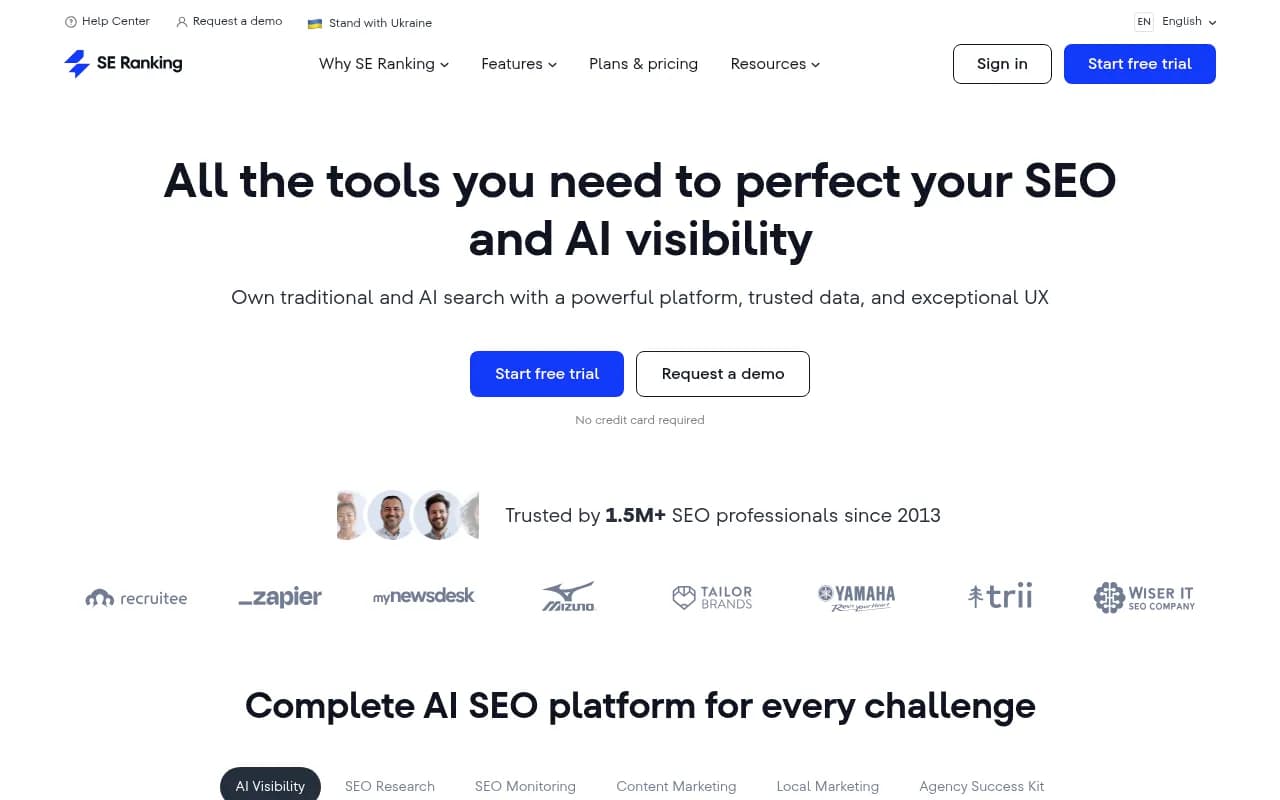
SE Ranking has added AI visibility tracking to its traditional SEO suite, which is useful if you're already using it for rank tracking.
Semrush has also added some AI Overview tracking, though it uses fixed prompt sets rather than custom queries.
Here's a quick comparison of the main approaches:
| Method | Cost | Data depth | Custom queries | Competitor data | Historical trends |
|---|---|---|---|---|---|
| Google Search Console | Free | Medium | No (query-based) | No | Yes (16 months) |
| Manual spot-checking | Free | Low | Yes | Yes (manual) | No |
| Otterly.AI | Low | Medium | Yes | Limited | Yes |
| SE Ranking | Medium | Medium | Yes | Yes | Yes |
| Semrush | Medium-High | Medium | Fixed prompts only | Yes | Yes |
| Promptwatch | Medium-High | High | Yes | Yes | Yes |
Method 4: Checking your server logs or crawler data
This one is more technical but gives you a different angle. When Google's AI systems crawl your site to gather information for AI Overviews, they use specific user agents. Googlebot-Extended is the crawler associated with Google's AI products.
If you have access to your server logs, you can filter for Googlebot-Extended visits to see which pages Google's AI systems are reading. This doesn't confirm you're appearing in AI Overviews, but it tells you which content Google is considering.
Some platforms -- Promptwatch included -- provide AI crawler log analysis that shows you exactly which pages AI crawlers are visiting, how often, and whether those crawls are leading to citations. That's a much cleaner workflow than digging through raw server logs yourself.
What to do if you're not appearing in AI Overviews
Finding out you're not cited is actually useful information. Here's what typically drives AI Overview inclusion:
Content structure matters more than you think
AI Overviews pull from content that directly answers questions. Pages that bury their answer in long introductions, or that are structured primarily for storytelling rather than information delivery, tend to get skipped. Clear headings, concise answers near the top of the page, and well-organized sections all help.
E-E-A-T signals still apply
Google's AI systems favor content from sources that demonstrate Experience, Expertise, Authoritativeness, and Trustworthiness. This means author credentials, citations, original research, and a strong backlink profile all feed into whether your content gets pulled into an AI Overview.
Technical accessibility is a prerequisite
If Google can't crawl and index your pages properly, they won't appear in AI Overviews regardless of content quality. Make sure your important pages aren't blocked by robots.txt, aren't behind login walls, and load quickly enough for Googlebot to process them.
Match the query intent
AI Overviews appear for specific types of queries. If your content is optimized for transactional intent ("buy X") but you want to appear for informational queries ("how does X work"), you may need separate content that directly addresses the informational angle.
Understanding the traffic impact
Here's something worth being clear-eyed about: appearing in AI Overviews doesn't automatically mean more traffic. In many cases, it means less, because the overview answers the question and users don't click through.
The value of AI Overview appearances is more about brand visibility and authority than direct click traffic. Users see your domain cited as a trusted source, which builds recognition even without a click. Some research suggests that brands appearing consistently in AI Overviews see downstream benefits in branded search volume and direct traffic, though this is hard to measure cleanly.
The traffic picture is also different depending on query type. For complex topics where users want to read more, AI Overview citations do drive meaningful clicks. For simple factual questions, they mostly don't.
This is why tracking impressions alongside clicks matters -- and why you shouldn't judge your AI Overview performance by CTR alone.
Putting it all together: a practical monitoring workflow
If you want to stay on top of your AI Overview visibility without it consuming your week, here's a workflow that works:
-
Set up Search Console filtering for AI Overviews and check it monthly. Look for impression trends and identify which queries are driving appearances.
-
Build a list of 20-30 priority informational queries. Do a manual spot-check in incognito once a month to see what's actually showing up.
-
If you're managing multiple sites or need competitor data, use a dedicated tracking tool. Even a basic setup in Otterly.AI or SE Ranking gives you systematic coverage that manual checks can't match.
-
For teams that want to go beyond monitoring -- identifying gaps, creating content to fill them, and tracking whether that content gets cited -- Promptwatch's answer gap analysis and content generation tools are built specifically for that workflow.
-
Review your top-cited pages quarterly. If certain pages are getting AI Overview impressions but low clicks, consider whether adding more depth or a clear call-to-action could convert more of that visibility into actual traffic.
AI Overviews aren't going away, and their share of search results is still growing. Getting a clear picture of where you stand is the first step to doing something about it.