Key takeaways
- All three tools track prompts and AI answers, but only Promptwatch ships citation-level crawler logs (which pages got crawled vs. which got cited) bundled with a fix-it content layer, starting at $245/mo.
- Bydefault's entry tier ($99/mo) includes crawler and citation analytics from day one, which Promptwatch gates to its $245/mo Professional plan, but bydefault's model roster skips Perplexity, Grok, and DeepSeek in favor of coding agents like Cursor and Claude Code.
- Searchable ($125/mo) leans on GA4 and CRM integrations for conversion attribution rather than a native tracking script, and its content gap analysis is close to nonexistent according to Promptwatch's own comparison.
- "Proving citation" is really two separate questions: did AI crawl the page at all, and did it actually get cited in an answer. Few tools distinguish between the two, which is where this comparison gets interesting.
- If your main worry is wasted crawl budget (AI bots visiting pages that never make it into an answer), the tool with a literal citation-rate metric wins the argument.
Why "proving citation" is a different bar than "tracking mentions"
Most AI visibility tools will happily tell you that ChatGPT mentioned your brand 14 times last week. That's a mention count. It is not proof your content got cited, and it's definitely not proof the crawler that visited your site ever turned that visit into a citation.
I think this distinction matters more than vendors want to admit. A tool can show you a rising line on a chart labeled "visibility" while your actual crawl-to-citation rate sits at 20%, meaning four out of five AI bot visits to your site produce nothing. Promptwatch's data shows ChatGPT cites roughly 5 sources per web-search-triggered response, while Google AI Overviews cites around 10. That's a brutally small inventory of slots per prompt, so knowing whether your pages are even in the running, not just mentioned somewhere in a generic answer, is the whole game.
That's the lens I'm using for this comparison: bydefault, Promptwatch, and Searchable all say they track AI visibility. Which one can actually show you the mechanical link between a crawler hitting your page and that page showing up as a cited source?
The three platforms at a glance
| Platform | Entry price | Models tracked (entry tier) | Crawler/citation analytics at entry | Content gap analysis | Conversion attribution |
|---|---|---|---|---|---|
| Bydefault | $99/mo | 4 of 8 (incl. Cursor, Codex, Claude Code, OpenCode) | Included | Not independently verified | Not publicly detailed |
| Promptwatch | $95/mo (crawler logs at $245/mo Professional) | 4 of 8 (OpenAI, Perplexity, Google, Claude, Gemini, Meta, DeepSeek, Grok) | Professional tier and up | Own-site index, feeds Content Agents | Native first-party tracking |
| Searchable | $125/mo | 3 named (ChatGPT, AI Overviews, Perplexity), others on request | Listed, audits-driven | "Zero mentions" per Promptwatch's comparison; manual schema fixes | Via GA4/CRM integrations |

A quick note on bydefault: I couldn't find it in our tools catalog as an embeddable card, which tells you something about how new and narrow its footprint still is compared to the other two. Its pricing and feature claims below come straight from its own site.
Bydefault: crawler data included everywhere, but a narrower model list
Bydefault's pitch is straightforward: prompt-level tracking plus real-time AI crawler data from your own site, starting at $99/month. Unlike Promptwatch, which keeps crawler logs behind its $245/mo Professional plan, bydefault bundles "AI crawler & citation analytics" into every tier, including the $99 Starter plan.
That's a genuinely good argument if your budget tops out around $100/month and crawler visibility is the single feature you care about most. The catch is the model roster. Bydefault's four engines per plan (you pick from ChatGPT, Claude, Gemini, Google AI Overviews, plus coding agents Cursor, Codex, Claude Code, and OpenCode) notably skip Perplexity, Grok, Meta Llama, and DeepSeek entirely. If your brand gets cited in Perplexity more than AI Overviews, which happens a lot for technical and finance content, bydefault simply won't see it.
The inclusion of coding agents like Cursor and Claude Code is unusual among the three, and it signals who bydefault is actually built for: developer-tool companies (its cited customers are Upstash, Context7, and the Monad Foundation) where getting recommended inside an AI coding assistant matters as much as showing up in a consumer chat answer. If that's your market, it's worth a look. If you're a consumer brand or ecommerce company, that feature is mostly wasted on you.
Promptwatch: the only one with a literal citation-rate number
Promptwatch's Agent Analytics feature is the thing I keep coming back to in this comparison, because it's the only one of the three that publishes an actual citation rate as a metric, not a vibe.
Here's how it works in practice. Promptwatch ingests your server-side crawler logs (via Cloudflare, AWS CloudFront, Vercel, Netlify, or a custom endpoint) and maps each URL through a funnel: discovered, indexed, blocked. Separately, it tracks crawled versus cited, with a citation rate attached to individual pages. A sample dashboard from the product shows 1,248 crawled pages against 312 cited, a 25% citation rate, which is exactly the kind of number that turns "AI mentioned us sometimes" into "three-quarters of the pages AI reads from us never get used, here's which ones."
That gap feeds directly into Content Agents, which draft and publish fixes to Webflow, Framer, or WordPress. In the comparison Promptwatch runs on itself, it cites a sample workflow of 18 gaps found, 12 pages created, 9 citations won. I'd take any vendor's self-reported funnel numbers with a grain of salt, but the structure, crawl data in, citation data out, published fix as the output, is the part that actually matters.
The tradeoff: crawler logs sit behind the $245/mo Professional tier, not the $95/mo Essential plan. If you're only willing to spend $95, you get prompt tracking, visitor analytics, and the API, but not the crawl-to-citation proof. That's a real gap compared to bydefault's entry tier.
Searchable: broad AEO coverage, attribution borrowed from GA4
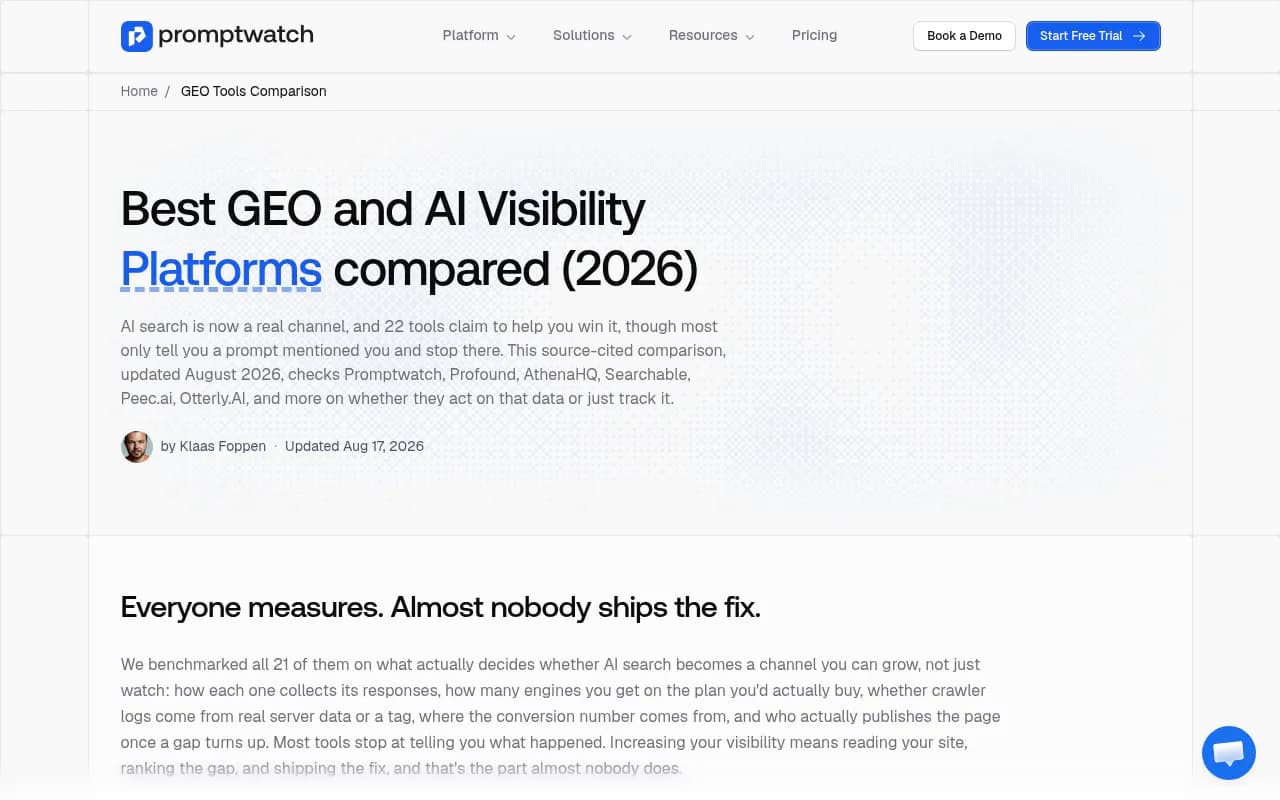
Searchable's Pro plan runs $125/month for 100 tracked prompts, 9,000 analyzed AI answers, 20 articles a month, and 200 site audits. On paper that's a lot of included volume, and Searchable's homepage cites customer results like 40% visibility increases and over £1 million in qualified pipeline traced back to AI search.
The weak spot shows up when you ask how Searchable actually proves a citation turned into a visit or a sale. Its integrations run through Google Analytics, Search Console, HubSpot, and Salesforce, meaning conversion attribution depends on your CRM and GA4 setup correlating with AI referral patterns, rather than a first-party tracking script built for the job. Promptwatch's own comparison page (admittedly not a neutral source, but specific in its claims) lists Searchable's content gap analysis as "zero mentions" and its fact-checking as manual review, and an independent review from SearchAtlas backs part of that up, noting Searchable's audits surface schema gaps as prioritized tasks but deploying the fix requires a person at every step. No auto-publish layer.
So Searchable is strong on breadth of AI-optimized content generation and site audits, weaker on the specific question this whole comparison is asking: can it show you, mechanically, why a page did or didn't get cited.
Side-by-side on the execution layer
| Capability | Bydefault | Promptwatch | Searchable |
|---|---|---|---|
| Crawler logs at entry price | Yes, all tiers | No (Professional+, $245/mo) | Partial, audit-based |
| Dedicated citation-rate metric | Not publicly documented | Yes, per-page | Not documented |
| Content gap analysis | Unclear | Own-site index feeding Content Agents | Described as minimal |
| Auto-publish fix to CMS | Not documented | Webflow, Framer, WordPress | Manual deployment |
| Coding-agent tracking (Cursor, Claude Code) | Yes | No | No |
| Conversion tracking | Not publicly detailed | Native first-party | Via GA4/CRM |
What the Promptwatch Data reports actually tell us about citation scarcity
Setting the three vendors aside for a second, it's worth grounding this in how AI engines actually cite things. Promptwatch's own research, built on monitoring real UI responses across ChatGPT, Gemini, Perplexity, and AI Overviews, found that ChatGPT cites around 5 sources per response when web search triggers, while Perplexity and AI Overviews both sit closer to 10, with Perplexity being the most stable of the bunch day to day. Microsoft Copilot, by contrast, swung from under 2 sources to nearly 17 within a few weeks before settling low again, which the report frames as Microsoft still rearchitecting Copilot's retrieval pipeline.
That volatility matters for this comparison because it means "proving citation" on Copilot specifically requires more patience and longer measurement windows than on Perplexity, where a citation change is more likely to reflect something you actually did to the content. None of the three platforms in this comparison can change how many slots an engine hands out. What separates them is whether they help you win the slots that exist.
Which one should you actually pick
If crawler and citation data at the lowest possible price is your single priority, and you don't care about Perplexity or Grok, bydefault's $99 entry tier is hard to beat on paper, especially if you're a dev-tool company that also wants visibility inside Cursor or Claude Code.
If you want the full loop, crawl logs showing exactly why a page isn't getting cited, a content gap index built from your own site, and an agent that publishes the fix to your CMS without you touching a content brief, Promptwatch is the one built for that, though you'll need the $245/mo Professional tier to get the crawler logs that make the whole argument work.
If you already live inside HubSpot or Salesforce and want AI visibility folded into existing revenue dashboards, with a large volume of included articles and audits, Searchable's breadth is appealing, even if its citation-gap detection and auto-fix layer lag behind the other two.
None of this is a universal answer. If you want to see how these three stack up against the other 18 or so tools in this category, the best GEO and AI visibility platforms comparison runs the same six core capabilities (prompt tracking, citation trends, crawler logs, visitor analytics, content gap, offsite mentions) across all of them, and it's a useful second opinion before you commit a budget line to any single vendor. For a broader look at adjacent tools, the GEO software directory at bestgeosoftware.com is worth browsing too.