Key takeaways
- Brandlight.ai has the deepest source intelligence of the three: roughly 98.5M+ sources indexed and typed, 100M+ AI answers analyzed, and a query set built from licensed AI-panel data rather than guesses. It is enterprise-only, with no free trial and a paid 3-month pilot as the entry point.
- Evertune wins on statistical rigor. It samples every prompt 100 times per model across 11+ AI models, where most competitors sample once a day. Pro pricing starts at $800/mo.
- Relixir is the least documented of the three on data depth. It pitches an all-in-one platform combining visibility tracking with AI content generation, which makes it attractive for teams that want one tool instead of three, but you will need to press them hard on methodology during a demo.
- Data depth is not a vanity metric. Promptwatch's data shows average citations per ChatGPT response dropped across all models after the GPT-5.3 rollout in March 2026, and Reddit's share of ChatGPT citations collapsed from roughly 4% to 0.5% in a single day in August 2026. Platforms with shallow or infrequent sampling will miss shifts like these entirely.
- If none of the three fit, Promptwatch is worth a look: it grounds its visibility scores in AI crawler logs and real UI data rather than API outputs, with published pricing from $95/mo.
Why data depth is the thing that actually matters
Most GEO platform marketing looks the same. Every vendor claims coverage of ChatGPT, Gemini, Perplexity, and Claude. Every dashboard has a visibility score. What separates a useful platform from an expensive one is what sits underneath the score: how the prompts were chosen, how often responses are sampled, whether the data comes from real user interfaces or APIs, and whether the platform can tell you why you are visible rather than only that you are visible.
Two things happened in 2026 that make this concrete. First, around the GPT-5.3 rollout on March 4, 2026, average citations per ChatGPT response dropped across all models, according to Promptwatch's citation drop research. A platform that samples each prompt once a day can easily misread that kind of shift, or miss it altogether. Second, reddit.com's share of ChatGPT Search citations collapsed from roughly 4% to 0.5% on August 14, 2026, per Promptwatch's Reddit citation data. If your GEO strategy was built on Reddit citations and your platform only reports a monthly visibility score, you would have learned about that collapse weeks late.
So when we compare these three platforms on data depth, we are asking four questions:
- Where does the prompt set come from, and how representative is it?
- How frequently and how many times is each prompt sampled?
- How granular is the source and citation data behind each answer?
- Does the platform connect visibility data to action, or does it stop at the dashboard?
Brandlight.ai: source intelligence for multi-brand enterprises
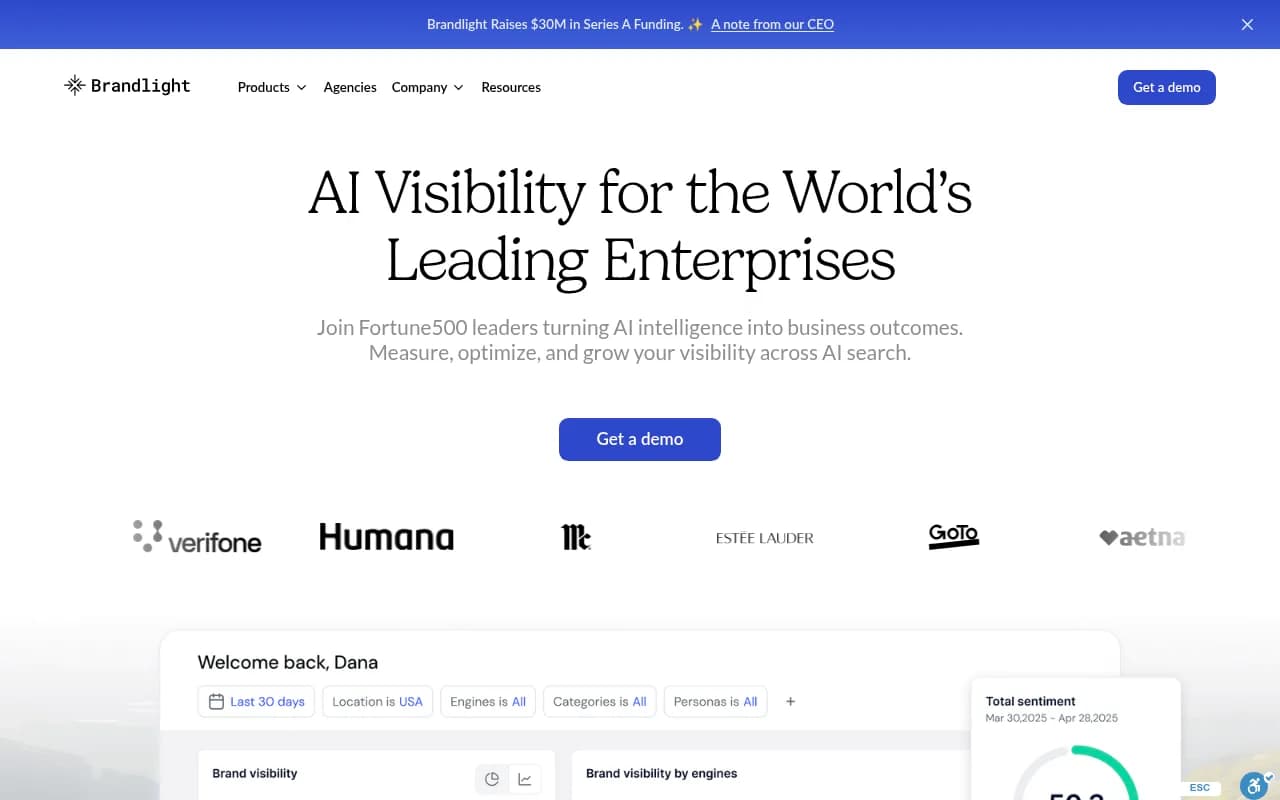
Brandlight is the most enterprise-shaped of the three. Its customers include Kimberly-Clark, Volkswagen, LG, and TD Bank, and its positioning is unapologetically aimed at Fortune 500-class, multi-brand, multi-market organizations. The company raised a $30M Series A and was named a Leader in CB Insights' ESP ranking for generative engine optimization.
On data depth, Brandlight's strongest asset is its source layer. The company reports tracking 13 engines, with 100M+ AI answers analyzed and roughly 98.5M+ sources indexed and typed (figures per Brandlight's research hub, worth re-confirming during procurement). Its own analysis found that roughly 85% of the sources AI cites for category questions are third-party or social, which is why the platform indexes review sites, editorial, Reddit, YouTube, and retailer pages rather than only your own domain. That matches what independent data shows: the sources AI engines cite are heavily skewed toward third-party content, and the mix shifts month to month.
The query set is another differentiator. Brandlight builds its tracked prompts from licensed AI-panel data plus search signals, funnel-tagged from awareness through decision, so you are tracking buying-intent questions rather than a list you invented yourself. Recommendations are prescriptive and tied to explainable source data, which matters if you have ever tried to defend a GEO budget to a CFO using a black-box score.
Content generation runs through a multi-agent workflow (strategist, writer, editor, validator) with deterministic brand and legal guardrails, and drafts route to your CMS for human review. It does not auto-publish, which will please your legal team and frustrate anyone hoping for a fully hands-off setup.
The catches: no free trial, no published pricing (third-party reporting puts entry around $199/mo with enterprise contracts in the $4K to $15K/mo range), and engagements typically start with a paid 3-month pilot. For a global CMO with budget and a multi-brand rollup problem, that is a reasonable ask. For everyone else, it is friction.
Proof point worth noting: for Kimberly-Clark, Brandlight reports moving 12 of 12 brands into the top three across all major LLMs, with 100% paid-pilot-to-annual conversion and zero enterprise churn to date.
Evertune: statistical rigor as the whole product
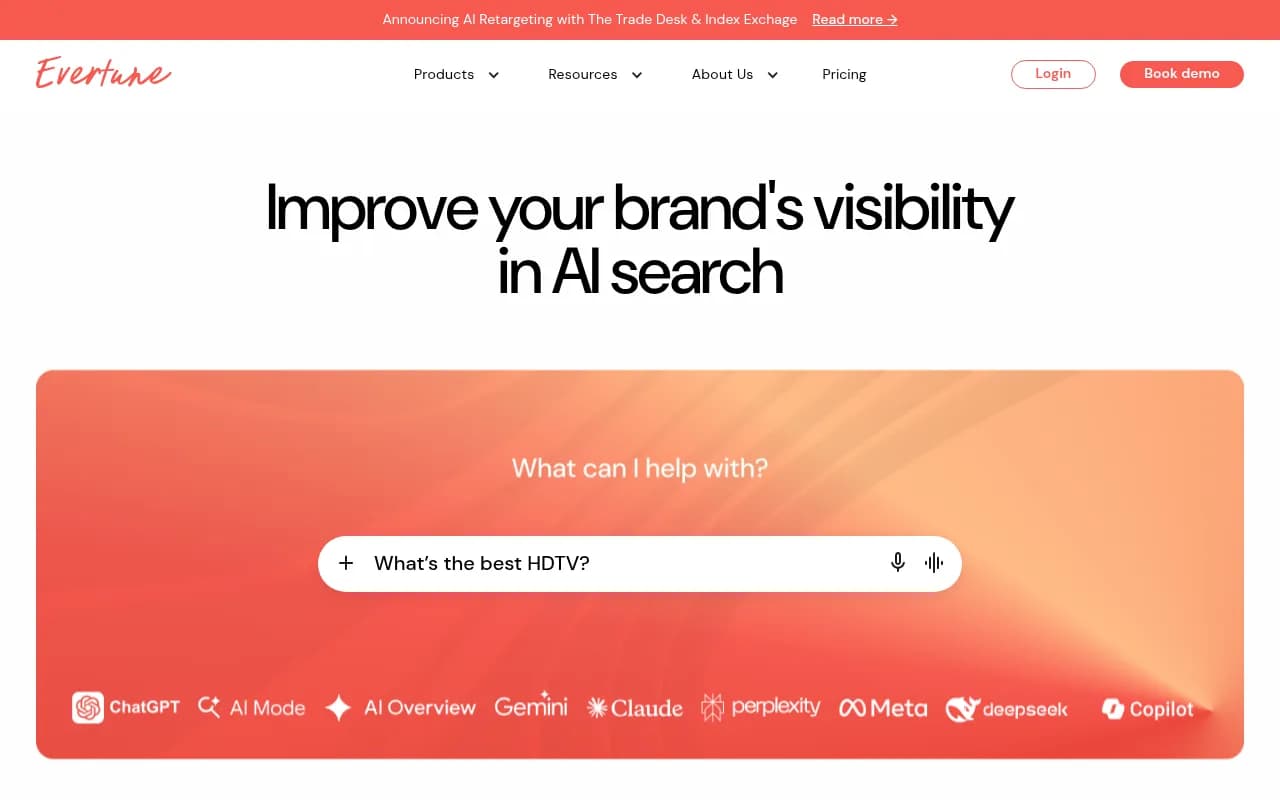
Evertune makes a different bet than Brandlight. Where Brandlight goes deep on source intelligence and organizational workflow, Evertune goes deep on measurement methodology. Its core claim is simple and, honestly, refreshing: most GEO tools sample each prompt once a day, while Evertune samples every prompt 100 times per model across 11+ AI models. That is the difference between an anecdote and a statistic.
This matters more than it sounds. AI responses to the same prompt vary run to run, and citation behavior shifted noticeably this year. Sampling at 100x per model gives you confidence intervals instead of noise, and Evertune argues this delivers statistically significant visibility data at roughly half the cost of competing platforms. The company has processed over 10 billion tokens on OpenAI infrastructure and was ranked #2 in CB Insights' GEO market analysis.
Its data foundation combines three layers: foundational model intelligence, daily consumer app data, and a 25-million-person consumer panel. A prompt agent mines over 150 million real user conversations to surface the exact questions buyers ask, an insights agent produces weekly recommendations, and an ads agent builds ChatGPT campaigns around visibility gaps. Evertune also connects into ChatGPT Ads and programmatic partners like The Trade Desk and Index Exchange, which makes it one of the few GEO platforms that treats paid AI surfaces as a first-class channel.
The AI Brand Index tracks how often and in what context LLMs reference your brand, including sentiment, associated attributes, and perception trends. Source-level attribution connects mentions back to the specific content driving them.
The catches: Pro starts at $800/mo with no free trial, and it is more of a deep analysis platform than a daily-use dashboard. One third-party review put it well: if you want a tool your marketing team opens every week, the UX trade-offs of an analytical platform may not fit. It is also worth asking how much of that 100x sampling budget you actually need. For most brands, 100 samples per prompt per model is more precision than the decision requires, and you are paying for the rigor whether you use it or not.
Relixir: the all-in-one bet
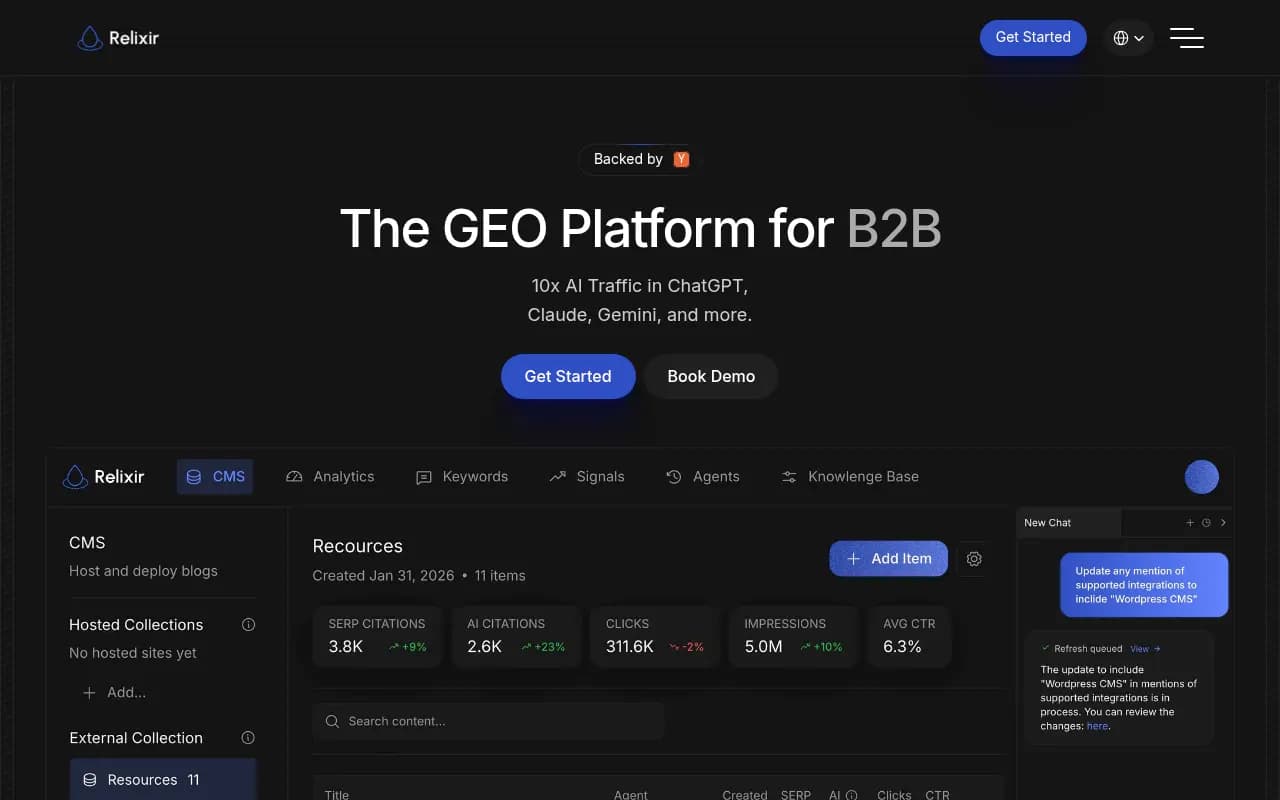
Relixir is the hardest of the three to assess on data depth, and I want to be straight about that rather than pad the analysis with vague praise. Public information on its methodology is thin compared to Brandlight's research hub or Evertune's published sampling claims. The company raised a $2M seed round, which puts it in a very different resource class from Brandlight's $30M Series A.
What Relixir pitches is an all-in-one GEO platform: visibility tracking and analytics combined with AI content generation in a single product. That positioning is genuinely appealing for a specific buyer, the mid-market or lower-enterprise team that wants monitoring and content execution from one vendor instead of stitching together a tracker, a content tool, and an analytics platform. If your alternative is a prompt tracker plus a separate AI writing tool plus a spreadsheet, Relixir's pitch lands.
The honest caveat is that "all-in-one" tells you nothing about data depth. The questions that separate these platforms, sampling frequency, prompt provenance, source indexing, UI-level versus API-level data, are exactly the questions Relixir's public materials answer least clearly. If you are evaluating it, go into the demo with a hard checklist:
- How many times per week is each prompt sampled, per model?
- Does the data come from real user interfaces or API endpoints? (User-facing answers and citations can differ from API outputs.)
- How are sources classified and how many are indexed?
- Where does the tracked prompt set come from, and how often is it refreshed?
- Can the platform show the crawl-to-citation path, or only the end score?
If Relixir answers those well, it may be the value pick of the three. If the answers are vague, the all-in-one convenience is not worth trading away measurement credibility, because in GEO your strategy is only as good as the data it is built on.
Data depth, side by side
| Dimension | Brandlight.ai | Evertune | Relixir |
|---|---|---|---|
| Engines tracked | 13 engines, adapted per market | 11+ AI models | Major LLMs (confirm current list in demo) |
| Sampling approach | Continuous, volume not published | 100 samples per prompt per model | Not published |
| Prompt data source | Licensed AI-panel data + search signals, funnel-tagged | 150M+ real user conversations mined by prompt agent, 25M-person consumer panel | Not published |
| Source intelligence | ~98.5M+ sources indexed and typed; ~85% of cited sources are third-party/social | Source-level attribution connecting mentions to driving content | Not published |
| Sentiment and perception | Yes, with narrative and misrepresentation tracking | Yes, sentiment scores, attributes, perception trends | Yes (per product positioning) |
| Content and action layer | Multi-agent content workflow with brand/legal guardrails, CMS routing, no auto-publish | Insights agent, website optimization, content creation, ads agent | AI content generation built in |
| Paid AI surfaces | Agentic commerce tracking | ChatGPT Ads, Trade Desk, Index Exchange | Not published |
| Buying process | Sales-led, paid 3-month pilot, no free trial | Sales-led, no free trial | Sales-led |
| Pricing | Custom; reported ~$199/mo entry, $4K–$15K/mo enterprise | Pro $800/mo, Enterprise custom | Not published |
| Best fit | Fortune 500, multi-brand, multi-market | Brands that need statistically defensible measurement | Teams wanting tracking plus content in one tool |
Pricing and buying process
| Brandlight.ai | Evertune | Relixir | |
|---|---|---|---|
| Entry price | Custom (reported ~$199/mo) | $800/mo (Pro) | Not published |
| Enterprise range | Reported $4K–$15K/mo | Custom | Not published |
| Free trial | No | No | Not published |
| Minimum commitment | Paid 3-month pilot | Annual typical | Unknown |
A pattern worth noticing: all three are sales-led with opaque or semi-opaque pricing. That is normal for enterprise software, but in a category this young it means you are partly underwriting the vendor's roadmap with your contract. Ask every vendor the same question: what does the data look like in month four that I cannot see in the demo?
How to choose between them
Pick Brandlight if you are a multi-brand, multi-market enterprise and the problem is organizational as much as technical. Brandlight's real product is the full loop, measurement plus prescriptive action plus a strategy team that executes, inside one data layer spanning owned, third-party, social, retail, and paid surfaces. No one else on this list offers that combination. The price and the sales-led process are the trade.
Pick Evertune if your board asks for statistically defensible numbers and your current platform's scores wobble for no explainable reason. The 100x sampling methodology is a genuine differentiator, and the consumer panel gives you prompt data grounded in real behavior. Accept that it is an analysis platform first and a workflow tool second.
Pick Relixir if you have evaluated the demo checklist above and the answers hold up, and your priority is consolidating tracking and content generation into one tool at a mid-market budget. Go in skeptical, because the burden of proof on data depth is on them.
Consider a fourth option if none of those profiles fit. Promptwatch takes a different angle on data depth than all three: instead of relying only on response sampling, it logs the actual AI crawler traffic hitting your site (400+ crawlers, including ChatGPTBot, ClaudeBot, and PerplexityBot), showing which pages AI systems read, what errors they hit, and the crawl-to-citation path per page. It also reads real user interfaces rather than API outputs, since user-facing answers and citations can differ from what APIs return. With 4.5B+ citations, clicks, and prompts analyzed, published pricing from $95/mo, and a 7-day free trial on its Essential tier, it is the lowest-friction way to test whether a visibility platform's data holds up against your own reality.

For a broader view of the category beyond these four, the GEO software directory at bestgeosoftware.com maintains current listings, and Profound remains the other serious enterprise contender if real-user prompt data is your priority.
Questions to ask any enterprise GEO vendor in 2026
Whatever you choose, put these five questions in your RFP. The answers will sort the platforms faster than any feature list:
- How do you handle model updates? When GPT-5.3 dropped citation counts in March 2026, did your scores and baselines adjust, or did customers see unexplained declines? Vendors who cannot answer this were surprised by the shift, and you do not want your measurement layer to be surprised by anything.
- UI or API? User-facing answers, citations, and shopping recommendations can differ from API outputs. If the platform only reads APIs, it is measuring a proxy of what your customers actually see.
- What is the prompt provenance? A tracked prompt set you invented yourself measures your assumptions. Licensed panel data or mined real conversations measures reality.
- Show me the why. Can the platform connect a visibility score to specific sources, pages, and crawler behavior? Promptwatch's data on average sources per response shows how much citation behavior varies across ChatGPT, Claude, Perplexity, and Gemini. A single blended score hides all of that.
- What happens after the dashboard? Measurement that never becomes action is an expensive report. Ask who writes the content, who fixes the pages, and who owns the outcome.
The enterprise GEO category is young enough that vendor claims still outrun verifiable data. The platforms that will still matter in 2027 are the ones whose numbers survive contact with your own traffic logs. Choose accordingly.