Key takeaways
- Brand narrative tracking records the individual claims AI makes about your brand (pricing, features, support, reputation), not just whether you get mentioned.
- On brand-specific prompts ChatGPT often cites only a handful of domains, so a few review sites, forums and your own pages shape the story.
- Stale landing, docs and pricing pages can keep feeding wrong claims into answers for months.
- The workflow is: define prompts, extract claims, trace the sources, mark what is accurate, fix the pages, then re-measure.
- Tools differ a lot. Some give you a sentiment score and a weekly index. Fewer pull out claim-level data and connect it to the pages that caused it.
What brand narrative tracking actually is
Most AI visibility reporting answers one question: did the model mention me? That is useful, but it hides the more expensive problem. A model can mention you in every answer and still say your product is overpriced, lacks a mobile app, or is built only for enterprises. If none of that is true, you are being recommended with a bad pitch attached.
Brand narrative tracking looks at the content of the answer. It pulls out the individual statements a model makes about you and your competitors, groups the ones that repeat, and shows how often each one appears and in which models. Think of it as the difference between knowing someone talked about you at a party and knowing exactly what they said.
A few terms are worth separating:
- Mention tracking counts appearances.
- Sentiment analysis gives a tone score, usually one number per response or per topic.
- Narrative or claim tracking lists the specific assertions ("affordable for small teams", "support is slow") and ties them to sources.
Sentiment tells you the temperature. Claims tell you what to fix.
Why the narrative is hard to control
A model does not read your homepage and summarize it. It assembles an answer from pieces: your site, review platforms, forum threads, comparison articles, old press, and whatever it learned in training. Different models pull different pieces, so you can have several narratives at once.
The number of sources matters too. According to Promptwatch Data's report on unique domains per ChatGPT response (Sep 28 to Oct 4, 2026), 47.6% of cited responses used 10 or more domains. But that changes sharply when a prompt names a brand. For brand-specific prompts like "is Asana good for small teams", only 21.3% cited 10 or more domains, 40.7% cited 5 or fewer, and 5 was the most common count at 14.9%.
That is the useful part. When someone asks about you directly, ChatGPT leans on a short list of sources. If two of them are an outdated review and a forum thread from 2023, those two documents effectively write your pitch.
Other engines behave differently. Promptwatch's average sources per response data (published September 2025, so treat the exact numbers as dated) showed ChatGPT citing about 5 sources per web-search answer, while Google AI Overviews and Perplexity sat near 10. More sources usually means a more blended, harder-to-steer narrative. Fewer sources means each one carries more weight.
Stale pages linger
There is another timing problem. In Promptwatch's content half-life study, pages cited on July 6, 2026 were tracked until October 4. After 30 days, ChatGPT still cited 78% of landing pages, 76% of docs and 72% of comparison pages. After 60 days those figures were 69%, 67% and 63%. News decayed fastest, with half of pages gone after 36 days.
The practical read: if your pricing page or docs say something wrong, that claim does not fade quickly. Pricing pages count as landing or product pages in that dataset, so they sit in the stickier group. Fix them early.
The claim-level workflow
Here is a process that works regardless of which tool you use.
1. Build a prompt set that reflects real buyers
Track three kinds of prompts, because the report above shows they pull different source mixes:
- Organic prompts that do not name you ("best project management tool for agencies")
- Brand-specific prompts ("is [your brand] good for small teams")
- Competitor comparisons ("[your brand] vs [competitor]")
Add personas if your tool supports them. A CFO and a junior marketer ask differently and may get different claims. Keep one language and country per monitor so markets do not blur together.
2. Extract the claims
This is the step manual testing handles badly. You can paste prompts into ChatGPT and read the answers, and for a first look you should. But after about 20 responses you stop noticing patterns. You need something that pulls statements out of every response and groups repeats.
What to record for each claim: the exact wording, how often it appears, which models say it, which competitors get the opposite claim, and the theme it belongs to (pricing, features, support, reputation).
3. Trace the claim to a source
A claim without a source is a to-do you cannot finish. For each recurring claim, find the cited pages behind it. Usually it falls into one of four buckets:
- Your own page says it (or says something ambiguous)
- A third-party review or comparison says it
- A forum or social thread says it
- No cited source supports it, so it comes from training data
The fix differs for each. Your own page, you edit. A review site, you request a correction or publish a stronger primary source. Training-data claims are the slowest to move, and the honest answer is that you push them by flooding the cited ecosystem with accurate material.
4. Mark claims accurate or inaccurate
Sit down with product, support and sales for an hour and sort the top 20 claims. You will find three groups: true and good (amplify), true and bad (fix the product or the messaging around it), and false (correct the sources). Teams skip this step and then argue about it later.
5. Fix the pages, then measure
The Promptwatch report's advice for narrative control is concrete: check which domains are cited for your brand and for your competitors, publish your own comparison pages, and make sure third-party comparison and review pages describe you accurately. Then rerun the same prompts after the pages get recrawled and see whether the claim frequency moves. If a claim persists after a fix, check whether AI crawlers can even reach the corrected page.
What the tools show
The market splits into three levels of depth.
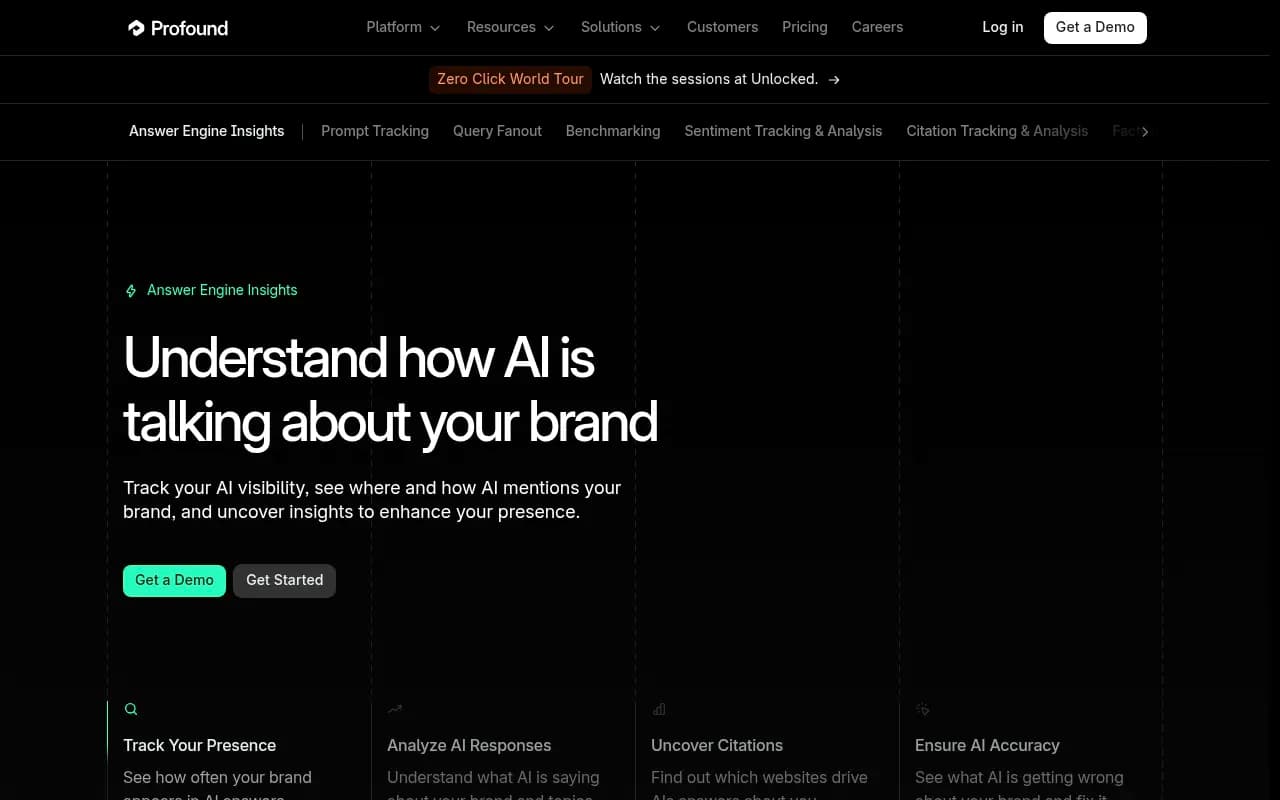
Profound's answer engine insights pitch covers visibility scores, share of voice, sentiment and keyword themes, citation sources, and a section about seeing what AI gets wrong. It is an enterprise product, so expect enterprise pricing and a sales conversation.
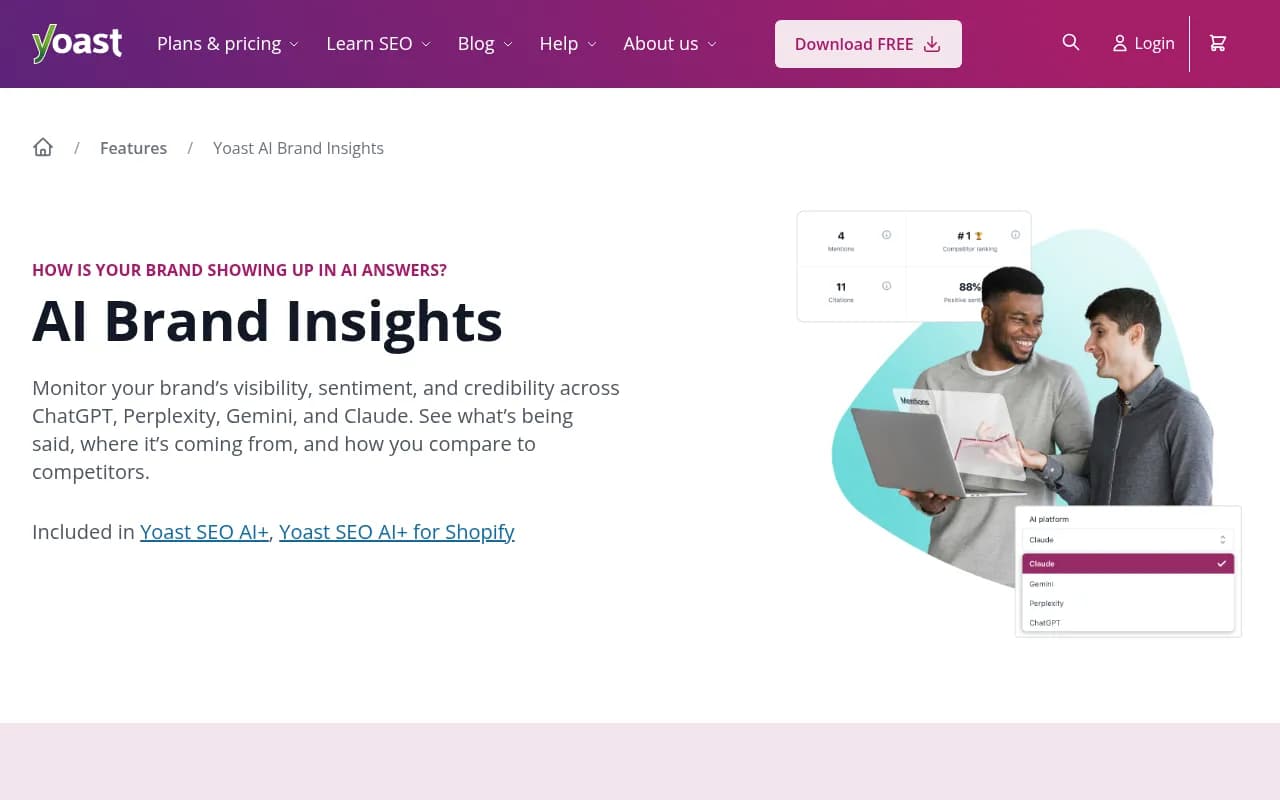
Yoast AI Brand Insights is the lightweight end. It tracks ChatGPT, Perplexity, Gemini and Claude with weekly scans, up to five brand questions you define, and a single AI Visibility Index combining mentions, sentiment, citations and positioning. It is included in Yoast SEO AI+. Five questions is enough to sanity-check a small brand but thin for a real narrative audit.
For claim-level work, Promptwatch has a Brand Narrative feature on every plan. It pulls individual claims (like "affordable for small teams" or "its mobile app lacks features") out of tracked responses, groups repeats, shows which models say each one, and files them under themes such as Pricing, Features, Support or Reputation, with a 0-100 score per theme you can compare against competitors. On Business and higher plans, Fact Check lets you mark a claim accurate or inaccurate and then scans your crawled pages for the ones that state it or its opposite, which closes the gap between spotting a bad claim and finding the page responsible. Pricing starts at $95/mo for Essential; confirm current tiers at promptwatch.com/pricing.

A few other platforms are worth a look when you are shortlisting, including Peec AI style monitors that stop at tracking, and tools with hallucination detection such as LLMClicks.

| Tool | Depth | Claim-level extraction | Best for |
|---|---|---|---|
| Yoast AI Brand Insights | Weekly scan, 5 questions | No, index score and sentiment | WordPress sites wanting a quick read |
| Profound | Enterprise monitoring | Themes and accuracy checks | Large brands with budget |
| Promptwatch | Monitor, trace, act, measure | Yes, with themes and Fact Check | Teams that want to fix claims, not just see them |
| Otterly.AI | Basic prompt tracking | Limited | Cheap monitoring |
| LLMClicks | Visibility plus hallucination detection | Hallucination focus | Catching outright errors |
For wider shortlists, the GEO software directory at bestgeosoftware.com lists dozens more.
A manual audit you can do this afternoon
If you are not ready to buy anything, do this first. It takes about two hours.
- Write 15 prompts: 5 organic, 5 about your brand, 5 comparisons against your top two competitors.
- Run each in ChatGPT, Perplexity and Gemini with web search on. Use a clean session, ideally logged out.
- Paste the answers into a spreadsheet. Add one row per claim about your brand.
- Add columns for model, cited source, accurate yes/no, and which page you would edit.
- Count repeats. Anything that shows up in three or more answers is your priority list.
Perplexity
The limits are obvious. Responses vary run to run, you test a tiny sample, and you are not seeing what real users in other countries get. Treat the result as a hypothesis, then validate with a tool that runs the same prompts daily from the real interfaces.
Fixing the common claim problems
Outdated pricing or plan limits
Update the pricing page, the FAQ, and any docs that mention plan limits. Make the numbers consistent everywhere, because models happily average contradictions. Given the half-life data, expect it to take weeks to clear, not days.
"Lacks feature X" when you shipped it
Publish a dedicated feature page with the name people actually search for, and update the comparison pages that list you. Then check third-party review profiles on G2 or Trustpilot and refresh them.
Wrong positioning (enterprise only, SMB only)
This one usually comes from old press and comparison articles. Publish your own comparison pages that state who you serve, with evidence like customer counts or case studies, and pitch corrections to the third-party pages that get cited most.
Hallucinated facts with no source
Some claims have no citation behind them. Make the correct fact easy to find: a clear about page, structured data, and a consistent description across your profiles. Also confirm AI crawlers can read the pages. Promptwatch's AI crawler logs and free Agentic Readiness Check are options for that.
What to report to leadership
Skip the vanity score. A narrative report that gets attention has four parts:
- The top five claims about us, with frequency and models
- Which are false, and which page or source is responsible
- What we changed this month
- Whether claim frequency moved after the fix
That last line is what keeps the work funded. Without a re-measure step, narrative tracking turns into a monthly slide of screenshots.
Where to start
Run the manual audit this week and write down your top five wrong or weak claims. If you find a pattern, a tool with claim extraction and source tracing will pay for itself quickly, because the alternative is reading hundreds of responses by hand. Promptwatch's free AI visibility report and 7-day trial are low-risk ways to see your own claims before committing to a plan. Whatever you pick, fix the pages AI actually cites first. That is where the narrative gets written.