Key takeaways
- Profound is a capable AI visibility platform, but its pricing jumps sharply ($99 for ChatGPT only, $399 for multi-model coverage) and it doesn't help you fix what it finds.
- Most alternatives fall into two camps: monitoring-only dashboards that show you data, and full optimization platforms that help you act on it.
- The biggest differentiator in 2026 isn't which AI models a tool tracks — almost everyone covers ChatGPT and Perplexity now. It's whether the tool helps you close visibility gaps with content.
- Promptwatch is the only platform in this comparison rated as a "Leader" across all categories in a 2026 review of 12 GEO platforms, largely because it combines tracking, gap analysis, and AI content generation in one loop.
- Your best pick depends on what you actually need: if you're already in the Ahrefs or Semrush ecosystem, their native AI tools may be enough. If you want to actively grow AI visibility, you need something that goes beyond dashboards.
Profound was one of the first serious platforms to answer the question: "How often does my brand show up when someone asks an AI engine about my category?" That's a real question, and Profound built real infrastructure to answer it — front-end response capture, real-user prompt volume data, even an Amazon Rufus shopping module that most competitors still don't have.
But "first mover" and "best fit" aren't the same thing.
At $99/month, Profound's Starter plan only tracks ChatGPT. Want Perplexity and Google AI Overviews? That's $399/month. Want Claude, Gemini, Grok, and the rest? Enterprise pricing, not published. And even at the Growth tier, you're capped at 100 tracked prompts with 3 user seats.
For a lot of teams, that math doesn't work. And for teams that do afford it, there's a second problem: Profound tells you where you're invisible. It doesn't help you become visible.
That's the gap this guide is about. Here are 12 alternatives, ranked by what they actually help you do.
How to think about this category
Before diving into individual tools, it helps to understand the landscape. AI visibility platforms in 2026 fall into roughly four buckets:
- Full GEO optimization platforms (track + analyze + generate content)
- Dedicated AI monitoring tools (track + analyze, no content help)
- SEO suites with AI tracking added on (broad coverage, variable depth)
- Lightweight trackers (cheap, simple, limited)
The monitoring-only tools aren't bad — they're just incomplete. If you already have a content team and just need data, they work fine. If you want the platform to help you close gaps, you need bucket one.
The 12 alternatives, ranked
1. Promptwatch — best for teams that want to actually fix their AI visibility
Promptwatch is the most complete option in this list. Where most tools stop at showing you a visibility score, Promptwatch is built around a loop: find the gaps, generate content to fill them, track the results.

The Answer Gap Analysis shows you exactly which prompts your competitors rank for in AI responses but you don't. Not just "you're missing coverage here" — it shows the specific topics, questions, and angles that AI models want to answer but can't find on your site. From there, Content Agents generate articles, comparisons, and briefs grounded in real prompt data, citation analysis, and competitor research. Then page-level tracking shows whether the new content is actually getting cited.
A few things set it apart from the rest of this list. First, it tracks how AI search engines behave in real user interfaces, not just through APIs — which matters because the answers users actually see can differ from what an API returns. Second, it has AI Crawler Logs: real-time data on when ChatGPT, Claude, Perplexity, and others crawl your site, which pages they read, what errors they hit, and when a crawled page moves to a citation. Most competitors don't have this at all.
It also covers 10 AI models (ChatGPT, Perplexity, Google AI Overviews, Google AI Mode, Claude, Gemini, Meta/Llama, DeepSeek, Grok, Mistral, Copilot), tracks Reddit and YouTube as citation sources, and includes ChatGPT Shopping tracking for brands in e-commerce.
Pricing starts at $99/month for one site and 50 prompts. The Professional plan ($249/month) adds crawler logs, multi-location tracking, and 15 AI-generated articles per month. Business is $579/month for 5 sites and 350 prompts. A free trial is available.
In a 2026 comparison of 12 GEO platforms, Promptwatch was the only tool rated "Leader" across all categories. That's not a marketing claim — it's because the others mostly stop at monitoring.
2. Ahrefs Brand Radar — best for teams already in the Ahrefs ecosystem
If you're an Ahrefs user, Brand Radar is the most natural addition. The core argument for it is data quality: rather than fabricating prompts and running them, Brand Radar pulls from 243M+ real "People Also Ask" queries with measurable search volume behind them. The prompts it tracks correspond to questions real people actually typed.
The tradeoff is that it's more of a monitoring and research tool than an optimization platform. You'll see where you're visible and where you're not, but you won't get content generation or gap-closing workflows built in.
Pricing is modular: $50/month for 2,500 checks, $100/month for 7,000 checks, or $699/month for all 6 AI indexes plus custom prompt checks. Worth it if you're already paying for Ahrefs. Less compelling as a standalone purchase.
3. Semrush AI Visibility Toolkit — best for Semrush users who want AI coverage without switching tools
Semrush has been building AI tracking into its existing platform, which makes sense given how many SEO teams already live in Semrush. The AI Visibility Toolkit gives you brand monitoring across major AI engines alongside the keyword research, backlink analysis, and content tools you're already using.
The limitation is that Semrush uses fixed prompt sets rather than letting you define custom prompts. That's fine for general category monitoring but less useful if you're tracking niche or long-tail queries specific to your business. There's also no AI traffic attribution — you can see visibility scores but not connect them to actual site traffic or revenue.
Still, for teams that want "good enough" AI monitoring without adding another tool to their stack, this is a reasonable choice.
4. SE Ranking — best for connecting AI visibility to traditional SEO performance
SE Ranking has built one of the more thoughtful integrations of AI visibility into a full SEO suite. Its AI Overviews tracker is genuinely useful for Google-first teams, and the platform connects AI visibility data to keyword rankings, organic traffic, and content performance in ways that most dedicated GEO tools don't.
It's not a pure GEO platform — if you want deep prompt analytics or content generation for AI search, you'll hit limits. But if your primary question is "how is our AI visibility affecting our overall search performance?", SE Ranking answers it better than most.
5. Scrunch AI — best for enterprises that need governance and brand safety controls
Scrunch takes a different angle on AI visibility. It's built for larger organizations that need to monitor not just whether they appear in AI responses, but how they appear — sentiment, accuracy, brand safety, and whether AI models are saying things about you that are wrong or harmful.
The platform covers a solid range of AI models and has strong reporting for stakeholder communication. The gap is on the optimization side: Scrunch is fundamentally a monitoring and alerting tool. It will tell you when something goes wrong; it won't help you build the content strategy to fix it.
Pricing is enterprise-tier, which means you'll need to talk to sales before knowing what it actually costs.
6. Athena HQ — best for enterprises focused on AI visibility measurement
AthenaHQ has positioned itself as an enterprise GEO platform with a focus on AI visibility measurement and competitive benchmarking. It covers multiple AI models and gives you visibility scores, competitor comparisons, and some automation capabilities.
The honest assessment: AthenaHQ is strong on monitoring and measurement but lighter on the content optimization side. It's a good fit for enterprise teams that need to report on AI visibility to leadership and want clean dashboards for that purpose. Less suited for teams that want to actively drive visibility improvements through content.
7. Otterly.AI — best for small teams that need affordable basic monitoring
Otterly is the budget-friendly option in this category. It tracks brand mentions across ChatGPT, Perplexity, and a few other models, gives you sentiment analysis, and sends alerts when something changes. The interface is clean and the setup is fast.

What you don't get: crawler logs, content generation, prompt volume data, query fan-outs, or any of the deeper analytics that help you understand why your visibility is what it is. Otterly is a monitoring dashboard, not an optimization platform. For a small team that just wants to know "are we showing up?", it's fine. For a team that wants to grow their AI visibility, it's not enough on its own.
8. Peec AI — best for prompt-level analytics without the enterprise price tag
Peec AI focuses on prompt-level analytics — tracking specific queries, seeing which sources AI models cite for those queries, and understanding how your content compares to what's getting cited. It's more granular than most monitoring tools and genuinely useful for content teams trying to understand citation patterns.
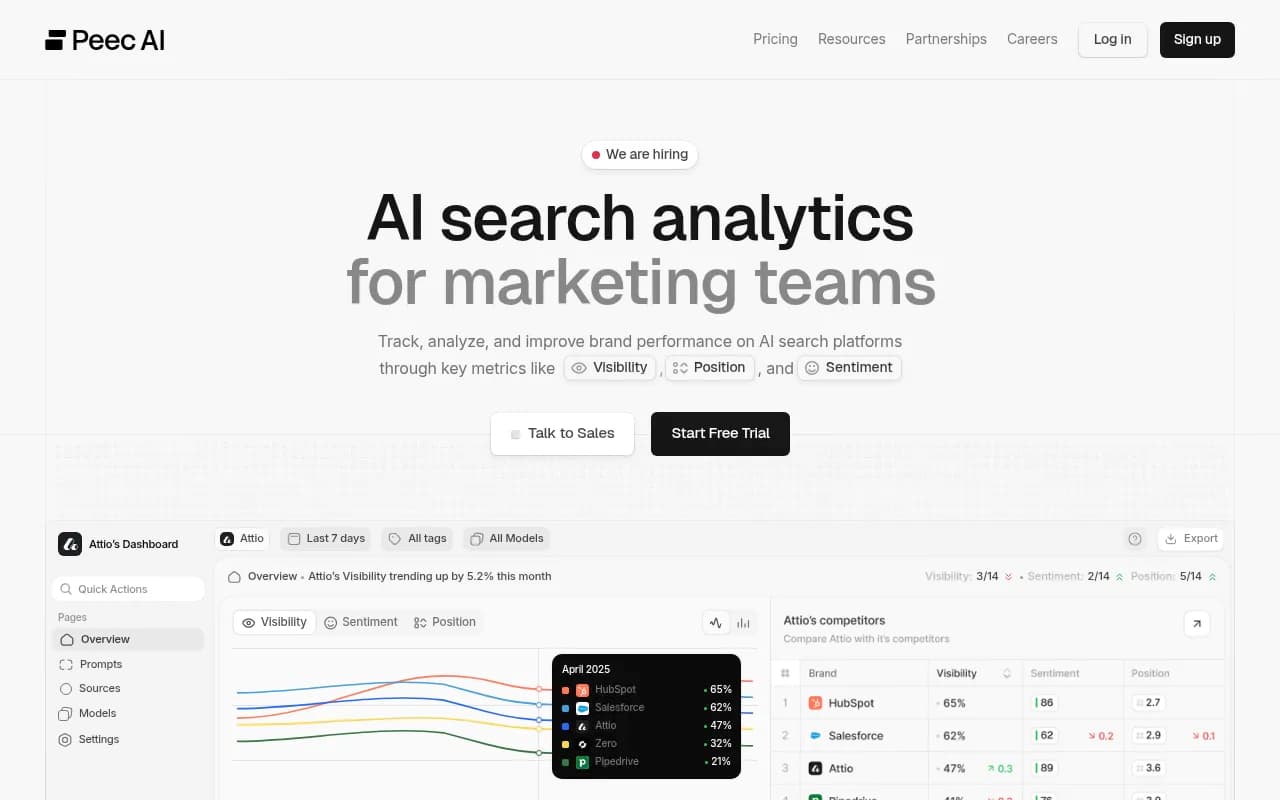
The gap is the same as most tools in this list: Peec shows you the data but doesn't help you act on it. There's no content generation, no gap-closing workflow, no crawler logs. It's a solid research tool for teams that know what to do with the data.
9. Writesonic — best for teams that want AI writing plus some visibility tracking
Writesonic has expanded from AI writing into AI visibility tracking, which makes it an interesting option for content teams. You get AI content generation alongside basic visibility monitoring, which is closer to the full loop than most pure monitoring tools.
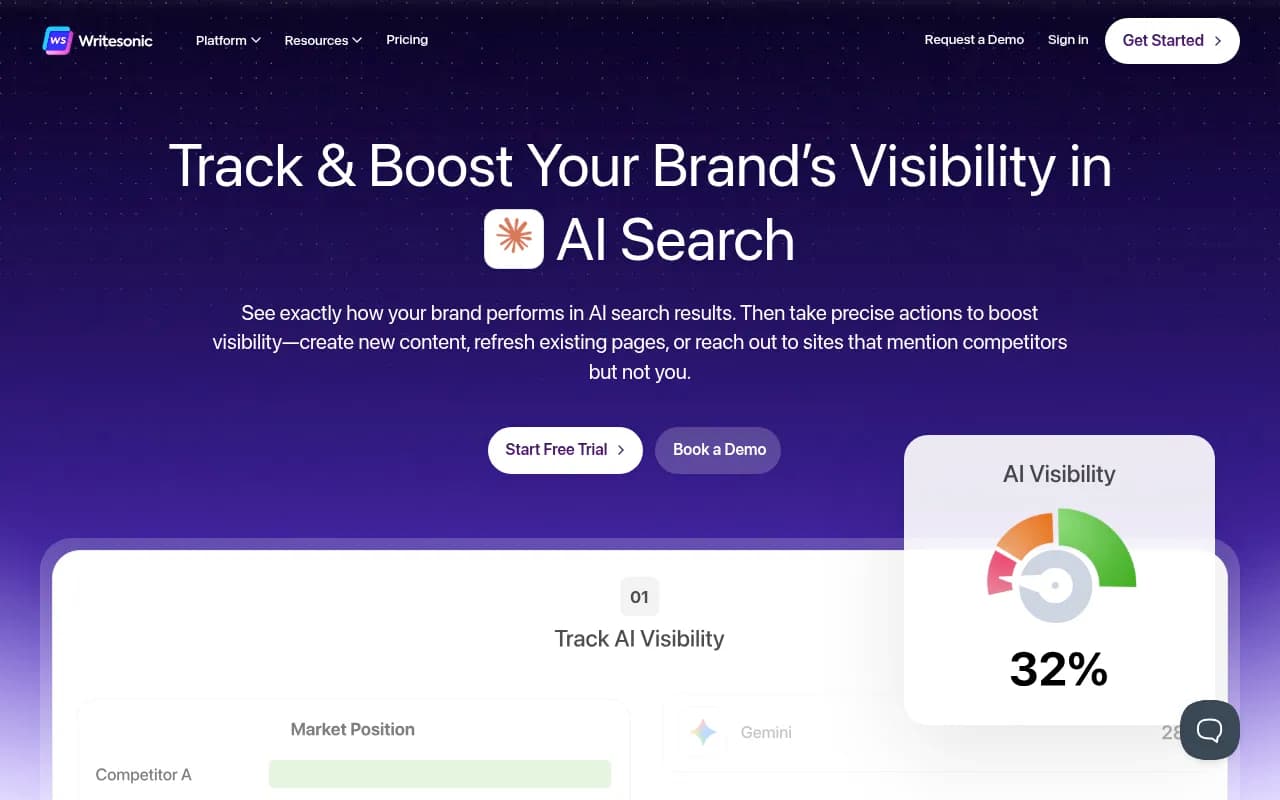
The tracking side is less mature than dedicated GEO platforms — prompt coverage is thinner, model coverage is narrower, and the analytics are more surface-level. But if you're primarily a content team that wants to understand AI visibility as one input into your writing workflow, Writesonic is worth considering.
10. LLM Pulse — best for lightweight tracking across multiple models
LLM Pulse is a straightforward tracker: set up your brand and competitors, monitor visibility across ChatGPT, Perplexity, and a handful of other models, get alerts. It's not trying to be a full GEO platform.
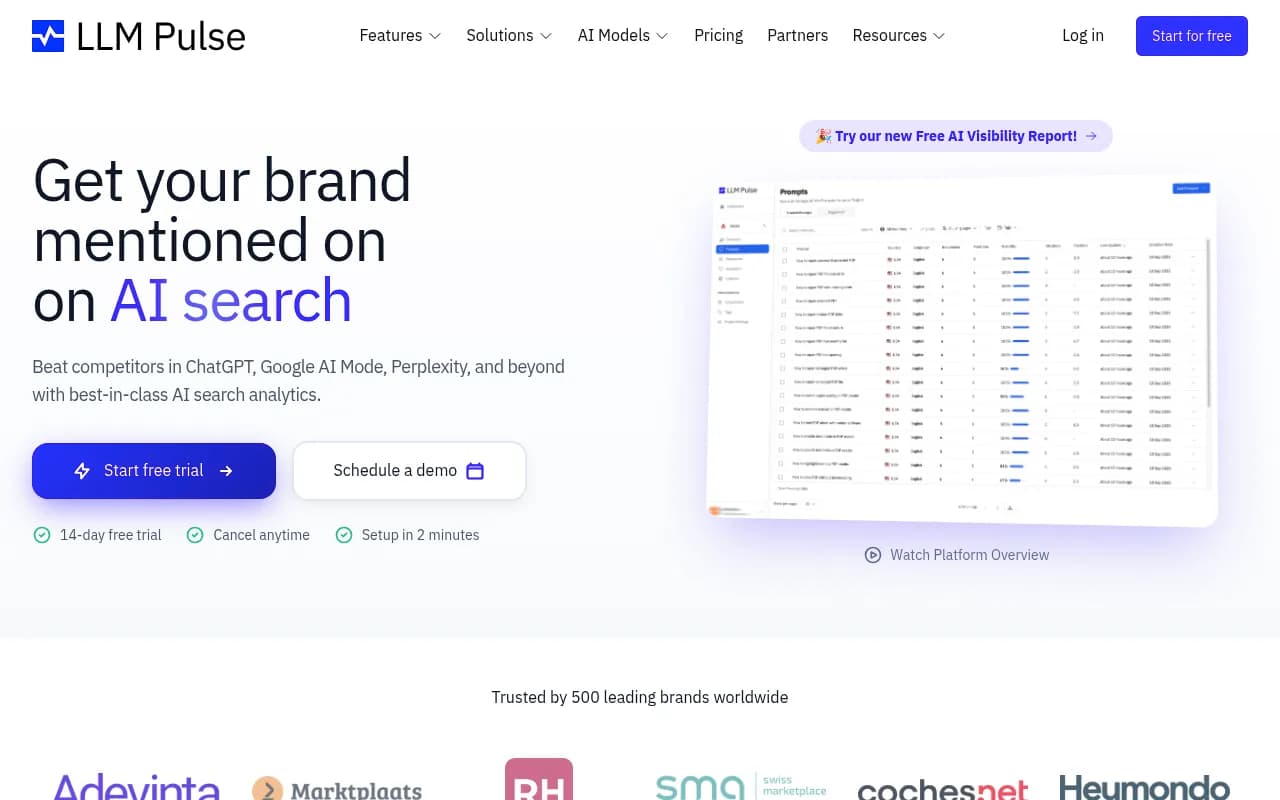
The appeal is simplicity and price. If you're a smaller team or an agency that needs to show clients basic AI visibility data without a complex setup, LLM Pulse gets the job done. Don't expect deep analytics or content tools.
11. Goodie AI — best for enterprise teams focused on structured data and entity optimization
Goodie AI takes a more technical approach to GEO, focusing on how AI models understand and represent your brand as an entity. It's particularly strong for brands that want to optimize structured data, schema markup, and the factual accuracy of how AI models describe them.
It's a niche fit — most marketing teams don't need this level of technical depth. But for brands where factual accuracy in AI responses is a compliance or reputation issue (financial services, healthcare, etc.), Goodie AI's approach is genuinely different from the rest of this list.
12. Radarkit — best for agencies managing multiple client AI visibility programs
Radarkit is built with agencies in mind: multi-client dashboards, white-label reporting, and the ability to track AI visibility across a portfolio of brands without the per-seat pricing that makes some enterprise tools expensive at scale.
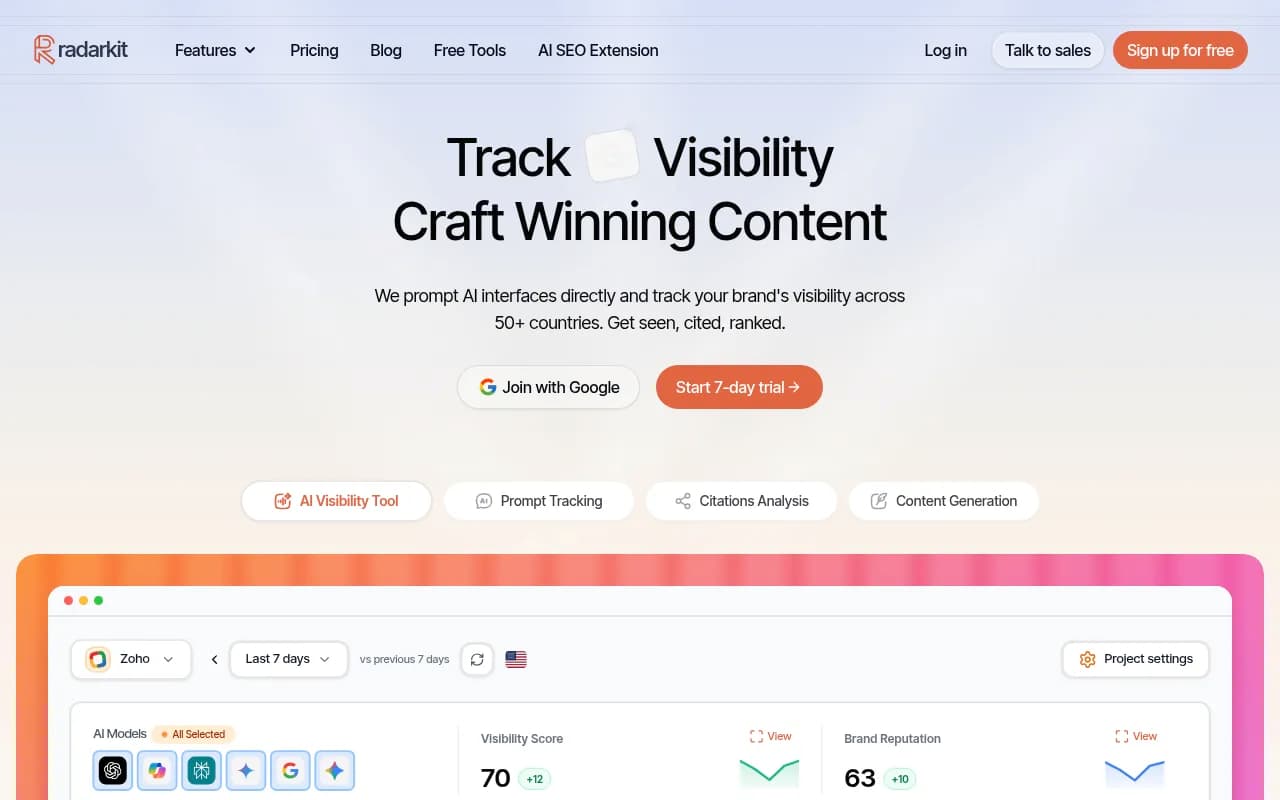
The monitoring capabilities are solid. Like most tools in this list, the optimization side is limited — you'll get the data, but the content strategy and execution stays with your team. For agencies that have content resources and just need the intelligence layer, Radarkit is a strong option.
Feature comparison table
| Tool | AI models tracked | Content generation | Crawler logs | Prompt volume data | Best for |
|---|---|---|---|---|---|
| Promptwatch | 10 | Yes (Content Agents) | Yes | Yes | Full GEO optimization |
| Ahrefs Brand Radar | 6 | No | No | Yes (PAA-based) | Ahrefs users |
| Semrush AI Toolkit | 4-5 | No | No | No (fixed prompts) | Semrush users |
| SE Ranking | 3-4 | No | No | Limited | SEO-first teams |
| Scrunch AI | 5+ | No | No | No | Enterprise brand safety |
| AthenaHQ | 8+ | Limited | No | No | Enterprise measurement |
| Otterly.AI | 3-4 | No | No | No | Small teams, basic monitoring |
| Peec AI | 4-5 | No | No | Limited | Prompt-level analytics |
| Writesonic | 3-4 | Yes (writing-focused) | No | No | Content teams |
| LLM Pulse | 4-5 | No | No | No | Lightweight tracking |
| Goodie AI | 5+ | No | No | No | Entity/structured data |
| Radarkit | 5+ | No | No | No | Agencies |
Why most alternatives still leave you stuck
Here's the honest problem with this category: the majority of these tools are monitoring dashboards. They show you a visibility score, maybe a competitor comparison, maybe some sentiment analysis. Then they stop.
That's useful data. But data without a path to action is just a report. And in 2026, when AI search is eating an increasing share of how people discover products and services, a report isn't enough.
The tools that actually move the needle are the ones that close the loop: they show you which prompts you're missing, they help you understand why (what content is being cited instead of yours), and they help you create the content that fills those gaps. That's the difference between knowing you're invisible and becoming visible.
Promptwatch is the clearest example of this in the current market. The Answer Gap Analysis, Content Agents, and page-level citation tracking work together as a system rather than as separate features. But even if Promptwatch isn't the right fit for your team, the question to ask any tool in this category is: "After I see my visibility score, what does this platform help me do next?"
If the answer is "export a CSV and figure it out yourself," you're looking at a monitoring tool, not an optimization platform.
How to choose
A few practical filters:
If you're already in Ahrefs or Semrush: Start with their native AI tracking features. You'll get reasonable coverage without adding another tool or another invoice. Upgrade to a dedicated platform when you've outgrown what they offer.
If you're a small team or agency with a limited budget: Otterly.AI or LLM Pulse give you basic monitoring at a price that makes sense. Accept that you'll need to do the optimization work manually.
If you're an enterprise team focused on reporting and measurement: AthenaHQ or Scrunch AI give you the dashboards and governance features that larger organizations need.
If you want to actively grow your AI visibility: You need a platform that does more than monitor. Promptwatch is the most complete option here, with the content generation and crawler intelligence to actually move your numbers.
If your concern is entity accuracy and structured data: Goodie AI is worth a serious look, especially in regulated industries.
The AI search landscape is moving fast enough that the right answer in six months might be different from today. But the underlying question — "does this tool help me fix what it finds?" — will stay relevant regardless of which models dominate or what features get added.
Pick the tool that answers yes to that question for your specific situation, and you'll be ahead of most teams still treating AI visibility as a reporting exercise.