Summary
ChatGPT Shopping launched in late 2024 and quickly became a major channel for product discovery. By early 2026, brands that appear in ChatGPT's shopping recommendations see conversion rates 4.4x higher than traditional search traffic. But how do you know if your products are being recommended? And how do you improve your visibility?
This guide covers the platforms built to track and optimize your brand's presence in ChatGPT Shopping. We'll compare features, pricing, and real-world results from brands using these tools. If you're selling products online -- whether D2C, B2C, or B2B -- understanding your ChatGPT Shopping visibility is no longer optional.
- ChatGPT Shopping is a new discovery channel: Over 800 million weekly active users now ask ChatGPT for product recommendations, making it a top-tier traffic source
- Traditional SEO tools don't track AI recommendations: You need specialized platforms that monitor how ChatGPT, Perplexity, and other AI assistants recommend products
- Early adopters gain lasting advantages: Brands optimizing for AI visibility now are building moats that competitors will struggle to overcome
- Tracking connects to revenue: The best platforms show not just mentions, but actual traffic and conversions from AI-driven recommendations
- Most platforms are still maturing: Expect rapid feature development and pricing changes as the market consolidates
What is ChatGPT Shopping and why does tracking matter?
ChatGPT Shopping is OpenAI's product recommendation feature that surfaces relevant products directly inside ChatGPT conversations. When users ask questions like "best running shoes for flat feet" or "affordable standing desks under $500," ChatGPT now generates shopping recommendations with product cards, images, and direct purchase links.
This isn't a minor feature addition. It's a fundamental shift in how people discover and buy products. Instead of clicking through Google search results and comparing options across tabs, users get curated recommendations in a conversational flow. The friction drops dramatically -- and so does your ability to influence the outcome using traditional SEO.
Tracking your ChatGPT Shopping visibility matters because:
- You can't optimize what you don't measure: If you don't know whether ChatGPT recommends your products (or your competitors'), you're flying blind
- AI search traffic converts better: According to multiple 2025-2026 studies, visitors from AI recommendations convert at 4.4x the rate of organic search traffic
- Visibility compounds over time: The more ChatGPT cites your brand, the more likely it is to cite you again -- early wins create momentum
- Traditional analytics miss AI traffic: Google Analytics and similar tools don't distinguish AI-driven visits from regular referrals, leaving you unable to attribute revenue correctly
How ChatGPT Shopping tracking platforms work
These platforms operate differently than traditional SEO tools. Instead of tracking keyword rankings on Google, they monitor how your brand appears in responses from large language models (LLMs) like ChatGPT, Claude, Gemini, and Perplexity.
The core workflow:
- Query simulation: The platform runs thousands of product-related prompts through ChatGPT and other AI models -- questions real users might ask when shopping
- Citation extraction: It parses the AI's responses to identify which brands, products, and websites are mentioned or recommended
- Visibility scoring: You get a quantitative measure of how often your brand appears, in what context (positive/neutral/negative), and compared to competitors
- Traffic attribution: Advanced platforms inject tracking parameters or analyze server logs to connect AI mentions to actual website visits and conversions
- Optimization recommendations: The best tools don't just show data -- they suggest specific content changes, schema markup, or product descriptions that improve your AI visibility
Unlike Google rankings, which update slowly and predictably, AI recommendations can shift rapidly based on new training data, user feedback, and model updates. This makes real-time monitoring essential.
Top platforms for tracking ChatGPT Shopping in 2026
The market for AI visibility platforms exploded in 2025-2026. Below are the platforms with proven ChatGPT Shopping tracking capabilities, ranked by feature depth, data accuracy, and ease of use for e-commerce brands.
Promptwatch: End-to-end AI visibility and optimization
Promptwatch is the only platform rated as a "Leader" across all categories in a 2026 comparison of 12 GEO platforms. It's built around an action loop: find content gaps, generate optimized content, track results.

What makes Promptwatch different for ChatGPT Shopping:
- Answer Gap Analysis: Shows exactly which product prompts competitors rank for but you don't -- the specific content your site is missing
- AI content generation: Built-in writing agent creates product descriptions, comparison articles, and buying guides engineered to get cited by ChatGPT
- ChatGPT Shopping tracking: Dedicated monitoring of when your products appear in ChatGPT's shopping carousels and product cards
- AI crawler logs: Real-time visibility into when ChatGPT, Perplexity, and other AI crawlers access your product pages -- see what they read and fix indexing issues
- Traffic attribution: Connect AI visibility to actual revenue with code snippet, Google Search Console integration, or server log analysis
Pricing: Essential $99/mo (1 site, 50 prompts, 5 articles), Professional $249/mo (2 sites, 150 prompts, 15 articles, crawler logs), Business $579/mo (5 sites, 350 prompts, 30 articles). Agency and enterprise plans available.
Best for: Brands that want to actively improve their ChatGPT Shopping visibility, not just monitor it. The content generation and gap analysis features close the loop between data and action.
Profound: Real-time simulation and enterprise features
Profound offers real-time ChatGPT response simulation and has become popular with larger e-commerce operations. It excels at showing exactly how ChatGPT responds to product queries right now, with detailed sentiment analysis.
Key features:
- Live ChatGPT query testing with instant results
- Sentiment tracking across all AI mentions
- Competitor comparison heatmaps
- Multi-language support for global brands
- API access for custom integrations
Pricing: Custom enterprise pricing. Expect $500-2000/mo depending on query volume and number of tracked competitors.
Best for: Mid-to-large e-commerce brands with technical teams who want deep customization and real-time testing capabilities.
Otterly.AI: Affordable monitoring for small teams
Otterly.AI focuses on straightforward monitoring without the complexity of optimization features. It tracks ChatGPT, Perplexity, and Google AI Overviews at a price point accessible to smaller brands.

Key features:
- Basic mention tracking across 3 AI platforms
- Weekly email reports
- Competitor comparison (up to 3 competitors)
- Simple dashboard with visibility scores
Pricing: Starts at $79/mo for basic monitoring. No content generation or optimization features.
Best for: Small e-commerce brands that need visibility data but don't have resources for active optimization.
Athena HQ: Multi-platform tracking with deep analytics
Athena HQ monitors 8+ AI search engines including ChatGPT, Claude, Gemini, and Perplexity. It's positioned as a comprehensive visibility platform with strong analytics but limited optimization tools.
Key features:
- Tracks 8+ AI platforms simultaneously
- Detailed citation analysis showing source URLs
- Prompt volume estimates and difficulty scoring
- Historical trend tracking
- No content generation features
Pricing: Professional $199/mo, Enterprise custom pricing.
Best for: Brands that need broad AI platform coverage and detailed analytics but plan to handle content optimization separately.
Peec AI: Fast sentiment analysis and multi-language support
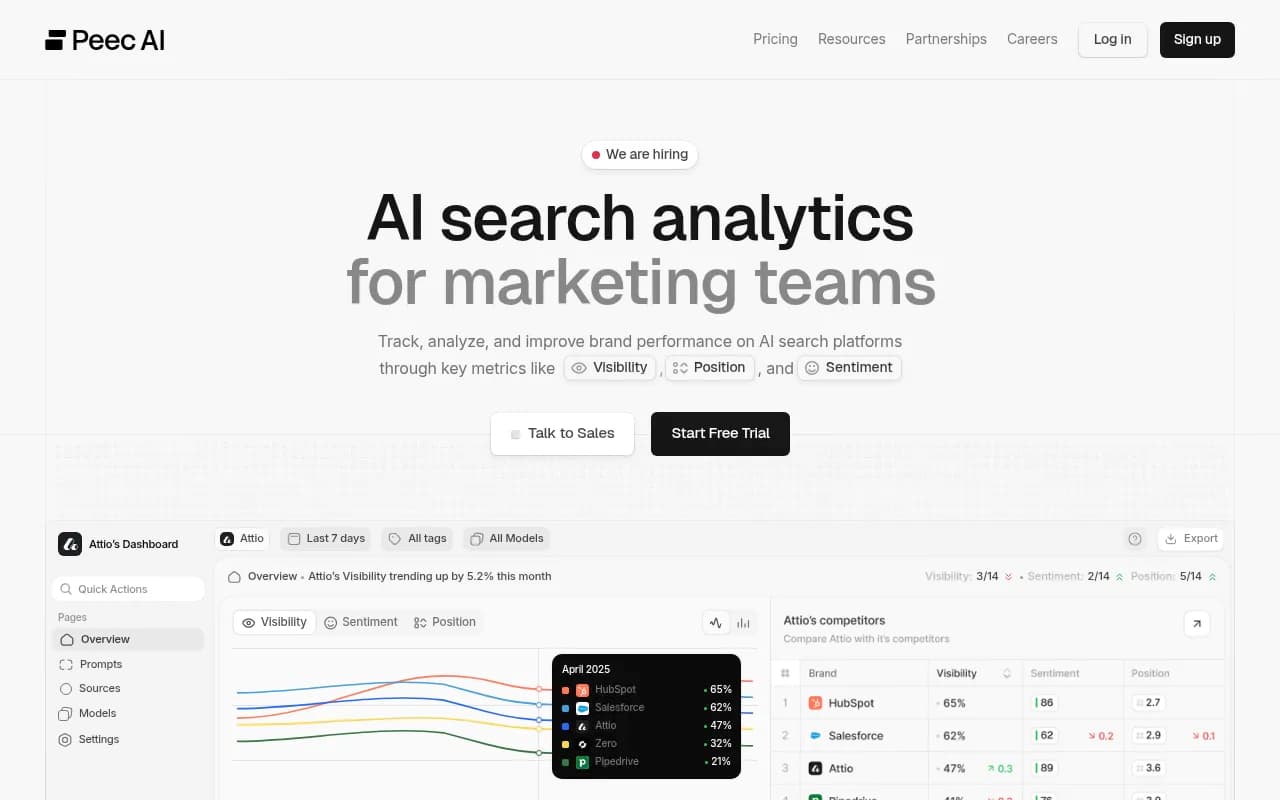
Peec AI specializes in quick sentiment analysis and supports multiple languages, making it a strong choice for international e-commerce brands.
Key features:
- Real-time sentiment scoring
- Multi-language query support (20+ languages)
- Competitor sentiment comparison
- Weekly automated reports
- Limited optimization features
Pricing: Starts at $149/mo. Multi-language support requires higher-tier plans.
Best for: International brands selling in multiple markets who need sentiment tracking across languages.
Feature comparison: What to look for
Not all ChatGPT Shopping tracking platforms offer the same capabilities. Here's what matters most:
| Feature | Why it matters | Leaders |
|---|---|---|
| ChatGPT Shopping monitoring | Tracks product card appearances | Promptwatch, Profound |
| Multi-platform coverage | Monitors Claude, Gemini, Perplexity | Athena HQ, Promptwatch |
| Content gap analysis | Shows missing content opportunities | Promptwatch |
| AI content generation | Creates optimized product content | Promptwatch |
| Traffic attribution | Connects mentions to revenue | Promptwatch, Profound |
| Crawler log analysis | Shows AI indexing behavior | Promptwatch |
| Sentiment tracking | Measures positive/negative mentions | Peec AI, Profound |
| Competitor comparison | Benchmarks your visibility | All platforms |
| API access | Enables custom integrations | Profound, Athena HQ |
| Pricing transparency | Clear, published pricing | Promptwatch, Otterly.AI |
The action gap: Most platforms (Otterly.AI, Athena HQ, Peec AI) are monitoring-only dashboards. They show you data but leave you stuck figuring out what to do next. Promptwatch is the only platform that closes the loop with content gap analysis and AI-powered content generation.
How to choose the right platform for your business
Your choice depends on three factors: budget, team resources, and optimization goals.
If you're a small brand (under $1M revenue) with limited resources:
- Start with Otterly.AI ($79/mo) for basic visibility tracking
- Focus on understanding whether ChatGPT mentions your products at all
- Manually optimize product descriptions based on competitor analysis
- Upgrade once you see clear ROI from AI traffic
If you're a mid-sized brand ($1M-10M revenue) with a marketing team:
- Choose Promptwatch Professional ($249/mo) for the full action loop
- Use Answer Gap Analysis to identify missing content
- Deploy the AI writing agent to create optimized product content
- Track results with crawler logs and traffic attribution
- Expect 25-40% improvement in AI mentions within 3 months
If you're an enterprise brand (over $10M revenue) with technical teams:
- Evaluate Profound for real-time simulation and API access
- Consider Athena HQ if you need coverage across 8+ AI platforms
- Budget $500-2000/mo for enterprise features
- Integrate with existing analytics and BI tools
- Build custom dashboards using API data
If you're selling internationally:
- Peec AI offers the strongest multi-language support
- Promptwatch supports multiple languages and regions with customizable personas
- Ensure the platform monitors AI models popular in your target markets (e.g., DeepSeek for China)
Setting up ChatGPT Shopping tracking: Step-by-step
Once you've chosen a platform, here's how to get started:
- Define your product categories: List the main product types you sell and the questions customers ask when shopping for them
- Identify competitors: Choose 3-5 direct competitors whose AI visibility you want to benchmark against
- Set up tracking: Most platforms require you to input your domain, competitor domains, and a list of product-related queries
- Establish a baseline: Run initial queries to see your current ChatGPT Shopping visibility -- this is your starting point
- Analyze gaps: Use the platform's gap analysis (if available) to identify which prompts competitors rank for but you don't
- Optimize content: Update product pages, create comparison guides, or generate new content targeting high-value prompts
- Monitor crawler activity: Check AI crawler logs to ensure ChatGPT and other models are actually reading your updated content
- Track traffic: Set up attribution to measure visitors and conversions from AI recommendations
- Iterate weekly: AI visibility changes faster than traditional SEO -- check your dashboard weekly and adjust content accordingly
Pro tip: Don't just track brand mentions. Track product category mentions too. If ChatGPT recommends "standing desks" but doesn't mention your brand, you're still losing sales.
Common mistakes brands make with AI visibility tracking
After working with dozens of e-commerce brands in 2025-2026, these are the mistakes that kill results:
Mistake 1: Treating it like traditional SEO AI models don't rank pages -- they synthesize information from multiple sources. Optimizing a single product page isn't enough. You need comprehensive content that answers related questions, compares alternatives, and provides context.
Mistake 2: Only tracking your brand name If you only monitor "[Your Brand] products," you miss 90% of the opportunity. Most users don't search by brand -- they search by need ("best budget laptops for students"). Track category and problem-based queries.
Mistake 3: Ignoring crawler logs ChatGPT and other AI models crawl your site to gather information. If they encounter errors, slow load times, or blocked pages, they can't cite you. Crawler log analysis (available in Promptwatch Professional) shows exactly what AI models see when they visit your site.
Mistake 4: Not connecting visibility to revenue Visibility scores are vanity metrics if they don't connect to traffic and sales. Use traffic attribution to measure actual ROI. If AI mentions increase but traffic doesn't, something is broken in the funnel.
Mistake 5: Waiting for perfect data AI visibility tracking is a new field. Data won't be perfect. Start tracking now, establish a baseline, and iterate. Brands that waited for "better tools" in 2025 are now 6-12 months behind competitors who started early.
The future of ChatGPT Shopping tracking
The platforms covered in this guide will evolve rapidly in 2026. Here's what to expect:
More AI models to track: As new models launch (and existing ones add shopping features), platforms will expand coverage. Expect tracking for Meta AI Shopping, Grok Commerce, and regional AI assistants.
Deeper attribution: Current traffic attribution is basic. Future versions will show which specific AI conversation led to a purchase, enabling true ROI measurement.
Automated optimization: Platforms will move beyond recommendations to automatic content deployment. Imagine a system that detects a visibility gap, generates optimized content, publishes it to your CMS, and tracks results -- all without human intervention.
AI model APIs: As OpenAI, Anthropic, and Google open their recommendation APIs, tracking platforms will gain direct access to citation data instead of relying on simulations.
Consolidation: The current market has 20+ platforms. Expect acquisitions and shutdowns as the market matures. Choose platforms with strong funding, clear revenue models, and active development.
Start tracking your ChatGPT Shopping visibility today
ChatGPT Shopping isn't a future trend -- it's happening now. Brands that establish AI visibility in 2026 will dominate their categories for years. Those that ignore it will watch competitors capture an increasingly large share of product discovery traffic.
If you're ready to start tracking:
- For most e-commerce brands: Start with Promptwatch Professional ($249/mo). The combination of tracking, content gap analysis, and AI content generation gives you everything needed to improve visibility, not just monitor it.
- For budget-conscious small brands: Try Otterly.AI ($79/mo) to establish a baseline, then upgrade once you see ROI.
- For enterprises with technical teams: Evaluate Profound for real-time simulation and API access.
The brands winning in AI search aren't guessing -- they're measuring, optimizing, and iterating. Your competitors are already tracking their ChatGPT Shopping visibility. The question is whether you'll catch up or fall further behind.