Key takeaways
- Peec AI is a solid monitoring tool, but it caps you at 100 prompts, lacks prompt difficulty and volume scoring, and has no content creation features.
- The most useful alternatives don't just show where you're invisible — they tell you which gaps are worth closing and help you close them.
- Prompt difficulty and volume data are what separate actionable GEO platforms from vanity metric dashboards.
- Tools like Promptwatch, Ahrefs Brand Radar, and Profound each take different approaches to this problem — the right one depends on your team's size, budget, and whether you need to act or just report.
- If you need the full loop (find gaps, generate content, track results), most monitoring-only tools will leave you stuck at step one.
Peec AI does what it says on the tin. You set up prompts, it runs them across ChatGPT, Perplexity, Google AI Overviews, and DeepSeek, and you get a clean dashboard showing where your brand appears. For teams just getting started with AI visibility, that's genuinely useful.
But there's a ceiling, and most teams hit it faster than expected.
The Pro plan (€199/mo) covers four base AI engines. Want Claude, Gemini, or Google AI Mode? Those are Enterprise add-ons with custom pricing. You're capped at 100 prompts and 9,000 AI answers per month. There's no prompt difficulty scoring, no volume estimates, no content gap analysis, and no way to generate content from within the platform. You can see that you're invisible for a prompt. You can't tell whether that prompt is worth targeting or what to do about it.
That's the gap this guide is about. The tools below go further — some by adding prompt intelligence, some by layering in content creation, some by connecting visibility data to actual revenue. Here's how they compare.
What "prompt difficulty and volume" actually means
Before getting into the tools, it's worth being precise about what we're looking for.
In traditional SEO, keyword difficulty tells you how hard it is to rank for a term, and search volume tells you how many people are searching for it. Together, they help you prioritize — go after high-volume, low-difficulty terms first.
The same logic applies to AI search, but the mechanics are different. Instead of ranking positions, you're competing for citations in AI-generated answers. "Prompt difficulty" in this context means how many strong, well-cited competitors are already answering a given prompt — and how entrenched they are. "Prompt volume" means how often real users are actually asking that question across AI engines.
Most GEO tools skip both. They let you input your own prompts (which may or may not reflect real user behavior), run them, and show you a visibility score. That's useful for tracking, but it doesn't help you find new opportunities or prioritize your content calendar.
The tools that stand out in 2026 are the ones that bring real data to these questions.
The comparison at a glance
| Tool | Prompt volume data | Prompt difficulty | Content generation | AI engines covered | Starting price |
|---|---|---|---|---|---|
| Promptwatch | Yes (volume + difficulty) | Yes | Yes (Content Agents) | 11 | $99/mo |
| Ahrefs Brand Radar | Yes (real search data) | Partial | No | 6 + YouTube/Reddit | $50/mo |
| Profound | Partial | Partial | No | 8+ | Custom |
| Semrush AI Toolkit | Partial | No | Via ContentShake | 5 | Bundled |
| Otterly.AI | No | No | No | 5 | $29/mo |
| Writesonic | No | No | Yes (AI writer) | 5 | $16/mo |
| SE Ranking | No | No | Partial | 5 | $65/mo |
| Athena HQ | No | No | No | 8+ | Custom |
Promptwatch: the only tool that closes the loop
Promptwatch is the most direct answer to what Peec AI is missing. Where Peec shows you visibility scores, Promptwatch shows you which prompts your competitors are winning that you're not — and then helps you create content to close those gaps.

The feature that matters most here is Answer Gap Analysis. It runs prompts across AI engines, identifies where competitors are being cited and you're not, and surfaces the specific content your site is missing. You're not guessing at what to write — you're looking at a list of prompts with volume estimates and difficulty scores, ranked by opportunity.
From there, Content Agents generate articles, listicles, comparisons, and briefs grounded in that prompt data. This isn't generic AI writing — it's content built around the exact questions AI models are already answering for your competitors but not for you.
The third piece is tracking. Page-level citation tracking shows which of your pages are being cited, by which models, and how often. Agent Analytics logs when AI crawlers hit your site, which pages they read, and when those pages move from crawled to cited. That timeline — publish, crawl, citation — is something almost no other tool surfaces.
On the prompt intelligence side, Promptwatch provides volume estimates and difficulty scores for each prompt, plus query fan-outs that show how one prompt branches into sub-queries. That's the prioritization layer Peec AI doesn't have.
Coverage spans 11 AI models: ChatGPT, Perplexity, Google AI Overviews, Google AI Mode, Claude, Gemini, Meta/Llama, DeepSeek, Grok, Mistral, and Copilot. Pricing starts at $99/mo for the Essential plan (1 site, 50 prompts, 5 articles), with Professional at $249/mo (150 prompts, 15 articles, crawler logs) and Business at $579/mo.
For teams that need to move from "we're invisible" to "we fixed it," this is the most complete option in the market.
Ahrefs Brand Radar: real prompt data, no content tools
Ahrefs Brand Radar takes a different approach to the prompt quality problem. Most GEO tools construct their own prompts — they guess what users might ask, fabricate those queries, and report visibility scores against hypothetical questions. Brand Radar's 243M+ prompts come from real search data, specifically "People Also Ask" questions with measurable search volume behind them.
That's a meaningful architectural difference. Every visibility score is anchored in actual user behavior, not simulated scenarios. If Brand Radar says you're invisible for a prompt, you know real people are asking it.
Coverage is broad: ChatGPT, Perplexity, Gemini, Copilot, Google AI Overviews, and Google AI Mode, plus YouTube, TikTok, and Reddit. Peec's Pro plan covers four base engines, so Brand Radar gives you more without needing enterprise pricing.
The gap is on the action side. Brand Radar doesn't generate content, doesn't provide content briefs, and doesn't have crawler logs. It's a strong monitoring and research tool, but you'll need to take the insights elsewhere to act on them.
Pricing starts at $50/mo for 2,500 checks, scaling up to $699/mo for all six AI indexes plus custom prompt checks.
Best for: Teams that want high-confidence prompt data grounded in real search behavior, and have a separate content workflow to act on it.
Profound: enterprise-grade, but monitoring-first
Profound has strong coverage and a clean interface. It's built for larger teams that need to track AI visibility across multiple brands or product lines, and it does that well.
Where it falls short for the specific use case of prompt difficulty and volume is that it's primarily a monitoring platform. You can track where you appear, benchmark against competitors, and see share-of-voice trends. Prompt prioritization — telling you which queries are high-volume and winnable — isn't a core feature.
Pricing is custom, which means it's typically positioned at enterprise budgets. For smaller teams or agencies looking for a Peec alternative with prompt intelligence, the price-to-feature ratio may not work out.
Best for: Enterprise teams with dedicated analytics resources who need robust tracking across many brands.
Semrush AI Visibility Toolkit: familiar platform, fixed prompts
Semrush has added AI visibility tracking to its existing suite, which is convenient if you're already paying for Semrush. The AI Toolkit tracks brand mentions across several AI engines and connects to the broader Semrush data ecosystem — keyword data, competitor analysis, content tools.
The limitation is that Semrush uses fixed prompts rather than letting you define your own or surfacing prompt opportunities from real user behavior. That makes it useful for broad monitoring but less useful for finding specific winnable queries in your niche.
ContentShake AI (bundled with some Semrush plans) handles content generation, so there's a path from monitoring to creation — it's just not as tightly integrated around prompt data as Promptwatch's Content Agents.
Best for: Teams already in the Semrush ecosystem who want to add AI visibility tracking without switching platforms.
Otterly.AI: affordable, but monitoring only
Otterly.AI is one of the more popular entry-level options, and for good reason — it's affordable (starts around $29/mo), covers the main AI engines, and gives you a clean view of brand mentions and citations.
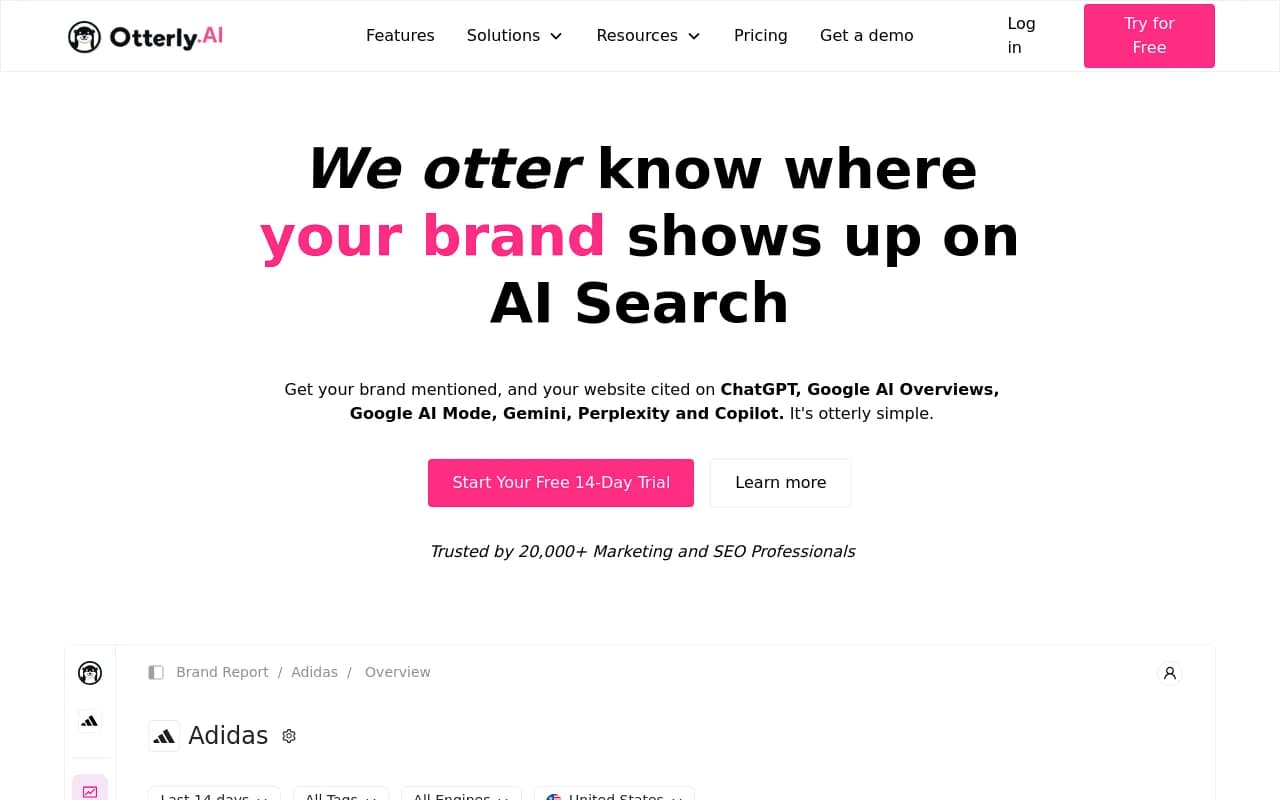
But it's firmly in the monitoring-only category. No prompt difficulty scoring, no volume estimates, no content generation, no crawler logs. If you're moving away from Peec AI because you need more than a dashboard, Otterly won't solve that problem — it's a lateral move, not an upgrade.
Best for: Small teams or solo marketers who need basic AI visibility tracking at a low price and aren't yet ready for optimization workflows.
Writesonic: content generation with some visibility tracking
Writesonic has expanded from an AI writing tool into something that also tracks AI search visibility. The content generation side is genuinely good — it's one of the more capable AI writers in this space.
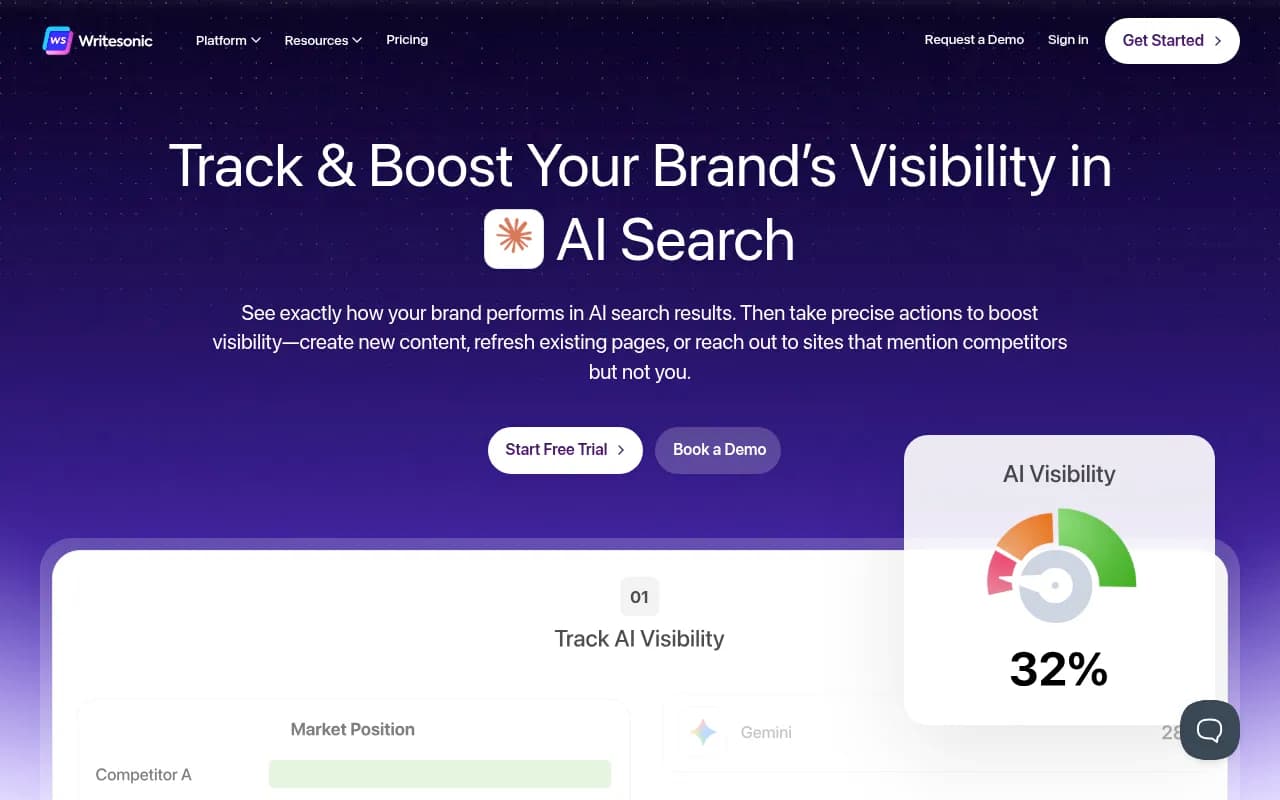
The visibility tracking is more limited. It covers a handful of AI engines and gives you basic mention data, but prompt difficulty and volume scoring aren't part of the picture. Think of it as a content tool with monitoring features bolted on, rather than a GEO platform with content tools integrated.
If your primary need is content creation and you want some AI visibility data alongside it, Writesonic is worth looking at. If prompt intelligence is the priority, it's not the right fit.
Best for: Content teams that want AI writing capabilities and basic visibility tracking in one tool.
SE Ranking: solid SEO suite, growing AI features
SE Ranking has been adding AI visibility features to its established SEO platform. The AI Search Toolkit tracks brand mentions across several engines and connects to SE Ranking's keyword and rank tracking data.
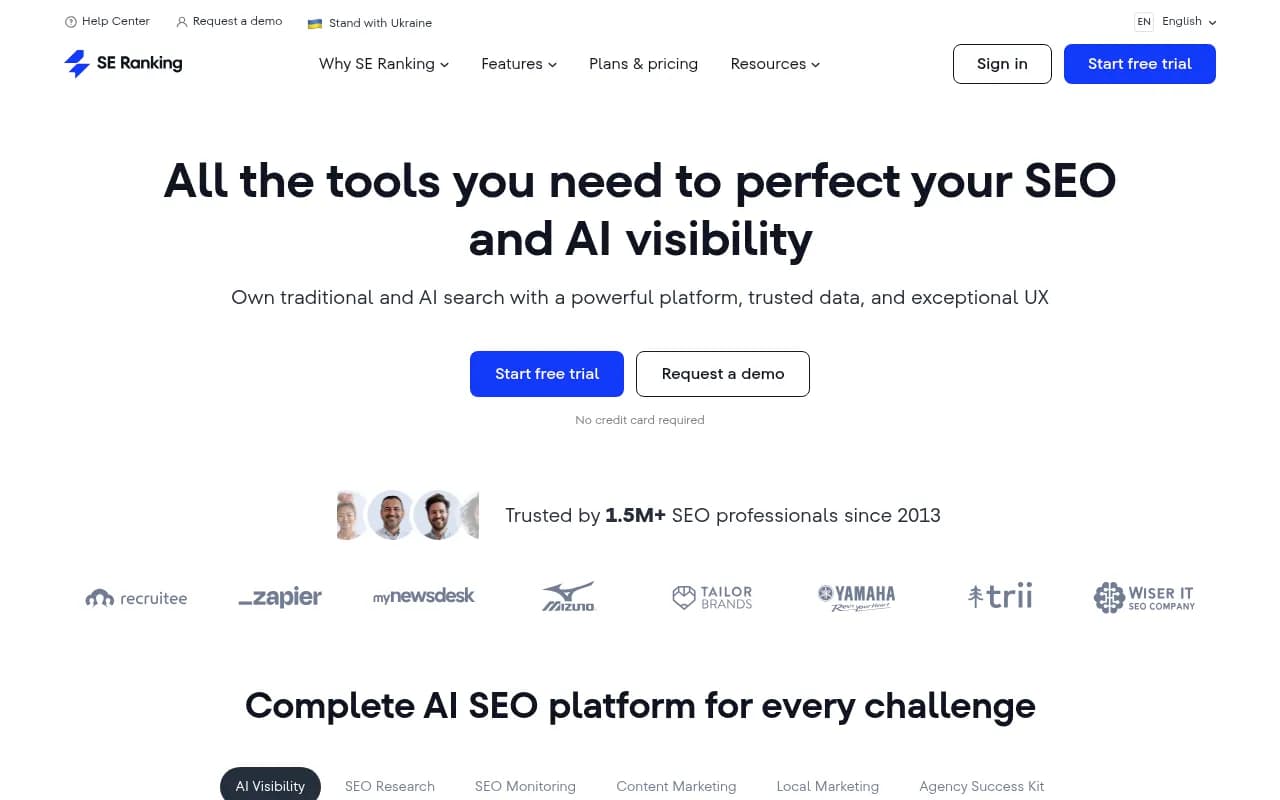
Like Semrush, the advantage here is integration with existing SEO workflows. The limitation is that the AI visibility features are still maturing — prompt difficulty and volume scoring aren't available, and content generation is partial at best.
Pricing is more accessible than Profound, starting around $65/mo, which makes it a reasonable option for teams that want SEO and AI visibility in one place without a large budget.
Best for: SEO teams that want to add AI visibility monitoring to an existing SE Ranking subscription.
Athena HQ: strong monitoring, no optimization
Athena HQ covers 8+ AI engines and has solid competitive benchmarking features. It's a capable monitoring platform, and the interface is clean.

The gap is the same as most tools in this category: it shows you where you stand but doesn't tell you which prompts are worth targeting or help you create content to improve. Prompt difficulty and volume data aren't part of the offering. Pricing is custom, positioning it at enterprise budgets.
Best for: Enterprise teams that need comprehensive monitoring across many AI engines and have separate resources for content strategy.
Other tools worth knowing about
A few more options that come up regularly in this space:
Scrunch AI has strong brand monitoring features and covers multiple AI engines. Like most tools here, it's monitoring-first without prompt prioritization.
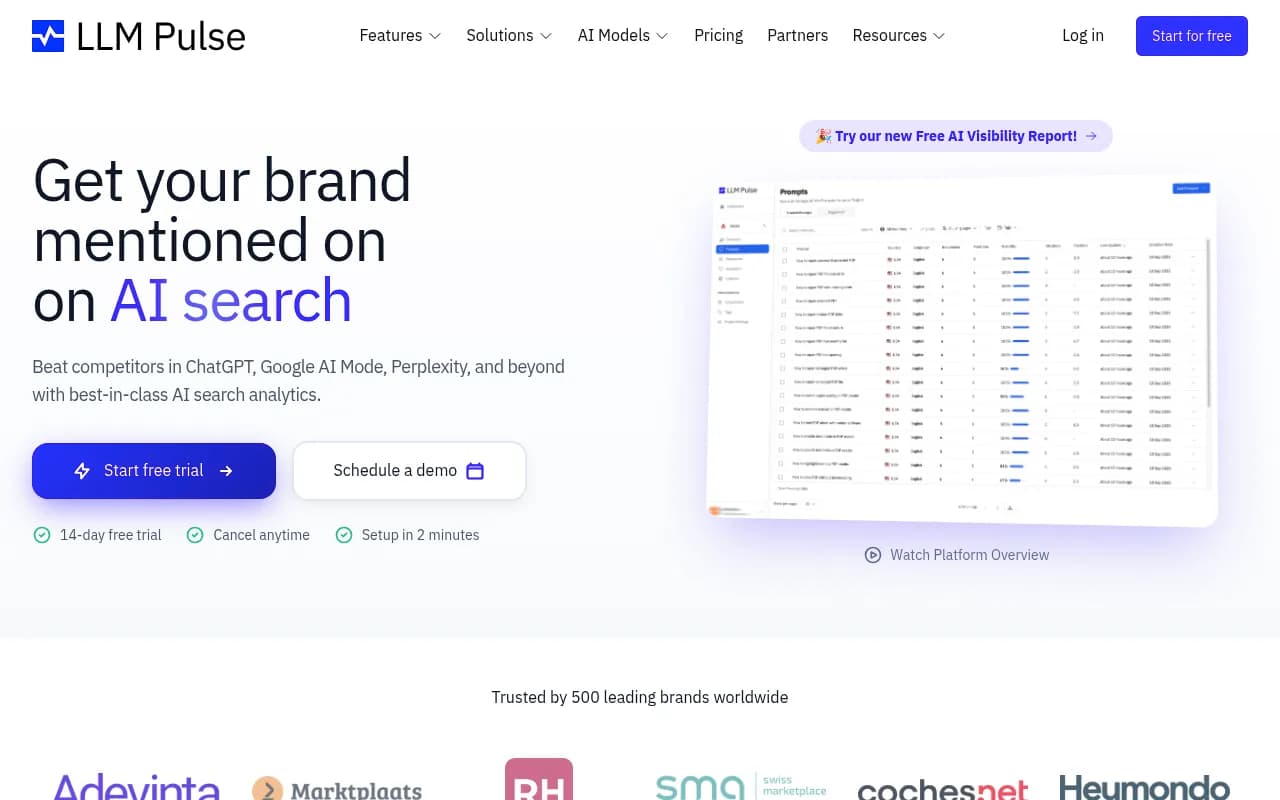
LLM Pulse is a lighter-weight option for tracking brand visibility across ChatGPT, Perplexity, and similar platforms. Good for basic monitoring, limited on analytics depth.
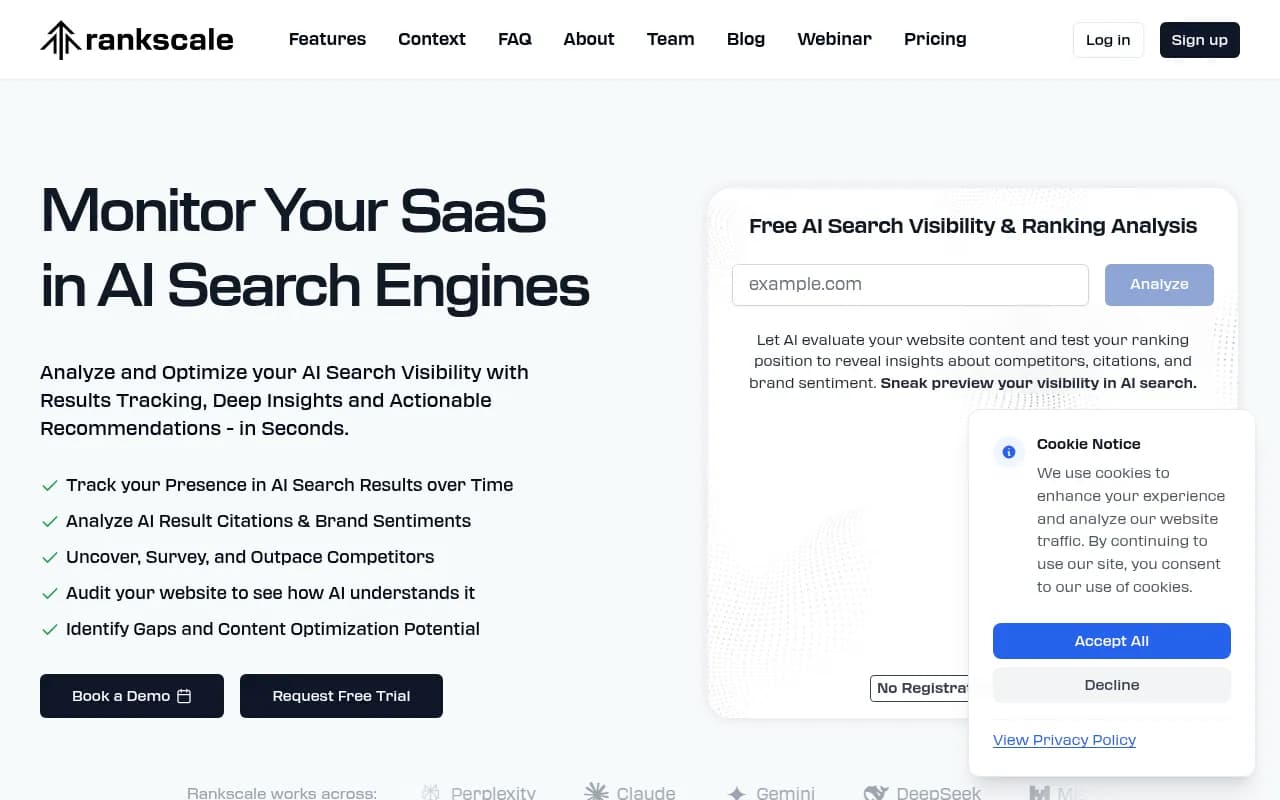
Rankscale focuses on AI visibility scaling and has some useful competitive benchmarking features.
Goodie AI is positioned as an enterprise GEO solution with strong data quality, though it's on the higher end of the price spectrum.
How to choose: a practical framework
The right tool depends on what you're actually trying to do.
If you're trying to prove AI visibility ROI to a client or executive, you need competitive benchmarking and share-of-voice reporting. Profound, Ahrefs Brand Radar, and Promptwatch all handle this.
If you're trying to find new content opportunities — prompts you're not targeting yet that have real volume — you need prompt intelligence. Promptwatch and Ahrefs Brand Radar are the strongest options here, for different reasons. Promptwatch gives you difficulty scoring and content generation. Brand Radar gives you real search-volume-backed prompts.
If you're trying to improve your citation rate on prompts you're already tracking, you need content gap analysis and creation tools. Promptwatch is the only platform in this list that handles the full cycle: identify the gap, generate the content, track the result.
If you're on a tight budget and just need basic monitoring, Otterly.AI or SE Ranking's AI toolkit are reasonable starting points — just know you'll outgrow them quickly.
One question worth asking before you commit to any platform: does this tool show me what to do next, or just where I stand? Most tools in this space answer the second question. The ones that answer the first are worth paying more for.
The prompt difficulty gap is real — and most tools ignore it
Here's the honest assessment of where the market is in 2026: most GEO tools are still solving the awareness problem. They're helping teams understand that AI search exists and that their brand may or may not appear in it. That was the right problem to solve in 2024.
The problem in 2026 is prioritization. You can't track every possible prompt. You need to know which ones matter — which have real volume, which are winnable given your current authority, and which competitors are already locked in on. That's prompt intelligence, and it's still rare.
Ahrefs Brand Radar has the best answer to the volume question, because its prompts come from real search data. Promptwatch has the most complete answer to the difficulty and prioritization question, because it combines volume estimates, difficulty scores, gap analysis, and content generation in one workflow.
Everything else in this list is useful for monitoring. But if you're trying to actually move your AI visibility numbers, monitoring alone won't get you there.