Key takeaways
- A ChatGPT rank tracker logs whether your brand is named or cited when a prompt runs. Most stop there. The useful ones also show why you lost and help you act on it.
- Look for four things beyond monitoring: citation and source data, AI crawler visibility, content creation or publishing, and traffic attribution.
- Promptwatch is the one in this list that covers the full loop, from tracking to writing and publishing to measuring. Tools like ZipTie, Nightwatch and SE Visible give lighter action guidance. Otterly and Peec are monitoring-first.
- Prices below come from vendor roundups and Promptwatch's own pricing. Check each vendor's site before you buy. Several roundups are written by vendors who rank themselves first.
- Product pages and landing pages take about 39% of ChatGPT citations, so fixing those usually beats writing more blog posts.
Why a tracker alone is not enough
ChatGPT has no results page. It runs a handful of searches behind the scenes, pulls sources, and writes one answer that names a few brands. So a "rank" is really a question: was my brand named, was my page cited, and how prominently?
A dashboard that answers that question is useful for about a week. After that you want to know what to do about it. If you are absent from an answer, the fix might be a missing comparison page, a page ChatGPT's crawler cannot fetch, a thin product page, or a competitor that shows up in every "best of" list in your category. A score will not tell you which.
One caution about the research behind this topic. Many of the listicles ranking "best ChatGPT rank trackers" are published by the vendors themselves (SE Ranking, KIME, Leapd, AIclicks, Searchable, Geoptie), and each puts its own product near the top. I treated those rankings as marketing and weighed features, not positions. I would also skip the widely repeated claim that 60% of organic traffic now comes from AI responses. It traces back to a 2025 article and I could not verify it.
What to look for in a tracker that also fixes things
Before the list, here is the checklist I would use. A tool earns the "fixes your rankings" label only if it covers most of these.
- Real ChatGPT data. Prompts run through the actual ChatGPT interface, not only the API, since the two can return different answers and citations.
- Citation and source analysis. Which pages and domains ChatGPT cites for your prompts, not just whether your name appeared.
- Crawler visibility. Whether OpenAI's bots can reach and read your pages. Without this you cannot tell an access problem from a content problem.
- Content actions. Gap analysis, briefs, or actual article generation and publishing.
- Outcome measurement. AI-referred visits and conversions, so you can see whether a fix paid off.
What the data says about where to point the fix: in Promptwatch's data on ChatGPT content types (Sep 28 to Oct 4, 2026), product pages took 22.4% of classified citations and landing pages 16.8%. Listicles took 13.6%, how-tos 8.7%, documentation 7.5%, and reviews 1.7%. For commercial prompts like "best CRM for small businesses", product pages, landing pages and listicles together reached roughly 62%, and comparisons added another 7.9%. Any tool that suggests only "write more blog posts" is ignoring that.
Freshness matters too. Promptwatch's content half-life report found news pages lose half their citations in about five weeks, while landing pages and docs keep most of theirs for months. Evergreen commercial pages are the better investment.
Comparison table
Pricing is from vendor-published roundups and Promptwatch's pricing page. Treat it as a starting point.
| Tool | Tracks ChatGPT | Fix-it features | Starting price | Best for |
|---|---|---|---|---|
| Promptwatch | Yes, real UI | Content Agent, Action Board, crawler logs, publishing, traffic attribution | $95/mo (Essential) | Teams that want tracking and execution in one place |
| ZipTie | Yes | Optimization suggestions, citation analysis | $69/mo | Marketers who want clear next steps |
| SE Visible | Yes | Sentiment, top sources, competitor benchmarks | $189/mo | CMOs and brand teams |
| Nightwatch | Yes | Hybrid SEO and AI tracking | $39/mo plus $99 AI add-on | Agencies already tracking Google ranks |
| Profound | Yes | Enterprise narrative and trend reporting | Listed from $99/mo in roundups | Large brands |
| Otterly.AI | Yes | GEO audit, monitoring | $29/mo | Cheap multi-brand monitoring |
| Leapd (Alex) | Yes | Audits and content generation | $39/mo | Small budgets |
| KIME | Yes | Action Centre | From 99 EUR/mo | Teams wanting recommendations |
The tools
Promptwatch
Promptwatch is the option here built around the full loop rather than the dashboard. It monitors ChatGPT, Gemini, Perplexity, Google AI Overviews, Claude, Copilot and others from their real interfaces, in the countries and languages you choose. Then it goes after the causes.

The parts that matter for fixing rankings:
- Crawler logs. IP-verified logs of GPTBot, OAI-SearchBot, ChatGPT-User and other AI bots show which pages they read and where they hit errors. This separates "ChatGPT can't read the page" from "ChatGPT read it and chose someone else." See the AI crawler logs feature.
- Content gap analysis and the Content Agent. It maps your pages against the prompts AI answers, then writes and publishes content to WordPress, Webflow or Framer, with a review inbox if you want a human in the loop. The Content Agents page has details. The Content Agent starts on the Business plan.
- Action Board. A prioritized to-do list generated from your data, so the next step is not a guess.
- Query fan-outs and prompt volumes. You see the actual searches ChatGPT runs per response, which tells you what headings and sub-pages to build. Read the query fan-outs guide.
- Visitor analytics. AI-referred traffic and conversions, so you can check whether a published page sends anything. ChatGPT stopped sending a referrer on October 8, 2026, so there is a setting that counts visits tagged utm_source=chatgpt.com as ChatGPT traffic.
Pricing: Essential is $95/mo (50 prompts), Professional $245/mo (150 prompts, 25M crawler logs), Business $579/mo (350 prompts, Content Agent, faster-than-daily tracking). Agencies have Kick-off at $199/mo, Growth at $399/mo and Scale at $799/mo. Confirm on promptwatch.com/pricing. There is a 7-day free trial on monthly billing, and a free AI visibility report if you just want a first look.
The honest tradeoff: Essential has no crawler logs or AEO articles, so the fix-it side really starts at Professional and Business. If you only need a cheap pulse check, it is more than you need.
In Crisp's case study, AI traffic converted at 2x the rate of traditional channels while they scaled to 5-10 articles a day. Read the Crisp case study.
ZipTie
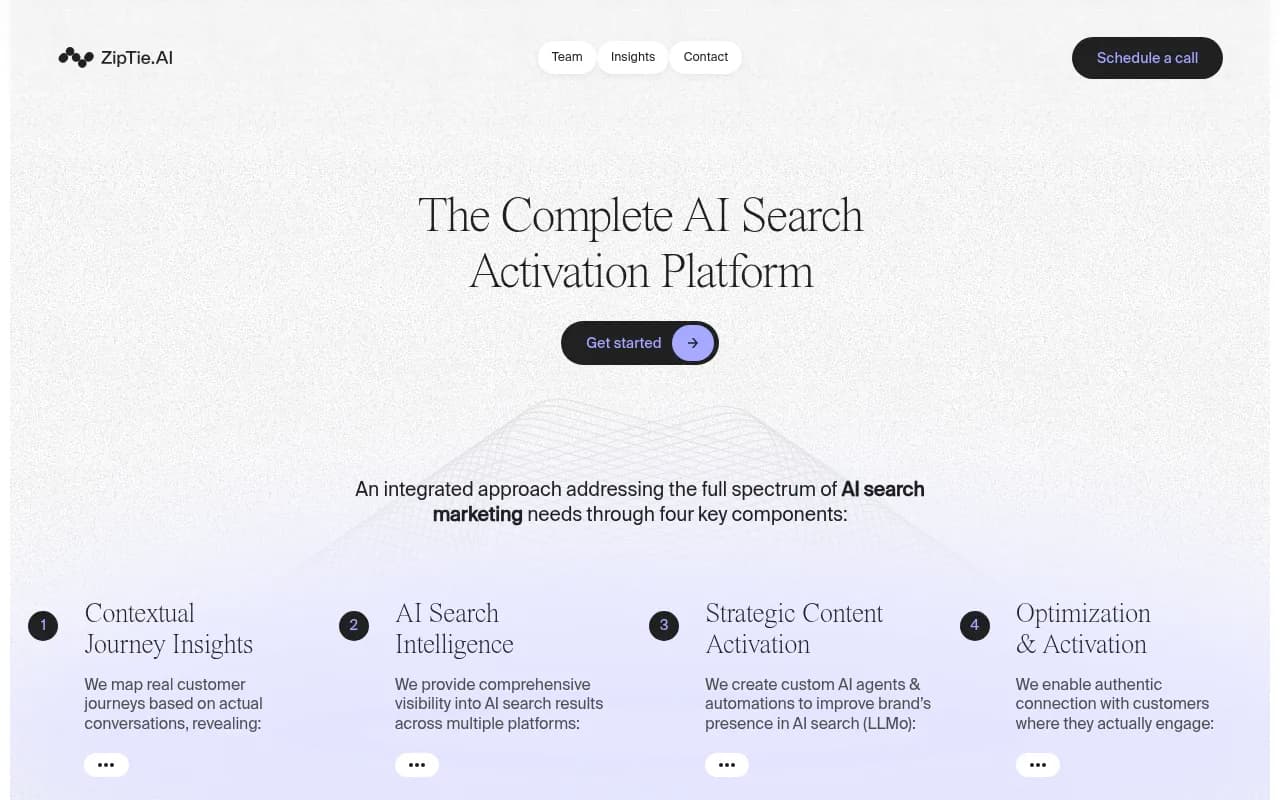
ZipTie positions itself around actionable optimization: an AI success score, citation analysis, and competitor comparison. Roundups list it at $69/mo and note credit-based billing and some report delays. It is a reasonable step up from pure monitoring if you want suggestions but no content engine.
SE Visible
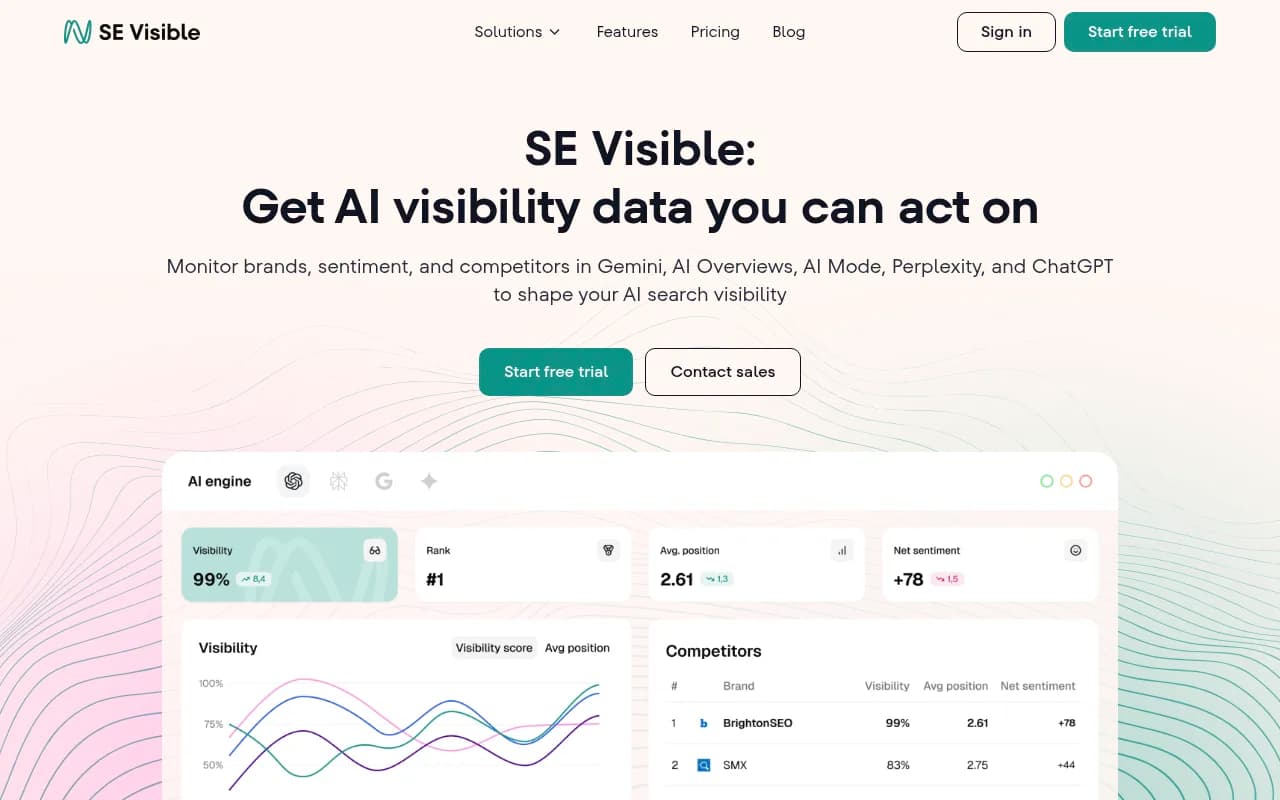
SE Ranking's AI visibility product covers visibility score, net sentiment, top sources and competitor benchmarks. It leans toward the brand and CMO audience, at $189/mo in the source comparison, with CSV-only export. Good for reporting, lighter on execution.
Nightwatch
Nightwatch combines classic Google rank tracking with generative rankings and citations. The catch is cost structure: $39/mo base plus a $99 add-on for AI tracking. If your team lives in rank tracking already, it keeps everything in one tool.
Profound
Profound targets enterprises with visibility scores, conversation volume and trend reporting. Roundups show $99/mo entry pricing with advanced features on higher plans. Strong on monitoring, but compared with Promptwatch it has no agentic execution and no Reddit tracking. See Promptwatch vs Profound.

Otterly.AI and Peec AI
Otterly starts at $29/mo and is the cheapest paid entry in most roundups, with prompt limits on lower tiers. Peec AI is similar in spirit. Both answer "was I mentioned?" well and stop there: no crawler logs, no visitor analytics, no content generation. Fine as a cheap monitor. Not a fix. Compare directly: Promptwatch vs Otterly and Promptwatch vs Peec.


Leapd, KIME and others
Leapd's Alex starts at $39/mo with 50 prompts every 48 hours and bundles audits and content generation. KIME starts at 99 EUR/mo with an Action Centre. Both are vendors who rank themselves first in their own guides, so test them on your own prompts before believing the pitch.

If you want to browse beyond this shortlist, the GEO software directory at bestgeosoftware.com and the AI rank tracking directory list many more.
How to turn tracking into fixes
Whatever tool you pick, the workflow is the same.
Step 1: Track the right prompts
Start with 30 to 50 commercial prompts your buyers actually use, plus a few branded and competitor-comparison ones. Persona-based prompting helps if your buyers differ by role.
Step 2: Check access before content
If ChatGPT's crawlers get errors on your key pages, no amount of writing helps. Run an AI crawler URL inspector or check crawler logs, and confirm your robots.txt is not blocking OpenAI bots.
Step 3: Read the citations
Look at which domains and page types win for your prompts. In software prompts, Promptwatch's October 2026 report found GitHub, Microsoft's docs and G2 lead, with documentation and help centers earning the largest share. In travel, booking and search sites took more than half. Your category has its own pattern, and it tells you whether to build docs, get into roundups, or collect reviews.
Step 4: Build to the fan-out
Promptwatch's query fanout data shows ChatGPT averaging about 1.84 fan-out queries per response by early March 2026, down from 2.15 in December, with shorter queries over time. The advice: write headings that read like short search queries, put the entity and category first in titles, and build focused pages for "X vs Y", pricing and alternatives. Note also that ChatGPT began using the site: operator at scale on August 8, 2026, per Promptwatch's report, so clear, crawlable pages on your own domain matter more.
Step 5: Publish and measure
Ship the product page, comparison page or FAQ. Then check three things on a delay: did crawlers fetch it, did ChatGPT cite it, did visits arrive. If a page underperforms, refresh it rather than writing a new one.
Which one should you pick?
- Under $50/mo and only need monitoring: Otterly.AI or Leapd.
- Already live in classic rank tracking: Nightwatch.
- Brand or CMO reporting: SE Visible.
- Want suggestions without a content engine: ZipTie.
- Want diagnosis, content, publishing and measurement in one product: Promptwatch, ideally Professional or Business.
- Agency with many clients: Promptwatch agency plans, or Otterly if client work is monitoring only.
My blunt take: a tracker that cannot tell you why you lost is a thermometer. Useful, but you still need a doctor. Pick based on whether your team has the capacity to do the fixing itself. If it does, a cheaper tracker plus your own content workflow is fine. If it does not, pay for the tool that does the work and then checks whether it worked.
To start, run the free AI visibility report for a baseline, then compare two tools on the same 30 prompts for two weeks.