Key takeaways
- Perplexity is the best pure AI search engine in 2026. Every query is search-grounded with inline citations, it hallucinates least (37% citation error rate vs ChatGPT's 67% and Gemini's 76% in Columbia Journalism Review testing), and its free tier is genuinely usable.
- ChatGPT Search is the best all-rounder. With 900M weekly users it has the largest ecosystem, but search is optional rather than default, so you can get stale training-data answers without realizing it.
- Gemini / Google AI Mode has the biggest reach (1B+ monthly users in Google Search) and the deepest Workspace integration, but it attempts nearly every question, which produces high fabrication rates at the edge of its knowledge.
- Claude is the best research agent. Its Research mode runs up to 45 minutes across hundreds of sources, and its writing quality is the strongest of the four.
- None of them is reliable enough to skip verification. Even the best engine fabricated claims in over a third of citations in independent testing. Treat every AI answer as a first draft, not a final one.
How AI search engines work (and why it matters)
A traditional search engine gives you ten blue links and lets you do the work. An AI search engine does the work for you: it retrieves web results, reads them, synthesizes an answer, and cites its sources. That last part is where things get messy.
The retrieval step is what separates an AI search engine from a chatbot. ChatGPT and Claude were built as conversational assistants first, with search bolted on later. Perplexity was built as an answer engine from day one, which is why its citation discipline is structurally better. Gemini sits somewhere in the middle, with Google's index behind it but a chat interface in front.
This structural difference shows up in the data. The Tow Center for Digital Journalism at Columbia tested how accurately these tools reproduce information from cited sources: Perplexity's Sonar models got it wrong 37% of the time, ChatGPT with search 67%, and Gemini 76%. Perplexity was the only tool that even attempted to reproduce full sentences from its sources with any accuracy. None of them is trustworthy enough to skip verification.
The four contenders compared
| Perplexity | ChatGPT Search | Gemini / AI Mode | Claude | |
|---|---|---|---|---|
| Best for | Research with citations | All-purpose use | Google ecosystem users | Long research and writing |
| Search by default | Yes, every query | Optional, auto-triggered | Yes in AI Mode, optional in Gemini app | Optional, toggle per chat |
| Citation quality | Best of the four | Inconsistent | Inconsistent | Good when search is on |
| Citation error rate (CJR test) | 37% | 67% | 76% | Not tested |
| Deep research | ~20/day on Pro | Included on Plus | Included on Pro | Up to 45 min, hundreds of sources |
| Context window | ~200K | 256K-400K | Up to 1M claimed, less in practice | 200K-500K depending on model |
| Free tier | Unlimited quick search, 3-5 Pro searches/day | Unlimited text (GPT-5.6 Luna), limited search | ~5 prompts/day, capped Deep Research | Limited messages, web search included |
| Paid tier | $20/mo Pro | $20/mo Plus | $19.99/mo AI Pro | $20/mo Pro |
| Weekly users | ~100M MAU | 900M WAU | 1B+ in AI Mode | Not disclosed |
Perplexity: the citation-first answer engine
Perplexity is the closest thing to a purpose-built AI search engine in this comparison. Founded in 2022 by Aravind Srinivas, it was designed around search and citations from the start, not retrofitted with them.
Every query runs a live web search. You get an answer with numbered inline citations, and you can click through to the exact passages. Pro Search mode does multi-step reasoning: it decomposes your question, runs several searches, and synthesizes across them. Deep Research goes further, running dozens of searches and producing a structured report.
The free tier is the most generous of the four: unlimited quick searches, a handful of Pro Searches per day, and access to the Fast model. Pro ($20/month) unlocks unlimited Pro Searches, ~20 Deep Research runs per day, file uploads, image generation, and the model picker: GPT-5.6, Claude Sonnet 4.6, Gemini 3.1 Pro, and Perplexity's in-house Sonar models.
The Sonar models are the interesting part. Perplexity fine-tuned them for search grounding, and it shows in the Columbia Journalism Review test, where Sonar was the only model family that reproduced source sentences accurately more than half the time. Sonar also cites 2-3x more sources per answer than comparable Gemini models in LMArena's Search Arena testing.
Where it falls short: creative and open-ended work. Perplexity is an answer engine, not a writing partner. Ask it to draft an essay or brainstorm ideas and you'll get competent but flat output. It also sometimes summarizes sources selectively, so the citation you see may not say exactly what the answer claims. Always open the citations.
Perplexity
ChatGPT Search: the generalist with the biggest ecosystem
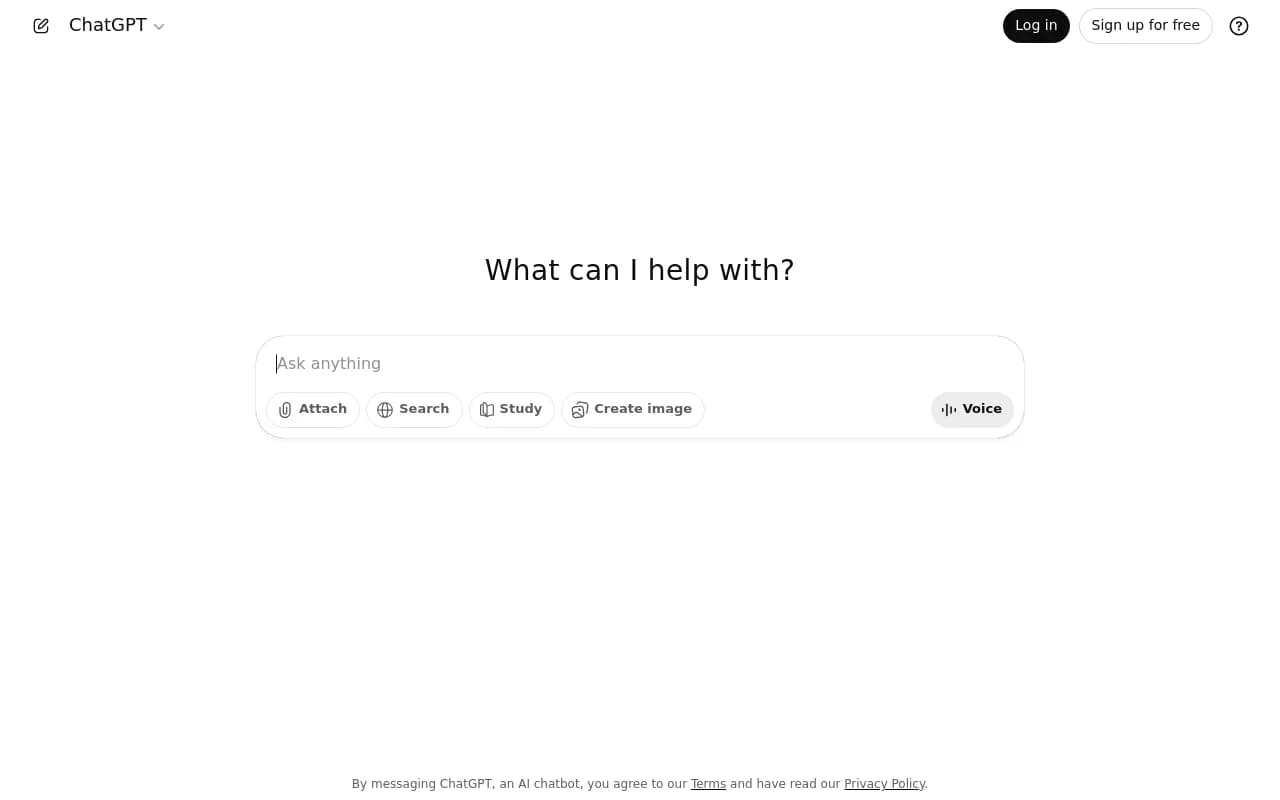
ChatGPT is the default AI tool for most of the planet, with roughly 900 million weekly users as of early 2026. Its search feature, launched in late 2024, is genuinely good when it fires: it searches the web, cites sources with links, and pulls current information.
The problem is that search is not the default. ChatGPT decides on its own whether a question "needs" search, and it frequently decides wrong, answering from stale training data when you expected current information. You can force it with the Search icon in the composer, but you have to remember to do that.
The free tier now runs GPT-5.6 Luna with unlimited text chats and limited search. Plus ($20/month) adds GPT-6 Astra, higher limits, and Deep Research, which can connect to external MCP servers and restrict searches to trusted sites. Pro ($200/month) adds GPT-5.6 Sol Pro and 400K reasoning context.
Where it falls short: citation discipline. In the Columbia Journalism Review test, ChatGPT with search fabricated or misattributed claims in 67% of citations. In practice, its citations are also less systematic: Zapier's hands-on testing found ChatGPT citing less authoritative sources (NY Post, SlashGear) where Perplexity cited NASA and scientific journals. If you use ChatGPT for research, verify every citation.
Gemini and Google AI Mode: the distribution play
Google is playing a different game. Rather than competing for chat users, it put Gemini directly into Search. AI Mode, the full Gemini-powered search experience, crossed 1 billion monthly users in May 2026, one year after launch. There's also a free standalone Gemini app and a paid tier structure (AI Pro at $19.99/month, AI Ultra at $99.99 and up).
Gemini's strengths are real. Its context window is the largest of the four, up to 1M tokens on Pro models (though independent testing suggests effective capacity is lower). Its Deep Research feature can draw on your Gmail, Drive, and Chat context. And its integration with Google's ecosystem, Docs, Gmail, Sheets, Maps, Flights, is unmatched.
But as a search engine, Gemini has a documented accuracy problem. In the Columbia Journalism Review test, it fabricated or misattributed claims in 76% of citations, the worst of the four. The pattern: Gemini attempts nearly every question rather than hedging, which produces confident, fluent answers that are wrong more often than its competitors'. In LMArena's Search Arena, Gemini grounding models rank below OpenAI and Anthropic search configurations.
Where it falls short: trust. If you use Gemini for research, you need to check citations more carefully than with any other tool here. The fluent writing style makes errors harder to spot.
Claude: the research agent
Claude's web search is a toggle, not a default. Click the "+" icon, enable Web Search, and Claude will search and cite for the rest of the conversation. It works well, but it's easy to forget, and free-tier users burn their usage limits fast when Claude fetches long web pages.
The real differentiator is Research mode, available on paid plans. Enable it, and Claude runs an agentic research process for up to 45 minutes across hundreds of sources, including your connected Gmail, Calendar, and Docs. It produces a structured, cited report. In Andy Stapleton's hands-on test running an identical literature review through all four tools, Claude was the only one that completed the task without technical problems, producing a 26-page referenced review with a full audit log of every source.
Claude's writing quality is also the best of the four. If your research output is a report, memo, or article, Claude's drafts need the least editing.
Where it falls short: search is not its center of gravity. Claude's free tier has the tightest usage limits of the four, and search plus long fetches can exhaust a free user's daily allowance in a couple of queries. For quick lookups, Perplexity is faster and cheaper.
Accuracy and hallucination: what the data actually says
The Columbia Journalism Review's test is the most rigorous independent evaluation of citation accuracy across these tools. Researchers asked each engine questions about news articles and checked whether the cited sources actually supported the answers. The results:
| Engine | Citation error rate |
|---|---|
| Perplexity Sonar | 37% |
| ChatGPT with search | 67% |
| Gemini | 76% |
Even Perplexity, the best performer, got it wrong more than a third of the time. That should recalibrate your expectations for the entire category.
Other data points worth knowing:
- Perplexity tied every claim to a specific source in 78% of complex research questions vs ChatGPT's 62% in Skywork's benchmark testing.
- In hallucination-calibration testing, Gemini 3.1 Pro cut its hallucination rate from 88% to 50% with tuning, at the cost of 1% accuracy. Claude models hallucinate less but hedge more.
- On LMArena's Search Arena, OpenAI and Anthropic search configurations currently outrank Gemini grounding models in human preference.
The practical takeaway: whichever engine you use, open the citations. The difference between a 37% and 76% error rate matters, but neither number is zero.
Pricing compared
All four have free tiers. All four have a ~$20/month paid tier. The differences are in what you get and what the free tier actually allows.
| Free tier | Paid tier | Annual discount | |
|---|---|---|---|
| Perplexity | Unlimited quick search, 3-5 Pro/day | $20/mo Pro | $200/year (~17% off) |
| ChatGPT | Unlimited text (GPT-5.6 Luna), limited search | $20/mo Plus | ~$200/year |
| Gemini | ~5 prompts/day, capped Deep Research | $19.99/mo AI Pro | ~$200/year |
| Claude | Limited messages, search included | $20/mo Pro | $200/year |
A few notes:
- Perplexity's free tier is the most usable for search-heavy work. Unlimited quick searches with citations is more than ChatGPT or Claude give you for free.
- ChatGPT's $8/month Go plan includes ads. Yes, a paid plan with ads.
- Google's AI Pro at $19.99/month is the cheapest of the four paid tiers and includes Gemini in Search, Workspace integration, and Veo video generation.
- Claude's Max plans ($100 and $200/month) exist for heavy users; Perplexity's $200/month Max adds the Perplexity Computer, an agentic orchestrator across 19 models.
Which one should you use?
For quick factual research
Perplexity. It searches every time, cites everything, and its free tier covers most quick lookups. The 37% citation error rate is the best in class, which is a low bar, but still the best.
For deep multi-source research reports
Claude with Research mode, or ChatGPT Deep Research. Claude's 45-minute agentic runs and audit logs are the strongest for work where provenance matters. ChatGPT's Deep Research is close and can connect to your own MCP servers.
If you live in Google's ecosystem
Gemini. The Workspace integration, the 1M-token context window, and AI Mode's reach into Search itself make it the natural pick if your work happens in Docs, Gmail, and Sheets. Just verify citations more carefully than you would with Perplexity.
If you want one tool for everything
ChatGPT. It writes, codes, analyzes, searches, and generates images, and its ecosystem of custom GPTs and connectors is the largest. The search feature is good when it fires; the problem is it doesn't always fire.
The honest answer for most people
Use two. Perplexity for search and research, ChatGPT or Claude for writing and synthesis. The tools that search best are not the tools that write best, and no single product in 2026 does both at the top level.
If you run a website or brand: you can't ignore any of them
There's a second audience for this comparison: anyone who publishes content. AI search engines are increasingly the first place people encounter your brand, and they don't send much traffic back. If you want to know whether ChatGPT, Perplexity, Gemini, or Claude recommends your product when people ask, you need to track your visibility in AI answers, not just your Google rankings.
Tools like Promptwatch do this: they monitor how your brand appears across ChatGPT, Claude, Gemini, Perplexity, and Google AI Overviews, show which of your pages get cited, and help you fix the content gaps that make you invisible. If AI search engines are where your customers now search, visibility tracking is how you find out whether you show up.

The bottom line
There is no single best AI search engine in 2026. Perplexity wins on citations and search-native design, ChatGPT wins on ecosystem and versatility, Gemini wins on distribution and integration, and Claude wins on research depth and writing quality. The Columbia Journalism Review's finding that even the best tool gets citations wrong 37% of the time is the number everyone should remember. Use whichever engine fits the task, and always, always open the citations.
Want to know if your brand shows up in AI answers across all four engines? Promptwatch tracks your visibility in ChatGPT, Claude, Gemini, Perplexity, and Google AI Overviews.