Key takeaways
- The quality of your prompt library directly determines the accuracy of your AI visibility data -- bad prompts produce misleading scores
- Platforms split into two camps: those that seed your library with data-driven starting queries, and those that expect you to build from scratch
- Building from scratch isn't inherently bad, but it requires significant SEO expertise and time to do properly
- A few platforms (including Promptwatch) go further than just providing prompts -- they use prompt data to surface content gaps and generate content to close them
- The right approach depends on your team's expertise, how many markets you cover, and whether you need optimization or just monitoring
The prompt library is the foundation of any AI visibility measurement program. Get it wrong and every dashboard, every visibility score, every competitive comparison you run is built on sand. You might think you're tracking the right things when you're actually measuring a narrow slice of how AI models respond to your category.
Yet this is one of the least-discussed differences between AI visibility platforms. Everyone talks about which LLMs a tool monitors, how many citations it tracks, whether it has content generation. Almost nobody asks: what does the platform actually give you to start with, and how good is it?
That's what this guide covers.
Why prompt library quality matters more than you think
Aleydas Solis, one of the more rigorous voices on AI search measurement, put it well in her June 2026 guide on building representative prompt libraries: "if the prompt set over-represents generic discovery prompts, ignores product lines, misses local competitors, or only tracks branded questions, your AI visibility dashboard can look useful while pointing you toward the wrong priorities."
That's the core risk. A prompt library that over-indexes on branded queries ("what is [Brand X]?") will show you high visibility scores that feel good but don't reflect how most people actually discover products in your category. A library that only covers top-of-funnel discovery prompts misses the comparison and purchase-intent queries where AI models are increasingly influential.
A representative prompt library needs to cover:
- Different journey stages (awareness, consideration, decision)
- Different audience segments and personas
- Competitor comparison queries
- Category and use-case prompts (not just branded ones)
- Local or regional variations if relevant
- Product-line-specific queries
Building that from scratch, for a new team without deep SEO experience, takes weeks. Which is why what a platform gives you on day one matters.
The two camps: seeded libraries vs blank slates
AI visibility platforms in 2026 fall into two broad categories when it comes to prompt setup.
Platforms that give you a seeded starting library
These tools either auto-generate a set of suggested prompts based on your domain, pull from a database of real-world query patterns, or use your competitors' visibility data to surface prompts you should be tracking. You still customize, but you're editing and pruning rather than inventing from nothing.
The better implementations here do something more sophisticated: they show you prompts ranked by estimated volume or difficulty, so you can prioritize which ones are worth tracking rather than just adding everything that looks vaguely relevant.
Platforms that start with a blank input
These tools give you a text field and expect you to know what to type. Some provide documentation or templates. A few have prompt suggestion features that are more autocomplete than actual intelligence. The burden of building a representative library falls entirely on you.
This isn't automatically a dealbreaker -- if you have an experienced SEO team that already knows your category's query landscape, you might prefer the control. But for most marketing teams, it's a significant time investment before you see any useful data.
How the major platforms handle prompt setup
Here's a direct comparison of how the main AI visibility platforms approach prompt libraries in 2026:
| Platform | Prompt seeding | Volume/difficulty data | Gap analysis | Content generation |
|---|---|---|---|---|
| Promptwatch | Auto-suggested from domain + competitor data | Yes, with difficulty scores | Yes (Answer Gap Analysis) | Yes (Content Agents) |
| Profound | Suggested prompts + prompt volume estimates | Yes | Partial | Yes (Agents feature) |
| AthenaHQ | Manual entry, some suggestions | Limited | No | No |
| Otterly.AI | Manual entry | No | No | No |
| Peec.ai | Manual entry | No | No | No |
| Semrush (Brand Monitoring) | Fixed prompt templates | No | No | No |
| Ahrefs Brand Radar | Fixed prompts | No | No | No |
| Search Party | Manual, agency-assisted | Limited | No | No |
The fixed-prompt approach from Semrush and Ahrefs is worth calling out specifically. Fixed prompts mean you're tracking what the tool decided matters, not what actually matters for your business. You can't add a product-line-specific query or a regional variation. That's a real limitation for any brand with a complex product catalog or multiple markets.
Promptwatch: prompt intelligence built into the workflow
Promptwatch takes a different approach to prompt setup. When you connect a domain, it doesn't just suggest prompts -- it uses competitor visibility data and real prompt patterns to surface queries that your competitors are already appearing for but you aren't. That's the Answer Gap Analysis feature, and it changes the nature of the prompt library from a tracking tool into a prioritization tool.
You're not just asking "where do I appear?" You're asking "where should I be appearing that I'm not?" Those are very different questions, and the second one is far more actionable.
Each prompt in Promptwatch also carries volume estimates and difficulty scores, so you can make informed decisions about which gaps to close first. High volume, lower difficulty? Start there. That's the kind of prioritization logic that would otherwise require a separate keyword research process.

The other thing worth noting: Promptwatch tracks prompts across 10 AI models (ChatGPT, Perplexity, Google AI Overviews, Google AI Mode, Claude, Gemini, Meta/Llama, DeepSeek, Grok, Mistral, Copilot) and does so by monitoring actual user-facing interfaces, not just API outputs. This matters because the answers, citations, and shopping recommendations a real user sees can differ from what the API returns. Your prompt library data is only as good as the underlying query execution.
Profound: strong prompt intelligence, enterprise pricing
Profound has a genuinely good prompt setup experience. It surfaces suggested prompts, provides volume estimates, and has a content agents feature for acting on what you find. The platform is well-regarded for data quality and has built out a solid feature set for enterprise teams.
The comparison page Profound published against AthenaHQ (April 2026) makes a fair point that monitoring-only platforms leave you stuck after you've identified a gap. Profound's agents feature addresses that to some degree. The main friction point for most teams is pricing -- Profound is positioned at the enterprise end of the market, which puts it out of reach for smaller brands and agencies.
AthenaHQ: monitoring-focused, limited prompt help
AthenaHQ is primarily a monitoring platform. The prompt setup is largely manual, and while the data quality is reasonable, there's no meaningful prompt suggestion engine and no content generation capability. If you know exactly what prompts you want to track and you're not looking for help identifying gaps, it works. But you're doing all the prompt strategy work yourself.
Otterly.AI and Peec.ai: affordable but you're on your own
Both Otterly.AI and Peec.ai are positioned as more accessible entry points into AI visibility monitoring. The tradeoff is that prompt setup is entirely manual. There's no seeding, no volume data, no gap analysis. You type in prompts, they track them.
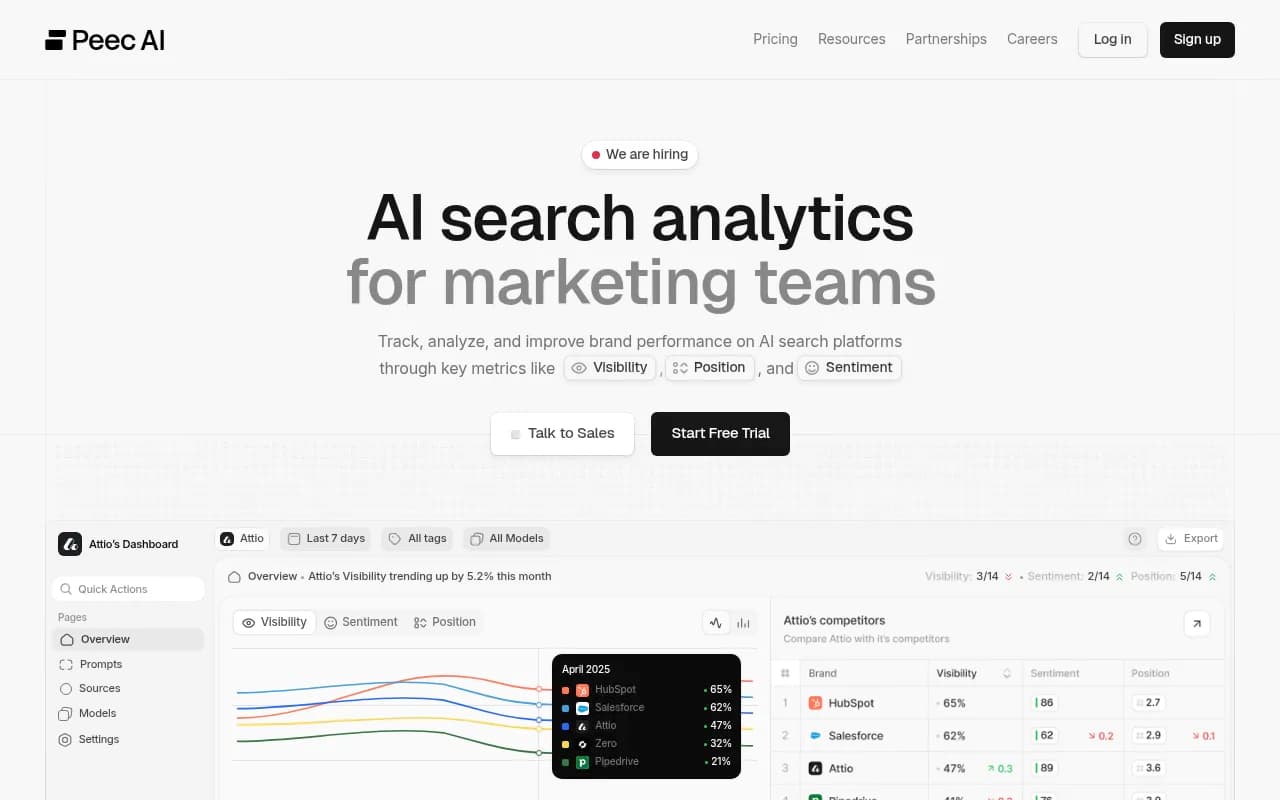
For a small team that already has a clear sense of what queries matter and just needs basic tracking, this can be fine. But for anyone trying to build a genuinely representative library from scratch, the lack of guidance is a real gap.
Semrush and Ahrefs: fixed prompts are a real constraint
Both Semrush's AI monitoring features and Ahrefs Brand Radar use fixed prompt templates. You can't customize them to match your specific product lines, audience segments, or regional markets. This is a significant limitation for any brand that isn't a generic consumer product.
The fixed-prompt approach also means you're measuring the same things as every other brand using the platform, which limits your ability to find competitive advantages in less-obvious query clusters.
What "building from scratch" actually costs you
If a platform requires you to build your prompt library manually, here's what that realistically involves:
- Mapping your customer journey stages and identifying the questions people ask at each stage
- Researching competitor positioning to understand which comparison queries matter
- Identifying product-line and use-case specific prompts beyond generic category terms
- Adding persona variations (prompts from a CFO vs a marketing manager vs a small business owner will differ)
- Building regional or language variants if you operate in multiple markets
- Estimating which prompts are high-priority vs noise (without volume data, this is guesswork)
For a mid-size B2B SaaS company, doing this properly takes a few days of focused work from someone who understands both your product and SEO. For an e-commerce brand with dozens of product categories, it could take weeks.
That's not an argument against manual prompt building -- it's an argument for understanding what you're signing up for when you choose a platform that doesn't help.
The prompt library as a living document
One thing that gets underemphasized: a prompt library isn't a one-time setup. It needs to evolve as your product changes, as competitors shift their positioning, and as AI models change how they handle certain query types.
Platforms that surface new gap prompts automatically (based on competitor visibility changes or new query patterns) have a real advantage here. You're not just maintaining a static list -- you're continuously discovering new territory to compete for.
This is where the difference between monitoring platforms and optimization platforms becomes most visible. A monitoring platform shows you your current scores. An optimization platform tells you what's changed, what new gaps have opened, and what to do about them.
Choosing the right approach for your team
The right choice depends on a few factors:
If you have a small team with limited SEO expertise: You need a platform that does the prompt strategy work for you. Manual-entry tools will leave you with an unrepresentative library and misleading data. Promptwatch's auto-suggestion and gap analysis features are worth the investment here.
If you have an experienced SEO team and a complex product catalog: You might actually prefer more control over prompt setup. But you still want volume data and difficulty scores to prioritize. Profound or Promptwatch both work well here.
If you're an agency managing multiple clients: You need prompt setup to be fast and scalable. Building from scratch for every client is not sustainable. Tools with seeded libraries and template-based setup save significant time.
If you're just starting out and want to test the concept cheaply: Otterly.AI or Peec.ai let you get started without a large commitment. Just go in knowing you'll need to invest time in prompt strategy yourself.
A practical framework for evaluating prompt library quality
When you're evaluating any AI visibility platform, ask these specific questions about prompt setup:
- Does the platform suggest prompts based on your domain, or do you start with a blank field?
- Are suggested prompts based on real query data, or are they generic templates?
- Does the platform show you prompts your competitors rank for that you don't?
- Is there volume or difficulty data attached to prompts, or are all prompts treated equally?
- Can you add custom prompts for specific product lines, personas, or regions?
- Does the platform surface new gap prompts over time, or is the library static after setup?
- What happens after you identify a gap -- does the platform help you close it?
That last question is the one most platforms can't answer well. Finding a gap is step one. Creating content that closes it is step two. Tracking whether that content actually improved your visibility is step three. Most platforms stop at step one.
The bottom line
Prompt library quality is one of the most consequential and least-discussed differences between AI visibility platforms. A tool that hands you a data-driven starting set of queries -- ranked by volume, enriched with competitor gap data, and continuously updated -- gives you a fundamentally different starting point than a tool that expects you to figure it out yourself.
That difference compounds over time. Better prompts produce more accurate visibility data. More accurate data leads to better prioritization. Better prioritization means you're working on the gaps that actually matter, not the ones that happened to occur to you when you were setting up the tool.
For most teams, the platforms that invest in prompt intelligence -- and then connect that intelligence to content creation and result tracking -- will deliver more value than monitoring-only tools, regardless of how good their dashboards look.