Key takeaways
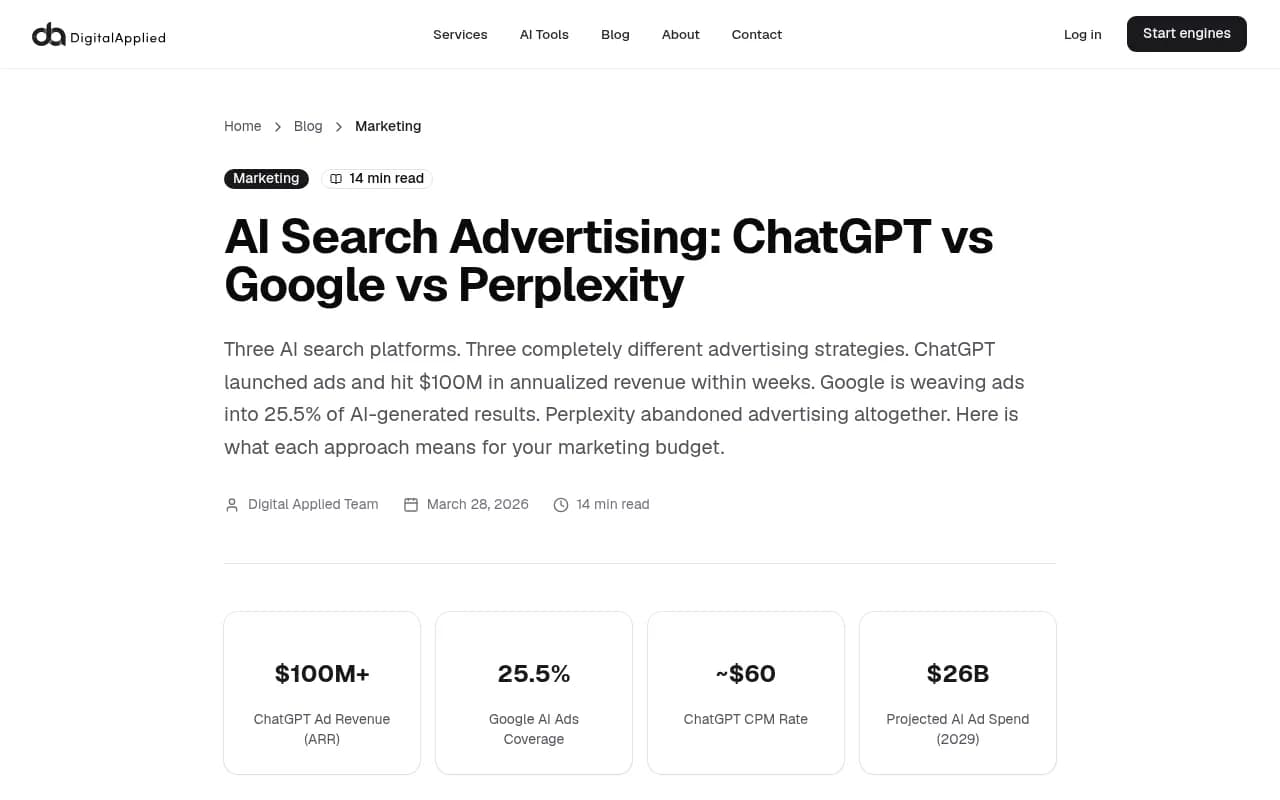
- ChatGPT ads launched February 9, 2026 for US users on Free and Go tiers; OpenAI opened a self-serve Ads Manager on May 5, 2026, and the platform hit $100M in annualized ad revenue within two months.
- Perplexity abandoned advertising entirely in February 2026, citing trust concerns. There are no sponsored placements to track there — only organic citations.
- Most AI visibility platforms do not track paid AI placements yet. This is a real gap: your organic tracking can look flat while competitors quietly buy visibility on your prompts.
- Tools that do monitor sponsored placements include Promptwatch (Ads Radar), Trendos Ad Radar, GrowByData, and Evertune.
- Benchmark your organic visibility before scaling paid, so ad-driven noise does not contaminate your baseline.
The ad era arrived fast
If you blinked in early 2026, you missed a lot. On February 9, OpenAI launched ads inside ChatGPT for US users on the Free and Go tiers. Within two months the platform was reportedly generating $100M in annualized ad revenue, with 600+ advertisers in the first six weeks. On May 5, OpenAI opened a self-serve Ads Manager to all US businesses, dropped the minimum spend from $200K to zero, and added CPC bidding alongside CPM.
Perplexity went the other direction. After testing sponsored follow-up questions through 2024 and 2025, it pulled all ads in February 2026 and confirmed it has no plans to bring them back, citing user trust. The company is now targeting roughly $500M in annualized subscription revenue as the ad-free alternative.
And Google sits in the middle, with ads now appearing alongside about a quarter of AI Mode and AI Overview responses, up from just over 5% in early 2025.
The result is a three-way split that nobody predicted a year ago: one platform monetizing aggressively, one refusing ads on principle, and one bolting ads onto an existing search business. For marketers, this creates a new category of question: who is advertising on my prompts, and can I even see it?
What ChatGPT ads actually look like
ChatGPT ads are sponsored placements that appear at the bottom of some answers, labeled "Sponsored." They show only to Free and ChatGPT Go ($8/mo) users — Plus, Pro, Team, Business, and Enterprise accounts remain ad-free.
A few mechanics worth knowing:
- Pricing has come down fast. The pilot charged a flat $60 CPM. By mid-2026, CPMs ranged roughly $25–60 depending on category, and CPC bidding is available with recommended starting bids of $3–5 per click. Bids under $3 often fail to deliver.
- Targeting uses "context hints" — topic, persona, and conversation-type signals — not keywords or demographics. This is closer to contextual display buying than search advertising.
- The auction rewards relevance. OpenAI runs a relevance-weighted second-price auction, so a more relevant ad at a lower bid can beat a generic higher bid.
- OpenAI's "Answer Independence" principle means ad spend never changes the organic answer. The ad appears after it, clearly separated.
- Attribution is thin. There is no pixel or Conversions API equivalent for most advertisers yet. Attribution is last-click via UTM parameters, with a proper measurement stack expected late 2026.
How much inventory is actually out there? GrowByData's panel found 9.2% of tracked ChatGPT prompts returned a sponsored ad in June 2026 — about 1 in 11. That is meaningful but still sparse, which is exactly why monitoring matters: the placements are too infrequent to catch reliably by hand.
One more wrinkle: Search Engine Roundtable reported that ChatGPT briefly dropped the "Sponsored" label at one point. Labeling practices on a brand-new ad platform are worth watching, not assuming.
Why Perplexity has nothing to track
This is the part of the headline that needs a correction, and it matters for how you spend your monitoring budget. Perplexity abandoned advertising in February 2026. There are no sponsored follow-up questions, no sponsored citations, no paid placements of any kind. What visibility platforms track in Perplexity is purely organic: whether your brand gets cited, how often, and in what context.
That does not make Perplexity tracking less valuable. If anything, it raises the stakes. Perplexity is now the purest test of your earned visibility — no budget can buy your way in. Ahrefs found that only about 12% of URLs cited by AI assistants also rank in Google's top 10, so your traditional rankings tell you almost nothing about whether Perplexity cites you. You have to track it separately.
The tracking gap most platforms ignore
Here is the uncomfortable truth about the AI visibility tool market in 2026: most of it was built to answer "is my brand mentioned?" — not "who is paying to appear next to my audience?" Those are different questions, and the second one barely existed as a product category before February.
The gap is concrete. A placement inside a chat response is invisible to SERP-tracking systems built for a page of links. There is no ad library for ChatGPT, no auction insights report, nothing equivalent to what Google Ads gives you. If a competitor starts buying ads on prompts where you dominate organically, most visibility dashboards will show you nothing unusual.
GrowByData also found that brands exposed in ChatGPT ads are often also exposed in Google AI Overviews ads. So you really need to monitor both surfaces, and most teams monitor neither.
Platforms that track sponsored placements
A small set of tools has moved to close this gap. Here is who is doing what, as of September 2026.
Promptwatch
Promptwatch includes an Ads Radar that tracks sponsored placements in AI search: which competitors bid on your prompts, their ad copy, positioning, and frequency. It sits alongside the rest of the platform — prompt tracking with volumes and difficulty, citation analytics, AI crawler logs, and ChatGPT Shopping tracking — so you can see paid and organic AI visibility in one place rather than stitching together two vendors.

Trendos Ad Radar
Trendos launched its Ad Radar in May 2026 specifically to fill what its CCO called the "no ad library / no auction insights" gap in conversational AI. It monitors tracked ChatGPT prompts and extracts sponsored-placement data: advertiser impression share, ad titles, descriptions, destination URLs, and competitor messaging frequency. Trendos maintains historical visibility data on 2.3M+ brands. One caveat: most of what is public about Ad Radar comes from the company's own press materials, so treat specifics as vendor claims until you test it.
GrowByData
GrowByData offers dedicated ChatGPT Ads monitoring that tracks which prompts trigger placements, which brands buy them, and provides dated screenshot evidence. It also tracks Google AI Overviews ads, which matters given the overlap in advertiser exposure between the two surfaces.
Evertune
Evertune takes a different angle: it runs ChatGPT ad campaigns directly from AI visibility data. It scores topics by organic visibility, then generates context hints and conversational ad copy for topics where your brand is not organically recommended. It also offers AI Search Intent (ads on pages AI cites) and AI retargeting via The Trade Desk and Index Exchange. Pro tier runs around $800/mo, which puts it in enterprise territory.
KIME
KIME claims to reveal which competitors advertise inside ChatGPT as part of its visibility platform, from €99/mo across 9 engines. Same caveat as Trendos: this is a vendor claim, so verify during a trial.
What the major visibility platforms track (and don't)
The broader AI visibility market is crowded and mostly organic-only. Here is where the major players stand on sponsored placements specifically.
| Platform | Entry price | Engines | Sponsored placement tracking | Notes |
|---|---|---|---|---|
| Promptwatch | $95/mo | 11+ (ChatGPT, Claude, Gemini, Perplexity, Grok, AI Overviews, AI Mode, and more) | Yes — Ads Radar plus ChatGPT Shopping tracking | Also includes crawler logs, citation analytics, and content generation |
| Profound | $99/mo | Up to 9–10 on Enterprise | ChatGPT Shopping on Enterprise | $155M raised, ~$1B valuation; strong monitoring, no ad execution |
| Semrush AI Toolkit | $99/mo/domain | 4 (ChatGPT, Google AI, Gemini, Perplexity) | No | Free tier removed after Adobe acquisition closed Aug 2026 |
| Ahrefs Brand Radar | $199/mo + base plan | Grok, Claude, AI Overviews, AI Mode | No | 476M+ monthly prompts indexed; requires Ahrefs base plan ($129–449/mo) |
| Peec AI | ~$80–95/mo | 7 | No | Pricing disputed across trackers; verify with vendor |
| Otterly.AI | $29/mo | 4 base, add-ons for more | No | Gemini, AI Mode, Claude are paid add-ons |
| Scrunch AI (Sitecore) | $250/mo annual | 7 | No | $26M raised |
| HubSpot AEO | $50/mo | 3 (ChatGPT, Gemini, Perplexity) | No | Free AEO Grader available |
| Evertune | ~$800/mo Pro | ChatGPT focus | Yes — plus ad campaign execution | Enterprise GEO positioning |
A pattern worth noticing: the platforms closest to the money are the ones tracking it. Tools that position as ad campaign platforms (Evertune) or that built ad monitoring as a headline feature (Promptwatch, Trendos) treat sponsored placements as first-class data. The monitoring-first incumbents, many of which raised large rounds in 2025 on the strength of organic tracking, have been slower to add it.
How to build a paid-plus-organic monitoring stack
If you are trying to figure out what to actually do with all this, here is a workflow that works in 2026.
1. Benchmark organic visibility first
Before you spend a dollar on ChatGPT ads, get a clean read on your organic baseline: mention rate, citation rate, and share of voice across the engines that matter to your audience. The reason is practical. Once ads start running, they contaminate your data — a spike in brand mentions might be paid reach, not earned visibility. Benchmark first, then scale paid, and you can tell the two apart.
2. Monitor which of your prompts carry ads
Set up tracking on your priority prompts and find out which ones trigger sponsored placements, and from whom. If a competitor is buying ads on prompts where you have strong organic visibility, that is a defensive signal. If nobody is advertising on your highest-value prompts yet, that is an opportunity, and likely a cheap one while the auction is young.
3. Track the overlap with Google AI surfaces
Because brands exposed in ChatGPT ads are frequently also exposed in Google AI Overviews ads, monitor both. A tool that covers ChatGPT and Google AI Mode in one dashboard saves you from reconciling two vendors' exports.
4. Decide where ads fit before you spend
Some honest framing on whether ChatGPT ads are worth it at all. An Ipsos survey found 63% of US adults say ads in AI search results make them trust the results less. That is a real headwind. But reported CTRs of 1.5–3.5% (versus 1.0–2.0% for traditional search ads) suggest the placements perform when they are relevant, and brands combining strong organic visibility with paid ChatGPT ads have reported roughly 2x higher conversion rates than either alone.
The sensible read: ads are a complement to organic visibility, not a substitute. The prompts where you are invisible organically are candidates for paid testing; the prompts where you already dominate may not need budget at all.
5. Keep attribution honest
Do not move your entire Google Ads budget to ChatGPT. Use consistent UTM structures and unified attribution so you can compare CPA across channels fairly. Until OpenAI ships its measurement stack, your numbers will be rough — plan for that.
A 30-day starting plan
If you want to be concrete about the next month:
- Days 1–7: Pick a visibility platform that tracks both organic citations and sponsored placements. Run a baseline audit across ChatGPT, Perplexity, and Google AI surfaces.
- Days 8–14: Identify your 20 highest-value prompts. Check which carry ads today and which competitors appear. Check whether you are cited organically on each.
- Days 15–21: Fix organic gaps first — content updates, citation sources, technical issues. This is cheaper than ads and compounds.
- Days 22–30: If budget allows, run a small CPC test ($3–5 bids) on 3–5 prompts where you are organically weak. Tag everything with clean UTMs and compare against your Google Ads CPA.
The bottom line
Sponsored placements in AI search went from theoretical to a $100M-ARR business in about six months, and the tracking category is still catching up. Perplexity has nothing to track because it chose ads-free as a positioning; ChatGPT has a growing auction that most visibility platforms cannot see. If you are investing in AI visibility at all in 2026, make sure at least one tool in your stack can tell you who is buying visibility on your prompts — because your competitors' dashboards will not show it either, and the ones who notice first get the cheap inventory.