Key Takeaways
- Prompt difficulty scores help you prioritize which AI search queries to target by showing competition levels and win probability
- Only a handful of platforms actually provide difficulty metrics—most just show raw prompt volumes without context
- Promptwatch leads with difficulty scoring tied directly to content gap analysis and AI content generation, creating an action loop instead of just monitoring
- Profound offers the most comprehensive prompt intelligence with volume estimates and query fan-outs, but at a higher price point
- Most competitors (Otterly.AI, Peec.ai, AthenaHQ) focus on monitoring without difficulty scoring or optimization features

What are prompt difficulty scores and why do they matter?
Prompt difficulty scores work like keyword difficulty in traditional SEO—they estimate how hard it will be to rank for a specific AI search query. But instead of backlinks and domain authority, these scores factor in citation density, source diversity, and how established the current answers are across LLMs.
The difference between a prompt with a difficulty score of 30 versus 80 is the difference between creating one solid article that gets cited next week and needing months of content, backlinks, and brand mentions to break through.
Without difficulty data, you're flying blind. You might spend weeks optimizing for a prompt that's already dominated by Wikipedia, Reddit threads with 10K upvotes, and government sites. Or you might ignore a low-competition prompt where one good article would get you cited immediately.
The platforms below all claim to help with AI visibility. But only some actually show you which battles are worth fighting.
The 7 platforms that surface prompt difficulty data
1. Promptwatch: Difficulty scoring tied to action
Promptwatch doesn't just show you difficulty scores—it shows you what to do about them. The platform's Answer Gap Analysis surfaces prompts where competitors are visible but you're not, then ranks them by difficulty and volume so you know which ones to target first.
What makes Promptwatch different: the difficulty score feeds directly into the AI content generation engine. You're not looking at a number and then switching to Google Docs. You click "Generate," and the platform creates an article grounded in 880M+ citations, optimized for the specific prompt, and engineered to get cited by ChatGPT, Claude, and Perplexity.
The action loop is: find gaps (with difficulty context) → generate content → track results. Most competitors stop at step one.
Additional capabilities that support this:
- Prompt Intelligence: Volume estimates, difficulty scores, and query fan-outs that show how one prompt branches into sub-queries
- Citation Analysis: See which pages, Reddit threads, and YouTube videos AI models cite—understand the competition before you create
- AI Crawler Logs: Real-time logs of ChatGPT, Claude, and Perplexity crawling your site—know if your content is even being discovered
- Page-level tracking: See exactly which pages get cited, how often, and by which models
Pricing: Essential $99/mo (1 site, 50 prompts), Professional $249/mo (2 sites, 150 prompts, crawler logs), Business $579/mo (5 sites, 350 prompts)
Best for: Teams that want to close the loop from insight to action—not just see data but actually improve visibility with content that ranks in AI search.
2. Profound: Most comprehensive prompt intelligence
Profound's Prompt Volumes tool is the most detailed prompt intelligence system on the market. It shows search volume estimates so you know what people are actually asking AI platforms, plus trending prompts and query fan-outs that reveal how broad topics branch into specific sub-queries.
The difficulty context comes through indirectly—Profound shows you which competitors are visible for each prompt and how often they're cited, which lets you infer competition levels. It's not a single difficulty score, but the data is there if you know how to read it.
Profound also tracks 10+ AI engines (ChatGPT, Perplexity, Claude, Gemini, Meta AI, Grok, DeepSeek, Copilot, Mistral, Google AI Overviews) and offers agent analytics for ChatGPT Shopping visibility.
Pricing: Starts at $99/mo for Starter, scales to $499/mo for Professional, custom Enterprise pricing
Best for: Enterprise teams and agencies that need the most comprehensive prompt data and are willing to pay for it. Strong feature set but higher price point than alternatives.
3. Scrunch: Difficulty scoring with multi-region support
Scrunch surfaces prompt difficulty through its competitive analysis features. You can see which prompts competitors rank for, how often they're cited, and the relative strength of their positions—essentially a proxy for difficulty.
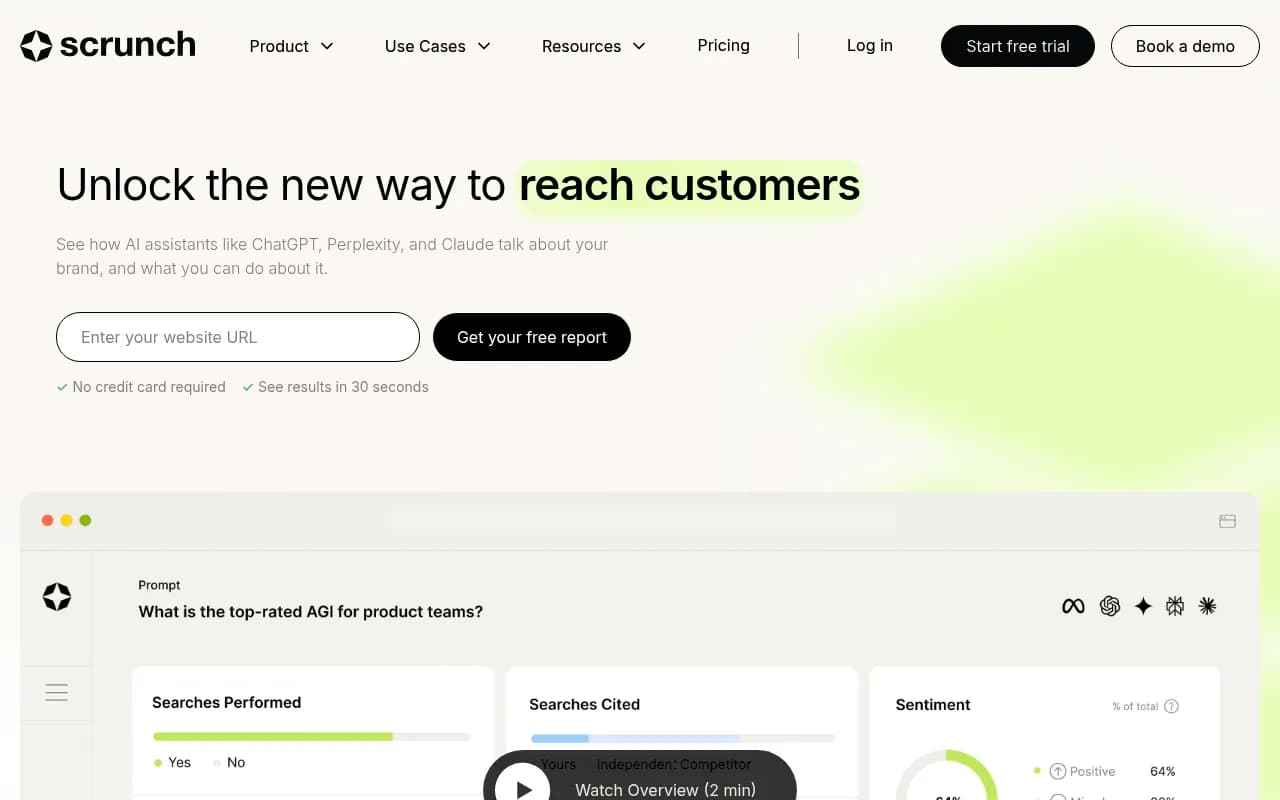
What Scrunch does well: multi-region and multi-language tracking. You can monitor AI responses in any country and language, which is rare among competitors. The platform also offers persona customization so you can see how different user types get different AI responses.
The gap: Scrunch is monitoring-focused. It shows you the data but doesn't help you act on it. No content generation, no optimization recommendations beyond "create content for this prompt."
Pricing: Starts around $199/mo, scales with features and volume
Best for: Global brands that need multi-region AI visibility tracking and have content teams that can act on the insights independently.
4. Peec.ai: Smart suggestions with difficulty context
Peec.ai doesn't label it as "difficulty," but the platform's smart suggestions feature essentially ranks prompts by opportunity—factoring in volume, current competition, and your existing content gaps.

The platform monitors ChatGPT, Perplexity, Claude, Gemini, and Google AI Overviews. It also offers multi-language support (20+ languages) and shows you which sources AI models cite for each prompt.
What's missing: like most competitors, Peec.ai is a monitoring dashboard. You get insights but no tools to create content or optimize existing pages. You're on your own for execution.
Pricing: Starts at $99/mo, scales with features
Best for: Teams that want affordable multi-language AI visibility tracking and already have content workflows in place.
5. Rankscale: Difficulty scoring before you track
Rankscale takes a different approach—it helps you identify weaknesses and opportunities before you commit to tracking. The platform analyzes your site, surfaces content gaps, and shows you which prompts are winnable based on your current authority and content.
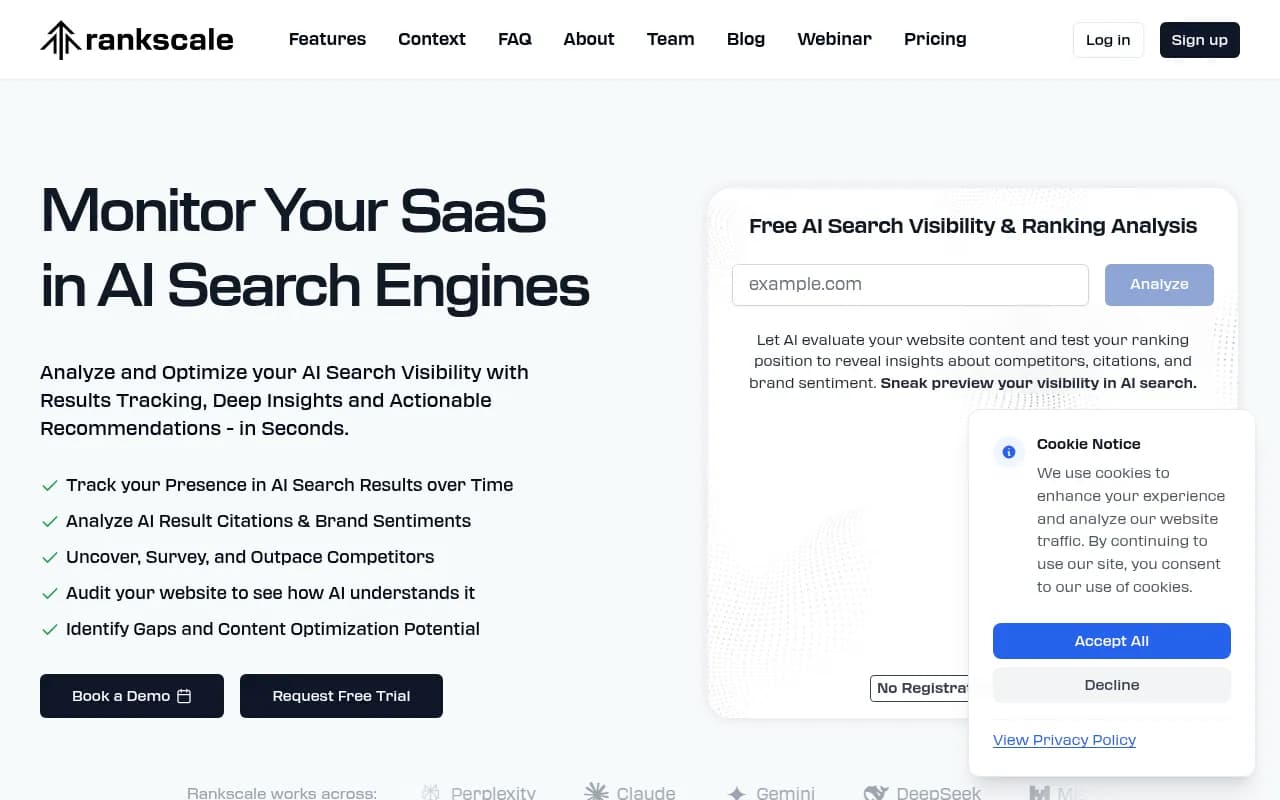
This is useful if you're just starting with AI visibility and want to understand where you stand before paying for ongoing monitoring. The difficulty context helps you prioritize which prompts to target first.
The limitation: Rankscale is more of a diagnostic tool than an ongoing monitoring platform. Once you've identified gaps and created content, you'll likely need another tool to track results over time.
Pricing: Starts around $149/mo
Best for: Brands that want to audit their AI visibility and get a prioritized action plan before committing to monthly monitoring.
6. Otterly.AI: Volume data without difficulty scoring
Otterly.AI shows prompt volumes—how often specific queries are asked—but doesn't provide difficulty scores or competition analysis. You can see which prompts are popular, but not which ones you can actually win.

The platform is affordable ($49/mo starting price) and covers the basics: track brand mentions across ChatGPT, Perplexity, Claude, and Gemini. But it's monitoring-only. No content generation, no optimization tools, no difficulty context to help you prioritize.
Pricing: Starts at $49/mo
Best for: Small teams that want basic AI visibility tracking on a budget and don't need advanced prompt intelligence or optimization features.
7. SE Ranking (SE Visible): Strategic view with limited difficulty data
SE Ranking's AI visibility tool (branded as SE Visible) provides a strategic overview of your brand's presence across AI search engines. It shows sentiment analysis, citation frequency, and competitor comparisons.
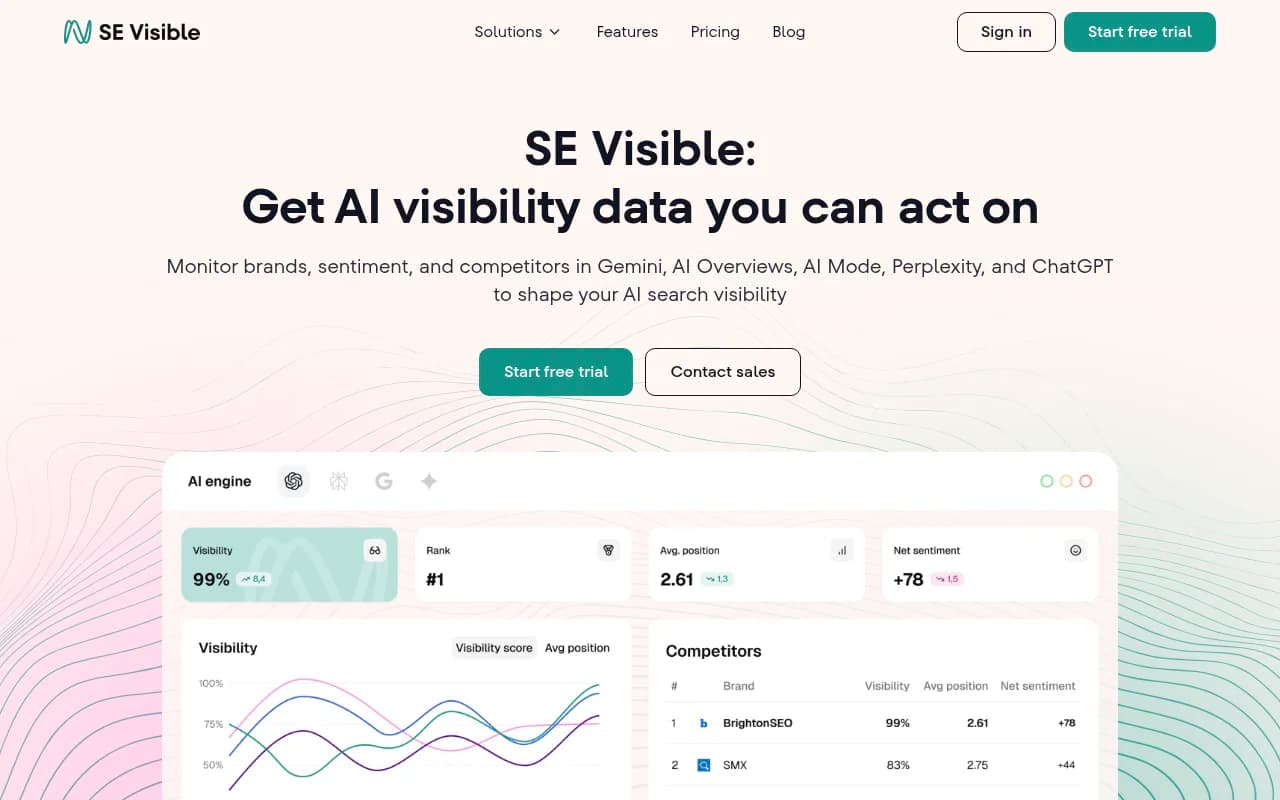
Difficulty context is limited—you can infer competition levels by seeing how often competitors are cited for specific prompts, but there's no explicit difficulty score. The platform is more about tracking overall visibility trends than prioritizing specific prompts to target.
Pricing: Part of SE Ranking's broader SEO platform, starts around $65/mo
Best for: SEO teams already using SE Ranking that want to add AI visibility monitoring to their existing workflow.
Feature comparison: What separates the leaders from the dashboards
| Platform | Difficulty Scores | Prompt Volumes | Content Generation | Crawler Logs | Multi-language | Starting Price |
|---|---|---|---|---|---|---|
| Promptwatch | Yes | Yes | Yes | Yes | Yes | $99/mo |
| Profound | Indirect | Yes | No | No | Yes | $99/mo |
| Scrunch | Indirect | Yes | No | No | Yes | $199/mo |
| Peec.ai | Indirect | Yes | No | No | Yes | $99/mo |
| Rankscale | Yes | Yes | No | No | No | $149/mo |
| Otterly.AI | No | Yes | No | No | No | $49/mo |
| SE Visible | No | Limited | No | No | Yes | $65/mo |
The table shows the core divide: most platforms are monitoring dashboards that show you data. Promptwatch is the only one that combines difficulty scoring with content generation and optimization tools—closing the loop from insight to action.
How to actually use prompt difficulty scores
Having the data is one thing. Using it effectively is another. Here's the framework:
1. Start with low-difficulty, high-volume prompts
These are your quick wins. Prompts where competition is light but search volume is real. One solid article can get you cited within days.
Example: A SaaS tool might find "best project management tools for remote teams" has a difficulty of 35 and volume of 2,000 monthly prompts. That's winnable with one comprehensive comparison article.
Vs. "best project management software" at difficulty 85 and volume 50,000—that's dominated by established players and will take months of effort.
2. Map difficulty to your content gaps
Difficulty scores are most useful when combined with gap analysis. Platforms like Promptwatch show you prompts where competitors are visible but you're not, then rank them by difficulty.
This tells you: "Here's what you're missing, and here's which gaps are easiest to fill."
Without gap analysis, you're just looking at a list of prompts. With it, you have a prioritized action plan.
3. Use query fan-outs to find related low-difficulty prompts
One broad prompt (high difficulty) often branches into dozens of specific sub-queries (lower difficulty). Profound and Promptwatch both surface these fan-outs.
Example: "AI marketing tools" (difficulty 90) fans out into:
- "AI tools for email marketing" (difficulty 45)
- "AI content generation for social media" (difficulty 40)
- "AI analytics for marketing campaigns" (difficulty 50)
Target the sub-queries first. Build authority there, then move up to the broader term.
4. Track results at the page level
Difficulty scores help you prioritize what to create. Page-level tracking shows you if it worked.
Platforms like Promptwatch and Profound let you see exactly which pages get cited, how often, and by which AI models. If you created content for a low-difficulty prompt and it's not getting cited after two weeks, something's wrong—either the content missed the mark or the difficulty score was off.
This feedback loop is what turns AI visibility from guesswork into a repeatable process.
What most platforms get wrong about difficulty scoring
The problem with most AI visibility tools: they treat difficulty as a static number. They show you a score and move on.
But difficulty is contextual. A prompt with difficulty 60 might be easy for a brand with strong domain authority and existing content on the topic. The same prompt might be impossible for a startup with no backlinks and no relevant pages.
The best platforms (Promptwatch, Profound) account for this by showing you:
- Which competitors are visible and why (citation analysis)
- What content you're missing (gap analysis)
- How AI crawlers interact with your site (crawler logs)
This context turns a difficulty score from a number into a decision-making tool.
The action gap: Why most platforms leave you stuck
Here's the pattern we saw testing these platforms: most show you great data, then leave you to figure out what to do with it.
You see a low-difficulty prompt with high volume. Great. Now what?
You open Google Docs. You research the topic. You write an article. You publish it. You wait. You check back in two weeks to see if AI models are citing it.
That's the workflow with Otterly.AI, Peec.ai, Scrunch, SE Visible, and most others.
Promptwatch collapses that loop. You see the prompt, you click "Generate," and the AI writing agent creates an article grounded in citation data, optimized for the specific difficulty level, and engineered to get cited. You're not guessing what to write—you're creating content based on what 880M+ citations show actually works.
Then you track results at the page level and see if it worked. If it didn't, you iterate. If it did, you move to the next prompt.
That's the difference between a monitoring dashboard and an optimization platform.
Bottom line: Difficulty scores only matter if you can act on them
Prompt difficulty scores are useful. They help you prioritize. They prevent you from wasting time on unwinnable queries.
But the score itself is just data. The value comes from what you do with it.
If you're looking for the most comprehensive prompt intelligence, Profound has the deepest dataset. If you want difficulty scoring tied to content generation and optimization tools, Promptwatch is the only platform that closes the loop.
Most competitors are monitoring dashboards. They show you where you're invisible, then leave you stuck. The platforms that actually help you improve—by surfacing gaps, generating content, and tracking results—are the ones worth paying for.