Key takeaways
- These tools don't actually compete. Yoast SEO optimizes content for Google search inside WordPress. Promptwatch tracks and improves your visibility in AI search engines like ChatGPT, Claude, and Perplexity. They solve fundamentally different problems.
- Yoast is dramatically cheaper. The core plugin is free; Premium is $118.80/year. Promptwatch starts at $99/month. The price difference reflects the difference in scope and audience.
- If AI search is part of your traffic strategy in 2026, Yoast can't help you there. It has no prompt tracking, no citation analysis, no AI crawler logs, and no content gap analysis for AI models.
- Promptwatch goes beyond monitoring. Most AI visibility tools just show you data. Promptwatch also generates content engineered to get cited by AI models -- a meaningful difference if you're trying to act on what you find.
- For WordPress site owners focused on Google, Yoast remains one of the best investments you can make. It's battle-tested, widely supported, and the free version is genuinely useful.
- Many teams will end up using both. Yoast for Google SEO, Promptwatch for AI search visibility. They don't overlap much.
Overview
Promptwatch

Promptwatch is an AI search visibility platform built around one core question: when someone asks ChatGPT, Claude, Perplexity, or Gemini a question relevant to your business, does your brand show up? It tracks brand mentions across 10+ AI models, analyzes which content gets cited, surfaces gaps where competitors are visible and you're not, and includes a content generation agent that creates articles designed to get cited by AI engines. It's used by 8,000+ brands and agencies including Booking.com, Typeform, and Yelp.
The platform covers the full loop: find gaps, create content, track results. That's what separates it from monitoring-only tools that show you data but leave you to figure out what to do next.
Yoast SEO
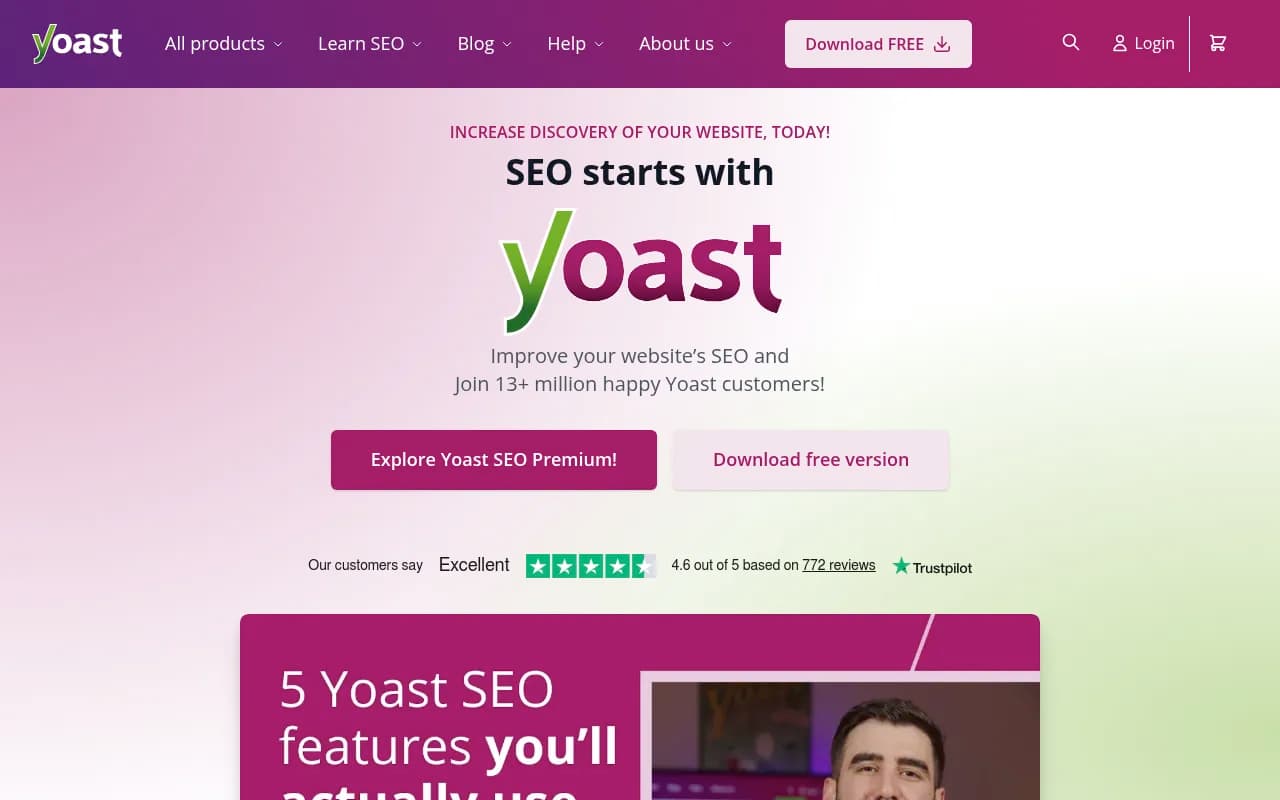
Yoast SEO is a WordPress plugin that has been helping site owners optimize for Google since 2010. It gives you real-time feedback as you write -- checking keyword usage, readability, meta descriptions, internal linking, and a long list of technical SEO signals. The free version is installed on over 13 million websites. Premium adds AI-assisted title and description generation, automatic redirects, and more advanced content analysis. There's also a Shopify version and a WooCommerce bundle.
It's a content editor tool, not a monitoring platform. You use it while writing, not to track what's happening after you publish.
Side-by-side comparison
| Feature | Promptwatch | Yoast SEO |
|---|---|---|
| Primary use case | AI search visibility & optimization | On-page SEO for Google (WordPress/Shopify) |
| Free tier | 7-day free trial | Free WordPress plugin (core features) |
| Starting price | $99/month | $118.80/year (Premium) |
| Platform | Web app (SaaS) | WordPress plugin, Shopify app |
| AI model monitoring | 10+ models (ChatGPT, Claude, Gemini, Perplexity, Grok, etc.) | None |
| Prompt/keyword tracking | Yes -- real user prompts with volume & difficulty | Keyword focus analysis (Google-oriented) |
| Content generation | Yes -- AI agent grounded in citation data | Yes -- AI-assisted titles, meta descriptions |
| Citation analysis | Yes -- 880M+ citations analyzed | No |
| Competitor visibility tracking | Yes -- heatmaps, share of voice | Limited (no direct competitor monitoring) |
| AI crawler logs | Yes -- real-time logs of ChatGPT, Claude, etc. crawling your site | No |
| Technical SEO | No | Yes -- schema, sitemaps, breadcrumbs, redirects |
| Readability analysis | No | Yes -- Flesch reading ease, sentence structure |
| Google search focus | No | Yes -- core purpose |
| Integrations | Cloudflare, Vercel, Fastly, GSC, Looker Studio, API | WordPress ecosystem, WooCommerce, Shopify |
| G2 / review score | 4.7/5 (G2) | 4.6/5 (Trustpilot) |
| Target user | Marketing teams, SEO agencies, brands investing in AI search | WordPress site owners, bloggers, ecommerce teams |
Head-to-head feature deep-dive
Core purpose and philosophy
This is where the comparison gets a bit unusual. Yoast SEO and Promptwatch are built for different eras of search -- or more accurately, different channels of search that now coexist.
Yoast was built for the world where Google is the primary discovery engine. You write a post, Yoast tells you if your keyword density is right, whether your meta description is too long, and if your sentences are too complex. It's a writing assistant with SEO guardrails baked in. That model still works well for Google organic traffic.
Promptwatch was built for the world where a growing share of discovery happens through AI models. When someone asks ChatGPT "what's the best project management tool for remote teams?" -- that's a prompt, not a search query, and traditional SEO tools have no visibility into whether your brand appears in the answer. Promptwatch does.
Verdict: Neither is better -- they're solving different problems. If you only care about Google, Yoast is the right tool. If AI search is part of your strategy, Yoast can't help you there.
Content optimization
Both tools help you create better content, but the definition of "better" differs completely.
Yoast's content analysis runs in real time inside the WordPress editor. It checks:
- Focus keyphrase usage (in title, slug, intro, subheadings)
- Keyphrase density
- Readability (Flesch score, passive voice, transition words, sentence length)
- Internal and external links
- Meta title and description length
- Image alt text
The Premium version adds AI-generated title and meta description suggestions, plus related keyphrase analysis. It's genuinely useful for writers who don't have deep SEO knowledge -- the traffic light system (red/orange/green) makes it easy to act on.
Promptwatch's content agent works differently. It analyzes which prompts your competitors are visible for but you're not, then generates full articles (listicles, comparisons, guides) grounded in real citation data. The goal isn't to satisfy Google's ranking signals -- it's to create content that AI models will cite when answering relevant questions. That means different structures, different angles, and different optimization targets.
Verdict: Yoast wins for Google-focused on-page optimization. Promptwatch wins for AI search content strategy. They're not interchangeable here.
Monitoring and tracking
Yoast doesn't monitor anything post-publish. Once you hit publish, it's done. You'd need Google Search Console, Google Analytics, or a separate rank tracker to see what happens next.
Promptwatch is built around ongoing monitoring. It tracks:
- Your visibility score across AI models over time
- Which prompts your brand appears in (and which it doesn't)
- Competitor share of voice across ChatGPT, Claude, Perplexity, Gemini, and others
- Which of your pages are being cited, and by which models
- Real-time AI crawler activity (when ChatGPT or Perplexity crawls your site, which pages they read, errors they hit)
The crawler logs feature is particularly useful -- most teams have no idea how often AI crawlers visit their site or what they're reading. Yoast has nothing equivalent.
Verdict: Promptwatch wins this category entirely. Yoast isn't a monitoring tool.
Pricing
| Plan | Promptwatch | Yoast SEO |
|---|---|---|
| Free | 7-day trial | Free WordPress plugin (core features) |
| Entry paid | $99/month (Essential: 1 site, 50 prompts, 5 articles) | $118.80/year (Premium WordPress: 1 site) |
| Mid tier | $249/month (Professional: 2 sites, 150 prompts, 15 articles, crawler logs) | $178.80/year (WooCommerce bundle) |
| Higher tier | $579/month (Business: 5 sites, 350 prompts, 30 articles) | $358.80/year (AI+ package) |
| Shopify | Not applicable | $19/month |
| Agency/Enterprise | Custom pricing | Not available |
The price gap is significant. Yoast Premium at $118.80/year works out to under $10/month. Promptwatch's entry plan is $99/month -- roughly 10x more expensive. That's not a knock on Promptwatch; the tools are in different categories and serve different budgets. A solo blogger optimizing WordPress posts doesn't need Promptwatch. A marketing team at a SaaS company trying to win in AI search does.
Verdict: Yoast is far more affordable for individuals and small teams. Promptwatch is priced for marketing teams with a real AI search strategy.
Integrations and ecosystem
Yoast integrates deeply with the WordPress ecosystem -- WooCommerce, Elementor, Divi, and most major page builders. It handles schema markup, XML sitemaps, breadcrumbs, and canonical tags automatically. The Shopify version brings similar functionality to ecommerce stores. If you're in the WordPress world, Yoast fits naturally.
Promptwatch connects to Cloudflare, Vercel, and Fastly for real-time traffic attribution. It integrates with Google Search Console, exports to Looker Studio, and has an API for custom workflows. It's built for marketing and SEO teams who want to pipe data into their existing reporting stack.
Verdict: Different ecosystems, different needs. Yoast wins for WordPress integration depth. Promptwatch wins for data export and analytics integrations.
Ease of use
Yoast is genuinely beginner-friendly. The traffic light system means you don't need to understand SEO to use it -- you just work toward green. The interface lives inside WordPress, so there's no separate tool to learn.
Promptwatch has more complexity by necessity. Setting up prompt tracking, interpreting visibility scores, running competitor heatmaps, and using the content agent all require some understanding of what AI search visibility means. That said, the platform is well-designed and the onboarding is solid. It's not hard to use -- it just assumes you know why you're there.
Verdict: Yoast is easier to get started with. Promptwatch has a steeper learning curve but it's proportional to what it does.
Pros and cons
Promptwatch
Pros:
- Tracks visibility across 10+ AI models in one place
- Goes beyond monitoring -- content agent actually helps you fix gaps
- AI crawler logs are a genuinely unique feature
- Prompt volume and difficulty scoring helps prioritize effort
- Citation analysis shows exactly what content AI models are citing
- Strong for agencies managing multiple clients
Cons:
- Expensive for smaller teams or solo operators
- No value if your audience isn't using AI search tools
- Doesn't help with traditional Google SEO at all
- Requires strategic buy-in to get full value -- not a set-and-forget tool
Yoast SEO
Pros:
- Free version is genuinely useful and widely supported
- Extremely easy to use -- no SEO knowledge required
- Deep WordPress integration, handles technical SEO automatically
- 13+ million installs means excellent community support and documentation
- Shopify version available for ecommerce teams
- Affordable Premium pricing
Cons:
- No AI search monitoring whatsoever
- Post-publish tracking requires separate tools
- The traffic light system can encourage gaming metrics over real quality
- Limited competitor analysis
- Primarily useful only if you're on WordPress or Shopify
Who should pick which tool
Pick Promptwatch if:
- AI search is a meaningful or growing traffic source in your category
- You want to know why competitors appear in ChatGPT answers and you don't
- You're running content marketing at scale and need to prioritize what to write
- You manage multiple brands or client accounts and need AI visibility reporting
- You want to track how AI crawlers interact with your site
Pick Yoast SEO if:
- You run a WordPress site and want to optimize for Google search
- You're a blogger, small business owner, or content creator without a dedicated SEO team
- You want real-time feedback while writing, not post-publish analytics
- Budget is a constraint -- the free plugin covers a lot of ground
- You're on Shopify and need basic SEO tooling without a big investment
Use both if:
- You're a marketing team that cares about both Google organic and AI search visibility
- You publish content on WordPress and want to optimize it for both traditional and AI search
- You have the budget and want comprehensive coverage across all search channels
Final verdict
Comparing Promptwatch and Yoast SEO is a bit like comparing a GPS navigation app to a car maintenance tool -- both matter for getting where you're going, but they do completely different things.
Yoast SEO is the right choice for anyone on WordPress who wants to rank in Google. It's affordable, well-built, and the free version alone is worth installing. For traditional SEO, it's hard to beat.
Promptwatch is the right choice if you're serious about AI search visibility -- tracking how your brand appears in ChatGPT, Claude, Perplexity, and other AI models, finding content gaps, and actually doing something about them. No other tool in this space combines monitoring, gap analysis, and content generation the way Promptwatch does.
If you're only picking one: use Yoast if Google is your primary channel and you're on WordPress. Use Promptwatch if AI search is a strategic priority and you need more than a dashboard to act on it.