Key takeaways
- Promptwatch and SEOBoost are not really competing for the same job. Promptwatch tracks and improves how your brand appears in AI search engines (ChatGPT, Claude, Perplexity, Gemini). SEOBoost helps you write content that ranks in Google. If you're only doing traditional SEO, SEOBoost is the pick. If AI search visibility matters to you, SEOBoost won't help at all.
- SEOBoost is significantly cheaper at entry level -- $30/mo vs Promptwatch's $99/mo -- and its free trial doesn't require a credit card.
- Promptwatch goes beyond monitoring: it identifies content gaps, generates AI-optimized articles, and tracks crawler activity from AI bots. SEOBoost's content tools are built around Google's ranking signals, not LLM citation patterns.
- If you're an SEO content writer or a content team producing articles for Google, SEOBoost gives you a tighter, more focused workflow. Promptwatch is overkill for that use case.
- For brands that care about showing up when someone asks ChatGPT "what's the best X?", Promptwatch is the only tool here that addresses that question. SEOBoost has no answer for it.
- The two tools can coexist. Many teams will find they need both -- one for Google, one for AI search.
Overview
Promptwatch

Promptwatch is an AI search visibility platform used by 8,000+ brands and agencies. Its core job is tracking how your brand appears in responses from ChatGPT, Claude, Perplexity, Gemini, Grok, DeepSeek, and other LLMs -- then helping you do something about it. That "doing something" part is what separates it from most monitoring tools: Promptwatch includes an Answer Gap Analysis that shows which prompts your competitors are visible for but you're not, a content agent that generates articles designed to get cited by AI models, and real-time AI crawler logs that show which of your pages AI bots are actually reading.
It's rated 4.7/5 on G2 and has been used by brands like Booking.com, Typeform, and Yelp. The platform covers 10 AI models and processes over 1.1 billion citations.
SEOBoost
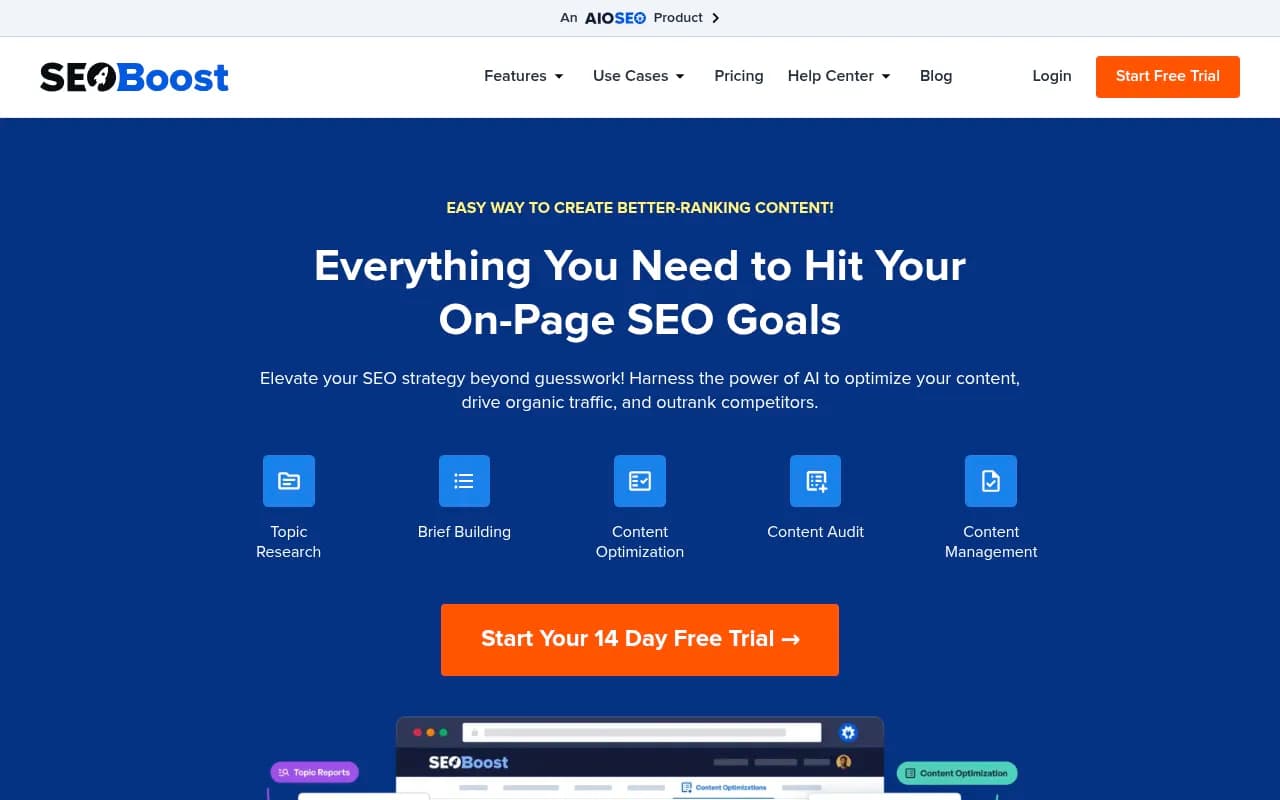
SEOBoost is a content optimization platform built for traditional SEO. It helps writers and content teams create better-ranking content for Google by providing topic research, AI-powered content briefs, real-time SEO scoring, NLP keyword suggestions, and content audit tools. It analyzes the top 30 ranking pages for any keyword and tells you what topics, phrases, and questions you need to cover to compete.
It's a solid, focused tool for teams that produce a lot of content and want a structured workflow from research to publication. The $30/mo starting price makes it accessible for freelancers and small teams. It doesn't touch AI search visibility at all -- that's simply not what it's built for.
Side-by-side comparison
| Feature | Promptwatch | SEOBoost |
|---|---|---|
| Primary use case | AI search visibility & GEO | Traditional on-page SEO content |
| Tracks ChatGPT/Claude/Perplexity | Yes (10 AI models) | No |
| Google SEO optimization | No | Yes |
| Content generation | Yes (AI-optimized for LLM citations) | Yes (SEO briefs & outlines) |
| Real-time SEO scoring | No | Yes |
| Content briefs | No | Yes |
| Topic/keyword research | No | Yes (top 30 competitor analysis) |
| AI crawler logs | Yes | No |
| Citation & source analysis | Yes (880M+ citations) | No |
| Competitor visibility tracking | Yes (AI share of voice) | Yes (Google SERP competitors) |
| Content audit | No | Yes |
| Free trial | 7 days | 14 days (no credit card) |
| Starting price | $99/mo | $30/mo |
| Agency/enterprise tier | Yes | Yes (custom pricing) |
| Multi-language support | Yes | Yes |
| API access | Yes | No (not publicly documented) |
| G2 rating | 4.7/5 | Not prominently listed |
Head-to-head feature deep-dive
Core purpose and target audience
This is where the comparison gets simple fast. These tools are built for different worlds.
Promptwatch exists because AI search is now a real traffic channel. When someone asks ChatGPT "what's the best project management tool for remote teams?", a brand either shows up in that answer or it doesn't. Promptwatch tracks that visibility, identifies why you're missing from certain answers, and gives you tools to fix it. The audience is marketing teams, SEO leads, and digital agencies who recognize that Google isn't the only search engine that matters anymore.
SEOBoost exists to help content teams write better articles for Google. It's a workflow tool: research a topic, build a brief, write optimized content, audit what you've published. The audience is content writers, SEO specialists, and content managers who produce a steady volume of articles and need a structured process.
There's almost no overlap in what these tools actually do day-to-day. Choosing between them is really a question of which search channel you're trying to win.
Verdict: Neither is "better" in absolute terms -- they're solving different problems. If you need both, you'll probably end up using both.
Content creation and optimization
Both tools have content creation features, but they're aimed at completely different outputs.
SEOBoost's content workflow is built around Google's ranking signals. You start with topic research (analyzing top 30 ranking pages), move to a content brief (AI-generated structure with keyword recommendations, LSI terms, and topic clusters), then write in the editor with real-time SEO scoring. The score updates as you type, flagging missing keywords, thin sections, and optimization opportunities. It also integrates NLP-ready keyword suggestions, which helps with semantic search.
Promptwatch's content agent works differently. It generates articles, listicles, and comparison pages based on citation data -- what sources AI models actually cite, what topics they want answers to, and what your competitors are being cited for. The goal isn't a high SEO score; it's content that an AI model will reference when answering a relevant prompt. That means different structures, different angles, and different keyword logic than traditional SEO content.
| Content feature | Promptwatch | SEOBoost |
|---|---|---|
| Content briefs | No | Yes |
| Real-time SEO scoring | No | Yes |
| NLP keyword suggestions | No | Yes |
| AI-generated articles | Yes (citation-optimized) | Yes (SEO-optimized) |
| Topic research | No | Yes (top 30 SERP analysis) |
| Content audit | No | Yes |
| Optimization target | LLM citations | Google rankings |
Verdict: SEOBoost wins for traditional SEO content workflows. Promptwatch wins for content designed to appear in AI-generated answers. They're not interchangeable.
Monitoring and tracking
Promptwatch's monitoring is deep and specific to AI search. You can track your brand's visibility score across 10 LLMs, see sentiment, monitor share of voice against competitors, and drill into which specific prompts you're appearing in (or missing from). The AI crawler logs are a genuinely useful feature -- you can see in real time when GPTBot, ClaudeBot, or PerplexityBot crawls your pages, which pages they visit, and whether those pages end up being cited.
SEOBoost's monitoring is focused on content performance in Google. The content audit tool analyzes published pages against current ranking signals and flags what needs updating. It's more of a periodic review tool than a real-time dashboard.
Neither tool does what the other does here. Promptwatch doesn't track Google rankings. SEOBoost doesn't track AI visibility.
Verdict: Promptwatch is the clear winner for AI search monitoring. SEOBoost is better for ongoing Google content auditing.
Competitor analysis
Both tools offer competitor analysis, but again, in completely different contexts.
Promptwatch's competitor analysis shows you which AI models are citing your competitors, for which prompts, and how often. The Answer Gap Analysis is particularly useful: it surfaces the specific prompts where a competitor is visible but you're not, so you know exactly what content to create. You also get competitor heatmaps that compare share of voice across different LLMs.
SEOBoost analyzes the top 30 Google search results for any keyword. It shows you what topics those pages cover, what phrases they use, and how frequently. This helps you understand what you need to include to compete on a given keyword.
Verdict: Both are solid in their respective domains. Promptwatch's gap analysis is more actionable for AI search; SEOBoost's SERP analysis is more actionable for Google content.
Pricing and value
| Plan | Promptwatch | SEOBoost |
|---|---|---|
| Entry/starter | $99/mo (1 site, 50 prompts, 5 articles) | $30/mo |
| Mid-tier | $249/mo (2 sites, 150 prompts, 15 articles) | Not publicly listed |
| Business/pro | $579/mo (5 sites, 350 prompts, 30 articles) | Not publicly listed |
| Agency/enterprise | Custom pricing | Custom pricing |
| Free trial | 7 days | 14 days (no credit card) |
| Annual discount | Yes | Yes |
SEOBoost is the more affordable option at entry level, and the 14-day free trial without a credit card is a lower-friction way to test it. Promptwatch's pricing reflects the complexity of what it does -- monitoring 10 AI models, processing crawler logs, and running content agents is computationally heavier than SEO scoring.
For a solo content writer or small blog, SEOBoost's $30/mo is genuinely good value. For a brand that wants to understand and improve its AI search presence, Promptwatch's $99/mo entry point is reasonable given the depth of data.
Verdict: SEOBoost wins on price for traditional SEO use cases. Promptwatch's pricing is justified if AI search visibility is a real priority for your business.
Ease of use and workflow
SEOBoost is designed around a clear, linear workflow: research > brief > write > audit. Content teams can pick it up quickly, and the real-time editor feedback is intuitive for writers who are used to tools like Surfer SEO or Clearscope.
Promptwatch has more moving parts -- visibility dashboards, crawler logs, prompt tracking, content agents, citation analysis. There's more to learn, but the platform is organized around a logical loop: find gaps, create content, track results. Teams with some SEO or marketing analytics experience will get up to speed without much friction.
Verdict: SEOBoost has a simpler, more focused workflow. Promptwatch requires more onboarding but covers more ground.
Integrations and ecosystem
Promptwatch integrates with Google Search Console, Cloudflare, Fastly, Vercel, and Looker Studio. It also has an API for custom workflows. The GSC integration is useful for connecting AI visibility data to actual traffic.
SEOBoost doesn't publicly document API access or a broad integration ecosystem. It appears to be a standalone web app, which is fine for its use case but limits how you can pull data into other tools.
Verdict: Promptwatch has a stronger integration story, especially for teams that want to connect AI visibility data to their existing analytics stack.
Pros and cons
Promptwatch
Pros:
- Tracks brand visibility across 10 AI models simultaneously
- Answer Gap Analysis identifies exactly what content you're missing
- AI content agent generates articles optimized for LLM citations, not just Google
- Real-time AI crawler logs show which pages AI bots are reading
- Citation analysis backed by 880M+ data points
- Reddit and YouTube tracking surfaces content that influences AI recommendations
- ChatGPT Shopping tracking for e-commerce brands
- Strong integration options (GSC, Cloudflare, Looker Studio, API)
- Trusted by 8,000+ brands including Booking.com and Typeform
Cons:
- Significantly more expensive than SEOBoost at every tier
- Shorter free trial (7 days vs 14)
- No traditional Google SEO features -- not a replacement for tools like Surfer or Clearscope
- Steeper learning curve due to feature depth
- Overkill for teams whose only goal is Google content optimization
SEOBoost
Pros:
- Very affordable entry point at $30/mo
- 14-day free trial with no credit card required
- Clean, focused workflow from research to publication
- Real-time SEO scoring in the editor
- Top 30 competitor SERP analysis
- NLP keyword suggestions and LSI term recommendations
- Content audit for existing pages
- Content management with calendar view and team collaboration
- Multi-language support
Cons:
- Zero AI search visibility features -- won't tell you anything about ChatGPT, Claude, or Perplexity
- No API documented publicly
- Limited integration ecosystem
- Not useful for brands trying to improve AI search presence
- Content briefs and scoring are Google-centric, which may become less relevant as AI search grows
Who should pick which tool
Choose Promptwatch if:
- You want to know how your brand appears when someone asks ChatGPT, Claude, or Perplexity a question in your category
- You're running GEO (Generative Engine Optimization) campaigns and need data to back them up
- You want to understand which of your pages AI crawlers are visiting and citing
- You're an agency managing AI search visibility for multiple clients
- You need to identify content gaps relative to competitors in AI search, not just Google
- You're in e-commerce and want to track ChatGPT Shopping recommendations
Choose SEOBoost if:
- Your primary traffic channel is Google organic search
- You have a content team producing regular articles and need a structured workflow
- You want real-time SEO scoring as you write
- Budget is a constraint and you need solid SEO content tooling at a low price
- You're a freelance writer or small agency doing traditional SEO content work
- You don't yet have a need to track AI search visibility
Use both if:
- You're a marketing team that cares about both Google rankings and AI search visibility (which, in 2026, is increasingly common)
- You produce content at scale and want to optimize it for both traditional and AI search channels
Final verdict
Promptwatch and SEOBoost are not really competitors -- they're tools for different eras of search. SEOBoost is a well-built, affordable tool for teams doing traditional Google SEO content work. It does that job cleanly and at a price that makes sense for most content teams.
Promptwatch is for a different problem: what happens when your potential customers stop typing into Google and start asking ChatGPT instead. It's the only tool in this comparison that answers that question, and it goes further than just showing you data -- it helps you act on it.
If Google is your only search channel, SEOBoost is the smarter, cheaper choice. If AI search visibility matters to your business in 2026, Promptwatch is the tool you actually need -- and SEOBoost won't fill that gap no matter how good its SEO scores are.