Key takeaways
- Promptwatch and Promeo are not competing tools -- they solve fundamentally different problems. Comparing them is like comparing a GPS to a paintbrush.
- Promptwatch is an AI search visibility platform: it tracks how your brand appears in ChatGPT, Claude, Perplexity, Gemini, and other AI engines, then helps you improve that visibility through content gap analysis and AI-generated articles.
- Promeo is a visual content creation tool: it helps you design social media graphics, short videos, and marketing visuals using AI templates and a drag-and-drop editor.
- On price, Promeo wins by a wide margin -- $3.33/mo on an annual plan vs Promptwatch's $99/mo entry point. But they're not substitutes for each other.
- If your question is "how do I show up when someone asks ChatGPT for a recommendation in my category?", Promptwatch is the answer. If your question is "how do I make a nice Instagram post?", Promeo is the answer.
- The only realistic scenario where you'd choose between them is if you have a very tight budget and need to pick one marketing tool -- in which case the right choice depends entirely on your current biggest gap.
Overview
Promptwatch

Promptwatch is an AI search visibility and Generative Engine Optimization (GEO) platform used by 8,000+ brands and agencies. It monitors how your brand is mentioned across 10 AI models -- ChatGPT, Claude, Gemini, Perplexity, Grok, DeepSeek, Copilot, Meta AI, Mistral, and Google AI Overviews -- and gives you the tools to actually improve that visibility. The key differentiator is that it goes beyond monitoring: it identifies which prompts your competitors rank for that you don't, and then helps you create content specifically engineered to get cited by AI models. Customers include Booking.com, Typeform, Yelp, and Center Parcs.
Promeo
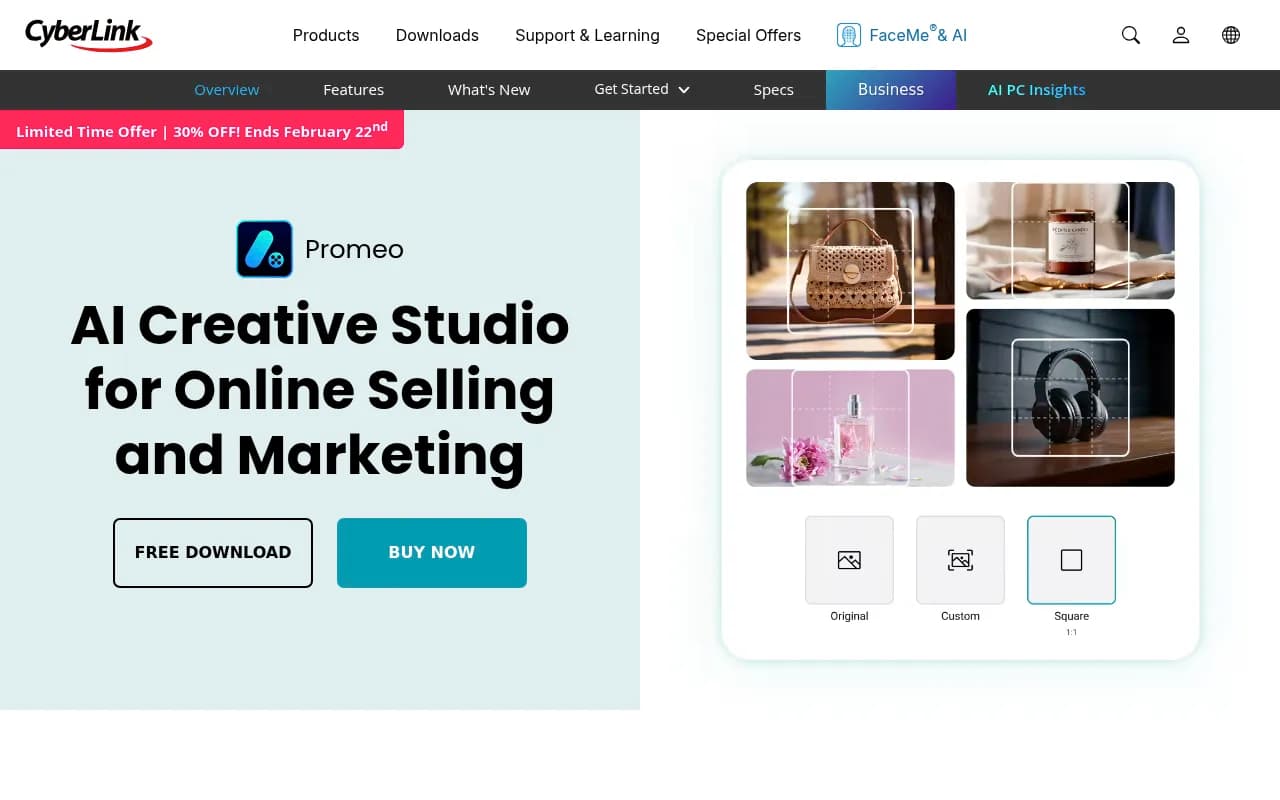
Promeo is CyberLink's AI-powered creative studio for social media and digital marketing. It's aimed at small business owners, e-commerce sellers, and social media managers who need to produce professional-looking visuals without a design background. The tool offers AI-generated templates, background removal, product photo enhancement, copy suggestions, and short video creation. It's available as a desktop app and mobile app, with a freemium model that makes it accessible to solo operators on tight budgets.
Side-by-side comparison
| Feature | Promptwatch | Promeo |
|---|---|---|
| Primary use case | AI search visibility & GEO | Social media visual content creation |
| Free tier | 7-day trial only | Yes (with watermarks) |
| Starting price | $99/mo | $3.33/mo (annual) |
| AI models monitored | 10 (ChatGPT, Claude, Gemini, Perplexity, etc.) | N/A |
| Content generation | Yes (articles, listicles, comparisons) | Yes (ad copy, captions, social posts) |
| Visual/design output | No | Yes (graphics, videos, templates) |
| Competitor analysis | Yes (visibility heatmaps, share of voice) | No |
| Crawler/bot logs | Yes (real-time AI crawler tracking) | No |
| SEO/GEO optimization | Yes (core feature) | No |
| Social media scheduling | No | Yes (post directly from app) |
| Mobile app | No | Yes (iOS & Android) |
| API access | Yes | No |
| Target user | Marketing teams, SEO/GEO specialists, agencies | Small business owners, social media managers |
| G2 rating | 4.7/5 | Not listed on G2 |
Head-to-head feature deep-dive
Core purpose and what you actually get
These tools don't overlap in any meaningful way, so this section is less about "which is better" and more about understanding what each one actually does.
Promptwatch's core loop is: find which AI prompts your competitors are winning that you're not, create content that fills those gaps, then track whether AI models start citing your new content. Every feature feeds into that cycle -- the Answer Gap Analysis, the AI writing agent, the page-level citation tracking, the crawler logs that show you which of your pages AI bots are actually reading.
Promeo's core loop is: upload a product image or start from a template, let AI suggest copy and design variations, then export or post directly to social media. The "AI Marketing Advisor" feature analyzes your product and suggests positioning angles and caption variations for different platforms. It's genuinely useful for someone who doesn't have a design team.
Verdict: Neither tool can replace the other. They operate in completely different parts of the marketing stack.
Content generation
Both tools generate content with AI, but the output is completely different.
Promptwatch generates long-form written content -- articles, listicles, comparison pages -- that is specifically engineered to get cited by AI search engines. The content agent is grounded in real citation data from 880M+ citations analyzed, so it knows what structure, topics, and angles AI models tend to cite. This isn't a generic AI writer; it's tuned for GEO.
Promeo generates short-form marketing copy: headlines, captions, ad text, product descriptions. It also generates visual content -- backgrounds, product photos, short videos. The copy suggestions are platform-aware, meaning it adjusts tone and length for Instagram vs. Facebook vs. TikTok.
| Content type | Promptwatch | Promeo |
|---|---|---|
| Long-form articles | Yes | No |
| Social media captions | No | Yes |
| Ad copy | No | Yes |
| Visual graphics | No | Yes |
| Short videos | No | Yes |
| GEO-optimized content | Yes | No |
| Platform-specific copy | No | Yes |
Verdict: Different outputs for different goals. Promptwatch for AI search content, Promeo for social media assets.
Analytics and tracking
Promptwatch has deep analytics built around AI visibility: visibility scores, share of voice across AI models, sentiment tracking, page-level citation data, and real-time AI crawler logs that show you exactly which pages ChatGPT or Perplexity's bots are reading. You can also track traffic attribution -- connecting AI visibility to actual website visits and revenue.
Promeo has no analytics in the traditional sense. It's a creation tool, not a tracking tool. You create content, post it, and then rely on the native analytics of whatever social platform you're posting to.
Verdict: Promptwatch wins on analytics, but Promeo isn't trying to compete here.
Ease of use and learning curve
Promeo is genuinely easy to pick up. The template-based approach means you can produce something decent in under 10 minutes. The AI suggestions reduce the blank-canvas problem that trips up non-designers. The mobile app makes it accessible anywhere.
Promptwatch has more complexity because the problem it solves is more complex. Setting up prompt tracking, understanding visibility scores, interpreting citation data, and running the content agent all take some learning. That said, the interface is clean and the platform guides you through the workflow. Most marketing teams get up to speed within a week or two.
Verdict: Promeo is simpler, but Promptwatch's complexity is proportional to what it does.
Integrations and ecosystem
Promptwatch integrates with Google Search Console, Cloudflare, Fastly, Vercel, and Looker Studio. It has an API for custom workflows and supports server log analysis for traffic attribution. It's built for marketing and SEO teams that already have a tech stack.
Promeo integrates with social platforms for direct posting. It's a standalone creative tool with limited third-party integrations beyond export formats.
Verdict: Promptwatch has a broader integration story for enterprise marketing teams. Promeo keeps it simple for its target audience.
Pricing comparison
| Plan | Promptwatch | Promeo |
|---|---|---|
| Free | 7-day trial | Yes (watermarked exports) |
| Entry paid | $99/mo (Essential: 1 site, 50 prompts, 5 articles) | $3.33/mo annual ($39.99/year) |
| Mid-tier | $249/mo (Professional: 2 sites, 150 prompts, 15 articles) | $9.99/mo (monthly billing) |
| Higher tier | $579/mo (Business: 5 sites, 350 prompts, 30 articles) | N/A |
| Enterprise | Custom pricing | Enterprise plan available |
| Annual discount | Yes | Yes (annual vs monthly) |
The price gap is stark. Promeo is one of the more affordable AI creative tools on the market. Promptwatch is priced for marketing teams and agencies with a real budget -- the ROI case is that showing up in AI search results drives measurable traffic and revenue, which justifies the cost.
Pros and cons
Promptwatch
Pros:
- Monitors 10 AI models in one platform -- the broadest coverage available
- Goes beyond monitoring to actually help you improve visibility (content gap analysis, AI writing agent)
- Real-time AI crawler logs are a genuinely unique feature most competitors lack
- Strong analytics: visibility scores, share of voice, page-level citation tracking, traffic attribution
- 4.7/5 on G2 with 8,000+ customers including major brands
- API and Looker Studio integration for custom reporting
Cons:
- Expensive for small businesses -- $99/mo is the floor
- No free tier beyond the 7-day trial
- Steeper learning curve than simpler monitoring tools
- No visual content creation -- you'll still need a separate design tool
Promeo
Pros:
- Very affordable -- $3.33/mo on annual plan, free tier available
- Easy to use with no design experience required
- Mobile app for on-the-go content creation
- Good range of visual output: graphics, videos, product photos
- AI copy suggestions are platform-aware (Instagram vs Facebook vs TikTok)
- Background removal and product photo enhancement are genuinely useful for e-commerce
Cons:
- No AI search visibility tracking whatsoever
- No competitor analysis or SEO/GEO features
- Limited integrations beyond social platform posting
- Watermarks on free tier exports
- Not useful if your goal is to rank in AI search results
Who should pick which tool
Pick Promptwatch if:
- You want to know how your brand appears when someone asks ChatGPT, Claude, or Perplexity for recommendations in your category
- You're running SEO or GEO for a brand and need to track AI search visibility alongside traditional search
- You're an agency managing AI visibility for multiple clients
- You want to create content specifically designed to get cited by AI models
- You need to understand which of your website pages AI crawlers are actually reading
Pick Promeo if:
- You need to produce social media graphics, videos, or product photos quickly and cheaply
- You're a small business owner or solo marketer without a design team
- Your biggest marketing gap is visual content, not AI search visibility
- You want a free or near-free tool to get started with AI-assisted design
- You're selling products online and need polished product imagery without a studio
Pick both if:
- You have budget for both and want to cover visual content creation AND AI search visibility
- Promptwatch tells you what content to create, and Promeo helps you promote it on social media
Final verdict
Promptwatch and Promeo are tools for different jobs. Choosing between them isn't really a choice -- it's a question of which problem you're trying to solve right now. If AI search visibility is your gap, Promptwatch is the right tool and there's nothing in Promeo's feature set that touches that problem. If social media visuals are your gap, Promeo is a solid, affordable option and Promptwatch won't help you there at all.
The only real comparison point is budget: if you have $100/mo to spend on one marketing tool, you need to decide whether AI search visibility or social media design is the higher priority. For most brands in 2026, AI search visibility is the faster-growing channel -- but that's a strategic call, not a feature comparison.
Worth noting: if you're investing in content to improve AI search visibility, Promptwatch is built specifically to track whether that content is actually getting cited by AI models and driving traffic.