Key takeaways
- Promptwatch and GrowthBar are not really competing for the same job. Promptwatch tracks and improves how brands appear in AI search engines (ChatGPT, Claude, Perplexity, Gemini). GrowthBar writes SEO blog content optimized for Google. They operate in different channels.
- If your question is "how do I rank in AI search results," Promptwatch is the answer. If your question is "how do I write more Google-friendly blog posts faster," GrowthBar is the answer.
- GrowthBar is significantly cheaper at entry level ($36/month vs $99/month), but the price difference reflects a genuine difference in scope -- Promptwatch monitors 10 AI models, logs AI crawler activity, and analyzes 880M+ citations.
- GrowthBar has no AI search monitoring, no crawler logs, no prompt tracking, and no visibility scoring across LLMs. Promptwatch has no traditional keyword rank tracking or Google SERP analysis.
- Teams that want to win in both Google and AI search might reasonably use both tools -- they don't overlap much.
- For brands where AI search is becoming a meaningful traffic channel (and it is, fast), Promptwatch's action loop -- find gaps, generate AI-optimized content, track results -- is something GrowthBar simply doesn't offer.
Overview
Promptwatch

Promptwatch is an AI search visibility platform built around one core question: when someone asks ChatGPT, Claude, or Perplexity a question in your category, does your brand show up? It monitors visibility across 10 AI models, tracks which prompts trigger brand mentions, logs AI crawler activity on your site, and -- this is the part most competitors skip -- helps you actually fix the gaps. The content agent generates articles grounded in real citation data, not generic SEO filler. Trusted by 8,000+ brands including Booking.com, Typeform, and Yelp, and rated 4.7/5 on G2.
GrowthBar
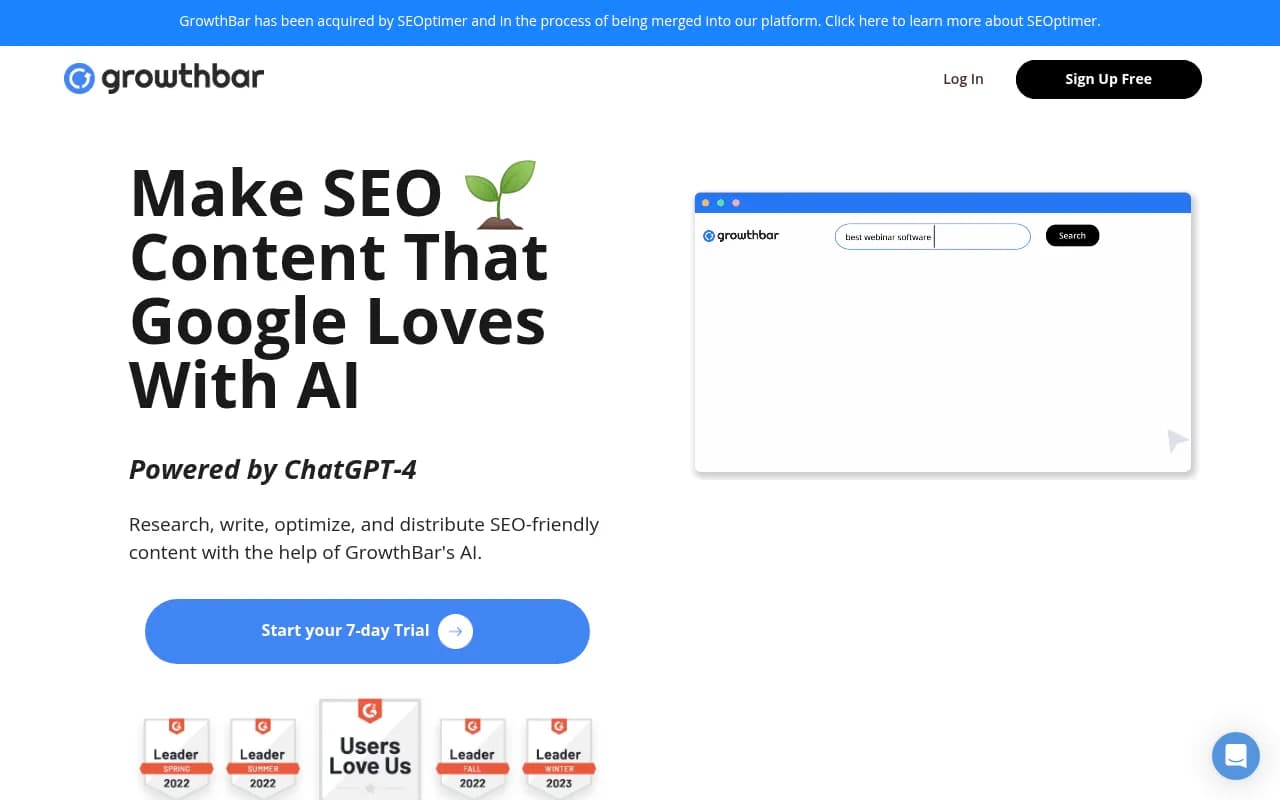
GrowthBar is an AI writing tool for SEO content teams. The pitch is simple: go from a keyword to a 1,500-word, Google-optimized blog post in about two minutes. It scans Google SERPs, generates outlines with suggested headings and word counts, and uses GPT-4 to write drafts. It also handles keyword research, competitor analysis, and content auditing for existing posts. Loved by 6,000+ customers and rated 4.9/5 on G2. It's a solid tool for teams that publish a lot of blog content and want to move faster without sacrificing SEO fundamentals.
Side-by-side comparison
| Feature | Promptwatch | GrowthBar |
|---|---|---|
| Primary use case | AI search visibility & optimization | Google SEO content creation |
| AI model monitoring | 10 models (ChatGPT, Claude, Gemini, Perplexity, Grok, DeepSeek, Copilot, Meta AI, Mistral, Google AI Overviews) | None |
| Content generation | Yes -- AI-optimized for LLM citations | Yes -- optimized for Google rankings |
| Keyword research | No | Yes |
| Google SERP analysis | No | Yes |
| Prompt tracking | Yes -- volume, difficulty, fan-outs | No |
| AI crawler logs | Yes -- real-time logs per page | No |
| Competitor visibility analysis | Yes -- across AI models | Yes -- Google traffic/rankings |
| Citation analysis | Yes -- 880M+ citations analyzed | No |
| Reddit/YouTube tracking | Yes | No |
| ChatGPT Shopping tracking | Yes | No |
| Free trial | 7 days | 7 days |
| Starting price | $99/month | $36/month (annual) |
| G2 rating | 4.7/5 | 4.9/5 |
| Target user | Marketing/SEO teams focused on AI search | Bloggers, content teams, agencies |
Head-to-head feature deep-dive
Core purpose and channel focus
This is the most important thing to understand before comparing anything else: these tools are built for different search channels.
GrowthBar is a Google SEO tool. Everything it does -- keyword research, SERP analysis, outline generation, content scoring -- is oriented around ranking in traditional Google search results. It's good at that job.
Promptwatch is an AI search tool. It tracks how brands appear when people ask questions directly to ChatGPT, Perplexity, Claude, or Gemini. These are different queries, different ranking signals, and increasingly different traffic sources.
The reason this matters in 2026: AI search is no longer a niche concern. ChatGPT alone handles hundreds of millions of queries per day, and a meaningful share of those are commercial or research queries that used to go to Google. If you're only optimizing for Google, you're potentially invisible in a channel that's growing fast.
Verdict: Neither tool is "better" here -- they're solving different problems. The question is which problem matters more to you right now.
Content generation
Both tools generate content with AI, but the underlying logic is completely different.
GrowthBar's content engine scans Google SERPs for a target keyword, analyzes what's ranking, and generates an outline and draft designed to compete in those results. It's fast -- the "2-minute blog builder" claim is roughly accurate for a first draft. The output is tuned for Google's ranking signals: word count, heading structure, keyword density, internal links.
Promptwatch's content agent works from citation data. It looks at which prompts are driving AI responses in your category, which sources AI models are citing, and what topics your site is missing coverage on. The articles it generates are designed to be the kind of source ChatGPT or Perplexity would want to cite -- structured, authoritative, specific. That's a meaningfully different optimization target than "rank on page one of Google."
| Content dimension | Promptwatch | GrowthBar |
|---|---|---|
| Optimization target | LLM citations | Google rankings |
| Data source | 880M+ AI citations | Google SERP analysis |
| Outline generation | Based on citation gaps | Based on SERP competitors |
| Draft speed | Workflow-based | ~2 minutes |
| Content types | Articles, listicles, comparisons | Blog posts, long-form articles |
| Existing content audit | No | Yes |
Verdict: GrowthBar wins for Google content volume and speed. Promptwatch wins for content that gets cited by AI models. If you want both, you'd need both.
Monitoring and tracking
GrowthBar doesn't monitor anything in AI search. Full stop. It has keyword rank tracking for Google, but nothing that tells you whether your brand appears in ChatGPT responses.
Promptwatch's monitoring is the core product. It tracks:
- Visibility scores across 10 AI models
- Which specific prompts trigger brand mentions
- Sentiment in AI responses
- Share of voice vs competitors
- Which pages AI crawlers are visiting (and how often)
- Real-time citation data by page
The AI crawler logs feature is worth calling out specifically. Most brands have no idea which pages ChatGPT or Perplexity are actually reading. Promptwatch shows you this in real time -- which pages get crawled, which get cited, and which have errors that might be blocking AI indexing. GrowthBar has nothing equivalent.
Verdict: Promptwatch wins this category entirely. GrowthBar doesn't compete here.
Competitor analysis
Both tools offer competitor analysis, but again, for different channels.
GrowthBar lets you see a competitor's estimated organic traffic, their top-ranking keywords, and their backlink profile. Useful for understanding where to attack in Google search.
Promptwatch's competitor analysis shows you which AI models are citing your competitors, which prompts they're winning that you're not, and how your visibility score compares across LLMs. The Answer Gap Analysis is particularly useful -- it surfaces the specific prompts where a competitor is visible but you're invisible, giving you a concrete content hit list.
Verdict: Depends entirely on which channel you care about. For Google competitive intel, GrowthBar. For AI search competitive intel, Promptwatch.
Ease of use and onboarding
GrowthBar is genuinely easy to get started with. Enter a keyword, get an outline, click to generate a draft. The learning curve is minimal, and the workflow is intuitive for anyone who's written blog content before.
Promptwatch has more moving parts -- you're setting up prompt tracking, connecting your site for crawler logs, configuring competitor comparisons. It's not hard, but it takes more setup time to get meaningful data flowing. The payoff is a much richer picture of your AI search position.
Verdict: GrowthBar is faster to get value from on day one. Promptwatch rewards the setup investment with deeper ongoing insights.
Integrations and reporting
GrowthBar integrates with WordPress for direct publishing and works with Google Search Console data. Reporting is focused on content performance and keyword rankings.
Promptwatch integrates with Cloudflare, Fastly, and Vercel for crawler log collection, Google Search Console for traffic attribution, and offers a Looker Studio integration plus API access for custom reporting. It also tracks Reddit and YouTube as citation sources -- a channel most SEO tools ignore entirely.
Verdict: Promptwatch has a broader integration story, especially for teams that want to connect AI visibility data to actual revenue.
Pricing comparison
| Plan | Promptwatch | GrowthBar |
|---|---|---|
| Entry | $99/month (Essential: 1 site, 50 prompts, 5 articles) | $36/month (Standard, annual billing) |
| Mid-tier | $249/month (Professional: 2 sites, 150 prompts, 15 articles) | $74.25/month (Mid, annual billing) |
| Top tier | $579/month (Business: 5 sites, 350 prompts, 30 articles) | $149.25/month (Agency, annual billing) |
| Enterprise/Agency | Custom pricing | N/A |
| Free trial | 7 days | 7 days |
| Annual discount | Yes | 40-45% |
GrowthBar is cheaper at every tier. That's real, and worth acknowledging. But the price difference reflects what each tool actually does -- Promptwatch is running live queries across 10 AI models, processing crawler logs, and analyzing citation databases at scale. GrowthBar is generating text from SERP data. Different infrastructure, different cost structure.
Pros and cons
Promptwatch
Pros:
- Monitors 10 AI models, not just one or two
- AI crawler logs show exactly which pages AI engines are reading
- Answer Gap Analysis gives you a concrete list of content to create
- Content agent generates articles optimized for LLM citations, not just Google
- Reddit and YouTube citation tracking -- a channel most tools miss
- ChatGPT Shopping tracking for e-commerce brands
- Strong integration story (Cloudflare, Vercel, GSC, Looker Studio, API)
- 880M+ citations analyzed means the data is genuinely deep
Cons:
- No traditional keyword rank tracking or Google SERP analysis
- Higher starting price ($99/month vs $36/month)
- More setup required to get full value
- Content article limits per plan may feel restrictive for high-volume teams
GrowthBar
Pros:
- Very fast to get started -- minimal learning curve
- Genuinely quick content generation (2-minute blog builder works as advertised)
- Cheaper at every tier
- Good for teams producing high volumes of Google-optimized content
- Content auditing for existing posts
- Team collaboration features built in
- 4.9/5 on G2 -- users seem genuinely happy with it
Cons:
- Zero AI search monitoring capabilities
- No visibility into how brands appear in ChatGPT, Claude, or Perplexity
- No crawler logs, no prompt tracking, no citation analysis
- Optimizes for a channel (Google) that is losing share to AI search
- No Reddit or YouTube insights
- No competitor AI visibility analysis
Who should pick which tool
Pick Promptwatch if:
- You want to understand and improve how your brand appears in ChatGPT, Perplexity, Claude, or Gemini
- AI search is already driving (or you expect it to drive) meaningful traffic to your site
- You're an SEO or marketing team that needs to show ROI from AI search investment
- You want to know which content gaps are costing you AI citations -- and have help filling them
- You manage multiple brands or client accounts across AI search channels
- You need crawler log data to understand how AI engines are indexing your site
Pick GrowthBar if:
- Your primary traffic channel is Google organic search and you want to produce more content faster
- You're a blogger, content team, or agency focused on traditional SEO
- Budget is a constraint and you need a capable tool at a lower price point
- You don't yet have a specific AI search strategy and want to focus on Google first
- You need a simple, fast workflow for generating SEO-optimized drafts
Consider both if:
- You're running parallel strategies for Google and AI search (increasingly common in 2026)
- You have a content team that needs to produce volume for Google while also building AI search visibility
- You're an agency with clients asking about both traditional SEO and AI search performance
Final verdict
These tools don't really compete -- they serve different channels and different goals. GrowthBar is a solid, affordable choice for teams that write a lot of Google-optimized content and want AI to speed up the process. It does that job well and costs less.
Promptwatch is the right tool if AI search visibility is on your radar -- and in 2026, it should be. It's the only platform here that tells you whether your brand shows up when someone asks ChatGPT a question in your category, and more importantly, what to do about it when you don't. The content agent, crawler logs, and Answer Gap Analysis together form a loop that monitoring-only tools can't match.
If you're choosing between them, the real question is: which search channel matters more to your business right now? For Google content production, GrowthBar. For AI search visibility and optimization, Promptwatch. For teams that need both, the tools are complementary enough that running both is a reasonable call.