Key takeaways
- Bluefish AI is built for Fortune 500 enterprises with quote-based pricing starting around $4,000/month. ZipTie starts at $299/month, making it accessible to mid-market and growth-stage teams.
- ZipTie's standout feature is customer journey mapping -- it tracks seven distinct journey stages in AI conversations, including emotional states and exit triggers. Bluefish doesn't do this.
- Bluefish AI goes deeper on brand influence and "how AI thinks" about your brand, plus agentic commerce tracking. ZipTie is stronger on Reddit activation and community-driven AI optimization.
- Neither tool offers a free trial, which is a real friction point for buyers evaluating either platform.
- If you need to pass enterprise infosec reviews and need custom data segmentation at scale, Bluefish is the safer bet. If you want journey insights and content automation at a reasonable price, ZipTie is more practical.
- Both tools are monitoring-first platforms with some optimization capabilities, but neither matches the full action loop (gap analysis + content generation + traffic attribution) that more comprehensive platforms offer.
Overview
Bluefish AI
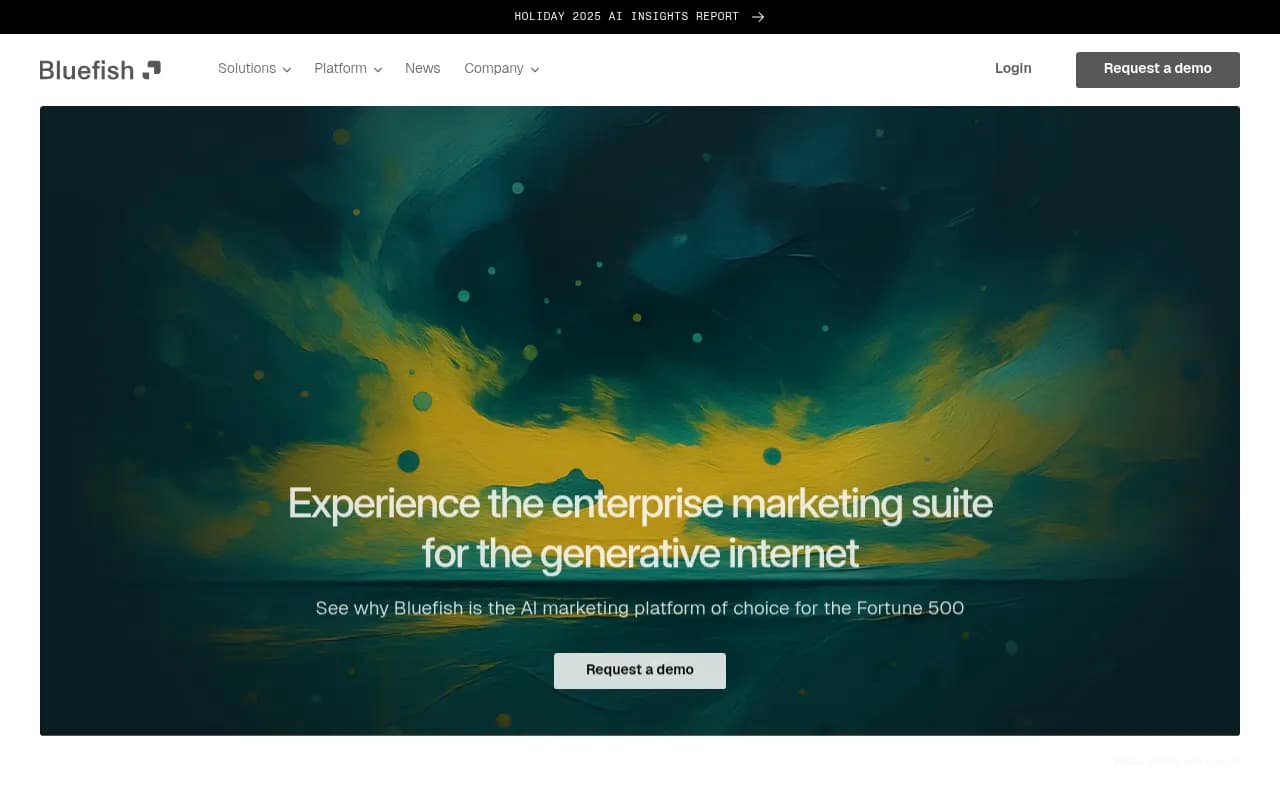
Bluefish AI positions itself as the enterprise GEO platform for Fortune 500 brands. The pitch is authority and control -- not just tracking where your brand shows up in AI responses, but understanding how AI models "think" about your brand and influencing that over time. It covers AI monitoring, GEO optimization, measurement, and AI commerce (including agentic shopping channels). The website explicitly targets enterprise marketing teams and touts easy infosec review passes, which matters a lot when you're trying to get a new vendor approved inside a large organization.
The downside is access. There's no self-serve option, no pricing page, and no free trial. You request a demo and go through a sales process. That's fine if you're a VP of Marketing at a Fortune 500 company. It's a dead end if you're not.
ZipTie
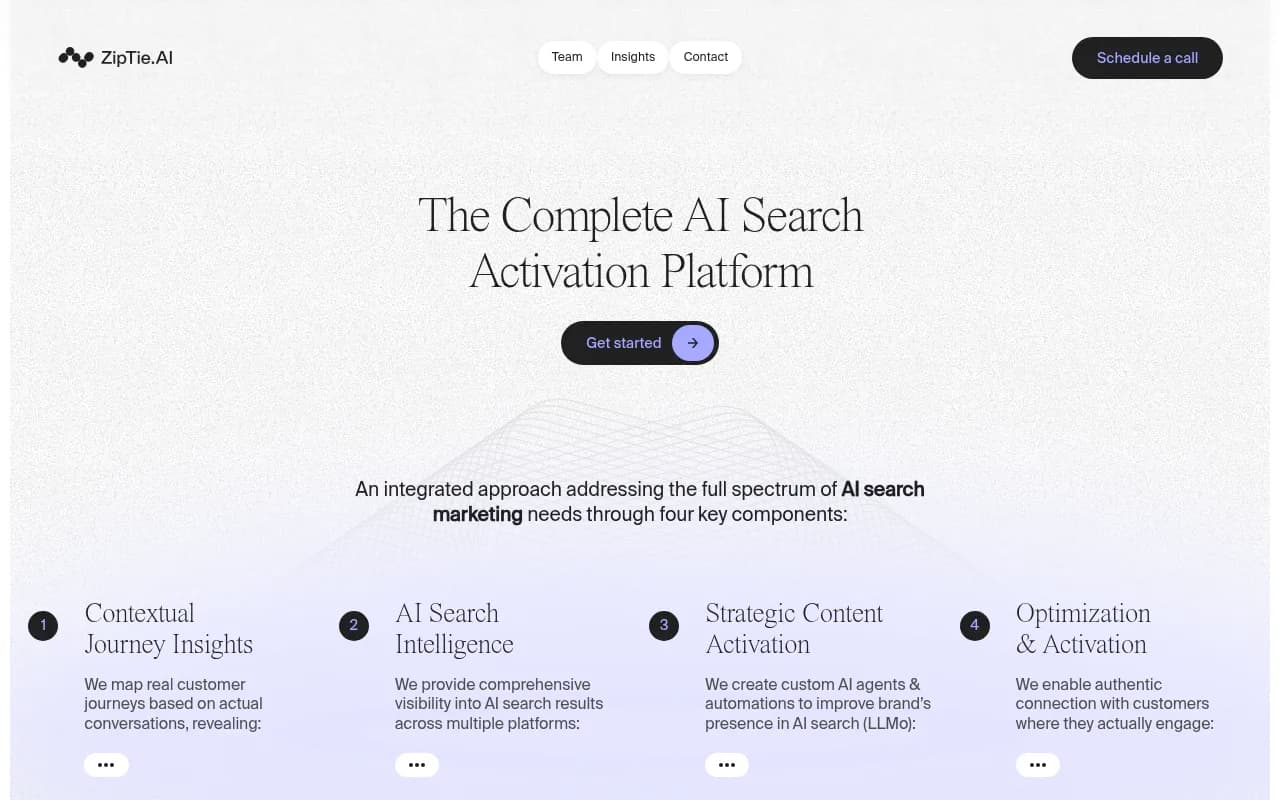
ZipTie takes a more consultative, journey-focused approach to AI search visibility. Its core framework breaks down into four components: contextual journey insights, AI search intelligence, strategic content activation, and Reddit/community optimization. The journey mapping piece is genuinely interesting -- ZipTie maps real customer conversations across seven stages, capturing not just what users ask but how they feel and what causes them to drop off. That's a different lens than most AI visibility tools, which tend to focus on brand mentions and citation counts.
ZipTie also has a self-serve pricing structure ($299/month Standard, $799/month Pro), which makes it far more approachable. The Reddit activation component -- helping brands engage authentically in communities that influence AI responses -- is a channel most competitors ignore entirely.
Side-by-side comparison
| Feature | Bluefish AI | ZipTie |
|---|---|---|
| Starting price | ~$4,000/mo (estimated, quote-based) | $299/mo (Standard) |
| Free trial | No | No |
| Self-serve signup | No (demo required) | Yes |
| Target audience | Fortune 500 / enterprise | Mid-market, growth brands |
| AI monitoring | Yes (multi-platform) | Yes (Google AIO, ChatGPT, Perplexity+) |
| Customer journey mapping | No | Yes (7 stages, emotional states) |
| Content generation / automation | Limited (optimization workflows) | Yes (custom AI agents, automation) |
| Reddit / community activation | No | Yes (core feature) |
| Agentic commerce tracking | Yes | Not mentioned |
| GSC integration | Not specified | Yes (3-10 properties by plan) |
| Enterprise infosec compliance | Yes (explicitly stated) | Not specified |
| Custom data segmentation | Yes | Limited |
| API access | Not specified | Not specified |
| Pricing transparency | None (quote only) | Public pricing page |
Head-to-head feature deep-dive
AI monitoring coverage
Both platforms cover the major AI search channels -- ChatGPT, Perplexity, Google AI Overviews. Bluefish goes further into agentic commerce, which matters if your brand sells products and you want to know when AI shopping agents are (or aren't) recommending you. ZipTie's monitoring is solid but the website doesn't detail which specific models beyond the big three.
Bluefish also claims to help marketers understand how AI "thinks" about their brand, which sounds vague but likely refers to sentiment analysis and narrative framing in AI responses -- not just citation counts. That's a meaningful distinction if brand perception in AI is your primary concern.
Verdict: Bluefish has broader coverage, especially for commerce. ZipTie covers the essentials well.
Customer journey intelligence
This is where ZipTie genuinely stands out. Most AI visibility tools ask: "Is my brand mentioned?" ZipTie asks: "What is the customer actually trying to accomplish, and where does the AI conversation break down for them?"
The seven-stage journey framework maps information needs, decision dimensions, emotional states, and exit triggers. That's qualitative depth you won't find in Bluefish's dashboard. For brands that want to understand the why behind AI search behavior -- not just the what -- ZipTie's approach is more useful.
Bluefish doesn't appear to offer anything comparable here.
Verdict: ZipTie wins clearly.
Content optimization and activation
ZipTie builds custom AI agents and automation workflows to help brands create content that improves AI search visibility. The Reddit activation piece is particularly interesting -- ZipTie helps brands engage in the communities that AI models actually pull from when forming recommendations. That's a smart, underutilized channel.
Bluefish focuses more on optimization workflows and measurement frameworks rather than content creation. It's more about telling you what to do than doing it for you.
If you're also thinking about how your content strategy connects to AI search visibility more broadly, Promptwatch is worth knowing about -- it combines answer gap analysis with an AI writing agent that generates content specifically engineered to get cited by ChatGPT, Claude, and Perplexity.

Verdict: ZipTie is more hands-on with content. Bluefish is more analytical.
Enterprise features and scalability
Bluefish is built for enterprise from the ground up. It explicitly mentions passing infosec reviews, custom audience segmentation, and data customization that "competitors can't match." For a Fortune 500 brand with strict vendor approval processes, that matters.
ZipTie's enterprise credentials are less clear. The pricing structure suggests it's designed for teams, not just individuals, but there's no mention of SSO, SOC 2 compliance, or enterprise SLAs on the website.
Verdict: Bluefish wins for enterprise requirements. ZipTie is better suited to teams that don't need that overhead.
Pricing and accessibility
This is the starkest difference between the two tools.
ZipTie has a real pricing page with real numbers. You can evaluate it, budget for it, and sign up without talking to a salesperson. That's a meaningful advantage for most marketing teams.
Bluefish requires a demo request and a sales process. The estimated $4,000+/month starting price puts it out of reach for most organizations. That's not a criticism -- enterprise software is priced for enterprise budgets -- but it's a hard filter.
Verdict: ZipTie wins on accessibility. Bluefish is only realistic for large organizations.
Measurement and attribution
Bluefish talks about "advanced performance tools" and custom measurement frameworks, and its "Collections" feature (launched February 2026) is designed to measure the ROI of digital marketing campaigns in the AI channel. That's a genuinely useful capability -- connecting traditional campaign spend to AI visibility outcomes.
ZipTie mentions "performance measurement beyond traditional metrics" but is less specific about what that means in practice. GSC integration is included in both plans, which helps connect AI visibility to organic traffic.
Verdict: Bluefish appears more sophisticated here, though specifics are hard to verify without a demo.
Pricing comparison
| Plan | Bluefish AI | ZipTie |
|---|---|---|
| Entry-level | ~$4,000/mo (estimated) | $299/mo (Standard) |
| Mid-tier | Custom | $799/mo (Pro) |
| Enterprise | Custom | Custom (not listed) |
| Free trial | No | No |
| Annual discount | Not specified | Not specified |
| Self-serve | No | Yes |
ZipTie's Standard plan includes 3,000 AI search checks and 3 GSC properties. The Pro plan bumps that to 10,000 checks and 10 GSC properties. For most mid-market teams, the Standard plan is a reasonable starting point.
Bluefish's pricing is entirely opaque. The $4,000+/month estimate comes from third-party sources -- the actual number depends on scope, team size, and what features you need. Budget accordingly.
Pros and cons
Bluefish AI
Pros:
- Purpose-built for enterprise scale with infosec compliance
- Tracks agentic commerce, not just AI search
- Deep brand influence analysis beyond simple citation counts
- Collections feature connects campaign spend to AI visibility ROI
- Backed by Fortune 500 client validation
Cons:
- No public pricing -- requires a full sales process
- Estimated $4,000+/month is inaccessible for most teams
- No free trial or self-serve option
- Limited transparency about which AI models are monitored
- No customer journey mapping or community activation features
ZipTie
Pros:
- Transparent, accessible pricing starting at $299/month
- Unique seven-stage customer journey mapping
- Reddit and community activation is a genuinely differentiated feature
- Custom AI agents for content automation
- GSC integration included in all plans
Cons:
- No free trial
- Enterprise credentials (infosec, compliance) are unclear
- Less detail on which AI models are covered beyond the big three
- Agentic commerce tracking not mentioned
- Smaller brand footprint compared to Bluefish
Who should pick which tool
Pick Bluefish AI if:
- You're at a Fortune 500 or large enterprise brand with a serious AI marketing budget
- You need to pass strict infosec and vendor approval processes
- Agentic commerce tracking is relevant to your business
- You want deep brand influence analysis and custom measurement frameworks
- You have a dedicated team to work with an enterprise vendor relationship
Pick ZipTie if:
- You're a mid-market or growth-stage brand that can't justify $4,000+/month
- You want to understand customer journeys in AI conversations, not just citation counts
- Reddit and community-driven AI optimization is part of your strategy
- You want content automation and AI agents to help execute on insights
- You prefer self-serve access and transparent pricing
Final verdict
These two tools are solving adjacent problems for very different buyers. Bluefish AI is a serious enterprise platform with the depth, compliance credentials, and commerce tracking that large brands need -- but it's priced and gated accordingly. ZipTie is more accessible, more journey-focused, and more hands-on with content activation, making it the better fit for teams that want actionable insights without a six-figure annual commitment.
If you're a Fortune 500 marketer with budget and a sales process to spare, Bluefish is worth evaluating. For everyone else, ZipTie is the more practical starting point -- though neither tool fully closes the loop from visibility gap to published content to traffic attribution the way a more complete platform would.