Key takeaways
- Bluefish AI is built exclusively for enterprise brands (think Fortune 500 budgets), with quote-based pricing estimated at $4,000+/month. Vaylis starts at €49/month with public pricing and self-serve signup.
- Vaylis is the more accessible option for agencies and SMBs -- it's explicitly designed for multi-client management and non-technical users can navigate it without training.
- Bluefish AI goes deeper on enterprise-specific needs: custom audience segmentation, infosec compliance, and understanding how AI "thinks" about your brand. That depth comes at a steep price.
- Both platforms monitor the same core AI engines (ChatGPT, Perplexity, Google AI, Claude, Gemini, Grok, Copilot, Meta AI), but Bluefish AI emphasizes influence and control beyond just monitoring metrics.
- Neither tool includes built-in AI content generation -- if creating content that ranks in AI search is your goal, you'll need to pair either platform with a tool that does.
- If you're a mid-market company or agency, Vaylis gives you 80% of the monitoring capability at roughly 5% of the cost.
Overview
Bluefish AI
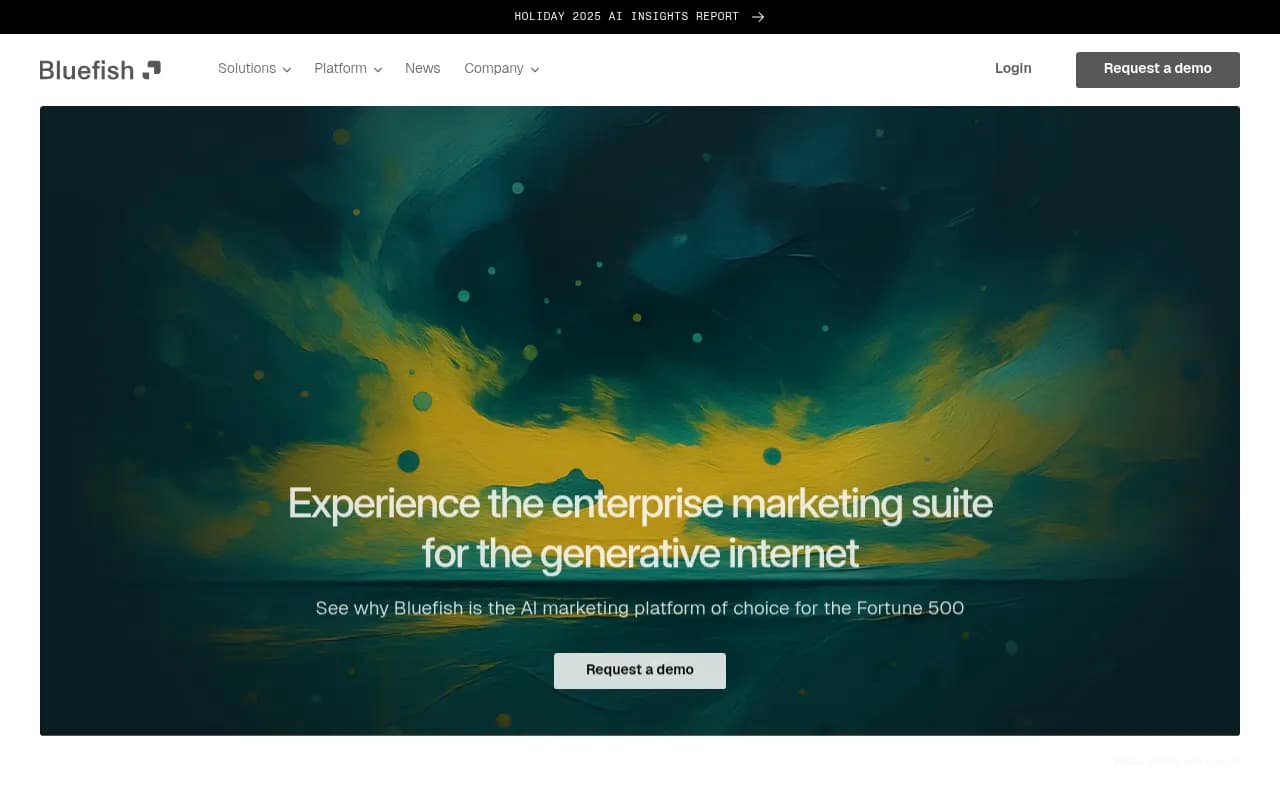
Bluefish AI positions itself as the enterprise GEO platform for brands that need more than a dashboard. The pitch is "authority, influence, and control" -- not just tracking where you appear in AI answers, but shaping how AI models think about your brand. Their client base is explicitly Fortune 500, and the product reflects that: custom audience segmentation, agentic commerce tracking, infosec-ready architecture, and a "Collections" feature for measuring campaign ROI in the AI channel. You won't find a pricing page. You'll find a "Request a demo" button.
Vaylis
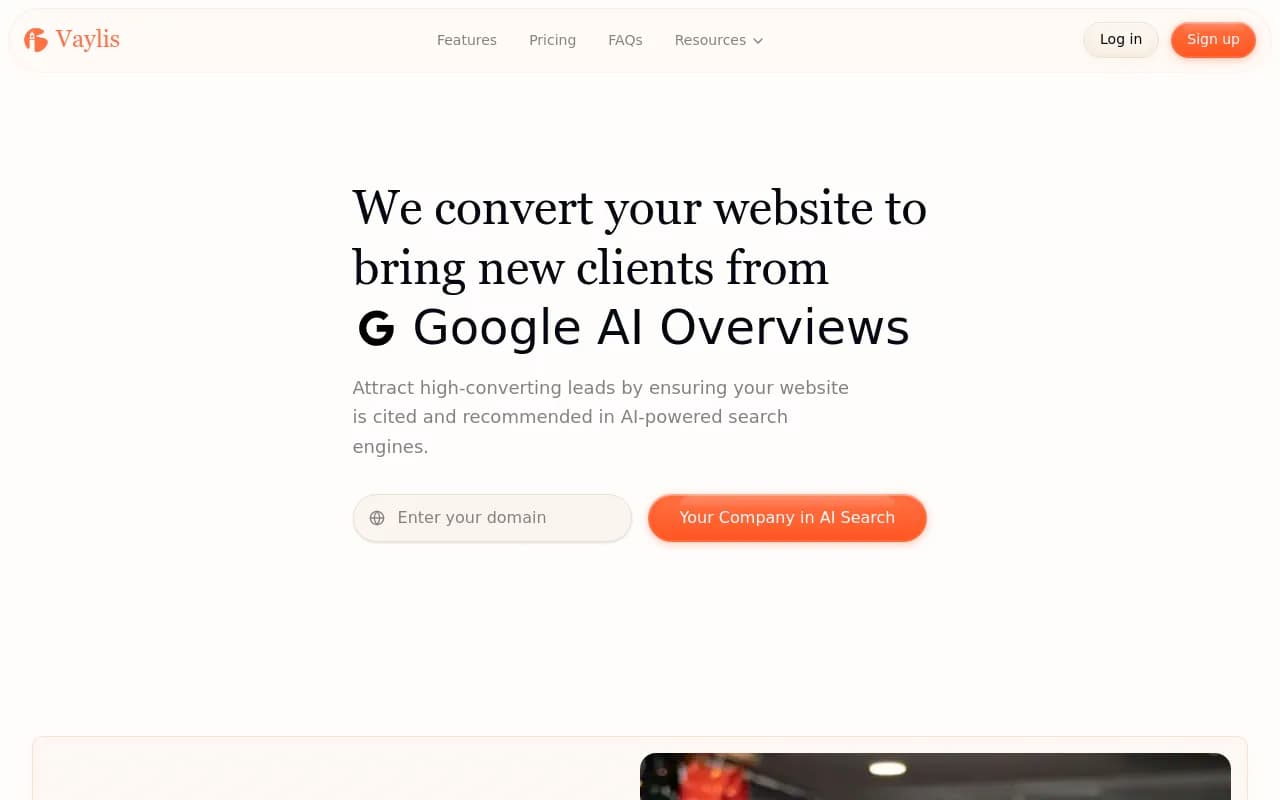
Vaylis takes the opposite approach. Transparent pricing, self-serve signup, and a product walkthrough video on the homepage that shows you exactly what you're getting. It's built for agencies and businesses that want to track AI visibility across ChatGPT, Perplexity, Google AI, and others without a procurement process. The platform differentiates between owned, earned, and competitor media -- a genuinely useful framing for agencies managing multiple clients. A case study from automotive services company Reifenhenrich claims 11x more AI mentions and 120% growth in customer inquiries after using the platform.
Side-by-side comparison
| Feature | Bluefish AI | Vaylis |
|---|---|---|
| Starting price | ~$4,000+/month (quote) | €49/month (public pricing) |
| Free tier | No | No |
| Self-serve signup | No (demo required) | Yes |
| AI engines monitored | ChatGPT, Perplexity, Google AI, Claude, Gemini, Grok, Copilot, Meta AI | ChatGPT, Perplexity, Google AI, Claude, Gemini, Grok, Copilot, Meta AI |
| Competitor tracking | Yes | Yes |
| Citation/source analysis | Yes | Yes |
| Content generation | No | No |
| Agency/multi-client support | Enterprise custom | Yes (built-in) |
| Campaign ROI measurement | Yes (Collections feature) | Not specified |
| Agentic commerce tracking | Yes | Not specified |
| Custom audience segmentation | Yes | Not specified |
| Infosec/enterprise compliance | Yes (passes infosec reviews) | Not specified |
| Update frequency | Not specified | Daily (all plans) |
| Target audience | Fortune 500 / large enterprise | Agencies, SMBs, mid-market |
| Onboarding | Sales-led | Self-serve, minutes |
Head-to-head feature deep-dive
Pricing and accessibility
This is where the two tools diverge most sharply. Vaylis publishes its pricing openly:
| Plan | Vaylis price | Bluefish AI price |
|---|---|---|
| Starter | €49/month | N/A |
| Growth/Pro | Mid-tier (not fully specified) | N/A |
| Enterprise | €699/month | ~$4,000+/month (estimated) |
| Custom/Agency | Available | Quote only |
Bluefish AI doesn't publish any pricing. The ~$4,000/month estimate comes from third-party research and is likely a floor, not a ceiling. For a Fortune 500 brand spending millions on traditional media, that's a rounding error. For an agency with 10 clients or a mid-market brand, it's a budget conversation that probably ends the evaluation.
Vaylis wins here by a wide margin for anyone outside the enterprise tier.
AI engine coverage
Both platforms cover the same set of major AI engines: ChatGPT, Perplexity, Google AI (including AI Overviews), Claude, Gemini, Grok, Copilot, and Meta AI. On paper, the coverage is equivalent.
The difference is depth. Bluefish AI claims to help marketers understand how AI "thinks" -- which suggests more than just tracking mentions. Their emphasis on "impact and influence" implies analysis of sentiment, framing, and recommendation patterns, not just presence/absence metrics. Vaylis focuses on visibility scores, citation tracking, and competitive benchmarking, which covers the core use case well but may not go as deep on the qualitative side.
Verdict: Roughly equivalent for monitoring breadth; Bluefish AI likely goes deeper on analysis for enterprise use cases.
Agency and multi-client management
Vaylis was clearly designed with agencies in mind. The product walkthrough video specifically highlights multi-company management and a global filter system that "even non-technical users can navigate." The differentiation between owned, earned, and competitor media is a useful framework for agencies reporting to clients.
Bluefish AI can handle multi-brand enterprise setups, but it's structured around a single large client relationship rather than an agency managing 20 smaller ones. There's no indication of a self-serve agency tier.
Verdict: Vaylis wins for agencies. Bluefish AI is better suited to in-house enterprise teams.
Optimization and actionability
Bluefish AI's "Actionability" pillar promises automated optimization workflows and custom measurement frameworks. Their Collections feature (launched February 2026) specifically measures the ROI of digital marketing campaigns in the AI channel -- which is a genuinely interesting capability if you're running Super Bowl ads and want to know if they moved your AI visibility scores (they published a study showing they do).
Vaylis provides "actionable recommendations" to improve AI search presence, which is the standard GEO monitoring platform promise. The specifics of what those recommendations look like aren't detailed publicly, but the framing is more tactical (here's what to fix) than strategic (here's how to shape AI perception of your brand).
Neither platform includes built-in content generation. If you want to actually create content that gets cited by AI models, you'd need to pair either tool with something that does. Promptwatch is worth knowing about here -- it combines monitoring with an AI writing agent that generates content grounded in citation data.

Verdict: Bluefish AI has more sophisticated optimization tooling for enterprise campaigns. Vaylis is more practical for day-to-day recommendations.
Enterprise features and compliance
Bluefish AI explicitly mentions passing infosec reviews "with ease" -- which matters a lot when you're selling to Fortune 500 procurement teams. Custom data segmentation, tailored prompt sets, and enterprise-grade data handling are core selling points.
Vaylis doesn't make specific claims about enterprise compliance or data security certifications. That's not necessarily a gap for SMBs and agencies, but it would be a blocker for large regulated industries.
Verdict: Bluefish AI is the only viable option for enterprises with strict security requirements.
Onboarding and time to value
Vaylis: sign up online, connect your website, start seeing data. The homepage claims "minutes" to get started, and the product is designed for non-technical users.
Bluefish AI: request a demo, go through a sales process, negotiate a contract, get onboarded. Realistically, you're looking at weeks before you have access to data.
Verdict: Vaylis wins on speed to value. Bluefish AI's onboarding is a feature for enterprises that need hand-holding, not a bug.
Pricing comparison
| Plan | Vaylis | Bluefish AI |
|---|---|---|
| Entry-level | €49/month | Not available |
| Mid-tier | ~€149-299/month (estimated) | Not available |
| Enterprise | €699/month | ~$4,000+/month |
| Custom/Agency | Available | Quote only |
| Free trial | Not confirmed | No |
| Annual discount | Not specified | Not specified |
Vaylis's Starter plan includes all features with daily updates, which is a strong value proposition at €49/month. Most monitoring platforms gate key features behind higher tiers.
Pros and cons
Bluefish AI
Pros:
- Genuine enterprise depth -- custom audiences, campaign ROI measurement, agentic commerce tracking
- Passes infosec reviews, which is table stakes for Fortune 500 procurement
- Goes beyond monitoring to influence and control over AI brand perception
- Collections feature for measuring marketing campaign impact on AI visibility is genuinely differentiated
- Backed by relationships with major AI platforms (OpenAI mentioned on homepage)
Cons:
- No public pricing -- you can't evaluate cost without a sales call
- Estimated $4,000+/month puts it out of reach for most companies
- No self-serve option -- weeks of lead time before you can use the product
- Not designed for agencies managing multiple smaller clients
- No built-in content generation
Vaylis
Pros:
- Transparent pricing starting at €49/month -- no surprises
- Self-serve signup, up and running in minutes
- Built explicitly for agencies with multi-client management
- Covers 8 major AI engines with daily updates on all plans
- Differentiates owned vs. earned vs. competitor media -- useful framing
- Non-technical users can navigate it without training
Cons:
- Less depth on enterprise-specific features (compliance, custom segmentation)
- Optimization recommendations may be less sophisticated than Bluefish AI's
- No built-in content generation
- Smaller company with less established track record than Bluefish AI
- Limited public information about data methodology and citation analysis depth
Who should pick which tool
Pick Bluefish AI if:
- You're at a Fortune 500 or large enterprise brand with a serious GEO budget
- You need to pass infosec reviews and have enterprise data requirements
- You want to measure how offline campaigns (TV, Super Bowl ads) affect AI visibility
- You need custom audience segmentation and tailored prompt sets
- You have a dedicated marketing team that can work with a sales-led onboarding process
Pick Vaylis if:
- You're an agency managing multiple clients and need a practical multi-client dashboard
- You want to start tracking AI visibility without a procurement process
- Your budget is under $1,000/month
- You're a mid-market brand or SMB that needs solid monitoring without enterprise complexity
- You want to be up and running this week, not next month
Final verdict
These two tools aren't really competing for the same customers. Bluefish AI is a premium enterprise platform for brands with the budget and complexity to justify it. Vaylis is a practical, accessible monitoring tool for agencies and businesses that want AI visibility data without the enterprise price tag.
If you're a Fortune 500 marketer trying to understand how AI models perceive your brand across campaigns and channels, Bluefish AI is worth the conversation. For everyone else -- agencies, mid-market brands, SMBs -- Vaylis delivers the core monitoring capability at a fraction of the cost, and you can start today without talking to a salesperson.
The honest gap for both tools is content optimization: neither one helps you create content that actually gets cited by AI models. That's a meaningful limitation if improving your AI visibility score is the end goal, not just measuring it.