Key takeaways
- Bluefish AI is an enterprise-only platform with quote-based pricing estimated at $4,000+/month. Sight AI starts at $49/month with a free trial -- the price gap is enormous.
- Sight AI includes a built-in AI content writer (13+ agents, SEO/GEO articles) and automated indexing. Bluefish AI focuses on monitoring and optimization workflows but doesn't offer native content generation.
- Bluefish AI is purpose-built for Fortune 500 infosec requirements, custom audience segmentation, and deep enterprise data controls. Sight AI is self-serve and accessible to any team.
- Both platforms track brand visibility across major AI models (ChatGPT, Claude, Gemini, Perplexity, Grok), but Bluefish goes deeper on "how AI thinks" diagnostics and agentic commerce tracking.
- Sight AI adds automated website indexing via Google, Bing, and IndexNow -- a practical feature that Bluefish doesn't appear to offer.
- For most teams outside the Fortune 500, Sight AI delivers more actionable value per dollar. Bluefish AI is the right call only if you need enterprise-grade controls and have the budget to match.
Overview
Bluefish AI
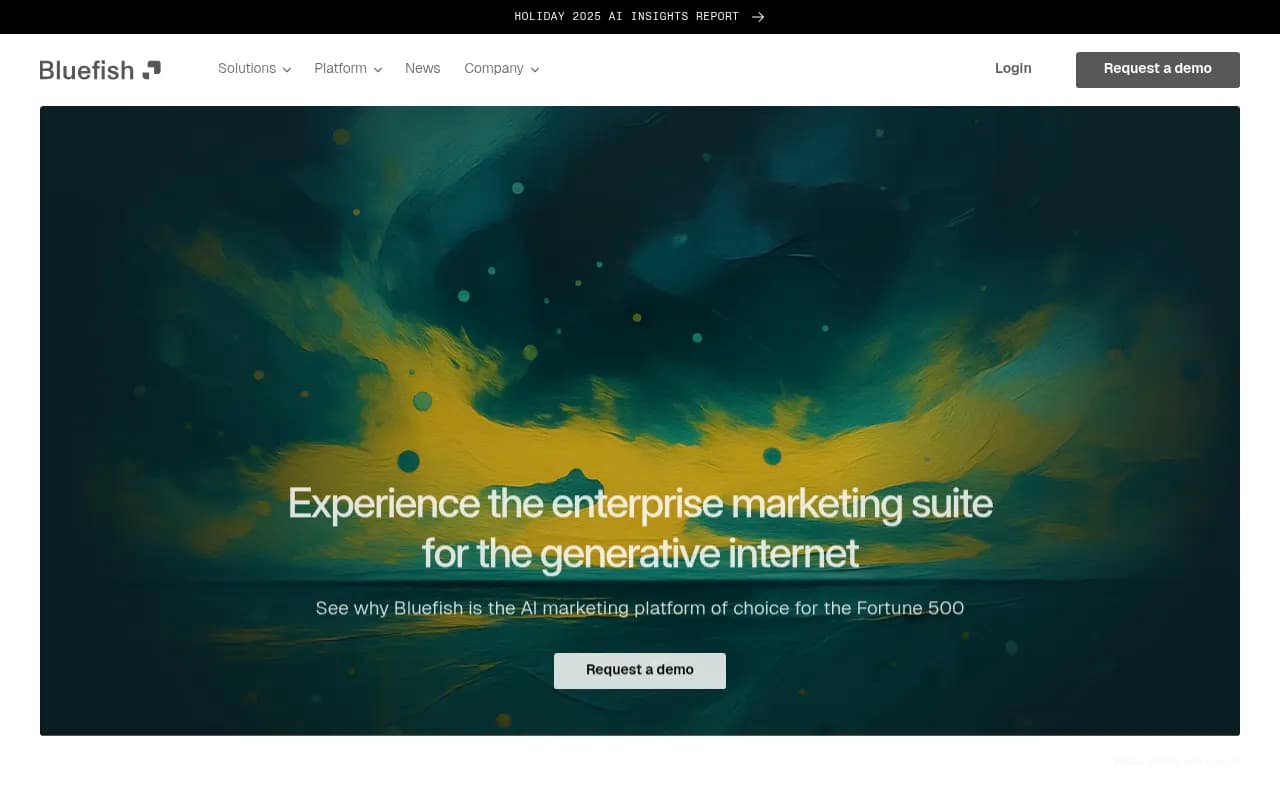
Bluefish AI positions itself as the AI marketing platform for the Fortune 500. The pitch is authority and control: not just tracking where your brand shows up in AI responses, but understanding the mechanics behind those recommendations and influencing them at scale. It covers AI monitoring, GEO optimization, and what it calls "AI commerce" -- tracking how brands appear in agentic shopping experiences. The platform passes enterprise infosec reviews and offers deep data segmentation for large marketing and data teams. There's no self-serve signup; everything goes through a sales demo.
Sight AI
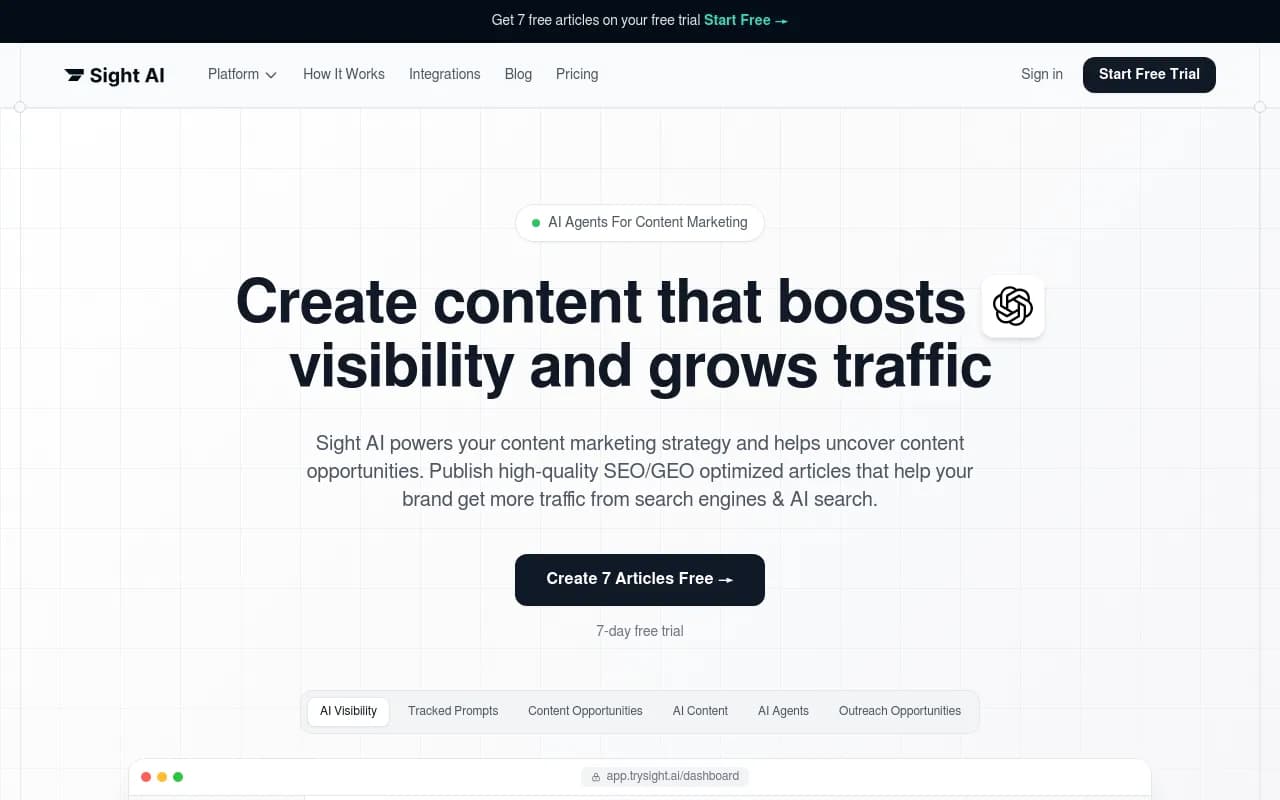
Sight AI takes a more accessible, full-funnel approach. It tracks your brand across ChatGPT, Claude, Gemini, Perplexity, and Grok, then immediately connects that data to content action: a built-in AI writing suite with 13+ specialized agents generates SEO/GEO-optimized articles based on the gaps it finds. It also handles automated indexing, pushing new content to Google and Bing via IndexNow. The whole loop -- track, identify gaps, generate content, index -- runs inside one platform. Pricing is transparent and starts at $49/month with a 7-day free trial.
Side-by-side comparison
| Feature | Bluefish AI | Sight AI |
|---|---|---|
| Target audience | Fortune 500 / enterprise | SMBs, agencies, growing teams |
| Pricing model | Quote-based (~$4,000+/mo) | Tiered: $49 / $99 / $199 / custom |
| Free trial | No (demo only) | Yes (7 days, 7 free articles) |
| AI models tracked | ChatGPT, Claude, Gemini, Perplexity, Grok + more | ChatGPT, Claude, Gemini, Perplexity, Grok |
| Content generation | No | Yes (13+ AI agents, SEO/GEO articles) |
| Automated website indexing | No | Yes (Google, Bing, IndexNow) |
| Competitor tracking | Yes | Yes |
| Agentic commerce tracking | Yes | Not mentioned |
| Custom audience segmentation | Yes (enterprise) | Limited |
| Infosec / enterprise compliance | Yes (passes reviews) | Not specified |
| API / data export | Yes (enterprise) | Not specified |
| Onboarding | Sales-led demo | Self-serve |
| Content gap analysis | Yes | Yes |
| Campaign ROI measurement (AI channel) | Yes (Collections feature) | Not mentioned |
Head-to-head feature deep-dive
AI monitoring and brand tracking
Both platforms scan major AI models for brand mentions and visibility. Bluefish goes further on the diagnostic side -- it claims to help marketers understand "how AI thinks," which means analyzing the underlying signals that drive recommendations, not just counting mentions. Its "Collections" feature (launched February 2026) lets enterprise teams measure the ROI of specific marketing campaigns in the AI channel, which is genuinely useful for large brands running Super Bowl-level spend.
Sight AI's monitoring is solid for its price point. You get a clean dashboard showing brand mentions across ChatGPT, Claude, Perplexity, Gemini, and Grok, with trend lines and an overall AI Visibility Score. It's not as deep as Bluefish on the diagnostic side, but for most teams, the data is actionable enough.
Verdict: Bluefish wins on depth and diagnostics. Sight AI wins on accessibility and price-to-value.
Content generation
This is where the two platforms diverge most sharply. Sight AI has a full content production system built in. The 13+ AI agents handle research, outlining, writing, and optimization -- producing explainer articles (2,500+ words) and listicles (4,500+ words) based on real visibility gaps. The Starter plan at $99/month includes 50 articles per month, which is a meaningful content volume for a growing team.
Bluefish AI doesn't offer content generation. Its optimization tools are more about workflow automation and measurement frameworks than producing new content. For enterprise teams with in-house content operations, that's fine. For smaller teams that need to actually create the content that will improve their AI visibility, it's a real gap.
Verdict: Sight AI wins, and it's not close. Content generation is a core feature of Sight AI and absent from Bluefish.
Pricing
| Plan | Bluefish AI | Sight AI |
|---|---|---|
| Free / trial | No | 7-day trial + 7 free articles |
| Entry-level | ~$4,000+/mo (estimated) | $49/mo (Lite, 25 prompts) |
| Mid-tier | Custom | $99/mo (Starter, 50 prompts, 50 articles) |
| Growth | Custom | $199/mo (Pro) |
| Enterprise | Custom | Custom (Advanced) |
The pricing gap is stark. Bluefish AI is simply not an option for most companies. Even a well-funded startup or a mid-market brand would struggle to justify $4,000+/month for a monitoring and optimization platform when alternatives exist at a fraction of the cost. Bluefish's pricing makes sense if you're a Fortune 500 brand spending millions on AI-channel marketing and need enterprise-grade controls. Otherwise, it's hard to rationalize.
Sight AI's $99/month Starter plan is particularly strong value -- 50 tracked prompts and 50 AI-generated articles per month covers a lot of ground for a small team.
Verdict: Sight AI wins decisively on pricing for any non-enterprise buyer.
Enterprise features and compliance
Bluefish AI is built for organizations with strict security requirements. It consistently passes infosec reviews, supports custom data segmentation, and gives data teams more ways to slice and analyze performance than competitors. If your procurement process involves a security review, legal sign-off, and a multi-month vendor evaluation, Bluefish is designed for that world.
Sight AI doesn't make specific claims about enterprise compliance or security certifications. It's a self-serve SaaS product, which is great for speed but may not clear the bar for large enterprises with strict vendor requirements.
Verdict: Bluefish AI wins for enterprise compliance. Sight AI wins for teams that just want to get started.
Automated indexing
Sight AI includes a feature that Bluefish doesn't seem to offer at all: automated submission of new content to Google and Bing via IndexNow. When you publish an article through Sight AI, it gets pushed to search engines immediately rather than waiting for organic crawling. For teams trying to move fast on content, this is a practical time-saver.
Verdict: Sight AI wins. Bluefish doesn't appear to offer this.
Agentic commerce and AI shopping
Bluefish AI tracks how brands appear in agentic commerce experiences -- the AI-powered shopping flows where models recommend products directly. This is an emerging channel that most GEO platforms haven't fully addressed yet. If your brand sells products and you're worried about how ChatGPT or Gemini recommends (or doesn't recommend) you in shopping contexts, Bluefish has specific tooling for this.
Sight AI doesn't mention agentic commerce tracking. Its focus is on content visibility and organic traffic.
Verdict: Bluefish AI wins for brands with e-commerce or product recommendation use cases.
User experience and onboarding
Sight AI is self-serve. You sign up, start a free trial, and can be tracking prompts and generating content within minutes. The dashboard is clean and the workflow is intuitive: track visibility, find gaps, generate content, index it.
Bluefish AI requires a sales demo to even see the product. That's appropriate for enterprise software, but it means there's no way to evaluate it without committing to a conversation with a sales team. The platform is described as having advanced customization and segmentation, which implies a steeper learning curve.
Verdict: Sight AI wins for speed to value. Bluefish AI is appropriate for teams with dedicated onboarding resources.
Pros and cons
Bluefish AI
Pros:
- Deep diagnostic capabilities -- goes beyond tracking to explain why AI models recommend what they do
- Built for enterprise infosec and compliance requirements
- Agentic commerce tracking for product-focused brands
- Campaign ROI measurement in the AI channel (Collections feature)
- Custom audience segmentation and advanced data controls
Cons:
- No public pricing -- requires a sales conversation
- Estimated $4,000+/month puts it out of reach for most teams
- No built-in content generation
- No self-serve trial or free tier
- No automated website indexing
Sight AI
Pros:
- Transparent, affordable pricing starting at $49/month
- 7-day free trial with 7 free articles -- genuinely low barrier to entry
- Built-in AI content writer with 13+ specialized agents
- Automated indexing via Google, Bing, and IndexNow
- Full loop: track, identify gaps, generate content, publish
- Self-serve onboarding -- no sales call required
Cons:
- Less diagnostic depth than Bluefish on "how AI thinks"
- No agentic commerce tracking
- No enterprise compliance certifications mentioned
- Prompt limits at lower tiers (25 prompts on Lite) may feel restrictive
- Newer platform with less enterprise track record
Who should pick which tool
Pick Bluefish AI if:
- You're at a Fortune 500 or large enterprise brand with a dedicated AI marketing team
- Your procurement process requires infosec reviews and enterprise-grade compliance
- You need to track how your brand appears in agentic commerce and AI shopping flows
- You want to measure the AI-channel ROI of specific marketing campaigns
- Budget is not a constraint and you need the deepest possible diagnostic tooling
Pick Sight AI if:
- You're an SMB, agency, or growing brand that needs to start tracking AI visibility now
- You want content generation built into the same platform as your tracking
- Budget matters and you need transparent, predictable pricing
- You want to get started without a sales conversation
- Automated indexing and faster content-to-search-engine pipelines are valuable to you
If you're also thinking about how your brand shows up across a wider range of AI models -- including DeepSeek, Mistral, Meta AI, and Google AI Overviews -- Promptwatch is worth a look. It covers 10+ AI models, includes crawler log analysis, and has a content gap and generation workflow similar to Sight AI's but with more depth on the citation and prompt intelligence side.

Final verdict
These two tools are aimed at completely different buyers. Bluefish AI is a serious enterprise platform with the depth and compliance credentials to match. If you're a Fortune 500 brand and need to understand AI recommendations at a granular level, it's a credible choice -- but you'll pay for it.
For everyone else, Sight AI is the more practical option. The combination of AI visibility tracking, content generation, and automated indexing in one affordable package is hard to argue with. The $99/month Starter plan in particular offers real value: 50 tracked prompts and 50 AI-generated articles per month is enough to run a meaningful GEO content program. Start there, and upgrade when you outgrow it.