Key takeaways
- Bluefish AI and Search Party are not really competing products. One is a GEO/AI visibility SaaS platform; the other is an AI implementation consultancy. You'd rarely be choosing between them for the same problem.
- Bluefish AI is built for enterprise marketing teams that want to monitor and improve how their brand appears in AI search engines like ChatGPT, Perplexity, and Gemini. Search Party is for operations and engineering leaders who want to eliminate internal workflow bottlenecks using custom-built AI agents.
- Both are expensive and require direct engagement -- no self-serve, no transparent pricing. Bluefish AI is estimated at $4,000+/month; Search Party engagements likely run $100K-$500K+ depending on scope.
- If your question is "how does our brand show up when someone asks ChatGPT about our category?", Bluefish AI answers that. Search Party doesn't touch that problem at all.
- If your question is "how do we stop our sales team from spending 40% of their time on manual data entry?", Search Party is the right conversation. Bluefish AI won't help.
- The only scenario where you'd genuinely compare these two is if you're a large enterprise with budget for both and you're trying to prioritize which AI investment to make first.
Overview
Bluefish AI
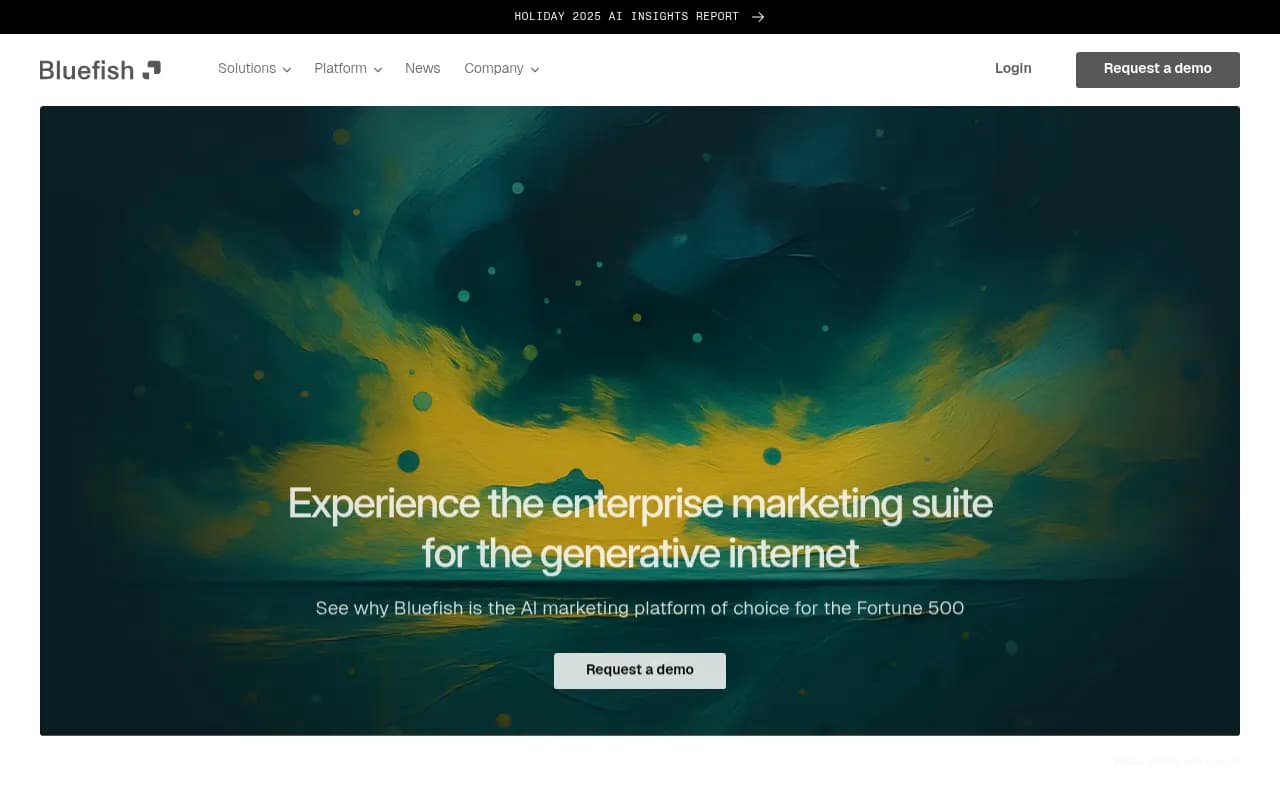
Bluefish AI entered the GEO market in 2024 with a clear target: Fortune 500 marketing teams that need more than a basic monitoring dashboard. The pitch is "authority, influence, and control in the age of AI" -- which sounds like marketing copy until you dig into what it actually means. Bluefish goes beyond share-of-voice metrics to help brands understand how AI models "think" about their category, which is a genuinely different angle from most monitoring tools. Features include AI monitoring across major models, GEO optimization workflows, and what they call "AI Commerce" tracking. It's enterprise-only, passes infosec reviews, and integrates with data teams that need custom segmentation. No pricing on the website -- you're booking a demo.
Search Party
Search Party
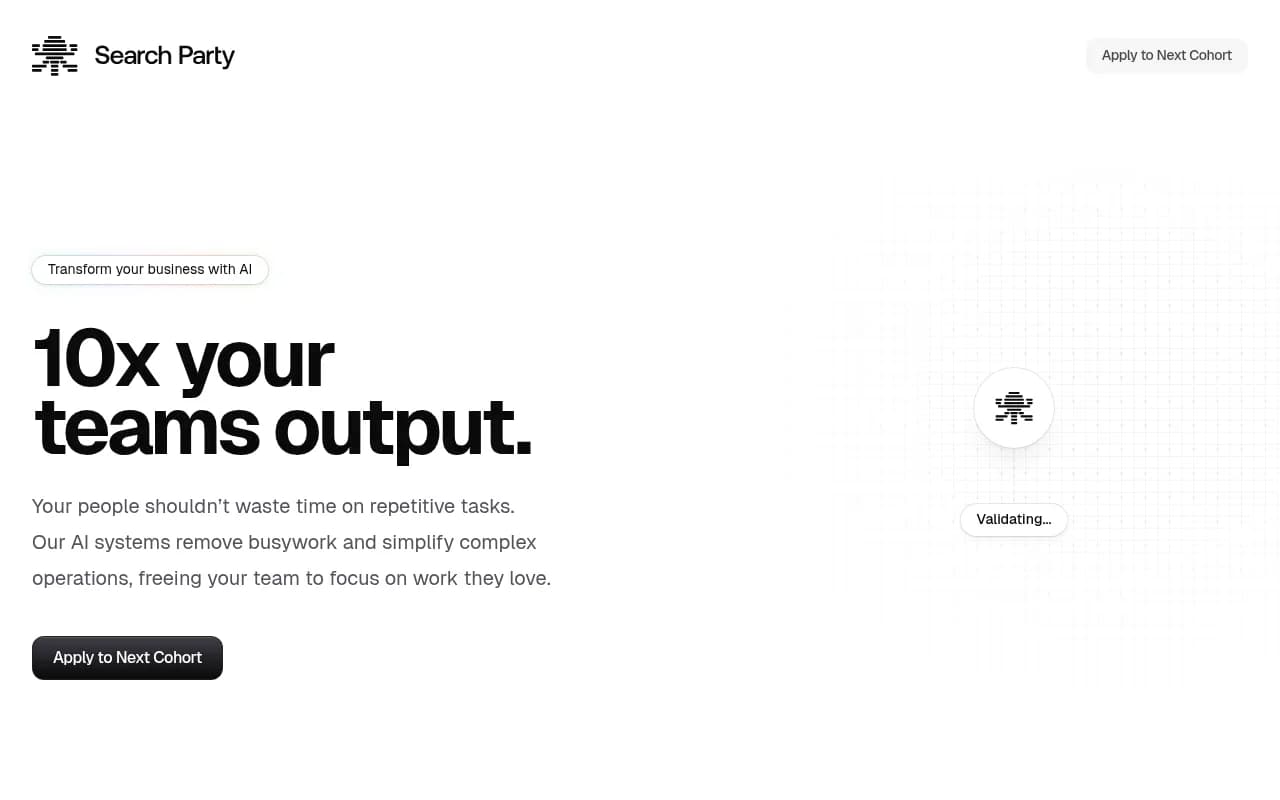
Search Party is not a SaaS tool. It's closer to a specialized consultancy that embeds engineering talent into your business to build custom AI automation systems. Their DOE Framework (Directives, Orchestration, Execution) is the methodology they use to diagnose workflow problems and deploy production-grade agentic systems. The process starts with a 90-minute validation session, moves into "Bottleneck Mining" (interviewing your team to find where time is being wasted), and ends with deployed systems across sales, marketing, operations, or R&D. They operate in cohorts, meaning you apply and get accepted rather than just signing up. The value proposition is measurable ROI from eliminating repetitive work -- not visibility metrics.
Side-by-side comparison
| Feature | Bluefish AI | Search Party |
|---|---|---|
| Product type | SaaS platform | Consultancy / implementation partner |
| Primary use case | AI search visibility & GEO | Internal workflow automation |
| Target buyer | Enterprise marketing teams | Operations, engineering, C-suite |
| AI models monitored | ChatGPT, Perplexity, Gemini, others | Not applicable |
| Content optimization | Yes (GEO workflows) | Not applicable |
| Custom automation | No | Yes (core offering) |
| Self-serve access | No | No |
| Pricing model | Subscription (quote-based) | Project/cohort engagement |
| Estimated cost | $4,000+/month | $100K-$500K+ per engagement |
| Free trial | No | No |
| Onboarding | Demo-led | 90-min validation session |
| Ongoing relationship | Platform subscription | Embedded team during engagement |
| Infosec/compliance | Enterprise-grade (passes reviews) | Custom (depends on engagement) |
| Measurable output | Visibility scores, share-of-voice | Time saved, ROI from automation |
Head-to-head feature deep-dive
What problem each tool actually solves
This is the most important section, because the tools don't overlap.
Bluefish AI solves an external visibility problem: your brand exists, people are asking AI models about your category, and you want to know whether those models are recommending you, ignoring you, or saying something wrong about you. The platform tracks this, helps you understand why it's happening, and gives you tools to influence the outcome.
Search Party solves an internal efficiency problem: your team is spending too much time on tasks that could be automated, and you don't have the in-house engineering capacity to build the right systems. They come in, find the bottlenecks, and build the automation for you.
These are genuinely different problems. A CMO worried about AI search visibility would call Bluefish. A COO worried about operational overhead would call Search Party.
Verdict: Not comparable on this dimension. Pick based on which problem you actually have.
Monitoring and analytics
Bluefish AI has a real monitoring product. It tracks brand mentions and recommendations across AI-native experiences, measures share-of-voice, and provides what they describe as "in-depth visibility and influence across major AI channels." Their "Collections" feature (launched February 2026) is specifically designed to measure the ROI of digital marketing campaigns in the AI channel -- meaning you can see whether a Super Bowl ad actually moved the needle on how AI models talk about your brand. That's a specific and interesting capability.
Search Party has no monitoring product. They don't track anything on an ongoing basis post-engagement. Once the automation system is built and deployed, the ongoing measurement is yours to handle.
Verdict: Bluefish AI wins by default. Search Party doesn't play in this space.
Implementation and customization
Search Party's entire model is custom implementation. They interview your employees, analyze your margins, map your workflows, and build systems tailored to your specific situation. The DOE Framework is their methodology for making sure the output is production-grade rather than a "toy pilot" (their words). This is a high-touch, high-investment process that results in something built specifically for your business.
Bluefish AI offers customization within a platform context -- custom audiences, tailored prompts, custom segmentation for data teams. It's more flexible than most GEO tools, but it's still a platform with defined parameters. You're configuring it, not building something from scratch.
Verdict: Search Party wins on depth of customization, but that's because they're building bespoke systems. Bluefish AI wins on speed to value for its specific use case.
Pricing and accessibility
Neither tool is accessible to most companies. Both require direct engagement, neither publishes pricing, and both are clearly positioned for organizations with significant budgets.
| Tier | Bluefish AI | Search Party |
|---|---|---|
| Entry point | ~$4,000/month (estimated) | ~$100K+ per engagement |
| Mid-range | Custom enterprise | ~$200K-$300K |
| Large enterprise | Custom | $500K+ |
| Self-serve option | No | No |
| Free trial | No | No |
| Annual commitment | Likely required | Project-based |
Bluefish AI is a recurring subscription, so the cost compounds over time. Search Party is a project engagement, so the cost is front-loaded but presumably doesn't recur at the same level once systems are built.
Verdict: Bluefish AI is more predictable in cost structure. Search Party is a larger upfront investment but potentially a one-time (or infrequent) expense.
Enterprise readiness
Bluefish AI explicitly calls out enterprise infosec compliance -- they say they "consistently pass infosec reviews with ease," which matters a lot for Fortune 500 procurement processes. Data teams get custom segmentation and optimization options that smaller platforms don't offer.
Search Party's enterprise readiness depends on the engagement. As a consultancy, their security posture is largely about the systems they build and the data they access during the engagement. There's no public information about certifications or compliance frameworks.
Verdict: Bluefish AI has a clearer enterprise compliance story. Search Party's readiness is engagement-specific.
Ongoing value and relationship
Bluefish AI is a subscription platform. You pay monthly, you get ongoing monitoring, and the value compounds as you accumulate data about your AI visibility over time. The relationship is platform-based.
Search Party is engagement-based. The relationship is intense during the project and presumably lighter afterward. The value is in the systems they leave behind -- if those systems work well, the ROI compounds. If they need maintenance or iteration, you're either re-engaging or handling it internally.
Verdict: Different models entirely. Bluefish AI suits teams that need continuous monitoring. Search Party suits teams that need a one-time (or periodic) transformation.
Pricing comparison
| Plan | Bluefish AI | Search Party |
|---|---|---|
| Entry | ~$4,000/month (estimated) | ~$100K+ engagement |
| Enterprise | Custom quote | Custom quote |
| Self-serve | Not available | Not available |
| Free trial | Not available | Not available |
| Pricing transparency | None (demo required) | None (application required) |
Worth noting: if you're evaluating GEO platforms at a lower price point, Promptwatch starts at $99/month and covers AI visibility monitoring, content gap analysis, and AI-powered content generation across 10+ AI models -- a meaningful difference in accessibility compared to Bluefish AI's enterprise-only positioning.

Pros and cons
Bluefish AI
Pros:
- Purpose-built for AI search visibility -- one of the few platforms that goes beyond basic monitoring to influence
- Enterprise-grade compliance and infosec posture
- "Collections" feature ties AI visibility to marketing campaign ROI, which is genuinely useful
- Custom audiences and tailored prompts give more control than generic GEO tools
- Tracks AI commerce and agentic shopping, not just text responses
Cons:
- No public pricing -- you're committing to a demo before knowing if it's in budget
- Estimated $4,000+/month puts it out of reach for most companies
- No self-serve or trial option -- high friction to evaluate
- Limited public information about which specific AI models are monitored
- Relatively new (2024) -- less track record than established SEO platforms
Search Party
Pros:
- Builds genuinely custom systems rather than configuring off-the-shelf software
- DOE Framework provides a structured methodology for complex implementations
- 90-minute validation session upfront means you know quickly whether there's ROI potential
- Addresses operational problems that no SaaS tool can solve out of the box
- Cohort model means focused attention rather than being one of thousands of customers
Cons:
- Not a product -- no ongoing platform, no dashboard, no self-serve anything
- Extremely high cost of entry ($100K+ estimated)
- No public pricing, no case studies with named clients or specific numbers
- Application/cohort model means you might not get accepted or have to wait
- Post-engagement support and maintenance is unclear
- Solves a completely different problem than most "AI tool" buyers are looking for
Who should pick which tool
Choose Bluefish AI if:
- You're a Fortune 500 or large enterprise marketing team
- Your primary concern is how your brand appears in AI-generated search results
- You need to pass enterprise infosec reviews before adopting any new platform
- You want to measure whether your marketing campaigns are influencing AI recommendations
- You have budget for $4,000+/month and need a dedicated GEO platform
Choose Search Party if:
- You're a COO, CTO, or operations leader -- not a marketing team
- Your team is visibly losing time to repetitive, automatable tasks
- You've already tried off-the-shelf AI tools and they haven't moved the needle
- You have budget for a six-figure engagement and want custom-built systems
- You want an embedded engineering team, not a software subscription
Consider neither if:
- You're a mid-sized company or startup -- both tools are priced for large organizations
- You want self-serve access, a free trial, or transparent pricing
- You need AI search visibility monitoring at a reasonable price point (look at platforms with accessible pricing tiers instead)
- You want a tool that does both external visibility and internal automation (no single tool does this well)
Final verdict
Bluefish AI and Search Party are solving different problems for different buyers, so the "vs" framing is a bit forced. If you're a marketing leader asking "how do we show up better in AI search?", Bluefish AI is the relevant conversation. If you're an operations leader asking "how do we stop drowning in manual work?", Search Party is the relevant conversation.
The honest answer is: most companies evaluating "AI tools" in 2026 are looking for something in between -- a platform that's accessible, actionable, and doesn't require a six-figure commitment before you see any value. Neither Bluefish AI nor Search Party fits that description.