Key takeaways
- Bluefish AI and Rankability are solving different problems. Bluefish is about enterprise brand governance in AI channels; Rankability is about running a repeatable SEO and AEO content workflow for agencies.
- Bluefish AI costs an estimated $4,000+/month (quote-based). Rankability is estimated at $99-$500/month. That's not a small gap -- it's a completely different buyer.
- Rankability has a built-in content production pipeline (research, brief, draft, optimize). Bluefish AI has no equivalent -- it's monitoring and influence, not content creation.
- Bluefish AI goes deeper on AI channel monitoring, including agentic commerce tracking and brand sentiment analysis across AI models. Rankability's AI tracking is solid but secondary to its SEO workflow.
- If you're an SEO agency managing multiple clients, Rankability was built for you. If you're a Fortune 500 brand trying to control how AI "thinks" about your company, Bluefish AI is the play.
- Neither tool is a direct replacement for the other -- they serve genuinely different audiences with different budgets and goals.
Overview
Bluefish AI
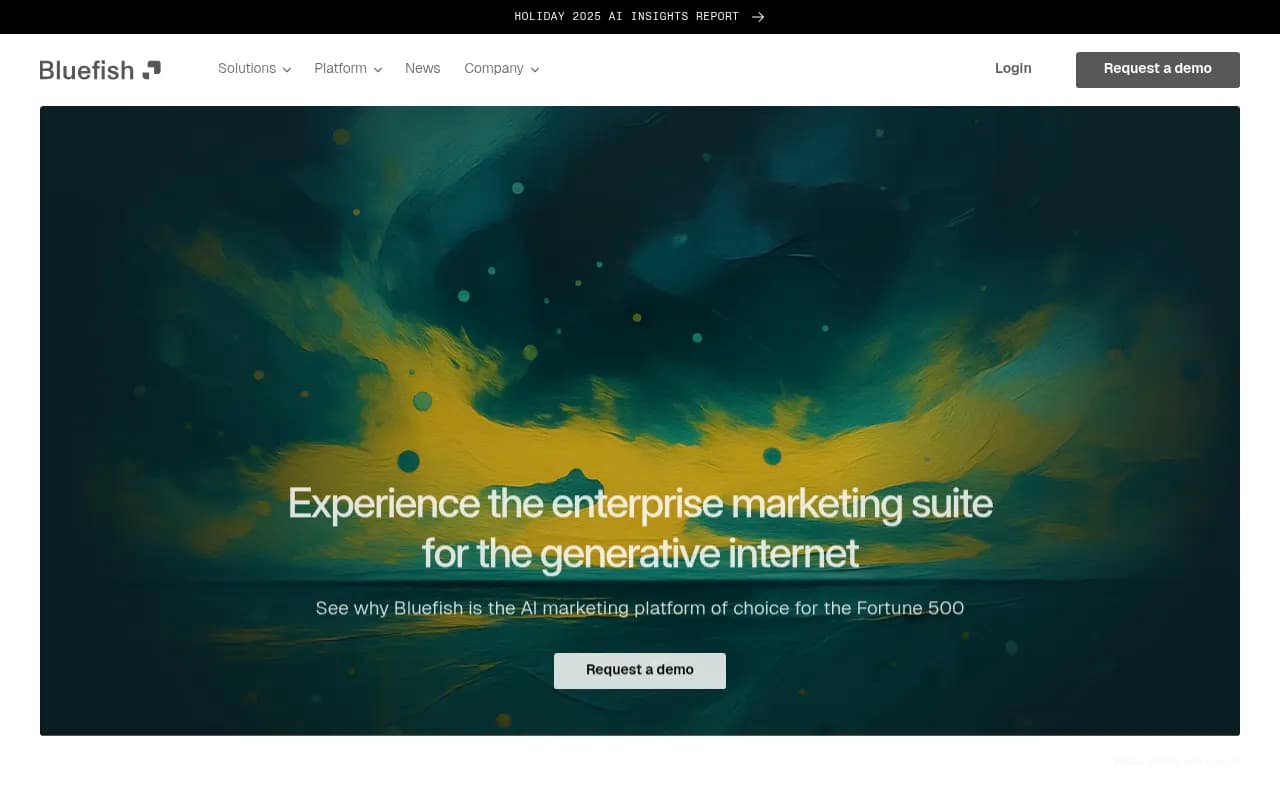
Bluefish AI positions itself as the enterprise AI marketing platform for Fortune 500 brands. The pitch is less about SEO mechanics and more about brand authority and influence in the generative internet. Their core claim -- that they help marketers understand how AI "thinks" about their brand -- is a meaningful differentiator from tools that just count mentions. Features include AI monitoring, GEO optimization, AI commerce tracking, and what they call "Collections" for measuring campaign ROI in the AI channel. It's a serious enterprise product with a serious enterprise price tag.
Rankability
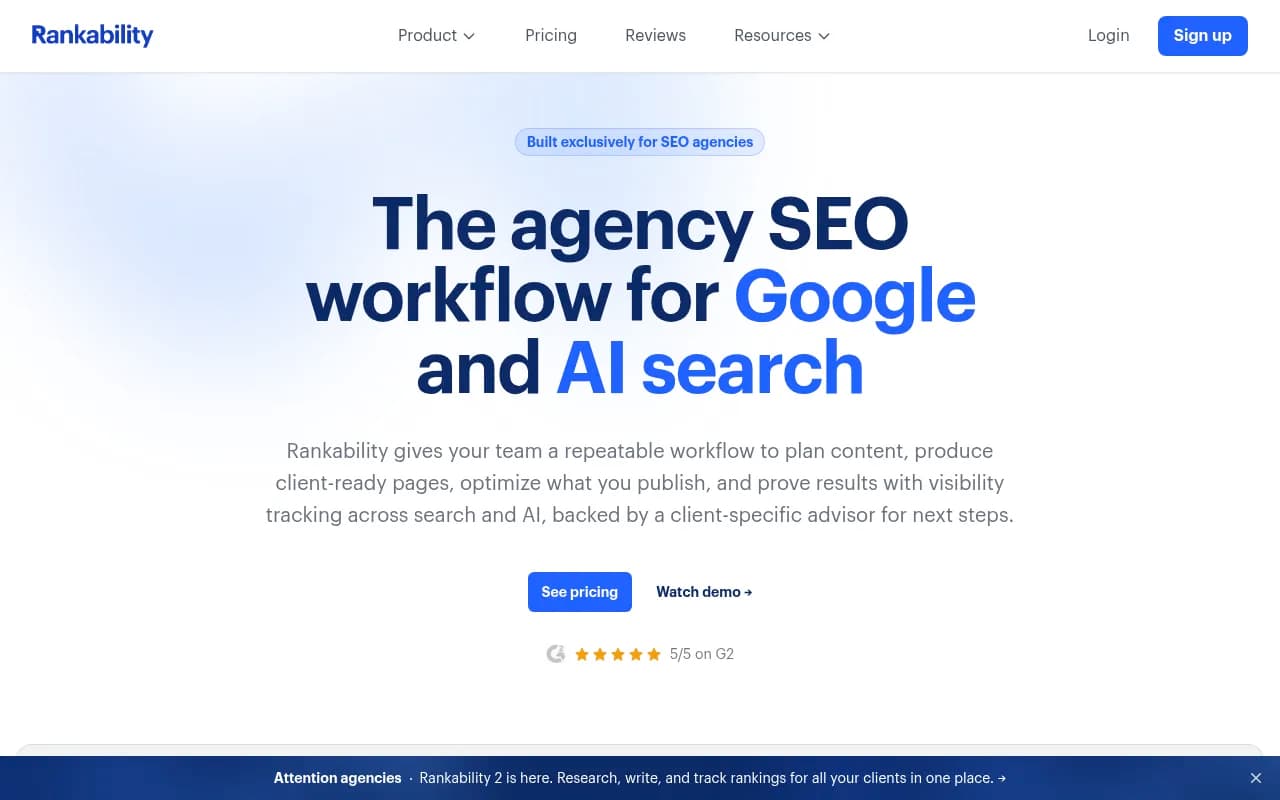
Rankability is an SEO and AEO (Answer Engine Optimization) platform built specifically for agencies. The workflow is the product: research opportunities, produce content with AI assistance, optimize pages, and track rankings across both Google and AI platforms. They launched Rankability 2 in 2026 with a stronger focus on multi-client management and a client-specific advisor feature. With a 5/5 rating on G2 and a growing list of agency clients, it's clearly found product-market fit in the agency space.
Side-by-side comparison
| Feature | Bluefish AI | Rankability |
|---|---|---|
| Primary audience | Fortune 500 enterprise brands | SEO/content agencies |
| Pricing model | Quote-based (~$4,000+/mo) | Subscription (~$99-$500/mo) |
| Free tier | No | No |
| AI search monitoring | Yes, deep (multi-model) | Yes, moderate |
| Traditional SEO tracking | Limited | Yes (Google rankings) |
| Content research | No | Yes (Researcher module) |
| Content writing/drafting | No | Yes (Copywriter module) |
| Content optimization | No | Yes (Optimizer module) |
| AI commerce tracking | Yes (agentic commerce) | No |
| Multi-client management | Not designed for it | Yes, core feature |
| Brand sentiment analysis | Yes | Limited |
| Infosec/enterprise compliance | Yes, passes enterprise reviews | Not highlighted |
| API access | Enterprise custom | Not publicly confirmed |
| G2 rating | Not listed | 5/5 |
Head-to-head feature deep-dive
Target audience and use case fit
This is the most important thing to get right before comparing anything else. Bluefish AI and Rankability are not competing for the same customer.
Bluefish AI is built for in-house enterprise marketing teams at large brands. The language on their site -- Fortune 500, infosec reviews, custom audiences, category leaders -- makes clear they're selling to companies with dedicated AI marketing budgets and legal/security requirements. You're not going to spin up a Bluefish account to manage a client's blog.
Rankability is built for agencies. The entire product is structured around a repeatable client workflow: research, produce, optimize, report. Multi-client management is a core feature, not an afterthought. The agency testimonials and G2 reviews back this up.
Verdict: If you're an agency, Rankability. If you're an enterprise brand, Bluefish AI. There's almost no overlap in the right buyer.
AI search monitoring
Both tools track brand visibility in AI search, but they approach it differently.
Bluefish AI goes deep on the monitoring side. They track across major AI models, analyze brand sentiment, and claim to help marketers understand how AI "thinks" -- meaning not just whether you appear, but how you're characterized. Their Collections feature lets you measure the impact of specific marketing campaigns (including offline ones like Super Bowl ads) on AI recommendations. That's genuinely interesting and not something most tools do.
Rankability's AI tracking is built into its Reporter module, which shows AI mentions and citations alongside traditional search performance. It's a unified view of your Search Performance Index across Google and AI channels. Useful, but it's more of a dashboard than a deep-dive analysis tool.
| Capability | Bluefish AI | Rankability |
|---|---|---|
| AI mention tracking | Yes | Yes |
| Brand sentiment in AI | Yes | Limited |
| Campaign impact on AI | Yes (Collections) | No |
| Agentic commerce tracking | Yes | No |
| AI citation analysis | Yes | Basic |
| Multi-model coverage | Yes | Yes (partial) |
Verdict: Bluefish AI wins on AI monitoring depth, especially for brands that care about how they're characterized, not just whether they appear.
Content production workflow
This is where Rankability has a clear advantage -- and where Bluefish AI simply doesn't compete.
Rankability's workflow covers the full content lifecycle:
- Researcher: keyword discovery, topic clustering, YouTube/Reddit/Google signal aggregation
- Copywriter: AI-assisted briefs and drafts grounded in a client Knowledge Base
- Optimizer: score content against real competitors, close coverage gaps
- Reporter: track rankings and AI visibility post-publish
Bluefish AI has no content production tools. It's a monitoring and influence platform. If you need to actually create content that ranks in AI search, you're using Bluefish alongside other tools.
Verdict: Rankability wins decisively. It's a content production platform with AI tracking built in. Bluefish AI doesn't play in this space.
Enterprise features and security
Bluefish AI is built for enterprise procurement processes. They specifically call out passing infosec reviews, custom data segmentation, and tailored measurement frameworks. For a Fortune 500 brand running content through legal and security review, this matters a lot.
Rankability doesn't highlight enterprise security features. It's designed for agency teams, not corporate procurement. That's not a knock -- it's just a different product.
Verdict: Bluefish AI wins for enterprise compliance requirements. Rankability isn't trying to compete here.
Pricing and accessibility
| Plan | Bluefish AI | Rankability |
|---|---|---|
| Entry-level | ~$4,000+/mo (estimated) | ~$99/mo (estimated) |
| Mid-tier | Custom quote | ~$200-$300/mo (estimated) |
| Agency/team | Custom quote | ~$400-$500/mo (estimated) |
| Enterprise | Custom quote | Custom (not confirmed) |
| Free trial | No (demo only) | Not publicly confirmed |
The pricing gap here is enormous. Bluefish AI is not a tool you evaluate on a credit card. It requires a sales conversation, a demo, and likely a procurement process. Rankability is something an agency can sign up for and start using this week.
Verdict: Rankability wins on accessibility and price. Bluefish AI is only realistic for large enterprise budgets.
Reporting and analytics
Bluefish AI's reporting is built around enterprise KPIs -- share of voice, brand sentiment, AI channel performance, campaign attribution. Their Collections feature is particularly interesting for connecting traditional marketing spend to AI visibility outcomes.
Rankability's Reporter gives a unified Search Performance Index that combines traditional search rankings, AI mentions, and AI citations. It's designed to be client-ready -- something you can put in front of a client without a lot of explanation.
Verdict: Depends on what you need. Bluefish AI for deep brand analytics; Rankability for clean, client-facing reporting.
Pricing comparison
| Plan | Bluefish AI | Rankability |
|---|---|---|
| Starter | Not available | ~$99/mo |
| Professional | Not available | ~$200-$300/mo |
| Agency | Custom quote | ~$400-$500/mo |
| Enterprise | ~$4,000+/mo (estimated) | Custom |
| Free tier | No | No |
| Billing | Annual contract (likely) | Monthly/annual |
Bluefish AI does not publish pricing. The $4,000+/month figure is an estimate based on third-party research and the enterprise positioning. Expect a multi-month contract and a formal sales process.
Rankability's pricing is also not fully public, but the estimated range puts it in reach for most agencies. Worth noting that if you're tracking AI visibility across multiple clients and want a full content workflow, Promptwatch is another option worth evaluating -- it covers AI monitoring, content gap analysis, and content generation in one platform with transparent pricing starting at $99/month.

Pros and cons
Bluefish AI
Pros:
- Deep AI monitoring with brand sentiment and influence analysis
- Agentic commerce tracking -- a genuinely rare feature
- Collections feature connects marketing campaigns to AI visibility outcomes
- Built for enterprise security and compliance requirements
- Custom audience and prompt segmentation
Cons:
- No content production tools whatsoever
- Pricing is inaccessible for most teams ($4,000+/mo estimated)
- No self-serve -- requires a sales process
- Not designed for agencies or multi-client workflows
- Limited transparency on pricing and feature details
Rankability
Pros:
- Full content workflow from research to publish to track
- Built specifically for agencies with multi-client management
- Combines traditional SEO and AI search tracking in one platform
- AI-assisted content drafting and optimization
- 5/5 on G2 with strong agency testimonials
- Much more accessible pricing
Cons:
- AI monitoring is less deep than Bluefish AI
- No agentic commerce or campaign attribution features
- Not designed for enterprise brand governance
- Pricing not fully transparent
- Less suited for large in-house brand teams
Who should pick which tool
Pick Bluefish AI if:
- You're at a Fortune 500 brand or large enterprise with a dedicated AI marketing budget
- You need to understand how AI models characterize your brand, not just whether you appear
- You're running large marketing campaigns and want to measure their impact on AI recommendations
- Enterprise security and compliance requirements are non-negotiable
- You have the budget for a $4,000+/month platform and a formal procurement process
Pick Rankability if:
- You run an SEO or content agency managing multiple client accounts
- You need a repeatable workflow from keyword research to content production to ranking tracking
- You want AI search visibility tracking alongside traditional Google rankings
- Budget matters and you need something you can start using quickly
- Client-ready reporting is a priority
Final verdict
These two tools are not really competing with each other -- they're built for different buyers with different problems. Bluefish AI is a serious enterprise platform for brands that want deep control over their AI presence and have the budget to match. Rankability is a practical agency workflow tool that happens to include AI search tracking alongside solid SEO capabilities.
If you're an agency, Rankability is the obvious choice. If you're an enterprise brand, Bluefish AI is worth the demo. The mistake would be buying Bluefish AI hoping it helps you produce content, or buying Rankability expecting enterprise-grade brand governance. Know what problem you're actually solving before you sign anything.