Key takeaways
- Bluefish AI is enterprise-only with pricing estimated at $4,000+/month and no self-serve signup. Promptmonitor starts at $29/month with a 7-day free trial anyone can access today.
- Bluefish AI is built for Fortune 500 marketing teams that need custom audiences, infosec compliance, and deep workflow automation. Promptmonitor targets SMBs, startups, and solo marketers.
- Promptmonitor covers ChatGPT, Claude, Perplexity, and Gemini out of the box. Bluefish AI's model coverage is broader but only disclosed during a sales conversation.
- Bluefish AI claims to be the only platform that helps marketers understand how AI "thinks" -- going beyond share-of-voice into influence and sentiment mechanics. Promptmonitor stays focused on presence tracking and basic recommendations.
- Neither tool offers the full optimization loop (gap analysis + AI content generation + traffic attribution) that more complete platforms provide -- both are primarily monitoring-first.
- If you're a mid-market or enterprise brand that also wants to track AI search traffic and generate content that ranks in LLMs, it's worth looking at Promptwatch alongside either of these tools.
Overview
Bluefish AI
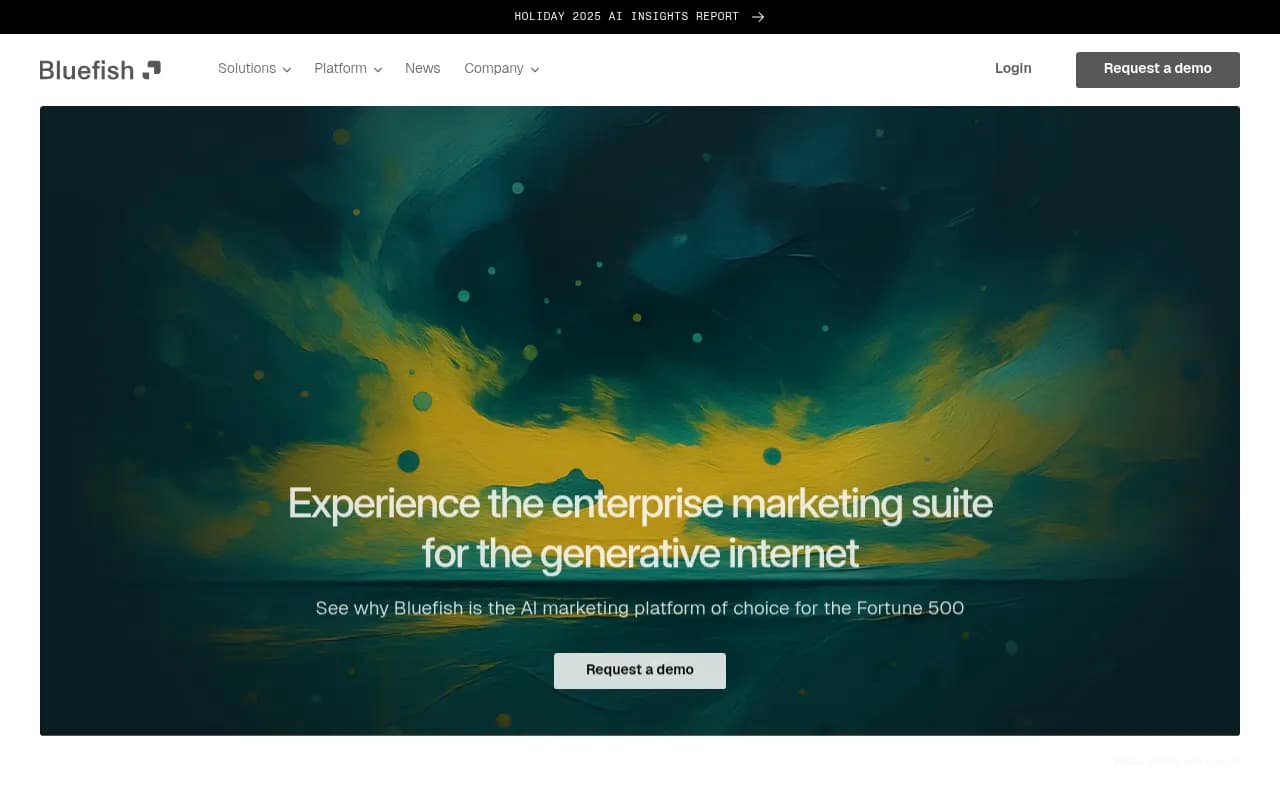
Bluefish AI positions itself as the enterprise GEO platform for Fortune 500 brands. The pitch is authority and control: not just knowing where your brand appears in AI responses, but understanding why, and being able to influence it. Their "Collections" feature (launched February 2026) lets teams measure the ROI of digital marketing campaigns specifically in the AI channel -- a genuinely interesting angle that most competitors haven't tackled yet. The platform passes enterprise infosec reviews, supports custom audience segmentation, and is built for large marketing teams with complex measurement needs.
The catch is obvious: there's no pricing page, no free trial, and no self-serve signup. You're committing to a sales process before you see anything. For a Fortune 500 brand with a dedicated marketing ops team, that's fine. For everyone else, it's a dealbreaker.
Promptmonitor
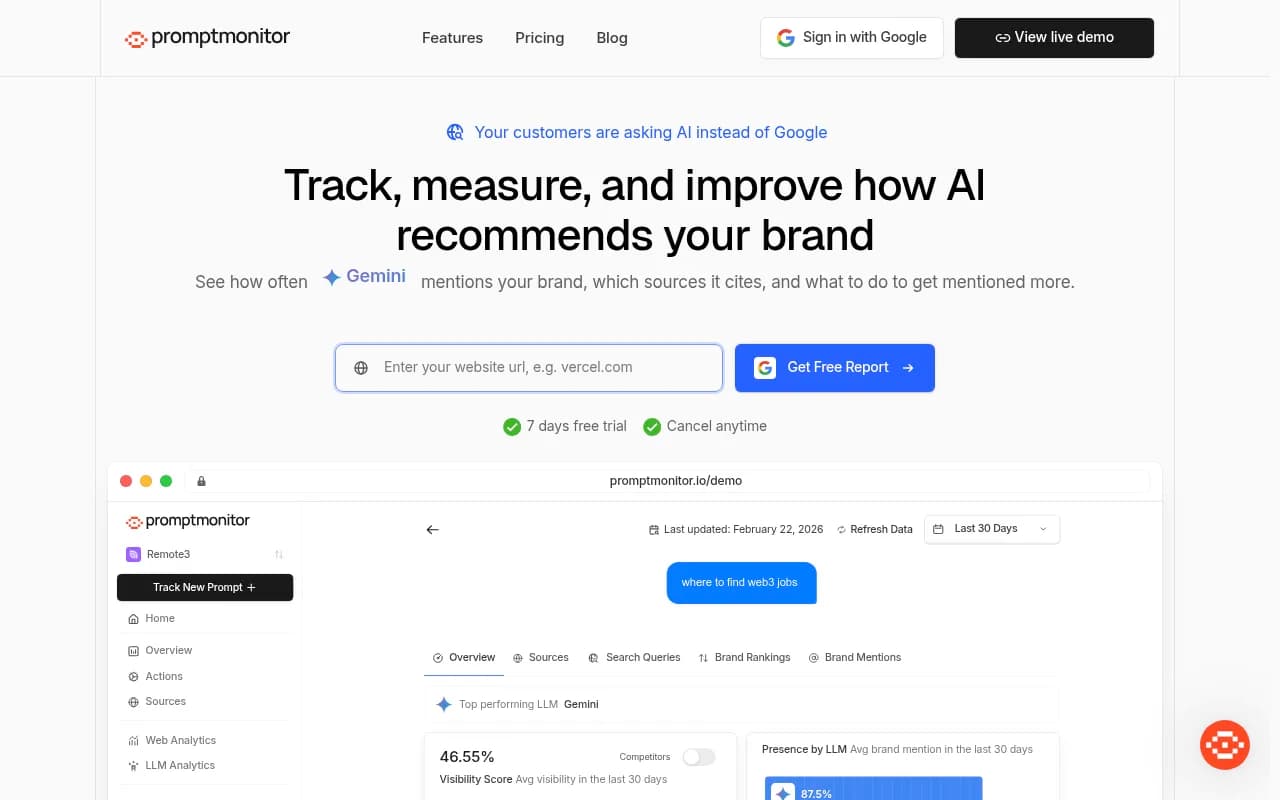
Promptmonitor takes the opposite approach. It's a clean, accessible tool that lets you track your brand's visibility across ChatGPT, Claude, Perplexity, and Gemini with minimal setup. The live demo is publicly accessible on their site, which is a nice touch -- you can see exactly what the product looks like before signing up. Plans start at $29/month, and there's a 7-day free trial with no credit card required.
The product covers the basics well: visibility scores, presence by LLM, source tracking, and an "Actions" tab with optimization recommendations. It also includes web analytics and LLM analytics tabs, suggesting some traffic attribution capability. What it doesn't have is the depth of enterprise features, custom audience targeting, or the kind of influence analysis Bluefish AI claims.
Side-by-side comparison
| Feature | Bluefish AI | Promptmonitor |
|---|---|---|
| Target audience | Fortune 500 / enterprise | SMBs, startups, agencies |
| Pricing model | Quote-based | Freemium / self-serve |
| Starting price | ~$4,000+/month (est.) | $29/month |
| Free trial | No | 7-day free trial |
| Self-serve signup | No (demo required) | Yes |
| AI models monitored | Multiple (undisclosed publicly) | ChatGPT, Claude, Perplexity, Gemini |
| Visibility / share-of-voice tracking | Yes | Yes |
| Source / citation tracking | Yes | Yes |
| Optimization recommendations | Yes (workflow automation) | Yes (Actions tab) |
| AI content generation | Not mentioned | Not mentioned |
| Traffic attribution | Yes (Collections feature) | Yes (Web Analytics tab) |
| Custom audiences / personas | Yes | Limited |
| Infosec / enterprise compliance | Yes | Not mentioned |
| API access | Not publicly disclosed | Not publicly disclosed |
| Agency plan | Not mentioned | Yes (custom pricing) |
| Agentic commerce tracking | Yes | No |
Head-to-head feature deep-dive
Pricing
This is the most important difference between these two tools, and it's not close.
Promptmonitor has transparent, public pricing with three self-serve tiers and a free trial. You can be up and running in minutes without talking to anyone.
| Plan | Promptmonitor | Bluefish AI |
|---|---|---|
| Free / trial | 7-day free trial | None |
| Starter | $29/month | N/A |
| Growth | $39/month | N/A |
| Pro | $129/month | N/A |
| Agency | Custom | N/A |
| Enterprise | N/A | ~$4,000+/month (est.) |
Bluefish AI doesn't publish pricing at all. The estimated $4,000+/month figure comes from third-party research and is consistent with their Fortune 500 positioning. There's no starter tier, no trial, and no way to test the product without going through a sales cycle.
Verdict: Promptmonitor wins on pricing accessibility by a wide margin. Bluefish AI's pricing only makes sense for large enterprise budgets.
AI model coverage
Promptmonitor publicly tracks ChatGPT, Claude, Perplexity, and Gemini. Their live demo shows per-model visibility scores and daily presence data across these four models. That covers the models most brands actually care about right now.
Bluefish AI covers "all AI native experiences" and "major AI channels" according to their site, but doesn't list specific models publicly. You'd find out during a demo. Given their enterprise positioning and Fortune 500 clients, it's reasonable to assume broad coverage -- but the lack of transparency here is a minor frustration.
Verdict: Tie in practice, but Promptmonitor gets credit for being upfront about what it monitors.
Monitoring and visibility tracking
Both tools track brand mentions, visibility scores, and source citations. Promptmonitor's live demo shows a clean breakdown: visibility score over time, presence by LLM (with percentages per model), and a day-by-day log of whether your brand was mentioned or not in each AI response.
Bluefish AI goes deeper on the "why" side. Their platform claims to help marketers understand how AI "thinks" -- analyzing sentiment, influence, and the factors that drive AI recommendations, not just whether you appeared. Their "Impact and Influence" module is positioned as something competitors can't match. Whether that's true is hard to verify without a demo, but the concept is compelling for brands that want to move beyond presence tracking.
Verdict: Promptmonitor is more transparent and easier to evaluate. Bluefish AI likely has more depth, but you have to take their word for it until you're in a demo.
Optimization and actionability
Promptmonitor has an "Actions" tab in their dashboard, which surfaces recommendations based on your visibility data. It's a reasonable starting point for smaller teams. The "Sources" tab shows which pages and domains AI models are citing, which helps you understand where to focus content efforts.
Bluefish AI talks about "automated optimization workflows" and "tailored measurement frameworks." Their Collections feature is specifically designed to measure how offline and digital marketing campaigns influence AI recommendations -- that's a genuinely differentiated capability. If you ran a Super Bowl ad and want to know whether it moved your AI visibility, Bluefish AI can apparently tell you that (they published a case study on exactly this in February 2026).
Verdict: Bluefish AI has more sophisticated optimization tooling for enterprise use cases. Promptmonitor's Actions tab is useful but basic by comparison.
Traffic attribution
Promptmonitor includes a "Web Analytics" tab and an "LLM Analytics" tab in their dashboard, suggesting some level of traffic attribution -- connecting AI visibility to actual site visits. The depth of this isn't fully clear from public information.
Bluefish AI's Collections feature is explicitly designed to measure ROI from AI channel activity, which implies meaningful traffic and conversion attribution. For enterprise teams that need to justify GEO spend to a CFO, this matters.
Verdict: Both have some attribution capability. Bluefish AI's is more developed for enterprise reporting needs.
Ease of use and onboarding
Promptmonitor wins here without much contest. Self-serve signup, a 7-day free trial, a public live demo, and transparent pricing. You can evaluate the product in an afternoon.
Bluefish AI requires a demo request, a sales conversation, and presumably a procurement process. That's appropriate for a $4,000+/month enterprise tool, but it means weeks between "I'm interested" and "I'm using it."
Verdict: Promptmonitor is dramatically easier to get started with.
Enterprise and compliance features
Bluefish AI explicitly mentions passing infosec reviews "with ease" and supports custom data segmentation for enterprise data teams. These are real requirements for Fortune 500 procurement, and it's good that Bluefish AI addresses them directly.
Promptmonitor doesn't mention infosec compliance, SSO, or enterprise security features. For a $29/month tool, that's expected. It's not built for that buyer.
Verdict: Bluefish AI is the only option here if enterprise compliance is a requirement.
Pricing comparison
| Plan | Promptmonitor | Bluefish AI |
|---|---|---|
| Free trial | 7 days | None |
| Entry-level | $29/month (Starter) | Not available |
| Mid-tier | $39/month (Growth) | Not available |
| Pro | $129/month | Not available |
| Agency | Custom | Not available |
| Enterprise | Not available | ~$4,000+/month (est.) |
There's no pricing overlap between these two tools. They serve completely different budget ranges.
Pros and cons
Bluefish AI
Pros:
- Built specifically for enterprise scale and compliance requirements
- Goes beyond presence tracking into influence and sentiment analysis
- Collections feature measures AI channel ROI from marketing campaigns
- Agentic commerce tracking is a forward-looking capability most competitors lack
- Trusted by Fortune 500 brands (credibility signal for enterprise buyers)
Cons:
- No public pricing, no free trial, no self-serve access
- Requires a full sales process before you can evaluate the product
- Estimated $4,000+/month puts it out of reach for most companies
- Limited public documentation of which AI models are covered
- No transparency on prompt volume limits or monitoring frequency
Promptmonitor
Pros:
- Starts at $29/month with a 7-day free trial
- Self-serve signup with no sales process required
- Public live demo lets you evaluate before committing
- Clean, readable dashboard with per-model visibility breakdowns
- Agency plan available for teams managing multiple clients
Cons:
- Monitoring-first tool with limited optimization depth
- Actions tab is basic compared to enterprise-grade platforms
- No mention of AI content generation capabilities
- Limited custom audience or persona targeting
- No agentic commerce or shopping tracking
- Unclear depth of traffic attribution
Who should pick which tool
Pick Bluefish AI if:
- You're at a Fortune 500 or large enterprise brand with a dedicated marketing ops team
- You need infosec compliance and enterprise-grade data controls
- You want to measure how traditional marketing campaigns (TV, digital, events) influence AI recommendations
- Budget is not a constraint and you need the deepest available GEO tooling
- You're tracking agentic commerce and AI shopping channels
Pick Promptmonitor if:
- You're an SMB, startup, or agency with a limited GEO budget
- You want to get started quickly without a sales process
- You need basic visibility tracking across ChatGPT, Claude, Perplexity, and Gemini
- You're testing the waters with AI search monitoring before committing to a larger platform
- You manage multiple client projects and need an affordable agency option
Neither tool is the right fit if you need a full optimization loop -- gap analysis, AI content generation, and traffic attribution in one platform. For that, Promptwatch is worth a look; it's the only platform in this space that takes you from "where am I invisible" to "here's the content that will fix it" without switching tools.

Final verdict
These two tools don't really compete with each other -- they serve completely different markets. Bluefish AI is a serious enterprise platform for brands with serious enterprise budgets. Promptmonitor is an accessible entry point for smaller teams that want AI visibility data without the complexity or cost.
If you're a Fortune 500 marketer with a GEO budget and infosec requirements, Bluefish AI is worth a demo. If you're anyone else, Promptmonitor's $29/month plan lets you start tracking today. The real question isn't which of these two to pick -- it's whether either one gives you enough to actually improve your AI visibility, or whether you need a platform that also helps you act on what you find.