Key takeaways
- Bluefish AI costs an estimated $4,000+/month with no self-serve option. Peec AI starts at €89/month with a free trial you can activate today. The price gap is enormous.
- Bluefish is built for Fortune 500 enterprises that need custom workflows, infosec compliance, and deep data segmentation. Peec is built for marketing teams that need to get up and running fast.
- Neither tool includes built-in content generation. Both are monitoring-first platforms -- they show you what's happening in AI search but don't help you fix it.
- Peec AI has stronger multi-language support out of the box (115+ languages), making it the practical choice for global brands on a budget.
- Bluefish's "Collections" feature for measuring campaign ROI in AI channels is genuinely differentiated -- nothing like it exists in Peec's feature set.
- If you're deciding between these two, the real question is: are you a large enterprise with a dedicated AI marketing team, or a marketing team trying to get AI visibility off the ground? The answer almost certainly points you to one tool.
Overview
Bluefish AI
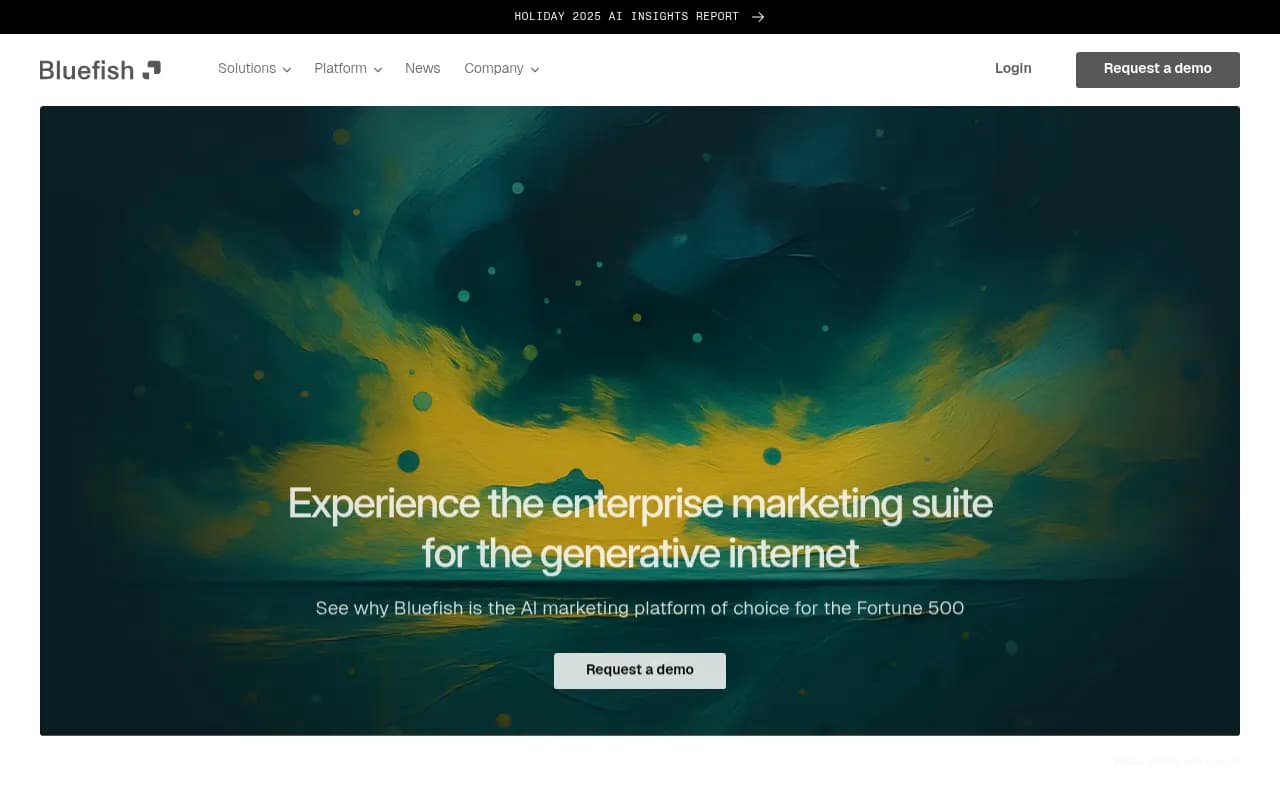
Bluefish AI positions itself as the enterprise GEO platform for Fortune 500 brands. The pitch is authority, influence, and control -- not just tracking where your brand shows up, but understanding how AI models "think" about your category and shaping that perception over time. The platform covers AI monitoring, GEO optimization, and AI commerce tracking, with a particular focus on agentic commerce (think: AI shopping recommendations, not just search results). Their February 2026 Super Bowl study, which tracked how TV ad spend influenced AI recommendations, gives a sense of the depth they're going for. This isn't a dashboard you spin up in an afternoon -- it's a platform you onboard into over weeks with a dedicated team.
Peec AI
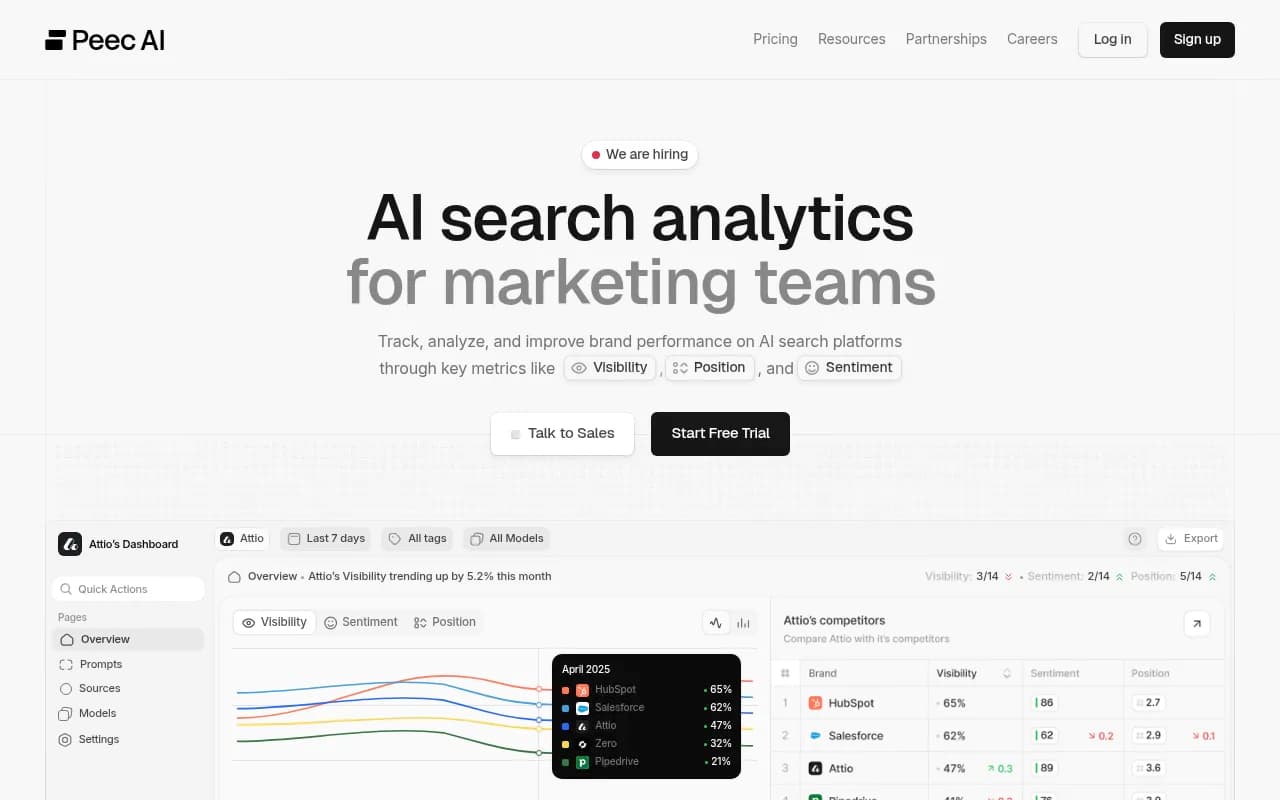
Peec AI takes the opposite approach. It's a clean, self-serve analytics tool for marketing teams who want to track brand visibility across ChatGPT, Perplexity, and Gemini without a procurement process. The core metrics -- visibility (share of chats where your brand appears), position (where in the response you rank), and sentiment (how AI describes you) -- are well-designed and easy to interpret. Peec is trusted by 2,000+ marketing teams, and the transparent pricing tiers mean you know exactly what you're getting before you talk to anyone. It's the kind of tool a marketing manager can sign up for, configure, and start getting value from in a single afternoon.
Side-by-side comparison
| Feature | Bluefish AI | Peec AI |
|---|---|---|
| Starting price | ~$4,000+/month (estimated) | €89/month |
| Free trial | No | Yes |
| Pricing transparency | Quote-based only | Fully public |
| Target user | Enterprise / Fortune 500 | Marketing teams, SMBs, agencies |
| AI models tracked | Major AI channels (undisclosed) | ChatGPT, Perplexity, Gemini + more |
| Multi-language support | Yes (enterprise config) | 115+ languages, self-serve |
| Multi-country tracking | Yes | Yes (3 countries Starter, 10 Pro) |
| Content generation | No | No |
| Campaign ROI tracking | Yes (Collections feature) | No |
| Competitor benchmarking | Yes | Yes |
| Sentiment analysis | Yes | Yes |
| Agentic / AI commerce | Yes | No |
| Infosec / enterprise compliance | Yes | Not emphasized |
| Self-serve setup | No (sales demo required) | Yes |
| API access | Yes (enterprise) | Yes |
Head-to-head feature deep-dive
Pricing and accessibility
This is the starkest difference between the two tools. Peec AI publishes its pricing openly:
| Plan | Price | Prompts | Countries |
|---|---|---|---|
| Starter | €89/month | 25 | 3 |
| Professional | €199/month | 75 | 10 |
| Business | Custom | Custom | Custom |
Bluefish AI doesn't publish pricing at all. Based on available market data and competitor comparisons, enterprise clients are looking at $4,000+ per month, which puts it in the same bracket as Profound and other high-end GEO platforms. You need to request a demo, go through a sales process, and likely wait weeks before you're actually using the product.
For most teams, this isn't just a cost difference -- it's a fundamentally different buying experience. Peec lets you start a free trial right now. Bluefish requires a business case and a budget approval.
Verdict: Peec AI wins on pricing and accessibility by a wide margin.
Monitoring and analytics depth
Both tools track the core AI visibility metrics: share of voice, brand mentions, position in responses, and sentiment. Where they diverge is in depth and customization.
Bluefish goes further with what they call "impact and influence" -- the platform claims to help marketers understand how AI models reason about a category, not just whether a brand appears. Their custom audiences and tailored prompt configurations are designed for competitive markets where generic datasets fall short. The Collections feature (launched February 2026) lets you measure how offline marketing campaigns (TV ads, for example) influence AI recommendations -- a genuinely novel capability.
Peec's analytics are solid but more straightforward. You get visibility, position, and sentiment scores with trend lines, competitor benchmarking, and source tracking. It's well-designed and easy to read. What you don't get is the deeper "how does AI think about my category" analysis that Bluefish is building toward.
Verdict: Bluefish AI has more analytical depth for enterprise use cases. Peec AI has better usability for standard monitoring needs.
Multi-language and multi-region support
Peec AI's 115+ language support is a real differentiator at its price point. The Starter plan covers 3 countries; Professional covers 10. For a brand managing AI visibility across Europe or Latin America, this is practical and affordable.
Bluefish supports multi-market monitoring too, but it's configured as part of an enterprise deployment rather than a self-serve setting. You're not toggling a language dropdown -- you're working with their team to set up the right configuration for your markets.
Verdict: Peec AI is the better choice for multi-language monitoring at accessible price points. Bluefish handles it, but at enterprise cost.
AI commerce and agentic tracking
This is an area where Bluefish has no real competition from Peec. Bluefish explicitly tracks AI commerce -- how brands appear in AI-powered shopping experiences and agentic recommendations. As AI models increasingly drive purchase decisions (not just research), this becomes a meaningful capability.
Peec doesn't cover AI commerce at all. Its focus is on conversational AI search (ChatGPT, Perplexity, Gemini), not shopping or agentic workflows.
Verdict: Bluefish AI wins here. Peec doesn't compete in this area.
Content optimization and gap analysis
Neither tool helps you create content. This is worth saying plainly because it's a real limitation of both platforms. You can see that your brand isn't appearing for certain prompts, but neither Bluefish nor Peec will tell you what content to write or help you write it.
Bluefish offers "GEO optimization" as a feature category, but based on available information, this is more about optimization workflows and measurement frameworks than content generation. Peec has no content optimization features at all.
If closing the loop from "I'm invisible for this prompt" to "I've published content that gets cited" is important to you, you'll need something beyond either of these tools. Promptwatch is worth looking at here -- it combines monitoring with answer gap analysis and a built-in AI writing agent specifically designed to generate content that gets cited by AI models.

Verdict: Neither tool wins. Both are monitoring-only when it comes to content.
Enterprise readiness and security
Bluefish is built for enterprise from the ground up. They specifically call out passing infosec reviews "with ease" -- a detail that matters a lot when you're trying to get a new vendor through a Fortune 500 procurement process. Custom data segmentation, enterprise-scale data pipelines, and dedicated support are part of the package.
Peec has a Business tier with custom pricing, but enterprise security compliance isn't a focus of their positioning. For a mid-market marketing team, this is fine. For a large enterprise with strict vendor requirements, it's a gap.
Verdict: Bluefish AI is the clear choice for enterprise security and compliance requirements.
Ease of use and time to value
Peec wins this one without much contest. The self-serve model, transparent pricing, and clean dashboard mean you can go from "I want to track our AI visibility" to "I'm looking at data" in a single session. The interface is designed for marketing managers, not data engineers.
Bluefish requires a demo, a sales conversation, and an onboarding process. That's not a criticism -- it's appropriate for the complexity of what they're building -- but it means weeks before you see any value.
Verdict: Peec AI wins on time to value.
Pricing comparison
| Plan | Bluefish AI | Peec AI |
|---|---|---|
| Entry level | ~$4,000+/month (estimated) | €89/month |
| Mid-tier | Custom | €199/month |
| Enterprise | Custom | Custom |
| Free trial | No | Yes |
| Pricing public | No | Yes |
Pros and cons
Bluefish AI
Pros:
- Deep enterprise feature set with genuine analytical differentiation
- Collections feature for measuring campaign ROI in AI channels is unique
- AI commerce and agentic tracking not found in most competitors
- Built to pass enterprise infosec reviews
- Custom audiences and tailored prompt configurations for competitive markets
Cons:
- No public pricing -- you have to go through sales to find out what it costs
- Estimated $4,000+/month puts it out of reach for most teams
- No self-serve trial or free tier
- No built-in content generation or gap analysis
- Long onboarding process before you see any value
- Overkill for teams that just need basic AI visibility monitoring
Peec AI
Pros:
- Transparent, affordable pricing starting at €89/month
- Free trial with no sales call required
- 115+ language support for multi-market teams
- Clean, intuitive dashboard that's easy to interpret
- Solid core metrics: visibility, position, sentiment
- Trusted by 2,000+ marketing teams
Cons:
- No content generation or gap analysis features
- No AI commerce or agentic tracking
- Fewer AI models tracked on lower-tier plans
- Not designed for enterprise security requirements
- Analytics depth doesn't match Bluefish for complex use cases
- Limited to 3 countries on the Starter plan
Who should pick which tool
Choose Bluefish AI if:
- You're at a large enterprise or Fortune 500 brand with a dedicated AI marketing team
- You need to pass infosec reviews and have strict vendor compliance requirements
- You want to track AI commerce and agentic shopping recommendations, not just conversational search
- You need to measure how offline campaigns (TV, events) influence AI recommendations
- Budget is not a constraint and you need the deepest possible analytical capabilities
Choose Peec AI if:
- You're a marketing team or agency that needs to get started quickly without a sales process
- Budget matters and you want transparent pricing you can justify to your manager
- Multi-language and multi-country monitoring is important and you want it self-serve
- Your core need is tracking visibility, position, and sentiment across ChatGPT, Perplexity, and Gemini
- You want to test the tool before committing any budget
Final verdict
These two tools are solving different problems for different buyers, which makes a direct "winner" call a bit misleading. Bluefish AI is a serious enterprise platform with capabilities -- AI commerce tracking, campaign ROI measurement, deep audience segmentation -- that Peec simply doesn't have. But it costs 40-50x more and requires a full enterprise procurement process to access.
For the vast majority of marketing teams reading this comparison, Peec AI is the practical choice. It covers the monitoring fundamentals well, it's affordable, and you can start using it today. If you're a Fortune 500 brand with a real AI marketing budget and need enterprise-grade depth, Bluefish is worth the conversation. Everyone else should start with Peec -- and if you find you need content optimization on top of monitoring, look beyond both of these tools for something that actually helps you act on what you're seeing.