Key takeaways
- Bluefish AI is built exclusively for enterprise brands (think Fortune 500 budgets), with pricing estimated at $4,000+/month and a mandatory sales process. LLMClicks offers lifetime deals from ~$200 USD with a self-serve free trial.
- LLMClicks has hallucination detection baked in -- it flags when AI models make up or distort facts about your brand. Bluefish doesn't prominently offer this.
- Bluefish goes deeper on AI commerce tracking and brand influence measurement, including how AI "thinks" about your brand. LLMClicks focuses on audits, citation analysis, and competitor benchmarking.
- For agencies, LLMClicks wins on practicality: white-label reports, multi-client dashboards, and lead magnet audits are built in. Bluefish is primarily positioned for large in-house teams.
- Bluefish passes enterprise infosec reviews and supports custom data segmentation at scale. LLMClicks is a lighter-weight tool that doesn't make enterprise security claims.
- Neither tool closes the full optimization loop (find gaps, generate content, track results) -- they're both primarily monitoring and audit platforms.
Overview
Bluefish AI
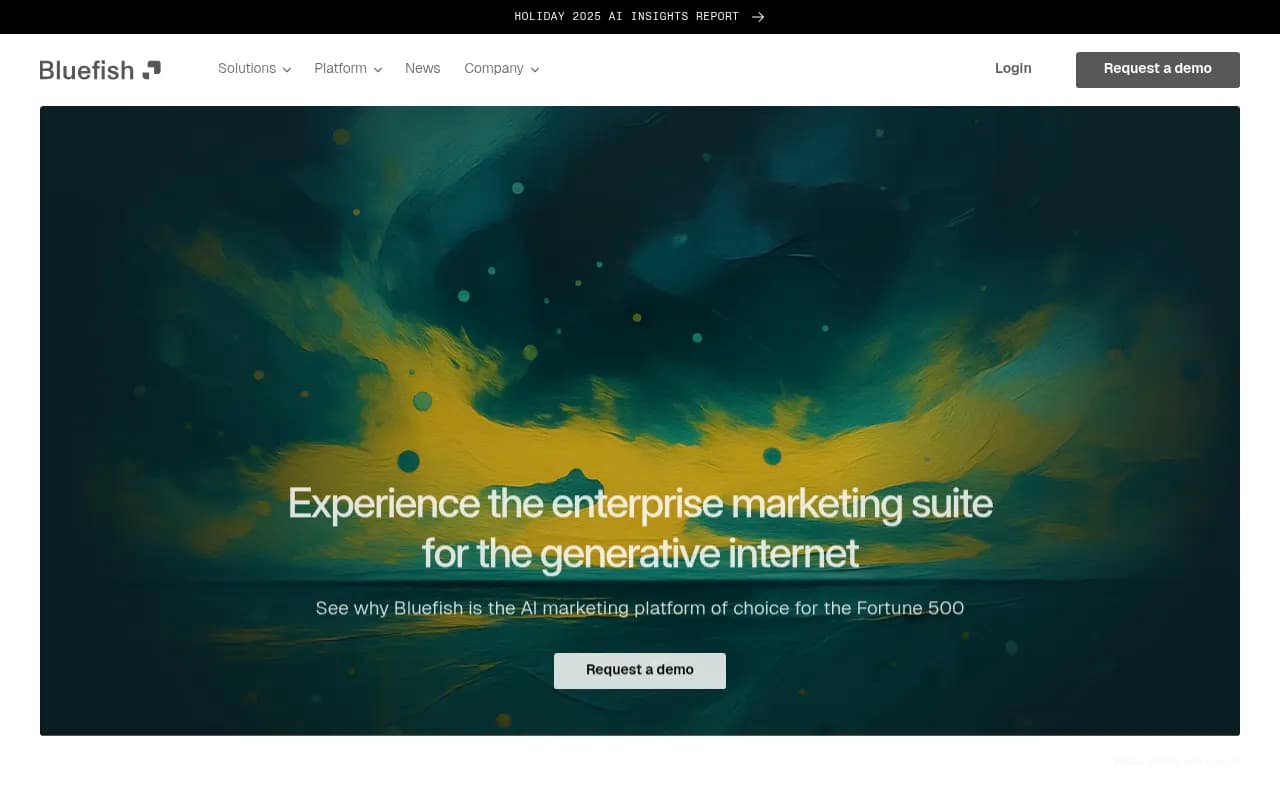
Bluefish AI positions itself as the AI marketing platform for Fortune 500 brands. The pitch is less about raw tracking and more about "authority, influence, and control" in AI channels -- a distinction that matters if you're a large brand that cares not just about whether you appear in AI responses, but how you're characterized. The platform covers AI monitoring, GEO optimization, measurement, and AI commerce tracking. Onboarding reportedly takes around four weeks due to custom alert configuration, and you won't find a pricing page -- everything goes through a sales demo.
LLMClicks
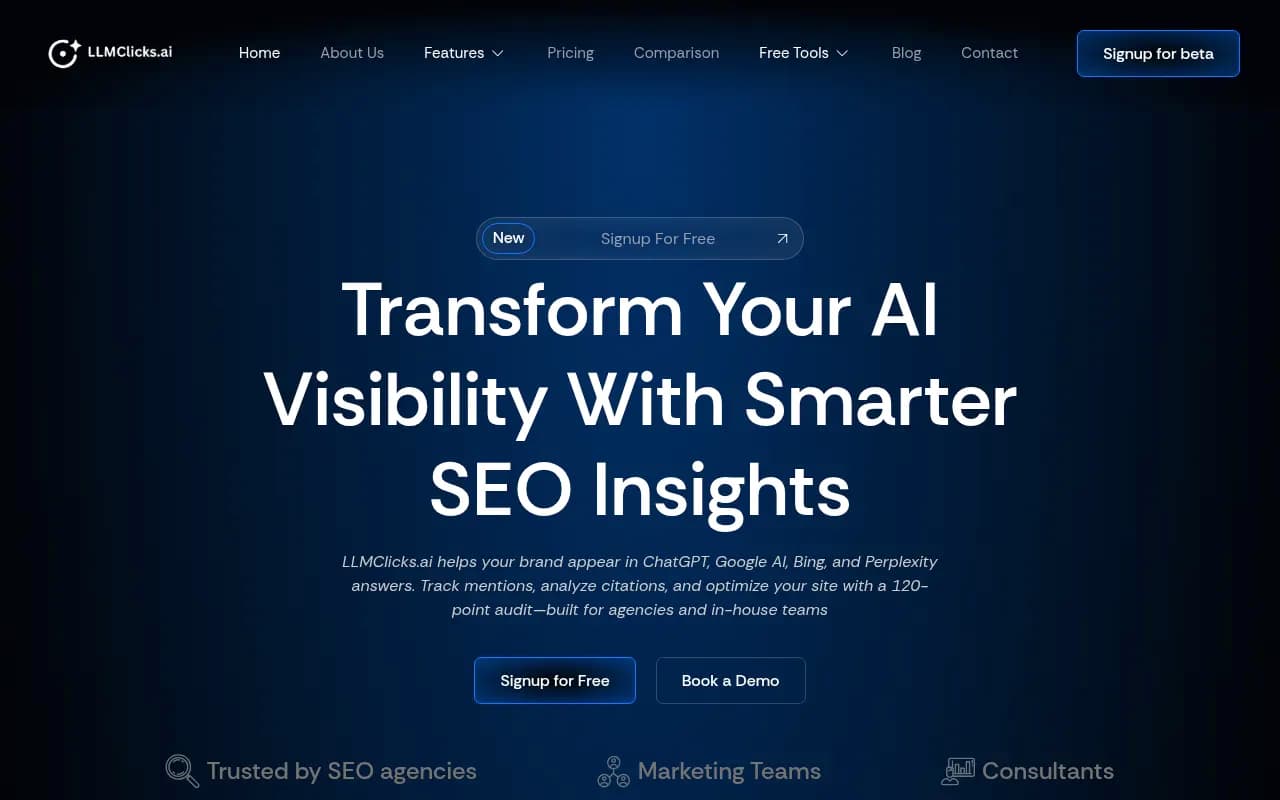
LLMClicks takes the opposite approach: self-serve, accessible pricing, and a clear focus on practical diagnostics. Its headline features are a 120-point on-page audit, citation analysis, competitor benchmarking, and hallucination detection. It's built for agencies and in-house SEO teams that want to understand why competitors show up in ChatGPT answers and fix it quickly. The lifetime deal pricing model is unusual in this space and makes it one of the most affordable AI visibility tools available.
Side-by-side comparison
| Feature | Bluefish AI | LLMClicks |
|---|---|---|
| Target audience | Fortune 500 / enterprise | Agencies, SMBs, consultants |
| Pricing model | Quote-based (~$4,000+/mo) | Lifetime deals ($200-$490 USD) |
| Free trial | Demo only | 14-day trial, 50 free credits |
| Hallucination detection | Not advertised | Yes |
| On-page SEO audit | Not advertised | Yes (120-point audit) |
| Citation analysis | Yes | Yes |
| Competitor benchmarking | Yes | Yes |
| AI commerce tracking | Yes (agentic commerce) | Not advertised |
| White-label reports | Not advertised | Yes |
| Multi-client dashboard | Not advertised | Yes |
| Enterprise infosec compliance | Yes | Not advertised |
| Self-serve onboarding | No (sales-led, ~4 weeks) | Yes |
| AI models monitored | ChatGPT, major AI channels | ChatGPT, Gemini, Perplexity, Bing |
| Content generation | Not advertised | Not advertised |
Head-to-head feature deep-dive
Pricing and accessibility
This is the starkest difference between the two tools. Bluefish AI doesn't publish pricing -- you request a demo, go through a sales process, and land somewhere in the $4,000+/month range based on available estimates. That's not a criticism of the product, but it does mean Bluefish is simply not a realistic option for most marketing teams.
LLMClicks flips this entirely. Lifetime deals mean you pay once and own access indefinitely. The Starter tier runs roughly $200 USD, Professional around $297, and Agency around $490. There's also a 14-day free trial with 50 credits to test before committing. For budget-conscious teams or agencies managing multiple clients, this pricing model is genuinely unusual in the GEO space.
Verdict: LLMClicks wins on pricing accessibility by a wide margin. Bluefish is only viable for enterprise teams with dedicated marketing technology budgets.
Hallucination detection
LLMClicks specifically calls out hallucination detection as a core feature -- the ability to flag when AI models generate inaccurate or fabricated information about your brand. This is a real problem: AI models sometimes confidently state wrong things about companies, products, or pricing, and most brands have no systematic way to catch it.
Bluefish AI doesn't advertise this capability. Its focus is on how AI "thinks" about your brand in terms of influence and positioning, which is adjacent but not the same thing as catching factual errors.
Verdict: LLMClicks has a clear edge here. If hallucination monitoring matters to your brand (and it should), LLMClicks addresses it directly.
On-page audit and SEO diagnostics
LLMClicks includes a 120-point on-page audit covering schema markup, E-E-A-T signals, meta tags, and other factors that influence how AI models discover and cite your content. This is a practical, actionable feature -- it gives teams a concrete checklist of fixes rather than just visibility scores.
Bluefish AI doesn't prominently feature an on-page audit. Its optimization focus is more about brand influence and AI performance measurement than technical SEO diagnostics.
Verdict: LLMClicks wins for teams that want technical SEO guidance alongside visibility tracking.
AI commerce and brand influence
Bluefish's most distinctive capability is its AI commerce tracking -- monitoring how your brand appears in agentic commerce contexts, where AI models are increasingly making or influencing purchasing decisions. The platform also claims to help marketers understand how AI "thinks" about their brand, going beyond share-of-voice into deeper influence metrics.
The "Collections" feature (launched February 2026) measures the ROI of digital marketing campaigns in the AI channel -- connecting traditional campaign spend to AI visibility outcomes. That's a genuinely useful capability for enterprise teams running large media budgets.
LLMClicks doesn't appear to offer AI commerce tracking or campaign ROI measurement at this level.
Verdict: Bluefish wins for enterprise teams that need to connect AI visibility to commerce outcomes and campaign ROI.
Agency and multi-client support
LLMClicks is explicitly built for agencies. White-label reports, multi-client dashboards, and lead magnet audit tools are all part of the package. The idea is that agencies can use LLMClicks to win new clients (by running a quick AI visibility audit as a lead magnet) and then retain them with ongoing monitoring.
Bluefish AI can serve agencies but is primarily positioned for large in-house teams. The sales-led process and enterprise pricing make it impractical for agencies managing many smaller clients.
Verdict: LLMClicks wins for agencies. The white-label and multi-client features are purpose-built for agency workflows.
Enterprise security and scalability
Bluefish explicitly states it "consistently passes infosec reviews with ease" and supports custom data segmentation and optimization in ways competitors can't match. For Fortune 500 brands with strict data governance requirements, this matters a lot.
LLMClicks doesn't make enterprise security claims. It's a lighter-weight tool that likely hasn't been through the same enterprise procurement process.
Verdict: Bluefish wins for enterprise security and compliance requirements.
Onboarding and time-to-value
LLMClicks is self-serve. You sign up, get 50 free credits, and start running audits. Fast.
Bluefish averages around four weeks for onboarding due to custom alert configuration and setup. That's not unusual for enterprise software, but it's worth knowing if you need results quickly.
Verdict: LLMClicks wins on speed-to-value. Bluefish's onboarding timeline is a real consideration for teams under pressure to show results.
Pricing comparison
| Plan | Bluefish AI | LLMClicks |
|---|---|---|
| Free tier | No (demo only) | 14-day trial, 50 credits |
| Entry-level | ~$4,000+/mo (estimated) | Starter: ~$200 USD (lifetime) |
| Mid-tier | Custom | Professional: ~$297 USD (lifetime) |
| Agency/Team | Custom | Agency: ~$490 USD (lifetime) |
| Enterprise | Custom | Not applicable |
| Pricing model | Quote-based, annual contract | One-time lifetime payment |
The pricing gap here is not a rounding error -- it's a different category entirely. LLMClicks' total lifetime cost is less than a single month of Bluefish AI.
Pros and cons
Bluefish AI
Pros:
- Deep brand influence and AI commerce tracking beyond basic share-of-voice
- Enterprise-grade security and compliance
- Campaign ROI measurement in the AI channel (Collections feature)
- Custom data segmentation for large, complex organizations
- Built for teams that need to justify AI marketing spend to leadership
Cons:
- No public pricing -- requires a sales process
- Estimated $4,000+/month puts it out of reach for most teams
- ~4-week onboarding timeline
- No self-serve trial or free tier
- Hallucination detection not advertised
- No on-page SEO audit
LLMClicks
Pros:
- Extremely affordable lifetime pricing ($200-$490 USD one-time)
- 14-day free trial with no credit card friction
- Hallucination detection is a genuinely useful differentiator
- 120-point on-page audit gives actionable technical guidance
- White-label reports and multi-client dashboards for agencies
- Self-serve onboarding -- fast time-to-value
Cons:
- No AI commerce tracking or campaign ROI measurement
- Lighter feature set compared to enterprise platforms
- No enterprise infosec certifications advertised
- Smaller company with less established track record than Bluefish
- Lifetime deal model raises questions about long-term product investment
- Limited information on prompt volume data or content generation
Who should pick which tool
Pick Bluefish AI if:
- You're at a Fortune 500 or large enterprise brand with a dedicated marketing technology budget
- You need to track AI commerce and connect campaign spend to AI visibility outcomes
- Your organization requires enterprise security and infosec compliance
- You want deep brand influence measurement, not just citation counts
- You have a 4-6 week runway for onboarding and setup
Pick LLMClicks if:
- You're an agency managing multiple clients and need white-label reporting
- You're an SMB or startup that can't justify $4,000+/month for AI visibility tracking
- Hallucination detection is a priority for your brand
- You want a 120-point technical audit to identify on-page fixes
- You need to get started quickly without a sales process
- You want to test the tool before committing (free trial available)
A note on the broader GEO landscape
Both tools are primarily monitoring and audit platforms -- they show you where you stand and flag issues, but neither closes the full optimization loop of finding content gaps, generating content to fill them, and tracking the results. If you're looking for a platform that goes beyond tracking into actual content optimization and AI search ranking, Promptwatch covers that angle with built-in content gap analysis, an AI writing agent trained on citation data, and page-level tracking across 10+ AI models.

Final verdict
Bluefish AI and LLMClicks are solving similar problems for completely different audiences. Bluefish is a serious enterprise platform with deep capabilities around brand influence, AI commerce, and campaign ROI -- but you need a Fortune 500 budget and tolerance for a sales-led process to use it. LLMClicks is a practical, affordable tool that punches above its weight with hallucination detection, a solid on-page audit, and agency-friendly features at a price point that's hard to argue with.
For most teams reading this comparison, LLMClicks is the realistic choice. For enterprise brands that need AI commerce tracking and infosec compliance, Bluefish is worth the conversation.