Key takeaways
- Bluefish AI and Diib are not really competing for the same customers. Bluefish targets Fortune 500 marketing teams at $4,000+/month. Diib is a free-to-start SEO tool for small business owners.
- Diib is primarily a traditional SEO platform (keyword tracking, site audits, Google Analytics sync) with AI visibility features added on. Bluefish AI is purpose-built for GEO and AI channel optimization from the ground up.
- If you're a small business trying to understand your website's SEO health and get a basic read on AI visibility, Diib is genuinely useful and costs almost nothing to start.
- If you're an enterprise brand that needs to monitor, influence, and measure your presence across AI search engines and agentic commerce channels, Bluefish AI is the more serious option -- though its pricing puts it out of reach for most teams.
- Neither tool offers AI crawler log monitoring (seeing which AI bots are crawling your site and when). That's a gap worth knowing about.
- For mid-market teams who want real GEO depth without the Fortune 500 price tag, there are better-positioned alternatives in the market.
Overview
Bluefish AI
Bluefish AI positions itself as the enterprise GEO platform of choice for Fortune 500 brands. The pitch is about going beyond basic share-of-voice metrics to give marketers actual influence over how AI models represent their brand. Features include AI monitoring, GEO optimization, AI commerce tracking (including agentic commerce), and what they call "Collections" -- a way to measure the ROI of digital marketing campaigns in the AI channel. The platform is built to pass enterprise infosec reviews and supports custom audience segmentation and tailored prompt frameworks. It's not self-serve; you request a demo and get a custom quote.
Diib
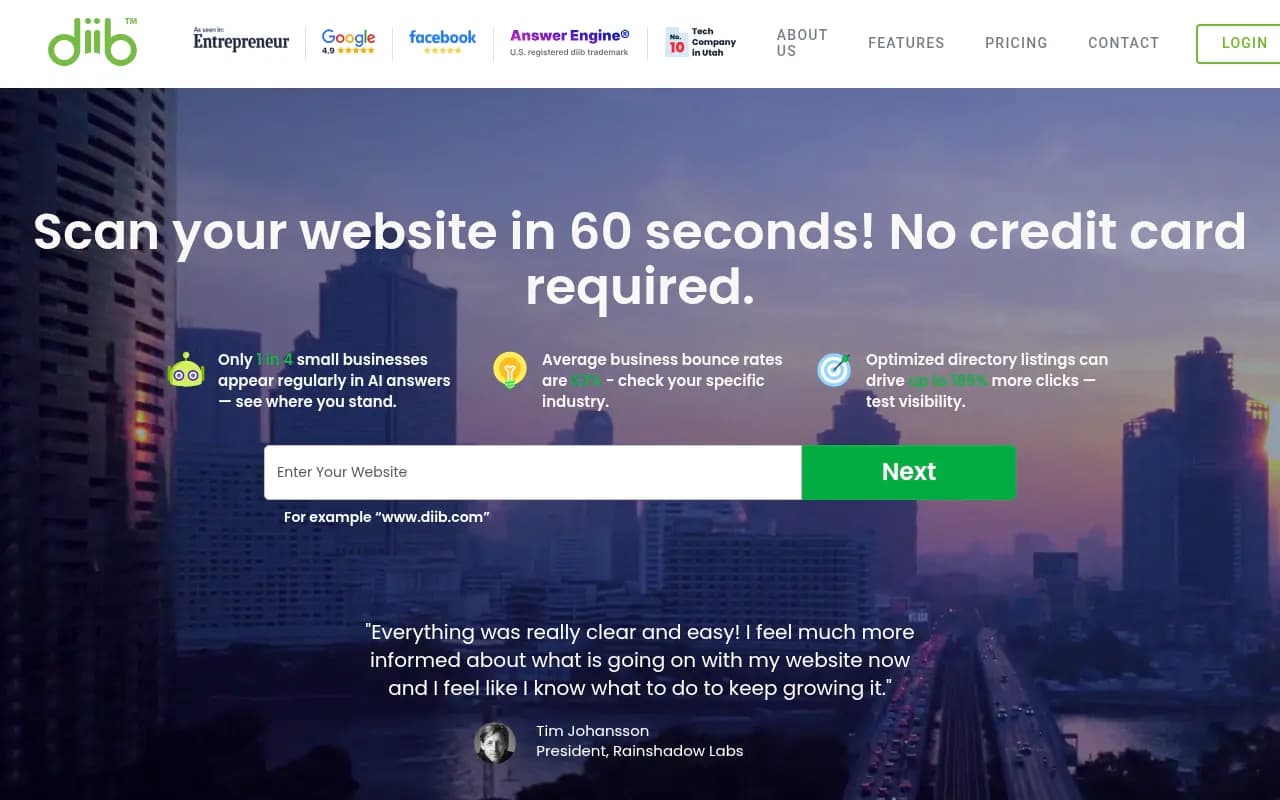
Diib is a self-serve SEO tool that's been around for years and has built a user base of 500,000+ website owners across 160 countries. The core product is an "Answer Engine" that syncs with Google Analytics and runs a site scan in about 60 seconds, then spits out a prioritized growth plan covering SEO, social, mobile, and user experience. It integrates with WordPress, Shopify, Wix, Squarespace, and most major CMS platforms. More recently, Diib has added AI visibility features -- specifically, checking whether your site appears in AI-generated answers. But that's an add-on to what is fundamentally a traditional SEO toolkit.
Side-by-side comparison
| Feature | Bluefish AI | Diib |
|---|---|---|
| Primary use case | Enterprise GEO / AI visibility | SMB SEO + basic AI visibility |
| Pricing model | Quote-based | Free tier + paid plans |
| Estimated cost | $4,000+/month | Free to ~$29-99/month |
| Free tier | No | Yes |
| Self-serve signup | No (demo required) | Yes |
| AI search monitoring | Yes (core feature) | Limited (add-on) |
| GEO optimization | Yes | No |
| AI commerce tracking | Yes (agentic commerce) | No |
| Traditional SEO tools | No | Yes (core feature) |
| Keyword tracking | No | Yes (unlimited on Pro) |
| Site audit | No | Yes |
| Google Analytics sync | No | Yes |
| Competitor monitoring | Yes (AI channels) | Yes (traditional SEO) |
| Custom audience/prompts | Yes | No |
| Enterprise infosec compliance | Yes | No |
| Target audience | Fortune 500 / enterprise | Small businesses / solo owners |
| Content generation | No | No |
| AI crawler logs | No | No |
Head-to-head feature deep-dive
AI search visibility monitoring
This is where the gap between these two tools is most obvious.
Bluefish AI was built specifically to track how brands appear across AI-native experiences -- ChatGPT, Perplexity, Gemini, and others. The platform goes beyond simple mention counting to analyze how AI models "think" about a brand, track share-of-voice across competitors, and monitor AI commerce channels including agentic shopping experiences. Their February 2026 research on Super Bowl ads influencing AI recommendations shows they're doing real work in understanding AI model behavior, not just scraping outputs.
Diib's AI visibility feature is newer and more surface-level. The homepage notes that "only 1 in 4 small businesses appear regularly in AI answers" and lets you check where you stand. That's a useful starting point for a small business owner who's never thought about AI search before. But it's not the kind of deep, ongoing monitoring that a brand actively managing its AI presence would rely on.
Verdict: Bluefish AI wins this category decisively. Diib's AI visibility check is a diagnostic, not a monitoring platform.
Traditional SEO capabilities
Flip the comparison around and Diib wins just as decisively.
Diib has a full SEO toolkit: keyword tracking, rank monitoring (including "Rank Guard" for protecting existing rankings), site speed audits, backlink analysis, social tracking, mobile experience scoring, and a growth plan that updates continuously based on your actual analytics data. It integrates directly with Google Analytics and supports 20+ CMS platforms. For a small business owner who wants one tool to handle their entire online presence, it covers a lot of ground.
Bluefish AI doesn't try to be an SEO tool. There's no keyword tracker, no site audit, no Google Analytics integration. It's focused entirely on AI channels. If you're an enterprise brand, you presumably already have Semrush or Ahrefs for traditional SEO -- Bluefish is meant to sit alongside those tools, not replace them.
Verdict: Diib wins for traditional SEO. Bluefish AI doesn't compete here.
GEO optimization and content influence
Bluefish AI's differentiator is what they call "impact and influence" -- the idea that you shouldn't just monitor AI visibility but actively shape it. The platform includes optimization workflows, custom audience targeting, and tailored prompt frameworks. Their "Collections" feature (launched February 2026) lets you measure how specific marketing campaigns affect your AI channel performance, which is genuinely useful for enterprise teams trying to connect brand spend to AI outcomes.
Diib has no GEO optimization features. There's no mechanism to improve how AI models represent your brand, no content gap analysis, no prompt-level insights.
Worth noting: if you want GEO optimization that also includes built-in content generation to close visibility gaps, Promptwatch takes a different approach -- its action loop goes from gap analysis to AI-optimized content creation to tracking the results, which neither Bluefish nor Diib offers end-to-end.

Verdict: Bluefish AI wins for GEO optimization. Diib doesn't play in this space.
Ease of use and onboarding
Diib is genuinely easy to use. The 60-second scan is real -- you enter your URL, connect Google Analytics, and get a prioritized list of things to fix. No sales call, no demo, no waiting. The interface is designed for non-technical users and the growth plan is written in plain language. This is probably Diib's biggest strength: it makes SEO accessible to people who don't have a dedicated marketing team.
Bluefish AI is the opposite experience. There's no self-serve option. You request a demo, go through a sales process, and get onboarded by their team. That's appropriate for a $4,000+/month enterprise tool -- you'd expect white-glove onboarding at that price. But it means there's no way to kick the tires before committing.
Verdict: Diib wins on ease of use and accessibility. Bluefish AI's onboarding is appropriate for its audience but not accessible to most.
Enterprise features and compliance
Bluefish AI is built for enterprise in ways that matter: it passes infosec reviews, supports custom data segmentation, and offers tailored measurement frameworks. For a Fortune 500 brand with strict security requirements and complex organizational structures, these aren't nice-to-haves -- they're requirements. The platform also supports custom audiences, which means you can track AI visibility for specific customer segments rather than just broad brand queries.
Diib has no enterprise tier. It supports up to 30 websites on Pro, which is fine for a small agency but not for a large enterprise with hundreds of properties. There's no mention of SOC 2 compliance, SSO, or enterprise security features.
Verdict: Bluefish AI wins for enterprise requirements. Diib isn't designed for this.
Competitor intelligence
Both tools offer competitor monitoring, but the scope is completely different.
Bluefish AI's competitor intelligence is focused on AI channels -- who's winning share-of-voice in ChatGPT responses, how competitors are represented in AI commerce, and how your brand stacks up across different AI models. This is the kind of intelligence that's genuinely hard to get elsewhere.
Diib's competitor monitoring is traditional SEO-focused: keyword overlap, traffic estimates, ranking comparisons. Useful for understanding where you stand in Google search, but it tells you nothing about AI channel performance.
Verdict: Depends on what you need. For AI channel competitive intelligence, Bluefish AI. For traditional SEO competitive analysis, Diib.
Pricing comparison
| Plan | Bluefish AI | Diib |
|---|---|---|
| Free tier | No | Yes (basic scan + limited features) |
| Entry-level paid | Quote-based | ~$29-99/month (estimated) |
| Enterprise | $4,000+/month (estimated) | Not available |
| Trial | Demo only | Free scan, no credit card required |
| Billing | Custom | Monthly or annual |
The pricing gap here is enormous. Diib is accessible to anyone with a website. Bluefish AI is priced for organizations with dedicated marketing budgets and enterprise procurement processes. There's no middle ground between them -- which is actually a useful signal about who each tool is built for.
Pros and cons
Bluefish AI
Pros:
- Purpose-built for GEO and AI channel monitoring, not an afterthought
- AI commerce and agentic channel tracking is genuinely differentiated
- Enterprise-grade security and compliance
- Custom audience and prompt frameworks for nuanced analysis
- "Collections" feature connects marketing campaigns to AI channel ROI
- Backed by real research (Super Bowl ad influence study, etc.)
Cons:
- Pricing ($4,000+/month) puts it out of reach for all but large enterprises
- No self-serve option -- everything goes through sales
- No traditional SEO capabilities
- No AI crawler log monitoring
- No built-in content generation to act on insights
- Limited transparency on pricing and features without a demo
Diib
Pros:
- Genuinely free to start, no credit card required
- Fast onboarding -- 60-second scan delivers real results
- Covers traditional SEO comprehensively for small businesses
- Google Analytics integration is seamless
- Supports 20+ CMS platforms
- 500,000+ user base suggests real product-market fit
- Plain-language recommendations accessible to non-technical users
Cons:
- AI visibility features are basic compared to dedicated GEO platforms
- No GEO optimization -- can't act on AI visibility gaps
- No competitor intelligence for AI channels
- Not designed for enterprise use cases
- Pro plan pricing isn't publicly listed (requires signup to see)
- No content generation or AI-specific content recommendations
Who should pick which tool
Pick Bluefish AI if:
- You're at a Fortune 500 or large enterprise brand with a dedicated marketing team
- AI channel performance is a strategic priority with budget to match
- You need to track AI commerce and agentic shopping, not just text responses
- Your organization has strict infosec requirements
- You already have traditional SEO tools and need AI-specific coverage on top
Pick Diib if:
- You're a small business owner or solo marketer managing your own website
- You want a simple, affordable way to understand and improve your SEO
- You're just starting to think about AI visibility and want a low-cost entry point
- You need Google Analytics integration and a plain-language growth plan
- Budget is a real constraint
Pick neither if:
- You're a mid-market brand or agency that needs serious GEO depth without enterprise pricing. In that case, there are platforms better positioned for your needs -- ones that combine AI visibility monitoring, content gap analysis, and optimization in a single workflow at a more accessible price point.
Final verdict
Bluefish AI and Diib are solving different problems for different customers, so calling one "better" than the other misses the point. Bluefish AI is a serious enterprise GEO platform with real differentiation in AI commerce tracking and influence measurement -- but at $4,000+/month with no self-serve option, it's only relevant to a small slice of the market. Diib is a solid, accessible SEO tool for small businesses that has added AI visibility as a feature, not a core capability.
If you're a small business owner, Diib is worth trying for free. If you're an enterprise brand with budget and a real AI channel strategy, Bluefish AI is worth a demo. If you're somewhere in between -- a growing brand or mid-size agency that needs genuine GEO depth at a reasonable price -- neither of these tools is the right fit.