Key takeaways
- Bluefish AI and Cairrot are aimed at completely different buyers. Bluefish targets Fortune 500 marketing teams with deep pockets; Cairrot targets agencies and SMBs who need something that works without a six-figure contract.
- The price gap is enormous. Cairrot starts at $39/month. Bluefish AI is estimated at $4,000+/month. That's not a small difference -- it's a different category of software.
- Cairrot lets you start immediately with a free trial. Bluefish requires a sales demo, which means weeks of evaluation before you see anything.
- Bluefish goes deeper on enterprise needs: custom audience segmentation, infosec compliance, workflow automation, and what they call "influence" measurement (understanding how AI models reason about your brand). Cairrot doesn't touch any of that.
- Cairrot's LLM crawl monitoring is a genuinely useful feature that shows which pages AI bots are actually visiting -- and it's available at $39/month, which is remarkable.
- If you're a mid-market or enterprise team that needs both tracking and content optimization in one platform, neither tool fully covers that loop. Promptwatch is worth knowing about here -- it combines monitoring, content gap analysis, and AI content generation in one place at a more accessible price point than Bluefish.
Overview
Bluefish AI
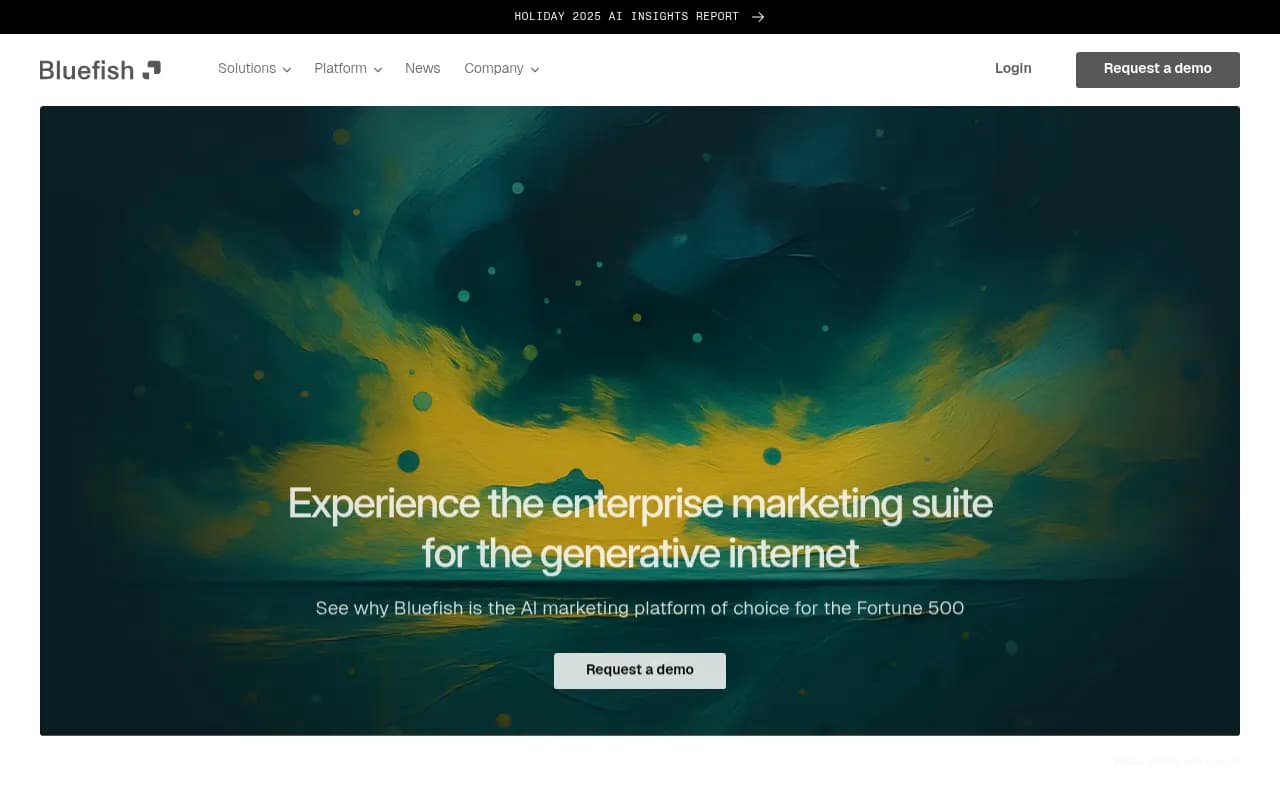
Bluefish AI positions itself as the enterprise GEO platform for brands that can't afford to get AI visibility wrong. The homepage leads with "Fortune 500" and "enterprise" in the first two sentences, which tells you exactly who they're selling to. Their pitch goes beyond just tracking share-of-voice -- they want to help brands understand how AI models "think" about them, and then influence that. Features like Collections (for measuring campaign ROI in the AI channel) and agentic commerce tracking suggest they're building toward a full AI marketing suite, not just a monitoring dashboard. The trade-off is that all of this comes with enterprise pricing, a sales-led process, and no self-serve option.
Cairrot
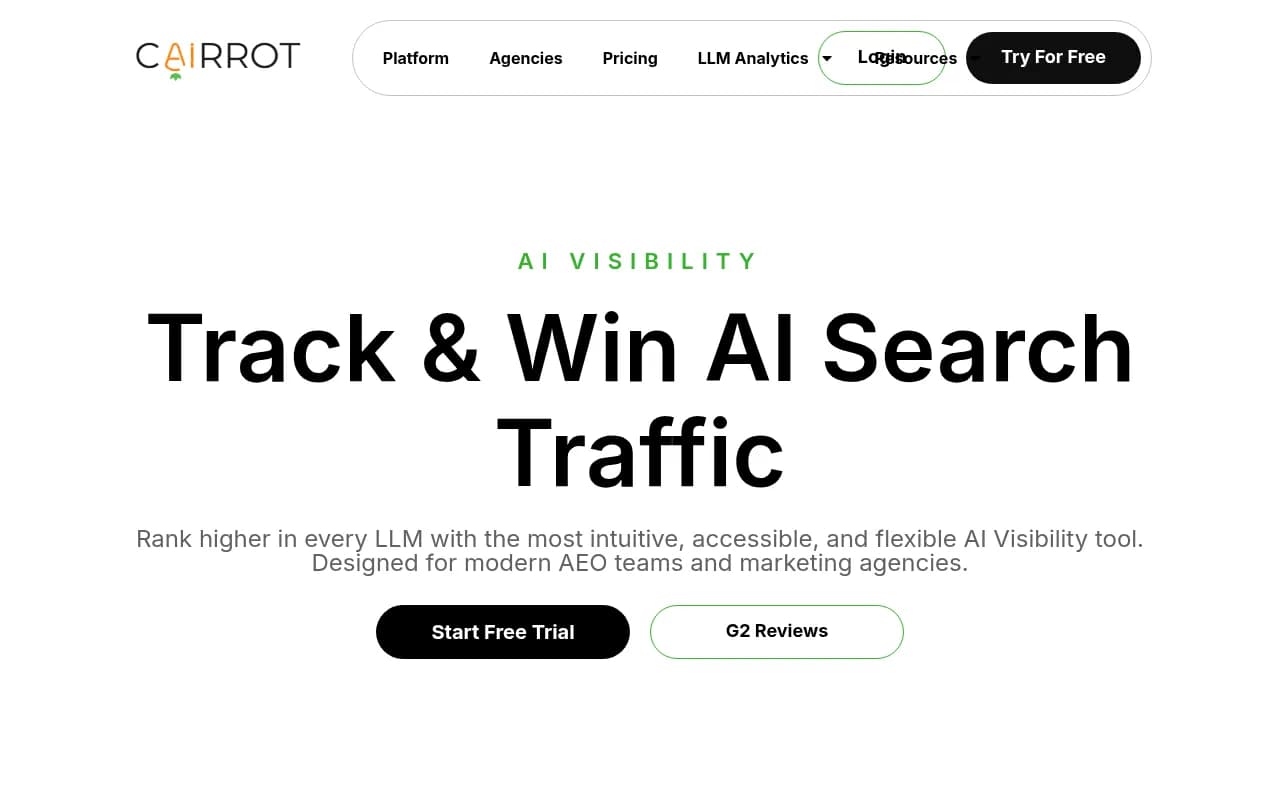
Cairrot takes the opposite approach. It's a clean, accessible AI visibility tool that tracks brand mentions and rankings across five major LLMs -- ChatGPT, Perplexity, Claude, Grok, and DeepSeek. The pricing is transparent, the free trial is real, and the whole product is designed to be usable without a dedicated data team. Their standout claim is that they're the only tool tracking all 5 LLMs for under $100/month, which is accurate as of early 2026. They also include LLM crawl monitoring -- showing which pages AI bots are visiting -- which is a feature you'd expect to find only in pricier tools.
Side-by-side comparison
| Feature | Bluefish AI | Cairrot |
|---|---|---|
| Starting price | ~$4,000/month (estimated) | $39/month |
| Free trial | No | Yes |
| Pricing model | Quote-based / sales-led | Self-serve, transparent |
| LLMs monitored | Multiple (exact count not public) | 5 (ChatGPT, Perplexity, Claude, Grok, DeepSeek) |
| AI commerce tracking | Yes (agentic commerce) | No |
| LLM crawl monitoring | Not confirmed | Yes |
| Content optimization | Yes (GEO workflows) | Basic (AEO insights) |
| Custom audience segmentation | Yes | No |
| Enterprise infosec compliance | Yes | Not confirmed |
| Campaign ROI measurement | Yes (Collections feature) | No |
| Multi-language / multi-region | Not confirmed | Yes (country/language) |
| Target user | Fortune 500 / enterprise | Agencies, SMBs, marketing teams |
| Onboarding | Sales demo required | Self-serve |
| API access | Not confirmed | Not confirmed |
Head-to-head feature deep-dive
Pricing and accessibility
This is where the comparison is most stark. Cairrot publishes its pricing openly: $39/month for Starter (2 LLMs), $99/month for Pro (5 LLMs), $299/month for Enterprise. You can start a free trial without talking to anyone. That's a genuinely low barrier for a category that's still maturing.
Bluefish AI doesn't publish pricing. Based on available market research and the enterprise positioning, estimates put it at $4,000+/month. Every interaction starts with "Request a demo," which is fine for a Fortune 500 procurement process but completely impractical for a 10-person agency trying to decide if AI visibility tracking is worth the investment.
Verdict: Cairrot wins on price and accessibility, by a wide margin. Bluefish's pricing is appropriate for its target market, but it's simply not a realistic option for most teams.
LLM coverage and monitoring depth
Cairrot tracks five LLMs on its Pro plan: ChatGPT, Perplexity, Claude, Grok, and DeepSeek. The Starter plan only covers two, which limits its usefulness unless you're very focused. The LLM crawl monitoring feature -- showing which pages AI bots are actually visiting and how often -- is a real differentiator at this price point. Most tools at this tier don't offer that.
Bluefish AI covers AI-native experiences more broadly, including what they describe as "agentic commerce" -- tracking brand presence in AI shopping and recommendation flows. This goes beyond standard LLM chat monitoring into a newer and arguably more commercially important channel. The exact list of models covered isn't published, but the enterprise positioning suggests comprehensive coverage.
Verdict: Depends on what you need. For standard LLM tracking, Cairrot covers the major ones. For AI commerce and agentic experiences, Bluefish goes further.
Optimization and content capabilities
Cairrot provides AEO insights and optimization suggestions -- it tells you what to fix and which content tactics are working across different LLMs. That's useful, but it stops short of actually helping you create content. You get the diagnosis, not the treatment.
Bluefish AI goes deeper with what they call GEO workflows and performance tools. The "influence" framing is interesting -- they're not just measuring whether you appear in AI responses, but trying to help brands shape how AI models characterize them. The Collections feature for measuring campaign ROI in the AI channel is a genuinely novel capability that Cairrot doesn't have.
Worth noting: if content generation is a priority alongside tracking, Promptwatch covers that gap with a built-in AI writing agent that generates content based on citation data and prompt analysis.

Verdict: Bluefish AI has more sophisticated optimization capabilities. Cairrot's insights are useful but limited.
Enterprise features and security
Bluefish explicitly mentions passing infosec reviews "with ease" and offers custom data segmentation for enterprise data teams. These aren't features most small tools can claim, and they matter a lot when a Fortune 500 procurement team is evaluating vendors.
Cairrot doesn't make any claims about enterprise security compliance. For a $39/month tool, that's expected -- but it means Cairrot isn't a realistic option for large organizations with strict vendor requirements.
Verdict: Bluefish AI wins here, clearly. This is its home turf.
Ease of use and onboarding
Cairrot is designed to be self-serve. You sign up, start a free trial, and can be tracking LLM visibility within minutes. The interface is described as "intuitive" and the product targets teams that don't have dedicated data analysts.
Bluefish AI requires a sales demo to get started. That's not a knock -- it's appropriate for enterprise software -- but it means the time-to-value is measured in weeks, not minutes.
Verdict: Cairrot is faster to start and easier to use for non-enterprise teams. Bluefish's onboarding is appropriate for its audience.
Reporting and analytics
Cairrot includes citation tracking, mention trends, visibility by country/language, and LLM crawl data. The reporting is designed to be shareable with clients, which makes sense for its agency audience.
Bluefish AI offers deeper analytics with custom measurement frameworks, audience segmentation, and campaign-level attribution. Their Collections feature specifically addresses a gap that most GEO tools ignore: connecting AI visibility to actual marketing campaign performance.
Verdict: Bluefish AI has more powerful analytics. Cairrot's reporting is solid for its price point.
Pricing comparison
| Plan | Bluefish AI | Cairrot |
|---|---|---|
| Free tier | No | Free trial available |
| Starter | N/A | $39/month (2 LLMs) |
| Pro | N/A | $99/month (5 LLMs) |
| Enterprise | ~$4,000+/month (estimated) | $299/month |
| Pricing model | Quote-based | Transparent, self-serve |
| Annual discount | Not confirmed | Not confirmed |
The pricing gap between these two tools is not a matter of degree -- it's a matter of category. Cairrot's $299/month "Enterprise" plan costs less than one-tenth of Bluefish AI's estimated starting price. They're not competing for the same customers.
Pros and cons
Bluefish AI
Pros:
- Built specifically for enterprise scale and security requirements
- Goes beyond monitoring into influence and how AI models reason about brands
- AI commerce and agentic experience tracking is ahead of most competitors
- Collections feature connects AI visibility to campaign ROI
- Custom audience segmentation and data workflows for large teams
Cons:
- No published pricing -- requires a sales process to evaluate
- No self-serve or free trial option
- Estimated $4,000+/month puts it out of reach for most teams
- Limited transparency about which specific LLMs are covered
- Overkill for any team that just needs basic LLM tracking
Cairrot
Pros:
- Genuinely affordable -- 5 LLMs for under $100/month is a real value
- Free trial with no sales call required
- LLM crawl monitoring is a standout feature at this price point
- Clean, accessible interface designed for non-technical marketers
- Multi-country and multi-language tracking included
- Good fit for agencies managing multiple clients
Cons:
- Starter plan only covers 2 LLMs, which limits usefulness
- No enterprise security compliance or infosec certifications
- Optimization insights are basic -- no content generation
- No AI commerce or agentic experience tracking
- Limited depth for teams that need custom segmentation or advanced workflows
Who should pick which tool
Choose Bluefish AI if:
- You're at a large enterprise or Fortune 500 brand with a real GEO budget
- You need to pass vendor security reviews and need enterprise-grade data controls
- You want to track AI commerce and agentic recommendation flows, not just chat responses
- You need to connect AI visibility to campaign ROI and custom audience segments
- You have a dedicated marketing ops or data team to work with the platform
Choose Cairrot if:
- You're a marketing agency or SMB that needs affordable LLM tracking
- You want to start immediately without a sales process
- You're tracking 5 or fewer LLMs and don't need AI commerce monitoring
- You want LLM crawl monitoring without paying enterprise prices
- You're evaluating whether AI visibility tracking is worth investing in at all
Final verdict
These two tools are not really competing with each other -- they're serving completely different markets. Bluefish AI is a serious enterprise platform for brands that need depth, security, and influence capabilities, and its pricing reflects that. Cairrot is a practical, affordable tracker for agencies and marketing teams who need to get started quickly without a procurement process.
If you're a Fortune 500 brand with a GEO budget, Bluefish AI is worth evaluating. If you're anyone else, Cairrot gives you solid LLM visibility tracking at a price that's hard to argue with -- and the LLM crawl monitoring alone makes the Pro plan worth considering.