Key takeaways
- Bluefish AI costs an estimated $4,000+/month (quote-only); Brandlight.ai starts around $199/mo, making the price gap enormous for mid-market buyers
- Both platforms are primarily monitoring tools -- neither includes built-in AI content generation or content gap analysis
- Bluefish markets itself on depth: custom audiences, understanding how AI "thinks," and agentic commerce tracking that Brandlight doesn't clearly match
- Brandlight raised $30M Series A recently, which means faster product velocity but also signals it's still building out its feature set
- Bluefish explicitly passes Fortune 500 infosec reviews and is built for data team customization; Brandlight targets similar clients but is less transparent about security credentials
- For teams that need to go beyond monitoring and actually fix their AI visibility gaps, neither tool covers content optimization -- that's a meaningful blind spot in both
Overview
Bluefish AI
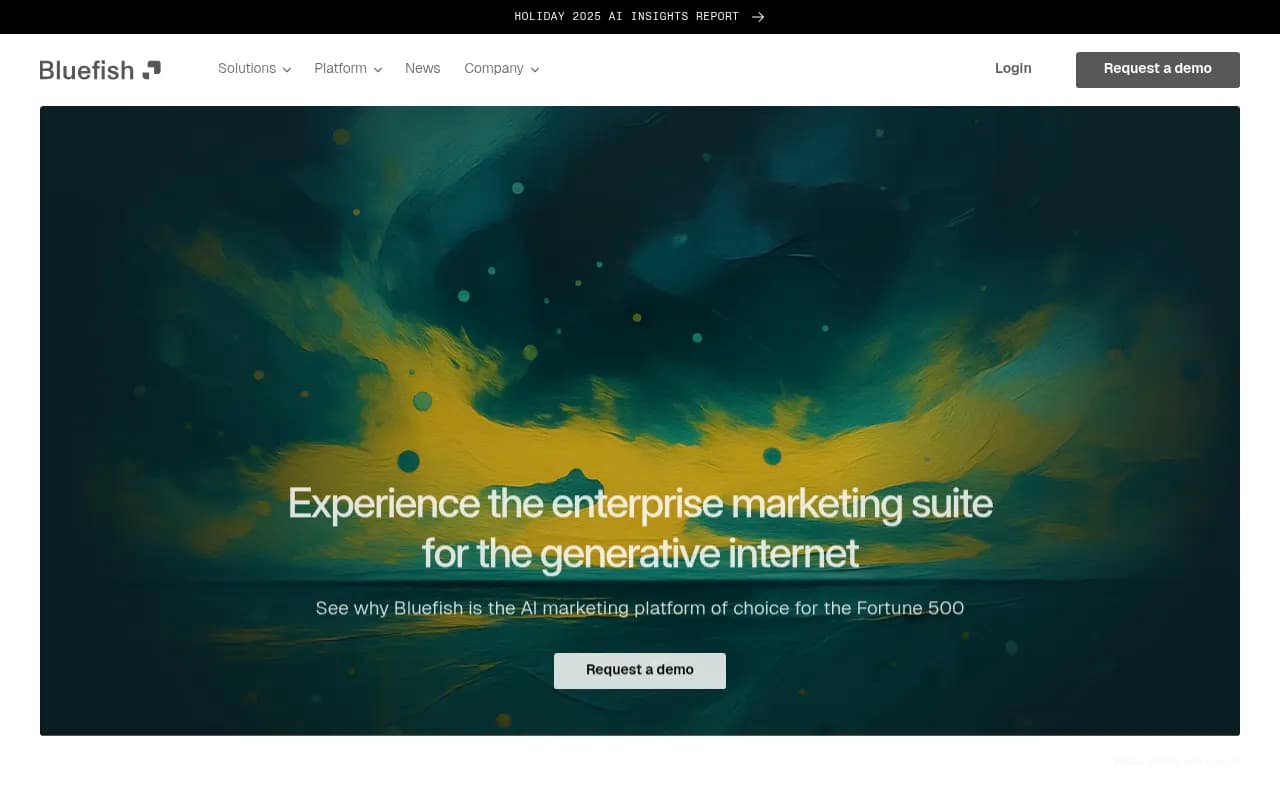
Bluefish AI calls itself the "AI marketing platform of choice for the Fortune 500," and it leans hard into that positioning. The pitch is authority and control: not just tracking where your brand shows up in AI responses, but understanding the mechanics behind those recommendations. Their "Impact and Influence" framing is interesting -- they claim to help marketers understand how AI models form opinions about brands, not just measure the output. The platform covers AI monitoring, GEO optimization, measurement, and AI commerce (including agentic shopping channels). Pricing is enterprise-only, quote-based, and by most accounts starts north of $4,000/month.
Brandlight.ai
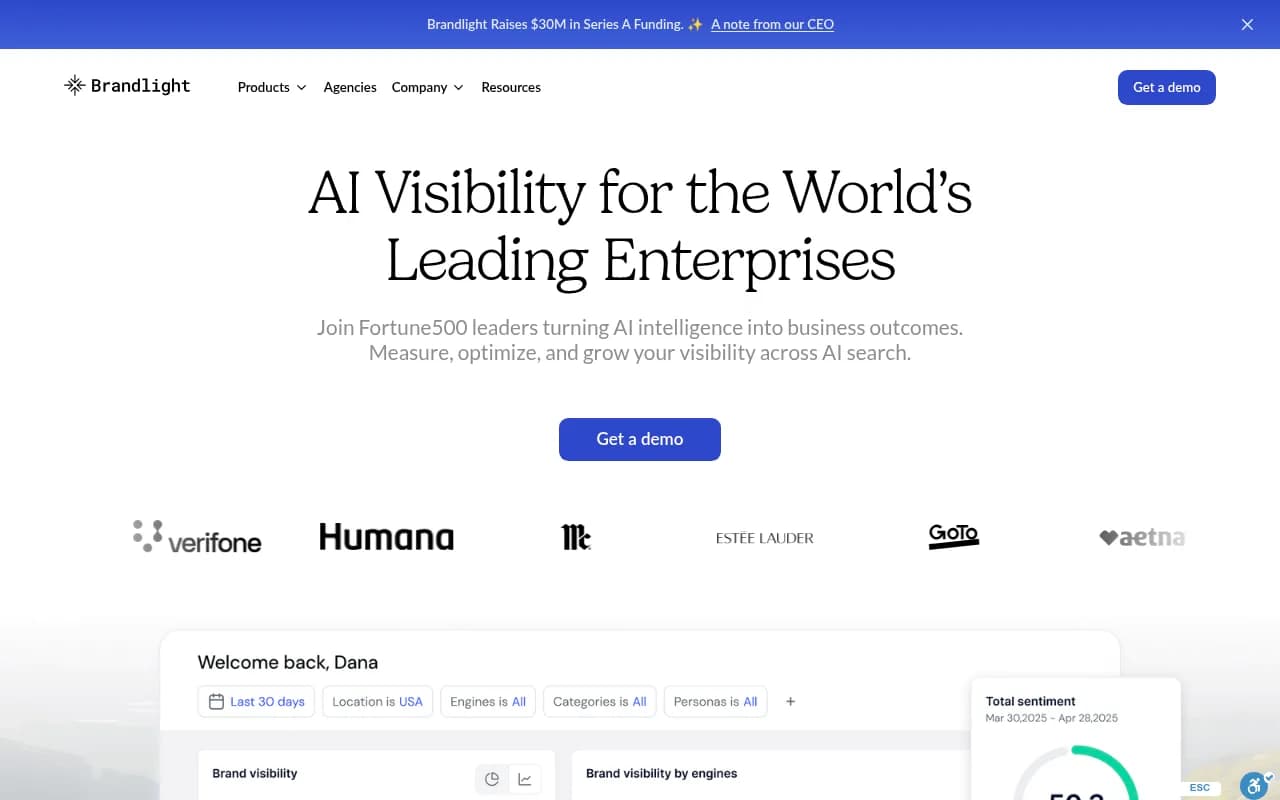
Brandlight.ai is an enterprise AI visibility platform that tracks brand mentions, sentiment, and citations across ChatGPT, Perplexity, Claude, Gemini, and other AI engines. The customer list is impressive -- Humana, Aetna, Mastercard, Estée Lauder, and Kimberly-Clark are among the logos on their homepage. The $30M Series A raise is the biggest recent news here, and it matters: that's a significant bet that the AI visibility market is real and growing. Brandlight's entry pricing is much lower than Bluefish's, with base plans reportedly available from $199/mo, though activation fees and enterprise tiers push the real cost higher.
Side-by-side comparison
| Feature | Bluefish AI | Brandlight.ai |
|---|---|---|
| Starting price | ~$4,000+/mo (quote) | ~$199/mo + ~$750 activation |
| Free trial | No | No |
| Target market | Fortune 500 enterprise | Fortune 500 + mid-market enterprise |
| AI engines monitored | ChatGPT, Perplexity, Claude, Gemini + more | ChatGPT, Perplexity, Claude, Gemini + more |
| Brand sentiment tracking | Yes | Yes |
| Citation tracking | Yes | Yes |
| AI commerce / agentic tracking | Yes (explicit feature) | Not clearly documented |
| Content generation | No | No |
| Content gap analysis | No | No |
| Custom audience segments | Yes | Limited |
| AI crawler logs | Not documented | Not documented |
| Infosec / enterprise security | Explicitly marketed | Not prominently marketed |
| Data team customization | Yes (advanced) | Limited |
| API access | Yes (enterprise) | Yes |
| Funding / stage | Not disclosed | $30M Series A |
| Onboarding complexity | High | Moderate |
Head-to-head feature deep-dive
Pricing and accessibility
This is where the two platforms diverge most sharply. Bluefish AI is a pure enterprise play -- no self-serve, no public pricing, no trial. You request a demo, go through a sales process, and end up with a contract that reportedly starts around $4,000/month. That's not unusual for enterprise software, but it does mean Bluefish is effectively off the table for anyone without a serious budget and a procurement process to match.
Brandlight.ai is more accessible. Base plans reportedly start at $199/month, though there's an activation fee of around $750 and enterprise tiers that push costs significantly higher. Still, the entry point is meaningfully lower, and that matters for marketing teams that want to test the platform before committing.
Verdict: Brandlight wins on accessibility. Bluefish is for organizations where $4,000+/month is a line item, not a decision.
AI monitoring depth
Both platforms track brand mentions, sentiment, and citations across the major AI engines. Where Bluefish differentiates is in its claim to go "beyond superficial metrics" -- specifically, the idea that you can understand how AI models form recommendations about your brand, not just whether you appear.
Bluefish also explicitly covers agentic commerce: tracking how your brand shows up in AI-powered shopping and purchasing flows. That's a forward-looking capability that matters as ChatGPT Shopping and similar features become more prominent. Brandlight's monitoring is solid but doesn't clearly document equivalent agentic commerce coverage.
Verdict: Bluefish has the edge on monitoring depth, particularly for brands selling products through AI-assisted commerce channels.
Optimization capabilities
Here's the honest assessment of both platforms: they're primarily monitoring tools. Neither Bluefish nor Brandlight includes built-in content generation, content gap analysis, or tools that help you create content specifically engineered to get cited by AI models. Bluefish talks about "automating optimization workflows" and "GEO measurement," but the public-facing detail on what that actually means is thin.
This is a real limitation. Knowing you're invisible in AI search is useful. Knowing exactly what content to create to fix that -- and having a tool that helps you write it -- is more useful. Neither platform closes that loop.
If that gap matters to your team, it's worth knowing that Promptwatch is built specifically around that action cycle: find gaps, generate content, track results.

Verdict: Draw -- both platforms are monitoring-first. Neither is an optimization platform in the full sense.
Enterprise features and security
Bluefish explicitly markets its infosec credentials. They say they "consistently pass infosec reviews with ease" -- which is a specific claim that matters to IT and security teams at large organizations. They also offer more advanced data customization, segmentation, and integration options for data teams.
Brandlight serves similar enterprise clients (Humana, Aetna, Mastercard) but is less explicit about security certifications and compliance in its public materials. That doesn't mean they lack them, but Bluefish makes it a selling point while Brandlight doesn't.
Verdict: Bluefish has the edge for organizations with strict infosec requirements. Brandlight's enterprise credentials are implied by its customer list but not clearly documented.
Ease of use and onboarding
Based on available comparisons, Brandlight has a lighter onboarding curve. The platform is designed to get teams up and running faster, which makes sense given its lower price point -- if you're paying $199/month, you can't afford a six-week implementation. Bluefish, by contrast, is a heavier implementation with more customization, which means more setup time but also more tailored output.
Verdict: Brandlight is easier to get started with. Bluefish requires more investment upfront but offers more control once configured.
Product velocity and roadmap
Brandlight's $30M Series A is the most significant recent development in this comparison. That's a meaningful amount of capital for a GEO platform, and it signals aggressive product development ahead. The risk is that some of what they're selling is still being built. Bluefish's funding situation is less transparent, but the platform appears more mature in its current feature set.
Verdict: Bluefish is more mature today. Brandlight may close the gap quickly with its new funding.
Pricing comparison
| Plan | Bluefish AI | Brandlight.ai |
|---|---|---|
| Entry / base | ~$4,000+/mo (est.) | ~$199/mo |
| Activation / setup | Not disclosed | ~$750 |
| Mid-tier | Quote-based | Custom |
| Enterprise | Custom | Custom |
| Free trial | No | No |
| Annual discount | Not disclosed | Not disclosed |
| Pricing model | Quote only | Tiered + custom |
The pricing gap here is real and significant. Brandlight's $199/mo entry point is almost certainly a limited-feature tier, and the real cost for a meaningful enterprise deployment will be higher. But even at $1,000-2,000/month for a mid-market Brandlight deployment, that's still well below Bluefish's floor.
Pros and cons
Bluefish AI
Pros:
- Deeper monitoring and influence analysis than most competitors
- Agentic commerce tracking for AI-powered shopping channels
- Strong infosec credentials for enterprise procurement
- Advanced data customization for data teams
- Custom audience segmentation
Cons:
- $4,000+/month pricing excludes most teams
- No self-serve or free trial
- No built-in content generation or gap analysis
- Limited public documentation on specific features
- Heavy implementation process
Brandlight.ai
Pros:
- Much lower entry price ($199/mo vs $4,000+/mo)
- $30M Series A means active product development
- Impressive enterprise customer list (Humana, Aetna, Mastercard, Estée Lauder)
- Lighter onboarding curve
- Covers major AI engines for brand monitoring
Cons:
- No content generation or content gap analysis
- Agentic commerce coverage unclear
- Less explicit about infosec certifications
- Activation fees add to real cost
- Still building out features post-funding round
Who should pick which tool
Choose Bluefish AI if:
- You're a Fortune 500 brand with a $4,000+/month budget for AI visibility
- Your team needs to pass strict enterprise infosec reviews
- You're selling products through AI-assisted commerce channels and need agentic tracking
- You want deep customization and control over how data is segmented and reported
- You have a data team that will actually use advanced configuration options
Choose Brandlight.ai if:
- You want enterprise-grade AI visibility monitoring without a $4,000+/month commitment
- You're a mid-market brand or a large brand testing the AI visibility category before a bigger investment
- Faster onboarding matters -- you need something running in days, not weeks
- You want to bet on a well-funded platform that's actively building new features
- Your primary need is brand mention and sentiment tracking across AI engines
Consider neither if:
- You need to actually fix your AI visibility gaps, not just measure them -- both tools are monitoring-first, and neither helps you create content that gets cited by AI models
- You're an agency managing multiple brands at different budget levels
- You want prompt-level intelligence, content gap analysis, or AI crawler logs
Final verdict
Bluefish AI and Brandlight.ai are solving the same problem -- enterprise AI visibility -- but for different buyers. Bluefish is the deeper, more expensive, more security-hardened option for organizations where budget isn't the constraint. Brandlight is the more accessible entry point, backed by fresh capital and a credible enterprise customer list.
The honest limitation of both: they tell you where you stand in AI search, but they don't help you change it. If your goal is to actually improve your AI visibility rather than just measure it, you'll need to look beyond either platform for content optimization capabilities.