Key takeaways
- Brandlight.ai is a capable enterprise monitoring tool, but its pricing is opaque, its buying process is sales-led, and it doesn't help you act on what you find.
- Promptwatch covers the full loop: find visibility gaps, generate content to close them, then track the results -- all in one platform.
- Brandlight lacks AI crawler logs, content generation, Reddit/YouTube tracking, and ChatGPT Shopping monitoring. Promptwatch has all of these.
- Promptwatch's pricing starts at $99/month with a self-serve free trial. Brandlight's enterprise contracts reportedly run $4K to $15K/month.
- For teams that want to move fast and actually improve AI visibility -- not just report on it -- Promptwatch is the more practical choice in 2026.
The AI search visibility space has grown up fast. A year ago, most teams were still figuring out whether ChatGPT and Perplexity were worth tracking at all. Now, the question isn't whether to monitor AI search -- it's which platform actually helps you do something about what you find.
Brandlight.ai raised a $30M Series A and built a genuinely serious product. It tracks brand mentions across ChatGPT, Gemini, Perplexity, Copilot, and Grok. It layers in sentiment analysis, citation data, and a multi-brand command center. For a global CMO at a Fortune 500 company with a dedicated AI strategy team and a large budget, it's a credible choice.
But a lot of teams aren't that. And even some teams that are that have started switching.
Here's what's driving it.
Reason 1: Brandlight shows you the problem. Promptwatch helps you fix it.
This is the core issue, and it comes up repeatedly in user feedback. Brandlight is fundamentally a monitoring dashboard. It tells you where your brand appears, how often, and with what sentiment. That's useful data. But it leaves you staring at a gap with no clear path forward.
Promptwatch is built around a different idea: visibility data is only valuable if you can act on it. The platform runs what it calls an Answer Gap Analysis -- it shows you exactly which prompts your competitors are visible for that you're not, and maps those gaps to specific content your site is missing. Not vague recommendations. Specific topics, angles, and questions that AI models are already surfacing but can't find answers to on your domain.
From there, Promptwatch's Content Agents generate articles, listicles, comparisons, and briefs grounded in real prompt data, citation patterns, and competitor analysis. You publish the content, and the platform tracks when AI crawlers pick it up, when it moves from crawl to citation, and how your visibility scores change as a result.

Brandlight doesn't have an equivalent to any of this. It can tell you that a competitor is outperforming you on a set of prompts. It can't tell you what to write to change that, and it can't generate the content for you.
For teams with dedicated content strategists and AI specialists who can translate monitoring data into action independently, that gap might be manageable. For everyone else, it's a real problem.
Reason 2: The pricing model is a significant barrier
Brandlight doesn't publish pricing. You have to book a sales call to find out what you'll pay, and based on what's been reported publicly, the entry point is around $199/month for basic access, with enterprise contracts running $4,000 to $15,000 per month.
That's a wide range, and the lack of transparency makes it hard to evaluate before you've already invested time in a sales process. For agencies managing multiple client accounts, or in-house teams at growing brands that need to move quickly, that friction is a dealbreaker.
Promptwatch publishes its pricing openly:
| Plan | Price | Sites | Prompts | Articles | Key features |
|---|---|---|---|---|---|
| Essential | $99/mo | 1 | 50 | 5 | Core monitoring, gap analysis |
| Professional | $249/mo | 2 | 150 | 15 | Crawler logs, city/state tracking |
| Business | $579/mo | 5 | 350 | 30 | Multi-site, full content generation |
| Agency/Enterprise | Custom | Custom | Custom | Custom | White-label, API, custom workflows |
There's a free trial. You can start without talking to anyone. That matters when you're trying to evaluate whether a tool actually works before committing budget.
Reason 3: Promptwatch tracks what AI engines actually do to your site
One of the most underrated capabilities in the AI visibility space is AI crawler log analysis. When ChatGPT, Claude, or Perplexity crawls your website, they leave traces -- which pages they read, how often they return, what errors they hit, and how long it takes for a crawled page to start appearing in citations.
Promptwatch captures all of this in real time. You can see exactly which pages AI crawlers are visiting, spot indexing issues before they affect your visibility scores, and understand the timeline from "content published" to "content cited." The platform connects through Cloudflare, Fastly, Vercel, server logs, or a tracking snippet.
Brandlight doesn't have this. Neither do most competitors in this space. It's a meaningful gap, because without crawler data you're essentially guessing at why your visibility is or isn't improving. You might publish new content, see your citation count tick up two weeks later, and have no idea whether it was the content itself, a technical fix, or just a model update.
With crawler logs, you can actually debug the process.
Reason 4: Brandlight misses channels that matter
Brandlight tracks the major AI surfaces -- ChatGPT, Gemini, Perplexity, Copilot, Grok. That's a reasonable starting point. But there are a few channels it doesn't cover that have become increasingly important.
Reddit and YouTube. AI models cite Reddit threads and YouTube videos constantly. If a Reddit post is driving ChatGPT to recommend a competitor over you, you need to know about it. Promptwatch surfaces these discussions directly -- which threads, which videos, which external pages are shaping AI responses about your category. Brandlight doesn't track either channel.
ChatGPT Shopping. As ChatGPT has expanded its product recommendation and shopping carousel features, brand appearances in those results have become commercially significant. Promptwatch monitors when your brand shows up in ChatGPT's shopping recommendations and entity mentions. This is a channel Brandlight hasn't built for.
Offsite citation analysis. It's not just your own pages that drive AI visibility. Third-party listicles, brand mentions on external sites, and forum discussions all feed into how AI models perceive your brand. Promptwatch tracks these offsite citations so you know where to invest beyond your own content.
Reason 5: Prompt intelligence makes prioritization possible
Here's a practical problem every team faces: you have limited time and content budget, and there are hundreds of prompts you could potentially target. Which ones do you go after first?
Brandlight gives you visibility data but doesn't help you prioritize. Promptwatch includes volume estimates and difficulty scores for each prompt, plus query fan-outs that show how one prompt branches into related sub-queries. You can see which prompts have high search volume, which are winnable given your current domain authority, and which ones a competitor has locked up so thoroughly that you'd be better off going elsewhere first.
That kind of prioritization data is what separates a tool that generates reports from one that actually shapes your content strategy. It's the difference between knowing you're invisible on 200 prompts and knowing exactly which 10 to fix this quarter.
How the two platforms compare
| Feature | Brandlight.ai | Promptwatch |
|---|---|---|
| AI model monitoring | ChatGPT, Gemini, Perplexity, Copilot, Grok | 10 models incl. Claude, DeepSeek, Meta AI, Mistral |
| Pricing transparency | No (sales-led) | Yes (self-serve from $99/mo) |
| Free trial | No | Yes |
| Content generation | No | Yes (Content Agents) |
| Answer gap analysis | No | Yes |
| AI crawler logs | No | Yes (Professional+) |
| Reddit/YouTube tracking | No | Yes |
| ChatGPT Shopping tracking | No | Yes |
| Offsite citation analysis | No | Yes |
| Prompt volume + difficulty | No | Yes |
| Query fan-outs | No | Yes |
| Traffic attribution | No | Yes |
| Multi-language/region | Yes | Yes |
| Target audience | Fortune 500, enterprise | Marketing teams, agencies, growing brands |
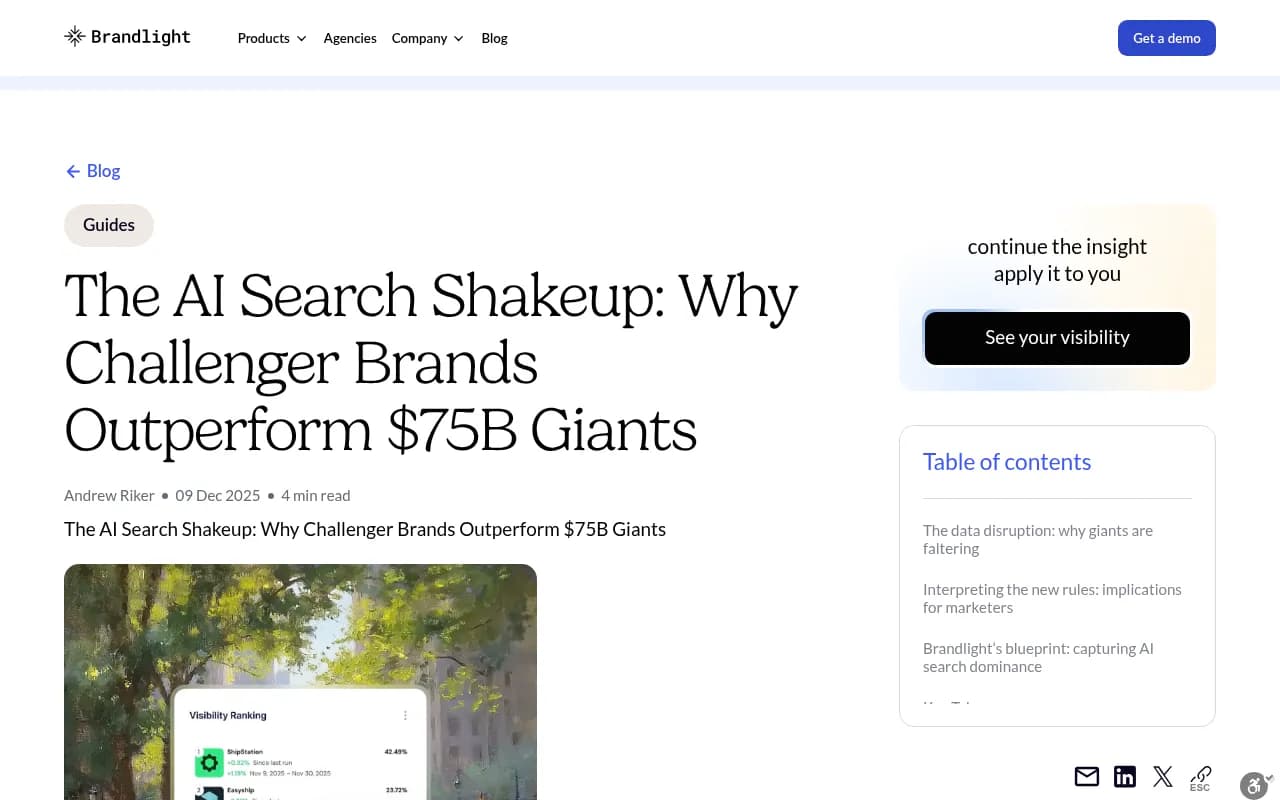
Brandlight is a real product with real customers. Volkswagen, LG, and TD Bank are on its roster. The research it publishes -- like its analysis showing ShipStation outperforming UPS and USPS on AI visibility despite being a fraction of the size -- is genuinely interesting and shows the team understands the space.
But "interesting research" and "helps your team improve" are different things. Brandlight has built a strong monitoring product for enterprise teams that have the resources to act on data independently. Promptwatch has built a platform for teams that need the monitoring and the action layer in one place.
Who should still consider Brandlight?
To be fair: if you're a Fortune 500 brand with a dedicated AI search strategy team, a large budget, and an existing workflow for translating monitoring data into content strategy, Brandlight's enterprise feature set and white-glove onboarding might genuinely suit you. Its multi-brand command center and technical health audits are built for that context.
But if you're:
- An in-house marketing or SEO team that needs to show results, not just reports
- A digital agency managing multiple client accounts with different budgets
- A growing brand that wants to compete with larger players in AI search (and Brandlight's own research shows this is very possible)
- Anyone who wants to start without a sales call
...then the calculus is pretty clear.
The bottom line
The AI search visibility space is splitting into two categories: monitoring tools and optimization platforms. Brandlight is in the first category. Promptwatch is in the second.
That distinction matters more in 2026 than it did a year ago, because the teams that have been tracking AI visibility for 12+ months have already learned that data without action doesn't move the needle. The next phase of this market is about who can actually improve their citation counts, not just measure them.
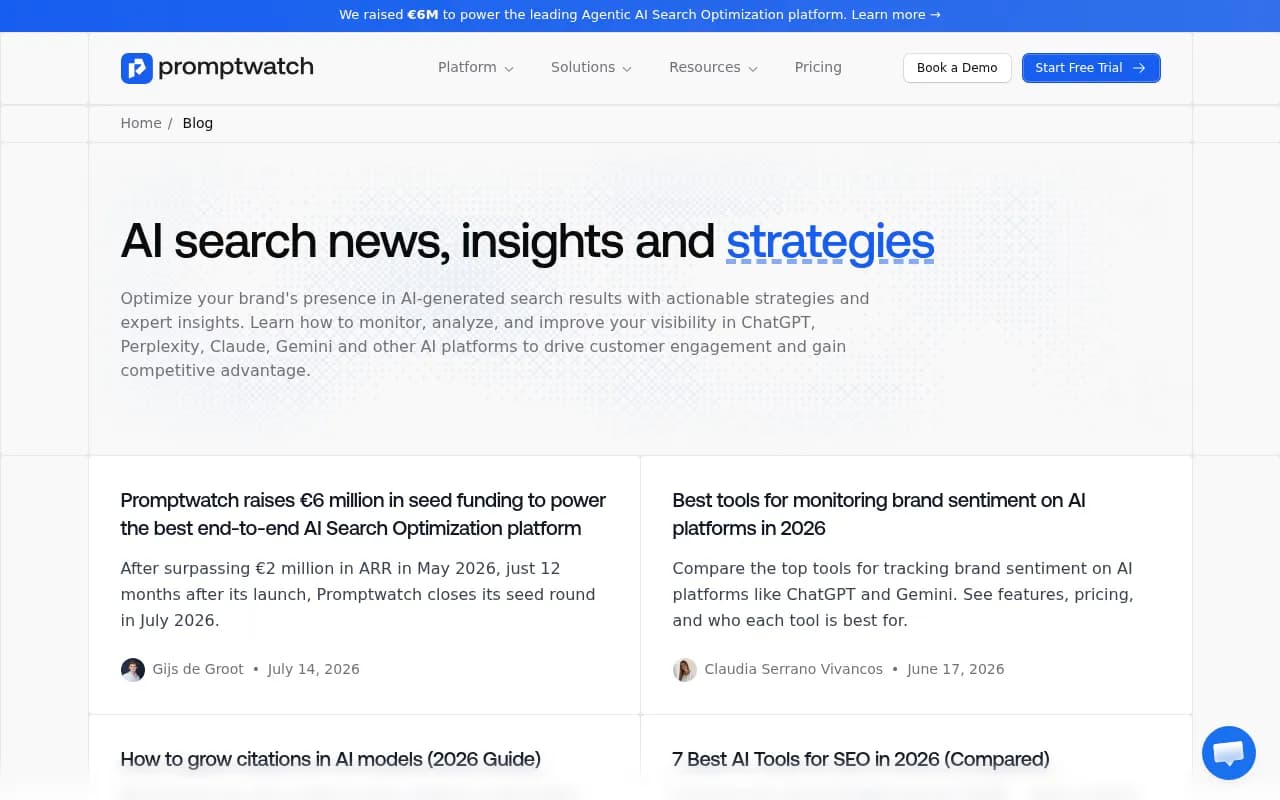
Promptwatch's recent €6M seed round -- closed in July 2026 after surpassing €2M in ARR in just 12 months -- suggests the market has noticed. So have the 1,480+ brands and agencies already on the platform.
If you're evaluating alternatives to Brandlight, Promptwatch is the most direct replacement that also goes further. The free trial is the obvious starting point.