Key takeaways
- Most GEO platforms track AI visibility at the brand or national level only. If you have 50 locations, 12 states, or a franchise network, you need granular state and city-level prompt tracking, which only a handful of platforms actually do well.
- Promptwatch is the only platform in this list that combines state/city-level AI prompt tracking with content generation and CMS publishing, not just monitoring.
- Pure local-SEO and multi-location management tools (Yext, Uberall, Synup, Chatmeter) have deep location data infrastructure but shallow or nonexistent AI-model-level visibility tracking by geography.
- Depth of coverage depends on three things: how many geographic levels the platform supports (country, state, metro, city), how many prompts you can run per location, and whether it ties that data back to actual content fixes.
- If AI visibility by location isn't core to your GEO tool, you'll end up stitching together a local SEO platform and a separate AI tracker, which is what most multi-location brands are doing right now.
Why state and city coverage depth even matters
If you run a single-location SaaS company, national-level AI visibility tracking is fine. You care about whether ChatGPT mentions your brand, full stop. But if you're a healthcare network with 40 clinics, a real estate brokerage active in 12 metros, or a restaurant chain with locations in six states, "are we visible in ChatGPT" is the wrong question. The right question is "are we visible in ChatGPT when someone in Dallas asks about urgent care clinics," and that's a completely different data problem.
Most GEO platforms were built for the first scenario. They sample a fixed set of prompts against a handful of AI models and report an aggregate visibility score. That's useful, but it tells a multi-location brand almost nothing about which city is underperforming or which state needs a dedicated content push.
This gap matters more now than it did a year ago. Google AI Overviews now appear on the large majority of branded searches, and AI answers increasingly personalize by location when a user's query includes geographic intent ("best dentist near me," "HVAC repair in Phoenix"). A platform that can't fan out prompts by state or metro is structurally blind to that layer of AI search.
There's also a content-side parallel worth noting. Digital PR teams have known for years that geo-specific content performs: campaigns like "best and worst states to retire in 2026" or city-by-city rankings earn backlinks and local press pickup precisely because they give every local newsroom its own angle. One roundup of 36 such campaigns found that the strongest ones used proprietary data and repeatable annual formats to keep earning links year over year.
The same logic applies to AI visibility. If a brand's content is structured by location (city pages, state guides, metro comparisons), it has more surface area for AI models to cite when answering geographically-scoped prompts. The platforms below vary enormously in how well they let you measure, and then act on, that surface area.
How we evaluated coverage depth
We looked at four things for each platform:
- Geographic granularity: can the tool track AI visibility at the country, state, metro, or city level, or only nationally?
- Prompt volume per location: how many location-specific prompts can you realistically run without hitting a hard limit?
- Model coverage: does location tracking work across ChatGPT, Google AI Overviews, Perplexity, Gemini, and others, or just one?
- Action layer: once you know a city is underperforming, does the platform help you fix it, or just report the gap?
The ranking
1. Promptwatch
Promptwatch supports state, city, and country-level tracking natively on its Professional plan and above, which puts it ahead of most competitors that treat location as an afterthought or a manual workaround. You can run location-specific prompt sets, see citation rates per page by geography, and track which of your location pages actually get pulled into AI answers.

What separates it from pure trackers is the action layer. Once Promptwatch flags that your Denver location page has zero AI citations while your Austin page gets cited weekly, its content gap analysis and Content Agents can draft and publish a fix to your CMS (Webflow, Framer, or WordPress) rather than leaving you with a spreadsheet of problems. It also pulls in AI crawler logs, so you can see whether ChatGPTBot or GoogleOther is even visiting your city pages in the first place, which is often the real reason a location is invisible. For multi-location brands, that diagnostic step (crawler visited vs. crawler never showed up vs. crawler visited but didn't cite) is the difference between guessing and knowing.
At $245/mo for the Professional tier (2 sites, 150 prompts, state/city tracking, automated content generation), it's priced for mid-market multi-location brands, not just enterprise. The Business tier ($579/mo) scales to 5 sites and 350 prompts for larger franchise or multi-brand operations.
2. Yext
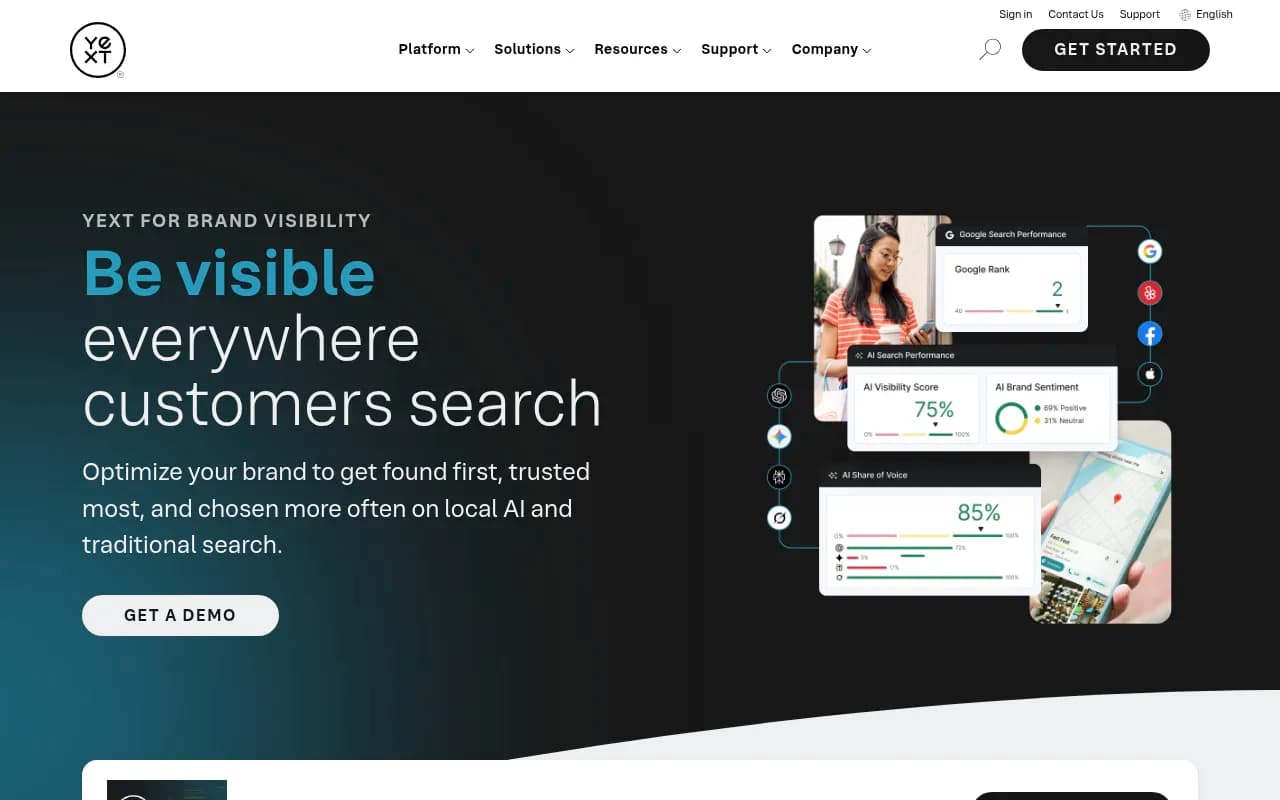
Yext built its reputation on structured location data: hours, addresses, services, and attributes synced across hundreds of directories and maps. That same structured data foundation is exactly what AI answer engines lean on when resolving "near me" and city-specific queries, which makes Yext a strong foundational layer even though its AI-model-level visibility reporting isn't as deep as a dedicated GEO platform's.
Coverage depth here is about data accuracy at scale across thousands of locations rather than prompt-level AI tracking. If your location data is wrong or inconsistent, no GEO platform will fix your AI visibility, so Yext functions as infrastructure other tools build on top of.
3. Uberall
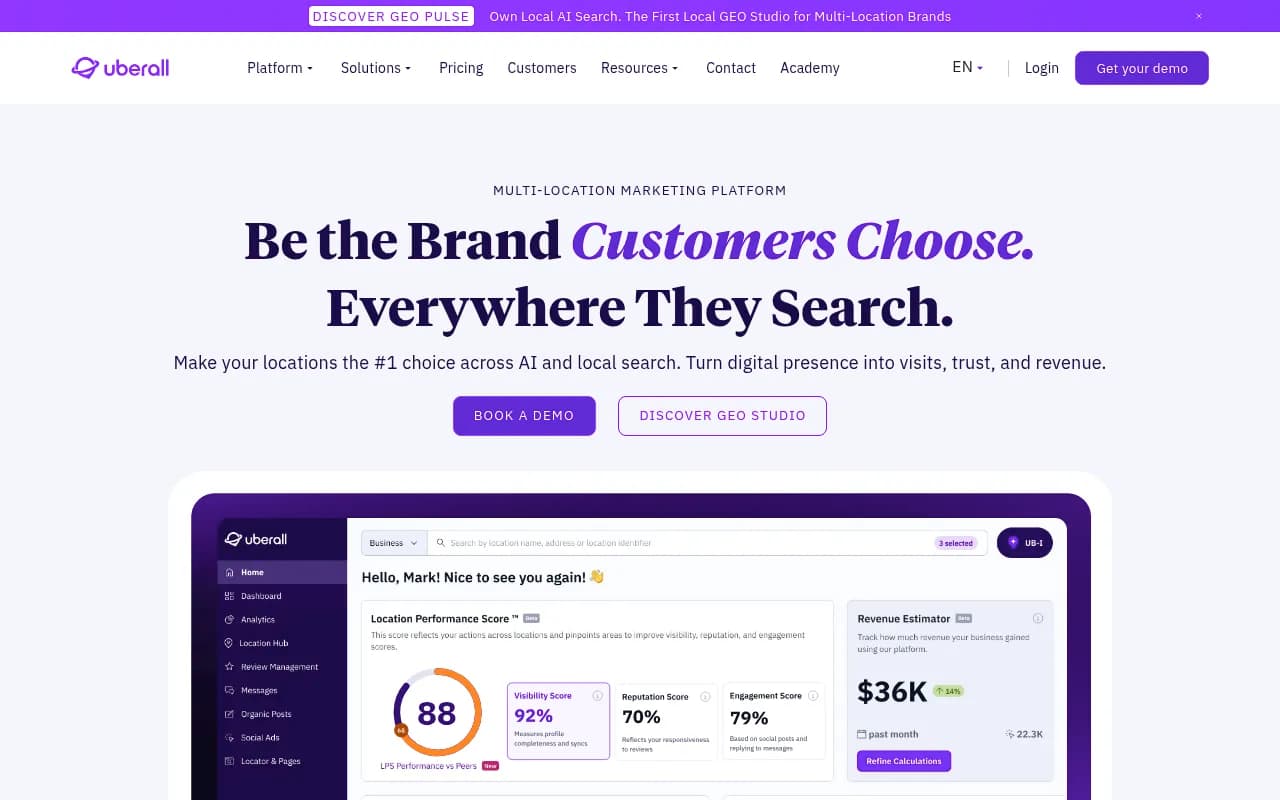
Uberall focuses on turning scattered multi-location data into a single searchable, AI-ready structure. It's strong on review management and listing consistency across cities, which indirectly feeds AI visibility since review volume and consistency are signals AI models pick up on when summarizing local businesses.
It doesn't offer the granular, prompt-level state/city AI tracking that Promptwatch does, but for brands with hundreds of physical locations, the sheer breadth of markets it manages is its real strength.
4. Synup
[tool:synup] is positioned as an AI agent that runs listings, reviews, and local visibility, which makes it a practical fit for brands that need hands-off management across many markets. Its coverage depth comes from automation breadth, handling dozens or hundreds of city-level listing profiles without manual upkeep, rather than from sophisticated AI citation analytics per location.
5. Birdeye
Birdeye's strength is reputation and review aggregation at multi-location scale, and reviews increasingly shape how AI models describe a business when a user asks something like "is [brand] good in [city]." Its city/state coverage is as deep as your location count, since it's built to scale linearly with however many branches you run. The tradeoff is that it reports sentiment and review volume by location rather than AI citation rate by location, so you still need a separate tool if you want to know whether ChatGPT is actually naming your Chicago branch in responses.
6. Chatmeter
Chatmeter is multi-location reputation and listings management that has started folding in AI visibility features. Coverage depth is solid for listings and review tracking across large franchise networks, and it's one of the few in this bracket explicitly positioning itself around the AI search shift rather than treating it as a bolt-on.
7. SOCi
SOCi is built for localized social and marketing execution across many markets, think a regional bank or a multi-unit restaurant chain publishing location-specific content and offers at scale. Its coverage depth is about distribution: getting the right message to the right city's audience. It's not a GEO visibility tracker in the AI-citation sense, but the localized content engine it provides is the raw material that feeds AI visibility if you later pair it with a tracking layer.
8. BrightLocal
BrightLocal is a long-standing local SEO platform for agencies managing many client locations. It's deep on traditional local search metrics (rank tracking by city, citation audits, review monitoring) but AI-model-level visibility tracking by geography is still a newer, less mature part of its offering compared to its core local SEO toolkit. Agencies already using it for Google Business Profile and local pack tracking will find it a reasonable place to start, but it's not yet a dedicated state/city AI visibility tool.
Comparison table
| Platform | Geographic granularity | AI model coverage for location tracking | Action layer | Best for |
|---|---|---|---|---|
| Promptwatch | Country, state, city | ChatGPT, Gemini, Claude, Perplexity, Google AI Overviews/AI Mode, and more | Content gap analysis, automated content generation, CMS publishing | Multi-location brands wanting AI visibility tracking AND fixes |
| Yext | City-level listing data, thousands of locations | Limited, mostly structured data feed | Listing sync, not content generation | Large multi-location data infrastructure |
| Uberall | City/metro listing and review data | Limited | Review and listing management | Hundreds of physical locations |
| Synup | City-level, automated | Limited | Automated listing/review upkeep | Hands-off multi-location management |
| Birdeye | Scales with location count | Limited | Sentiment and review reporting | Reputation-first multi-location brands |
| Chatmeter | City/franchise level | Emerging | Listings plus early AI visibility features | Franchise networks |
| SOCi | City/metro content distribution | None dedicated | Localized content publishing | Regional marketing execution |
| BrightLocal | City-level local SEO metrics | Emerging | Rank tracking, citation audits | Agencies managing local SEO clients |
How to choose for your situation
If AI visibility by location is your primary concern, meaning you want to know whether ChatGPT or Google AI Overviews mention your Austin branch when someone asks a city-specific question, start with a dedicated GEO platform that supports state/city prompt tracking rather than retrofitting a local SEO tool. Promptwatch is currently the clearest option here because it's built the location layer into the same product that handles content fixes.
If your bigger problem is basic data hygiene (wrong hours, inconsistent addresses, missing listings across 200 locations), start with Yext, Uberall, or Synup. No amount of AI visibility tracking will help if your underlying location data is a mess, since that's exactly the kind of inconsistency that erodes AI model trust in your brand's information.
If you're an agency managing local SEO for many small business clients and just need basic rank and citation tracking city by city, BrightLocal remains a sensible, affordable starting point, with the caveat that you'll likely need to add a dedicated AI visibility tool on top as client demand for AI search reporting grows.
A practical setup for a mid-size multi-location brand in 2026 often looks like this: Yext or Uberall for listing data hygiene, Birdeye or Chatmeter for review management, and Promptwatch layered on top for the actual AI citation tracking and content fixes by state and city. That's three tools, which sounds like a lot, but each solves a distinct problem that the others don't.
Common mistakes to avoid
Treating national AI visibility scores as a proxy for local performance is the biggest one. A brand can show up strongly in aggregate ChatGPT visibility tests while being completely invisible in half its operating states, because the national score averages out the gaps. Ask any vendor directly how many distinct locations their platform can track simultaneously before you commit.
Another mistake is assuming that fixing listing data alone will fix AI visibility. Listing accuracy matters, but AI models cite content, not directory entries, when answering substantive questions. If your city pages are thin, duplicated across locations, or missing entirely, no amount of NAP consistency will get you cited.
Finally, don't ignore the crawler layer. A location page can be perfectly written and still never get picked up because an AI crawler never successfully reads it, whether due to a robots.txt block, a JavaScript rendering issue, or a server error. Platforms with crawler log visibility, Promptwatch among them, catch this before it becomes a months-long mystery.
For brands exploring the broader category beyond these eight, the GEO software directory at bestgeosoftware.com is a reasonable place to compare more general-purpose AI visibility platforms against the local-specific ones covered here.