Key takeaways
- Ranked AI ($99–$349/mo per website) is a managed service with software included: humans write and edit weekly blog content, do outreach-based link building, and implement technical fixes in your CMS or codebase.
- NytroSEO (free to $499/mo, credit-metered) is a full-automation tool: a JavaScript snippet in your header dynamically rewrites meta titles, descriptions, ALT text, and anchors using AI-interpreted search intent.
- The core trade-off is control vs. hands-off: JS-injected meta tags carry real technical risk, since Google may not execute the script reliably and defaults to raw HTML.
- AI search increasingly rewards actual content (product pages led ChatGPT citations at 32.8% in July 2026), so meta-tag automation alone is a thin strategy for GEO.
- Best fit: Ranked AI for businesses that want outcomes without hiring in-house; NytroSEO for agencies and site owners who want cheap, scalable on-page optimization and can verify the results.
Two very different bets on the same problem. Ranked AI says "let our team and software handle your SEO and PPC." NytroSEO says "install a snippet and let algorithms rewrite your meta-tags forever." One is a service with software attached. The other is software with no service at all. Which one makes sense depends on what you actually need, so let's break both down honestly.
What each product actually is
Ranked AI: a managed service with software included
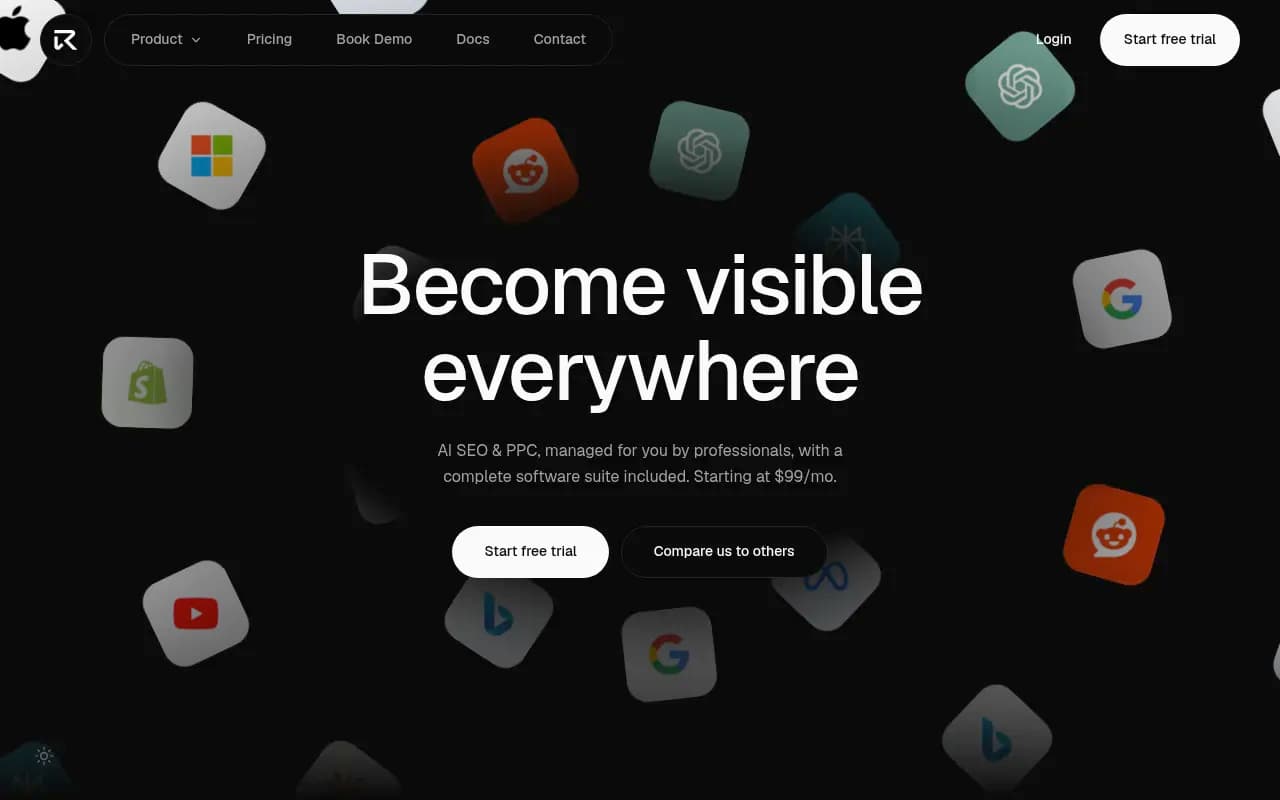
Ranked AI describes itself as "primarily a service" that also includes its software with no limits. For a flat monthly fee per website, you get a team doing the work: weekly blog content (AI-drafted, human-edited), backlink acquisition through human outreach, Google Business Profile management, and technical fixes implemented directly in your CMS or codebase rather than injected via a script. The software side includes unlimited keyword tracking, unlimited prompt tracking for AI visibility, SEO audits, daily backlink tracking, GA/GSC/GBP integrations, local heatmaps, and a free white-label option at every tier. The company serves 5,000+ businesses and holds 4.6/5 from 224+ Trustpilot reviews.
NytroSEO: automated meta-tag optimization via code injection
NytroSEO's pitch is that meta-tag optimization is essential but labor-intensive, so a machine should do it. You place a small JavaScript snippet in your website header. The system then dynamically updates and refines meta titles, meta descriptions, OG tags, image ALT text, and link anchor text, using AI to interpret search intent and adaptive ML algorithms that react in real time to SERP and algorithm changes. It supports unlimited keywords and pages in principle, multi-language, and claims an "AEO Conversational Ask Search Optimization" feature for AI chat visibility. There is no account team. The product is the automation.
Pricing compared
| Ranked AI | NytroSEO | |
|---|---|---|
| Entry price | $99/mo per website | Free (1 site, 5 keywords) |
| Mid tier | $198/mo (50 keywords, 2 articles/week) | $119/mo Professional (10 sites, 100 keywords) |
| Top tier | $349/mo (100 keywords, 4 articles/week, dedicated AE) | $499/mo Agency (100 sites, 1,100 keywords) |
| Pricing model | Flat, month-to-month, no contracts | Credit/quota-metered, 30-day trial on paid plans |
| Overages | None stated | $11/mo per 1,000 additional pages |
| Contracts | None, month-to-month | None, subscription or AppSumo lifetime deal |
| What you get | Humans + software | Software only |
NytroSEO is dramatically cheaper per site, especially at agency scale, and its free tier lets you test the mechanism before paying anything. Ranked AI costs more but the fee is buying labor: writers, an outreach team, and someone who answers your emails.
The technical elephant in the room: JS-injected meta tags
Here's where I have to be blunt about NytroSEO's core mechanism. Google's own JavaScript SEO guidance says Google won't recommend using JavaScript to inject certain tags, and warns that if JS execution times out or errors, Google defaults to the raw HTML. A Google Search Central support thread on dynamic meta tag injection via JavaScript documents the same problem: Google can't reliably detect when a page has finished loading before evaluating tags, so JS-injected meta changes can be missed or picked up late and inconsistently.
What that means in practice: if your pages already have decent meta tags in the source HTML, a JS layer rewriting them may or may not be seen by Google on any given crawl. If your pages have no meta tags at all, the injection may help, but you'd get the same benefit from just writing the tags into the source. And there's a second-order risk worth naming: tools that layer changes over the DOM rather than the source HTML sit uncomfortably close to the cloaking boundary, where search engines see one version of a page and visitors see another. Ranked AI makes this exact critique of pixel-based competitors like Search Atlas OTTO, arguing that source-level changes stay after you leave, while script-dependent fixes evaporate the moment the snippet is removed.
To be fair, NytroSEO's Trustpilot rating sits at 4.3/5, and AppSumo reviews praise the onboarding calls and ease of use for non-technical owners. But there's also a Reddit thread on r/appsumo titled "Stay away from NytroSEO. Fake Company, Non Working..." describing "spammy keyword stuffing and a JS injection that doesn't work to add metas / descriptions." Mixed signals. The pattern I'd note is that satisfied customers tend to be small-business owners who had poorly optimized sites to begin with, where almost any meta-tag attention helps. The unhappy ones tend to be people who expected the automation to do more than meta-tags can.
Does meta-tag automation even matter for AI search?
This is the deeper question, and the data is not kind to the "automate the meta-tags" thesis.
Promptwatch's citation-type research for July 2026 shows product pages leading ChatGPT citations at 32.8% of the total, nearly double their roughly 18% share in March 2026, followed by listicles at 9.7% and news articles at 5.2%. On the Google side, AI Overviews in July 2026 cited listicles at 18.0%, product pages at 16.3%, and how-tos at 15.1%, with product pages overtaking listicles as the single most-cited format from July 28 onward. The pattern across both engines: AI search rewards substantive, structured content, actual product pages with specs and pricing, real comparisons, genuine how-tos.
Meta tags are almost invisible in this picture. They help Google understand and rank a page in traditional results, and a better title can lift click-through rate, but AI engines build answers from page content, structured data, and offsite signals, not from meta descriptions.
The retrieval side tells a similar story. Promptwatch's query fan-out data shows ChatGPT breaking a single prompt into multiple separate web searches, with average query length dropping from roughly 117 characters in December to about 53 by April, meaning ChatGPT's searches look more like terse keyword queries than full sentences. That rewards pages whose headings and content match narrow search phrasings, which is a content and architecture problem, not a meta-tag problem.
And the slots are scarce. Promptwatch's sources-per-response data shows ChatGPT citing roughly 5 sources per web-search answer, about half of a traditional Google results page, while AI Overviews and Perplexity each cite around 10. Every citation slot is contested, and you win those slots with pages that answer one question well, not with optimized meta descriptions.
None of this makes NytroSEO useless. Clean, intent-matched titles and descriptions still matter for classic SEO and CTR, and at agency scale, having a machine maintain thousands of page titles beats doing it by hand. But as a strategy for "AI search optimization" specifically, meta-tag automation is a thin slice of the work.
What you're really choosing between
Choose Ranked AI if
- You want outcomes, not tooling, and don't have in-house SEO staff.
- You value weekly human-written and human-edited content, which is what actually earns AI citations.
- You want backlinks from human outreach rather than automated networks.
- You want technical fixes made in your source code or CMS, where they survive cancellation.
- You want AI visibility tracking (unlimited prompt tracking) bundled with execution.
The honest caveats: at $99/mo you get 25 focus keywords and one article per week, which is modest velocity. Managed services also mean trusting someone else's judgment, and Ranked AI's own blog warns about the category's pitfalls, providers using PBNs, hiding behind proprietary dashboards, making unapproved changes. Their advice is worth keeping regardless of who you hire: retain your own GA/GSC/Ads logins, set approval guardrails (title tags and alt text can be free rein; pricing, legal, and brand messaging need sign-off), and ask direct questions about link building and AI content editing.
Choose NytroSEO if
- You run an agency with many client sites and need scalable on-page optimization cheaply.
- Your sites have genuinely neglected meta-tags and you want a fast, automated cleanup.
- You're comfortable verifying that Google actually sees the injected tags (check the rendered HTML in Search Console's URL Inspection, and spot-check indexed pages).
- You want a free tier to test the mechanism before committing.
The honest caveats: the JS-injection mechanism carries the reliability risk described above, the credit system adds metering complexity, and the loudest criticism online calls the output "spammy keyword stuffing." The gap between the 4.3 Trustpilot score and the angry Reddit thread suggests results vary a lot depending on the starting condition of the site.
The third option: neither, or both
There's a middle path the question hides. A Reddit thread on r/seogrowth about AI-powered SEO services put it well: "The best AI SEO service is usually the one that helps your team make better decisions faster, not just automate more tasks." Full automation of a narrow task (NytroSEO) and full outsourcing of a broad program (Ranked AI) are two points on a spectrum, and many teams are better served by software that shows them what to fix plus in-house or agency execution.
If your gap is specifically AI visibility, meaning you don't know how often ChatGPT, Gemini, or AI Overviews mention your brand, a dedicated GEO platform like Promptwatch can track prompts, citations, and AI crawler behavior across engines, then tell you which content gaps to close. Ranked AI bundles some of this via unlimited prompt tracking; NytroSEO's AEO claims are harder to verify.

And if you want to survey the broader field before committing, the GEO software directory at bestgeosoftware.com covers the AI visibility side, while surferstack.com has reviews and comparisons for general SEO and marketing tools.
Bottom line
Ranked AI and NytroSEO aren't really competitors; they answer different questions. NytroSEO answers "how do I maintain meta-tags across hundreds of pages without hiring anyone?" Ranked AI answers "how do I get SEO and AI visibility outcomes without building a team?" If your site's problem is neglected on-page basics at scale, NytroSEO's automation, carefully verified, is a reasonable cheap fix. If your problem is that nobody is producing citable content, building links, or tracking how AI engines see you, a managed service like Ranked AI does work that a snippet cannot. Given that AI citations in 2026 flow overwhelmingly to substantive product, comparison, and how-to content, the managed-and-content-heavy approach is the one aligned with where search is actually going.