Key takeaways
- Profound's public pricing page no longer lists numeric tiers for most buyers. Legacy references put a Starter plan around $99/month for ChatGPT only, but real quotes for multi-engine coverage now start closer to $399/month and run into the thousands at Enterprise.
- AthenaHQ ($295/mo), Scrunch ($250/mo), and Peec AI's Pro tier (around $245/mo) are the closest sub-$300 matches for multi-engine tracking, though each cuts something Profound includes at Enterprise: SSO, unlimited history, or native query fan-out visualization.
- The biggest hidden gap isn't price, it's data collection method. Tools that scrape real chat interfaces return roughly double the citations and words per answer compared to tools that rely on the API alone, according to Surfer SEO's testing.
- Query fan-out tracking (seeing the sub-searches an engine runs behind one prompt) is mostly an enterprise-tier feature. Budget tools make you approximate it by manually adding prompts, which burns through your monthly quota faster than you'd expect.
- If you want tracking that turns into actual content fixes rather than another dashboard to check, look for tools with a content agent or CMS publishing built in, not just an alert.
Why this question even matters now
Profound built its name on a legitimate pitch: track how ChatGPT, Perplexity, Gemini, and the rest talk about your brand, and do it with more rigor than a scrappy scraper tool. It worked well enough to land Walmart, Target, and DocuSign as customers, and to raise serious venture funding along the way (reports cite figures anywhere from $96M in early 2026 to a later $180M round, depending on which announcement you're reading).
The problem is what happened to the pricing page after that money came in. Profound's public site now shows a free trial (10 prompts, ChatGPT only, one-time) and then jumps straight to "Enterprise, contact us." Some legacy references and a Reddit thread from Profound's own team still mention a $99/month Starter tier for ChatGPT-only tracking, but ask for Perplexity and Google AI Overviews on top of that and quotes reportedly jump to $399/month. Add Claude, Gemini, Grok, and the rest, and you're in custom-pricing territory, with third-party estimates putting real enterprise deployments at $2,000 to $5,000+ a month.
That's a real number for a Fortune 500 marketing team. It's not a real number for most SaaS companies, agencies, or DTC brands trying to figure out if ChatGPT even knows they exist. So the question worth asking isn't "is Profound good" (it clearly is, for the buyers it's built for). It's: what do you actually lose by paying under $300/month instead?
The sub-$300 field, ranked by what they actually cover
Here's the current landscape as of September 2026, focused only on tools with real, self-serve pricing under $300/month for meaningful multi-engine coverage (not a single-engine starter tier that doesn't reflect how people actually use these tools).
| Tool | Price under $300 | Engines covered | Prompts/credits | What's missing vs. Profound Enterprise |
|---|---|---|---|---|
| AthenaHQ | $295/mo (Starter) | ChatGPT, Perplexity, AIO, AI Mode, Gemini, Claude, Copilot, Grok | 3,600 credits/mo, unlimited topics | API is a paid add-on; no SSO, no advanced claim/citation engine |
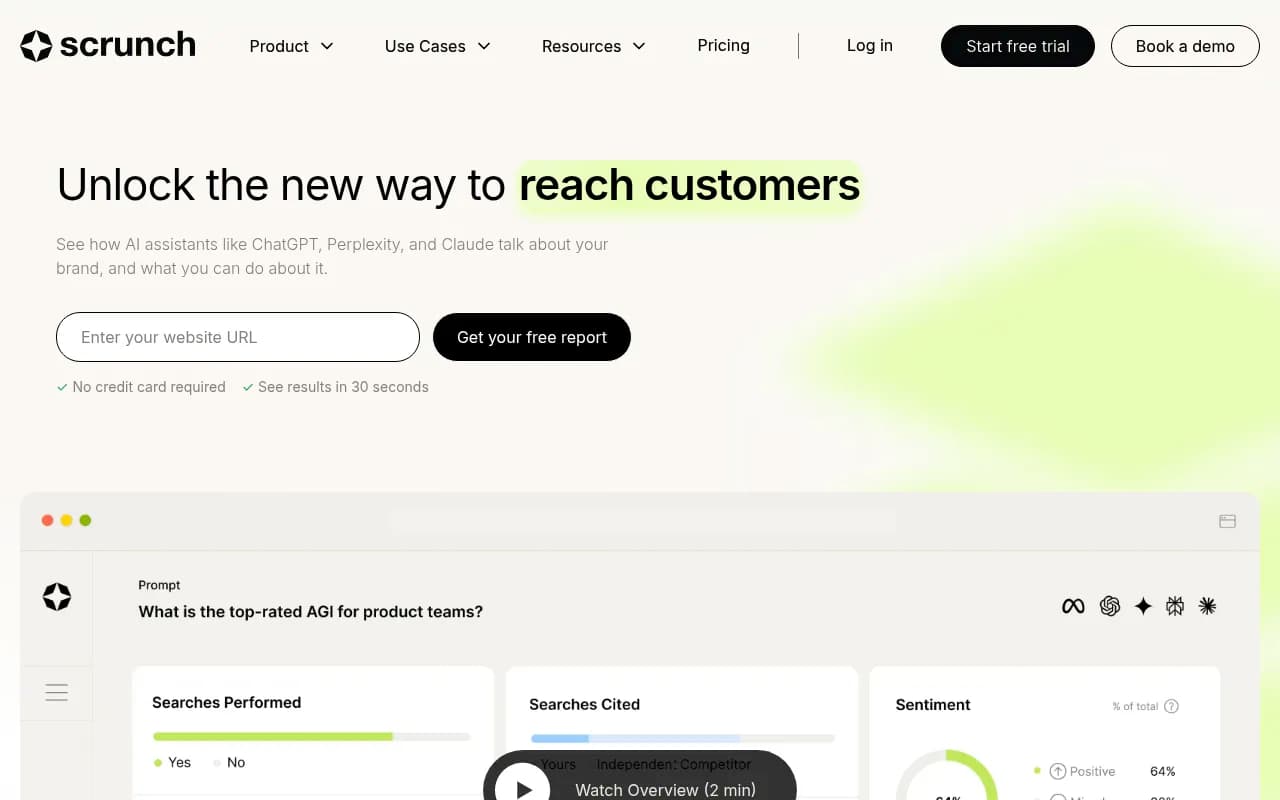
| Scrunch | $250/mo (Core) | 4 engines: ChatGPT, Perplexity, Google AIO, Copilot | 125 prompts, 5 site audits/mo | Only 4 engines; Claude, Gemini, AI Mode, Grok gated to Enterprise |
| Peec AI | ~$212/mo (Pro, EUR converted) | Choose 3 of 6 models | Unlimited seats | Extra engines cost add-on fees per model; full coverage pushes past $300 |
| Otterly.ai | $189/mo (Standard) | 4 base engines, Claude/Gemini as paid add-ons | 100 prompts | Full 7-engine coverage on Standard can exceed $300 once add-ons stack |
| Semrush AI Visibility Toolkit | $99/mo base | ChatGPT, Google AI, Gemini, Perplexity | 25 prompts | Add-ons compound fast: extra domain, seat, or 50 prompts each cost roughly $60-99/mo more |
A few of these numbers are moving targets. Scrunch, for one, A/B-tested a completely different pricing ladder earlier this year before settling on its current Core/Enterprise split, so it's worth checking the live pricing page before you commit rather than trusting any screenshot, including this table.


What you actually give up
Fewer engines, or engines that cost extra one by one
This is the most obvious trade-off and the easiest to spot. Scrunch's $250/month Core plan covers four engines. Profound Enterprise covers up to nine, including DeepSeek and Exa Search, which almost nobody else tracks. Otterly and Peec both use an a la carte model where the base price gets you a handful of engines and each additional one (Claude, Gemini, AI Mode) costs extra per month. Add three or four of those and your "$189/month" plan is suddenly a $300+ plan.
If your brand's audience genuinely lives in ChatGPT and Google's AI surfaces and rarely touches Claude or Grok, this trade-off barely matters. If you're B2B software and your buyers are the kind of people who use Claude for research, it matters a lot.
Query fan-out visibility
When someone asks an AI engine a question, the engine often doesn't answer directly, it runs several sub-searches behind the scenes to build the answer. Profound built a dedicated Query Fanouts feature that shows you exactly which sub-queries a tracked prompt generates. Very few budget tools replicate this natively. Goodie AI has its own version, but it starts at $495/month, above the ceiling we're discussing here.
The workaround with cheaper tools is to manually anticipate the sub-queries and load each one as its own tracked prompt. It works, but it eats into your prompt quota fast, and you're guessing at fan-outs instead of seeing them.
The data collection method, which matters more than the price tag
This is the trade-off almost nobody talks about, and it's bigger than any feature comparison. Surfer SEO ran 1,000 ChatGPT prompt executions through the API and compared them to the same prompts scraped from the actual browser interface. The API responses averaged 406 words. The scraped, real-user-facing responses averaged 743 words, nearly double.
More relevant to visibility tracking: the API returned zero sources roughly 25% of the time, while the scraped answers always included sources and averaged 16 sources versus 7 via API. Brand detection through the API missed a brand entirely about 8% of the time when the scraped version found it every time. Only 24% of the brands identified via API and via scraped UI actually overlapped for ChatGPT, and only 8% of sources overlapped for Perplexity.
In plain terms: a tool that pulls from the API alone might be measuring a version of the AI's behavior that real users never see. Before picking any Profound alternative, ask the vendor directly whether they monitor real interface responses or rely on API calls. It's a more consequential question than most of the feature checklists you'll find in comparison posts.
Promptwatch is one platform that monitors the actual user-facing interfaces of ChatGPT, Gemini, AI Overviews, AI Mode, Perplexity, and Claude rather than treating API output as a stand-in, which is worth checking for if this data-integrity issue matters to you.

Enterprise polish: SSO, audit logs, dedicated support
AthenaHQ gates SAML SSO, audit logs, dedicated Slack support, and a 2-hour SLA to its Enterprise tier. Same story with Scrunch, whose Enterprise plan adds the Agent Experience Platform and SSO on top of the extra five engines. If you're a solo marketer or a five-person team, none of this matters. If you're at a company with a security team that requires SSO before anyone touches a new vendor, it matters immediately, and you'll end up on a custom quote regardless of which tool you pick.
Claim verification and hallucination detection
A Neil Patel study found 36.5% of marketers say hallucinated or incorrect AI-generated content has gone live publicly, and 43.5% call fabricated information their most common error type. Current hallucination rates on major models sit around 0.7-0.8%, which sounds small until you realize that's roughly 1 in 100 answers containing something false about your brand. Cheaper tools that only report "mentioned / not mentioned" without sentiment or claim verification can miss the case where you're named but misrepresented. AthenaHQ's Knowledge Base and claim review features exist for exactly this, but they're Enterprise-only.
What you don't give up
Core citation and mention tracking across the engines that matter most
Most brands don't need nine engines. Promptwatch Data's citation share reports show that even the most-cited domain on ChatGPT held under 4% of total citations in June 2026, and citation share for any single source is a long tail rather than a winner-take-all game. What that tells you: the value of AI visibility tracking is in the trend line and the pages that get cited, not in chasing the ninth-most-obscure engine. ChatGPT, Perplexity, Google AI Overviews, and AI Mode cover the vast majority of real AI-search traffic for most industries, and every tool in the sub-$300 table above covers at least the first three.
Real, usable prompt volume
AthenaHQ's $295 Starter plan includes 3,600 credits a month with unlimited topics and unlimited competitor tracking. That's a workable volume for most single-brand programs. Scrunch's 125 prompts on Core is tighter but still enough to cover a focused set of branded and category queries.
Daily tracking cadence
Every tool in the comparison table tracks daily, matching Profound's own cadence. The volatility argument backs this up: Promptwatch Data recorded Reddit's ChatGPT citation share dropping from 6.11% in May 2026 to 3.71% in June, a roughly 40% swing in a single month. One-off audits would completely miss a shift like that. Daily tracking at $99 catches the same trend as daily tracking at $2,000.
A path from "we found the problem" to "we fixed it"
This is where the sub-$300 field has actually gotten stronger, not weaker, over the past year. Several budget-adjacent tools now bundle a content agent or CMS publishing directly into the tracking product, closing the loop between spotting a citation drop and shipping a fix. That's the same philosophy behind Promptwatch's Content Agents, which plan, write, and publish GEO-optimized updates to Webflow, Framer, or WordPress once a visibility gap shows up in the data, and its Unified Actions feature, which turns raw citation and crawler data into a prioritized to-do list instead of leaving you to interpret a dashboard yourself.
How to choose without overpaying
Start by counting the engines your actual audience uses, not the engines that sound impressive in a sales deck. Then ask every vendor, in writing, whether their data comes from real interface scraping or API calls, since that answer changes what the numbers you're paying for actually mean. After that, decide whether you want a tool that stops at reporting or one that also drafts and publishes the fix, because that second category is where the market has moved fastest in 2026.
If your team is under five people and doesn't need SSO or a dedicated SLA, almost every tool under $300 covers the fundamentals Profound covers at its lower tiers. The gap only opens up once you need nine engines, native fan-out visualization, or enterprise security sign-off, and at that point you were probably always going to end up on a custom quote anyway, whether it says Profound on the invoice or something else.
For a broader look at where these tools sit relative to each other, the GEO software directory at bestgeosoftware.com tracks pricing and feature changes across the category as vendors update their plans, which happens more often than any single comparison article can keep up with.